Video wird geladen...

Video konnte nicht geladen werden

Zur Startseite

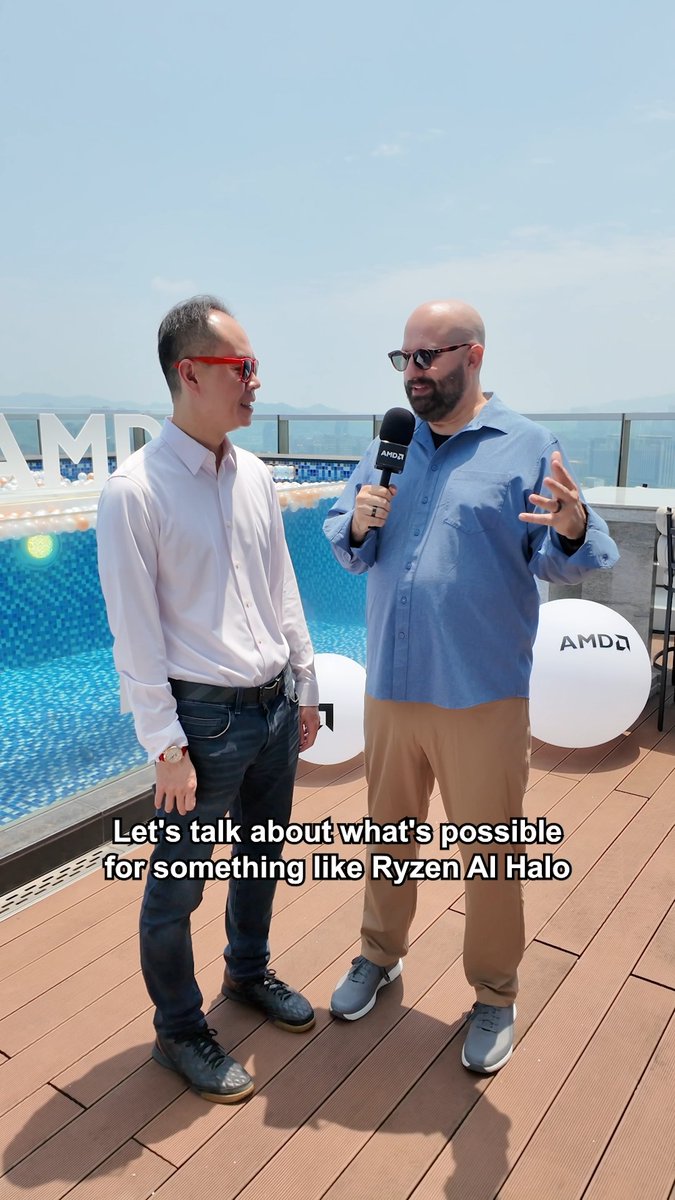
LFM2-2.6B-Transcript AMD🤝Liquid AI > Private, on-device meeting summarization > Cloud-level quality > Faster processing, lower memory footprint > Runs across CPU, GPU, and NPU on AMD Ryzen AI PC Great showcase of what tiny models can achieve when fine-tuned

27,703 Aufrufe • vor 6 Monaten •via X (Twitter)

0 Kommentare

Keine Kommentare verfügbar

Kommentare vom Original-Post werden hier angezeigt

Ähnliche Videos

$AMD Strategic Price Positioning Long🧵 AMD is increasingly the most hated semi stock that can rival $NVDA dominance in GPUs and software(Cuda v. ROCm). $AMD is also the most under-owned among all Funds in 2025 according to Bank of America! For what I learnt for years as an investor with Dr. Lisa Su, all analysts and market are underestimate Dr. Su leadership. $AMD is capable of raising price, making high quality hardware with software. Dr. Su or AMD choice to adopt a lower price strategy to gain market share is a deliberate and multifacets approach rooted in competitive positioning, market dynamics, and long-term growth objectives. As an investor, it may take time like CPUs and embedded to see margin improving. 1. . Penetration Pricing to Challenge Dominant Competitors AMD has historically positioned itself as a cost-effective alternative to dominant players like Intel in CPUs and Nvidia in GPUs. By setting prices lower than competitors, AMD aims to attract customers and quickly gain market share. This is a classic penetration pricing strategy, where the goal is to capture a significant portion of the market by offering high-performance products at a lower price point. ~CPU Market Example: When AMD launched its Ryzen processors in 2017, it priced them competitively compared to Intel's Core processors, emphasizing a better price-to-performance ratio. Ryzen CPUs offered higher core counts and multi-core performance at lower prices, appealing to cost-conscious consumers, gamers, and professionals. This strategy helped AMD increase its CPU market share to 16.6% by early 2025, narrowing the gap with Intel. ~GPU Market Context: In the GPU market, where Nvidia holds an 88% share compared to AMD's 12%, AMD has been criticized for not launching GPUs at low enough prices to compete effectively. However, posts on X and articles suggest AMD is shifting its GPU strategy to focus on mainstream, cost-effective products rather than high-end enthusiast segments, aiming to regain market share through competitive pricing. 2. Appealing to Cost-Conscious Market Segments AMD targets price-sensitive customers, including gamers, small businesses, and enterprises looking for high-performance computing at a lower cost. This is particularly effective in segments where performance is critical, but budgets are constrained. ~Value Proposition: AMD’s Ryzen and EPYC processors, as well as Radeon GPUs, are designed to deliver performance comparable to or better than competitors in specific workloads (e.g., multi-core processing or AI compute) at a lower price. For example, Ryzen processors have been noted for their superior multi-core performance compared to Intel CPUs at similar or lower price points, making them attractive for tasks like video editing or gaming. ~AI and Data Center: In the AI and data center markets, AMD’s cost-effective Instinct MI300X GPUs and EPYC CPUs target enterprises seeking affordable alternatives to Nvidia’s expensive AI ecosystem. This strategy taps into an underleveraged market segment that Nvidia’s broad, premium-priced AI solutions may not fully address. 3. Building Scale and Developer Support AMD’s leadership, including Jack Huynh, has emphasized the importance of scale—gaining a larger market share to attract developer support and optimize software ecosystems. A lower price strategy helps AMD achieve this by increasing adoption among consumers and enterprises. ~Gaming GPUs: By focusing on mainstream GPUs with competitive pricing (e.g., targeting an 80% addressable market rather than the high-end 10%), AMD aims to build a larger user base. This scale encourages developers to optimize games for AMD’s technologies, such as FSR 3 (FidelityFX Super Resolution) and Anti-Lag 2, improving the ecosystem and competitiveness against Nvidia’s CUDA platform. ~Open Ecosystem in AI: AMD’s open-source ROCm platform contrasts with Nvidia’s proprietary CUDA, appealing to developers who prefer flexibility. Lower-priced hardware makes it easier for developers to adopt AMD’s solutions, fostering a broader AI software ecosystem. 4. Historical Context and Brand Positioning Since its founding in 1969, AMD has positioned itself as a challenger brand, often acting as a “second source” supplier to Intel. This role required competitive pricing to gain a foothold in markets dominated by established players. Over time, AMD has built a reputation for quality and affordability, reinforced by products like the Am9080 (a reverse-engineered Intel 8080) and modern Ryzen and EPYC lines. This historical strategy of undercutting competitors’ prices while delivering comparable performance continues to define AMD’s approach. 5. Countering Competitor Dominance AMD operates in highly competitive markets where Intel and Nvidia have significant advantages in brand recognition, market share, and ecosystems. A lower price strategy is a pragmatic way to disrupt this in CPUs: ~Intel’s historical dominance in the CPU market (servers, desktops, and laptops) has been challenged by AMD’s Ryzen and EPYC processors, which offer better value. For instance, AMD’s EPYC CPUs have driven a 122% year-over-year revenue increase in the data center segment, partly due to their cost-effectiveness, helping AMD capture 94% of CPU sales at some retailers. ~Nvidia in GPUs: Nvidia’s 88% GPU market share and premium pricing (e.g., high-end GPUs like the RTX 4090) leave room for AMD to compete in the mid-to-low range. However, AMD’s failure to launch GPUs at sufficiently low prices (e.g., the RX 7900 XT at $900 instead of its current $680) has limited its success, prompting a strategic shift toward more aggressive pricing in future RDNA 4 GPUs. 6. Market Share as a Long-Term Investment AMD’s lower price strategy is not just about immediate sales but also about long-term market positioning. By capturing market share, AMD can: ~Increase Brand Loyalty: Affordable, high-performance products build customer loyalty, especially among gamers and small businesses, creating a foundation for future sales. ~Drive Revenue Growth: Market share gains in CPUs (e.g., 16.6% in 2025) and data centers (e.g., $3.5 billion in Q3 revenue) translate into higher revenue, even if margins are initially lower. ~Influence Industry Standards: Greater market presence allows AMD to influence hardware and software standards, such as pushing for open-source AI frameworks or gaming optimizations, reducing reliance on competitors’ proprietary systems. 7. Challenges and Risks While effective, AMD’s lower price strategy carries risks: ~Profitability Concerns: Lower prices can compress profit margins, and some analysts note that AMD’s high stock valuation expects future profitability that may be delayed if pricing remains aggressive. ~Perception of Quality: Persistently low prices risk positioning AMD as a “budget” brand, potentially undermining its ability to compete in premium segments. ~Competitor Response: Intel and Nvidia can counter with price cuts or superior features, as seen with Nvidia’s feature-rich GPUs. AMD must balance price with innovation to avoid being outmaneuvered. 8. Strategic Shift in GPUs Recent reports indicate AMD is adjusting its GPU strategy to prioritize market share over competing in the high-end enthusiast segment. For the upcoming Radeon RX 8000 series (RDNA 4), AMD is focusing on mainstream GPUs priced competitively to appeal to a broader audience, rather than chasing Nvidia’s high-end dominance. This shift aligns with AMD’s broader goal of achieving 40–50% market share by targeting the “80%” of the market that prioritizes affordability over premium features. Lastly, AMD’s lower price strategy is a calculated move to disrupt Intel and Nvidia’s dominance, capture market share, and build scale for long-term growth. By offering high-performance CPUs and GPUs at competitive prices, AMD appeals to cost-conscious consumers and enterprises, particularly in the CPU and AI markets, where it has seen significant gains (e.g., 16.6% CPU market share and $3.5 billion in data center revenue). Recent price increase on MI350 and MI355 and more on MI400 signaled #AI chip leadership and pricing power, which will result in significant top and bottom line growth.

Mike

38,006 Aufrufe • vor 10 Monaten

Dylan Patel on the importance of memory and storage Two key quotes: "An $NVDA GPU is faster than an $AMD GPU in most cases, but because AMD GPUs have more memory, they can outperform Nvidia in certain workloads." “It is a difficult, multivariable problem. Generally, you need the best GPU, such as a GB300, but you also need the best storage solutions. I will not spoil who comes out on top, but storage solutions matter a lot, memory solutions matter a lot, and frontend networking also matters significantly" Full Quote: “We have over $80 million of compute: GPUs from $NVDA and $AMD, TPUs from Google, and Trainium from Amazon. We constantly run this benchmark using the newest inference engines, drivers, PyTorch versions, and other software. It runs every day through automated CI across the latest Chinese models from GLM, Zhipu, Moonshot, Kimi, Alibaba, and others. Initially, when we were benchmarking the differences between these chips, inference engines, and parallelism schemes, we used fixed context lengths. But with Agent X, we have now analyzed more than $5 million worth of Claude Code traces. This is real production traffic that users have donated to us, combined with internally generated data, so we now understand what an actual agent workload looks like. When we implement those workloads and run the benchmarks, it turns out that the chip you are using is very important, but how you handle memory offload can be even more important. An Nvidia GPU is faster than an AMD GPU in most cases, but because AMD GPUs have more memory, they can outperform Nvidia in certain workloads. Similarly, you can use a less powerful GPU with a much better storage solution and outperform the best GPU when it lacks those solutions. Simply buying the newest GPU does not necessarily give you the best inference economics. You need to layer in other innovations, including storage and memory.” Interviewer: “Who is the top player on your chart? Can you tell us?” Dylan Patel: “It is a difficult, multivariable problem. Generally, you need the best GPU, such as a GB300, but you also need the best storage solutions. I will not spoil who comes out on top, but storage solutions matter a lot, memory solutions matter a lot, and frontend networking also matters significantly.”

Daniel Romero

38,220 Aufrufe • vor 4 Tagen

Some time ago, I had the idea to port NVIDIA Physical AI stack to AMD. The motivation was to improve hardware diversity and enable world models and VLAs to run beyond a single ecosystem. We started with NVIDIA Cosmos Predict 2.5-2B. Porting wasn’t trivial: these models are deeply optimized for NVIDIA’s stack. We used this as an opportunity to apply our ROCm kernels. The results were surprising: Both encode and diffusion run faster on AMD Instinct MI300X vs. NVIDIA H200 (FA3) and we still saw significant headroom for further optimization. Quality is unchanged across modalities (validated with WorldJen) To be clear, this is no luck. We have deep experience with diffusion models and AMD GPUs. But this just gives us a good opportunity to get closer to a true hardware-to-hardware comparison, as we work with less software abstractions than usual. Just to give an example, on AMD, memory instructions are async with a hardware queue of ordered pending instructions, enabling concurrent load/store with compute without warp specialization. Bottom line: there are real architectural advantages on AMD, if you take the time to work with the hardware. Note, we did tradeoff ~20% higher memory usage, That being said, AMD has more to give to begin with :) in the coming weeks: AMD versions of Cosmos Transfer and GR00T, an even faster version of Cosmos Predict, and open-sourcing an attention kernel faster than AITER v3 (which is closed-source for some reason? cc: Anush Elangovan )

Omer Shlomovits

36,593 Aufrufe • vor 3 Monaten

AMD might have disrupted Nvidia's entire cloud GPU rental business. In January at CES, AMD CEO Lisa Su demonstrated a $1,499 mini PC running the same class of AI model that currently costs companies $2,500 to $3,000 every month to rent from Nvidia-powered cloud servers. AMD's own branded version opened pre-orders this month at $3,999. Third party manufacturers have been selling the same chip since 2025 starting at $1,499. Here is exactly why this is dangerous for Nvidia. Nvidia's $75 billion quarterly revenue is built almost entirely on one business model, companies rent access to Nvidia GPUs through cloud providers like AWS and Lambda Labs to run AI. They pay monthly. Nvidia gets paid every time someone runs an AI model in the cloud. That recurring rental income is what turned Nvidia into a $5 trillion company. The AMD box eliminates that monthly fee permanently. One AI consultant switched from $2,800 per month in Nvidia cloud rental costs to $8 per month in electricity. The hardware paid for itself in 11 days. Over 8 months he generated $47,000 running the same AI workloads that previously left him paying Nvidia's ecosystem $2,800 every single month. Multiply that across thousands of enterprise customers and the revenue erosion becomes structural. Every business that buys this box stops paying cloud rental fees forever. Lawyers, doctors, banks, accountants, and financial advisors, businesses with sensitive data that cannot legally go to a cloud server represent billions in annual cloud GPU fees that Nvidia is now at risk of losing permanently. The threat is also closing in from the top. Google signed deals worth tens of billions with Anthropic and Meta to replace Nvidia with its own chips. Amazon built its own AI chips across AWS. Apple trained its AI on Google's chips, not Nvidia's. Custom silicon has grown from 21% of the AI chip market in 2025 to 28% in 2026. Nvidia's rental model only worked because serious AI compute had no alternative.

Bull Theory

26,668 Aufrufe • vor 29 Tagen