Loading video...

Video Failed to Load

Go Home

Licensing is the big question mark around base:0x0c03ce270b4826ec62e7dd007f0b716068639f7b But with Phil David.. they literally have the best guy for the job 👇 - 30 years experience in tech IP law - 20 year stint at ARM Holdings - ARM is UKs most successful tech company - Their chips are...

11,366 views • 8 days ago •via X (Twitter)

0 Comments

No comments available

Comments from the original post will appear here

Related Videos

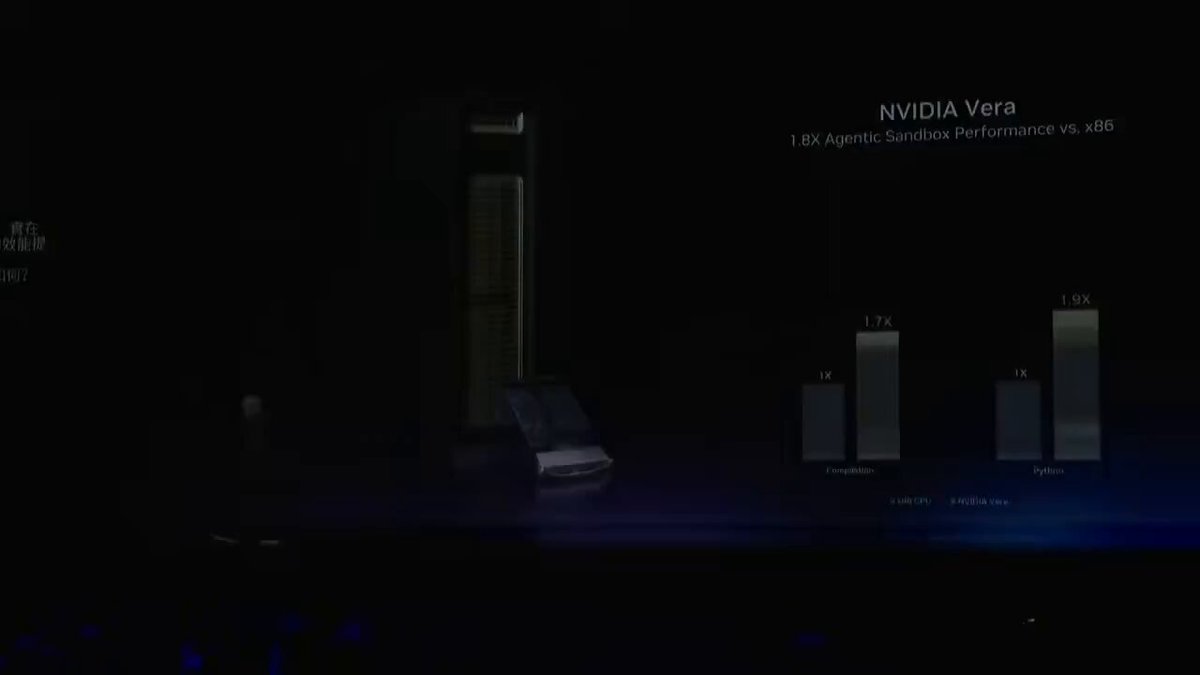
Jensen Huang just identified the next $200 billion market (Save this). The shift starts with a observation about agentic AI that changes everything about infrastructure. In the era of training and inference, the GPU was everything while CPU was a traffic cop, scheduling work, managing memory, dispatching tasks while the GPU did the heavy lifting. Agentic AI breaks that model entirely. An AI agent does not just run a single inference pass but rather it plans, calls tools, executes code in sandboxes, retrieves data from multiple sources and loops through complex multi-step reasoning sequences often thousands of times per second at scale. Every one of those operations runs through the CPU and the GPU sits idle waiting for the CPU to prepare the next task, supply the right context and execute the retrieval and tool calling logic fast enough to keep the accelerators fed. The CPU is now the conductor and the GPU is the orchestra and the bottleneck is the conductor falling behind. This is showing up in production AI factory utilization right now, which is exactly why Jensen built Vera from scratch rather than licensing x86. Vera achieves 40% lower peak memory latency than x86, 50% faster core to core communication, and 1.8 times the agentic sandbox performance of current x86 processors on a purpose-built architecture designed around the agentic loop. Now here is where the investment thesis gets interesting. The obvious beneficiary is Nvidia itself, and that thesis is real. Nvidia's CFO has guided for nearly $20 billion in Vera CPU revenue this fiscal year alone, a market Nvidia had zero presence in just three years ago. Intel held 60% of server CPU market share as recently as Q4 2025 and that transition is now happening at a pace Intel structurally cannot respond to. But the deeper question is, what architecture is Vera actually built on? Vera's Olympus cores are ARM compatible and every single Vera CPU deployed in every Vera Rubin rack in every data center in the world runs on ARM architecture. And ARM Holdings collects a royalty on every one of them. ARM does not make chips but rather licenses the instruction set architecture and CPU core designs that others build on top of. Every time Nvidia ships a Vera CPU, every time a hyperscaler deploys a Vera Rubin rack, every time an enterprise qualifies Vera for their AI factory, ARM earns a royalty. The secular tailwind here is almost perfectly constructed for ARM's business model. Amazon's Graviton, Microsoft's Cobalt, Google's Axion, Apple's silicon stack, and Qualcomm's data center push all run on ARM. And now Nvidia's Vera, which is projected to displace Intel as the largest server CPU supplier by revenue in a single fiscal year, is ARM. ARM's royalty rate on high end server chips is estimated at roughly 1 to 2% of chip selling price. At $5,000 per Vera CPU and 4 million units projected for FY2027, that is a royalty line growing from near zero to potentially $400 million to $800 million annually from Nvidia's data center CPU business alone before counting Amazon, Microsoft, Google, Apple, and Qualcomm. The total ARM addressable royalty base across all the silicon it already licenses is compounding at a rate that the current $130 billion market cap does not fully reflect. Jensen's CPU thesis is the most underappreciated catalyst in ARM's fundamental story, and the royalty compounding has barely started. Come join Milk Road Pro and get our full ARM royalty model and our entire AI trade thesis. Link below!

Milk Road AI

11,819 views • 3 months ago

I can't believe that the once richest man on earth just bet his entire empire on ONE company. And he has 9 days to pull it off. SoftBank is scrambling to deliver $22.5 billion to OpenAI by December 31st. To get there, CEO Masayoshi Son sold his ENTIRE stake in the best-performing AI stock on the planet. Then sold billions more in other holdings. Cut staff. Froze dealmaking. Borrowed against everything he owns. This is the biggest all-in bet in the past few years. And it might be the most reckless financial engineering since 2008. Here's what's actually happening: SoftBank promised OpenAI $40 billion back in April when the company was valued at $300 billion. The deal had conditions. OpenAI had to convert to a for-profit structure by year-end. They did that in October. Now the clock is ticking. $22.5 billion must arrive in 9 days or the deal breaks. Son already delivered $17.5 billion earlier this year. Getting the rest is proving harder than anyone expected. The moves Son made to raise the cash are absolutely wild: He dumped SoftBank's entire $5.8 billion position in Nvidia. Not trimmed. Not reduced. LIQUIDATED. The same Nvidia that's been printing money for AI investors all year. He sold $4.8 billion worth of T-Mobile shares. Slashed staff across the company. And the Vision Fund that used to write checks for everything? Dead. Any deal over $50 million now requires Son's personal approval. Investment managers who used to hunt for the next big thing are now working full-time on the OpenAI transaction. But it still wasn't enough cash... So Son went to the debt markets. He expanded SoftBank's margin loan capacity by $6.5 billion, bringing total undrawn capacity to $11.5 billion. All of it backed by Arm Holdings stock. If Arm's stock drops, those loans get called. SoftBank faces margin calls. The whole thing unravels. And the risk gets crazier. OpenAI's valuation has tripled since April. Started at $300 billion. Now heading toward $900 billion according to sources. Amazon is reportedly joining the next round. On paper, SoftBank's investment looks brilliant. A 3X return in 8 months. But here's the thing: OpenAI is hemorrhaging cash at a rate that makes Uber's losses look responsible. The company generates $13 billion in annual revenue. Impressive... right? But they're literally projected to LOSE $74 billion by 2028. Not break even with losses. Not approach profitability. $74 billion in the red. Their revenue is growing. Their losses are growing faster. Because AI compute costs don't scale down. They scale UP. Every new ChatGPT user costs OpenAI money. Every API call burns cash. Every model training run requires millions in compute. Sam Altman told employees OpenAI is now in "code red" mode. Pausing all other product launches to focus entirely on beating Google's Gemini. That's the language of desperation. And Altman's long-term vision is even more expensive. He wants to build 30 gigawatts of AI compute capacity. Cost: $1.4 TRILLION. For context, that's larger than Mexico's entire GDP. He wants to add 1 gigawat every single week. Each gigawatt costs over $40 billion. The math doesn't work. The business model doesn't work. The capital requirements are impossible. But Son is betting everything anyway. Why would he do this? Because if it works, he owns the future. If OpenAI becomes the infrastructure layer for the next 20 years of computing, that $22.5 billion turns into trillions. SoftBank becomes the kingmaker of AI. Son becomes the most powerful investor in history. But if it fails? SoftBank vaporizes. The Nvidia stake is gone. Can't get it back. The T-Mobile shares are gone. The margin loans against Arm come due. Son has systematically dismantled his portfolio to concentrate everything into one bet. This is the opposite of diversification. This is the opposite of prudent risk management. This is a founder going all-in on a vision that everyone else thinks is insane. And he might be right. Other investors see it too. That's why OpenAI's valuation tripled in 8 months. BlackRock, Fidelity, and JP Morgan are all writing massive checks to private AI companies. Databricks just raised $4 billion at a $134 billion valuation. The entire market is betting that AI infrastructure will define the next decade. But the difference? They're diversifying. Spreading risk. Building portfolios. Son put everything on one company. The deadline is December 31st. In 9 days, we'll know if SoftBank pulled it off. If they deliver the $22.5 billion on time, the bet stays alive. If they miss the deadline, the deal could collapse. The terms could change. Competitors could swoop in. And Son will have sold the farm for nothing. This is either: The greatest venture bet in history. Or the most reckless financial move since Lehman Brothers. There's no middle ground. Masayoshi Son doesn't do middle ground. He bet big on Alibaba in 2000 and turned $20 million into $60 billion. He bet big on WeWork and lost $14 billion. Now he's betting bigger than ever. $22.5 billion. 9 days. Everything on the line. What would you do?

Ricardo

1,880,981 views • 8 months ago

🚨 NEW EPISODE FOR EUROPE'S MOST AMBITIOUS STARTUPS 🇪🇺 And this might easily be the best video we have done so far! The company, their product and the team is just insane. The goal of this company is to make money out of thin air – literally. No joke. TLDR: Heavy machinery, in the middle of London, easily one of the most cracked team is met in a while, and their first test site? A military base. What's crazy to me is that they are so heads down that nobody knows them yet… but still they already raised GBP 10M+ from the founders of stripe (Patrick Collison John Collison), Nat Friedman, Harry Stebbings, Pietro Invernizzi, taavet hinrikus and Plural and many more. The Company is RIVAN – Rivan Their product? Getting the CO2 out of the air and combine it with H2 from water -> to create gas, which they directly pump into the network grid to make money. The same kind of gas we currently have to pay Russia for… we fight wars for… just without drilling into the ground and releasing CO2, but "mining the sky" instead! This kind of tech is still in early stages – and tons of hypotheses have to be validated – but in the next five years the math can work out and if there's a team to figure this out, it's this one. I took my camera and visited Harvey Hodd and his team in their warehouse office in London and joined him to their first test site on a military base. I am a big fan of this guy. Intensity, obsession, technical competence. And the whole team is like this. In the video you will see how everything works… every machine… but also how they keep urgency in the team… how they pay people to move closer to the office… why they are already running a military base only a few months in… how this can even ever work economically… and how the hell do you avoid everything blowing up – literally. RIVAN – You can watch the full video on the youtube channel: Please RT + LIKE here and comment/share/like on youtube too please! Every little bit of engagement helps in youtube's algorithm! Let's frigging go! 👇

Andreas Klinger 🦾

21,897 views • 1 year ago