Video wird geladen...

Video konnte nicht geladen werden

Zur Startseite

Marc Andreessen: Revolutionary technologies were often viewed as “trivialities” or “jokes” “If you read history, the great innovations of the past are now well understood as being very important. In almost every case, they were not widely understood as such at the time. In fact, I would assert that...

286,362 Aufrufe • vor 7 Monaten •via X (Twitter)

0 Kommentare

Keine Kommentare verfügbar

Kommentare vom Original-Post werden hier angezeigt

Ähnliche Videos

.DHH credits Marc Andreessen Marc Andreessen 🇺🇸 with helping him the most during the darkest time of his professional life: "It was during that rough going where Andreessen came in. We were a small company of 60 people and 20 took the offer and left. That's almost a third of the company that decided to leave and we got to a point where we were thinking that not many more have to leave before we need to worry about whether we can keep the lights on. And it was actually Tobi who then put me in contact with Marc Andreessen because Marc had been exposed to this phenomenon at some of his portfolio companies. And Marc gave us reassurance and a bunch of contacts. Marc said, "Do you need someone to come in to help do programming or help with operations or whatever?" And I was floored by the generosity because Marc and I haven't always seen eye to eye on things. Especially in terms of venture capital. He's been one of the main faces of venture capital for decades and I've been kind of critical at times. And it was just a realization that all those grievances we might have thought to be so big once upon a time were actually minuscule. We were fighting the white walkers on the other side of the wall and all our internal squabbles were going to be for nothing if those f*ckers got inside the wall and destroyed everything. And that felt like a real threat at the time. That could've happened. They could very well have just ripped the whole thing apart. And Marc clearly saw that that this was a collective, almost existential threat to the entire industry. If these activists were able to take over these institutions in the same way that they have taken over academia we would be f*cked and not just for a little while but potentially for decades. That couldn't stand. And Marc was incredibly helpful not just in terms of these contacts and introductions and so on but it was very powerful. When you have literally 40,000 people on Twitter calling you all the worst things in the world even the strongest individual might go for a second like "Holy sh*t. The mob is coming for me and there's no one else there." And there are other people there. Tobi was there. Marc was there. And it was incredibly helpful to give us the fortitude to go like "No do you know what? We're going to stick with it. We're not going to grovel. We're not going to apologize. We're not going to revert." And then what Marc also did was he gave me a syllabus for understanding the history of wokeness going all the way back to the '60s and beyond. That this didn't just come as lightning from a blue sky. This had an institutional grounding that was set in motion particularly in the '60s and the long march through the institutions, Herbert Marcuse and a lot of The Frankfurt School and all of these groups that had designs on how to reshape society and create the revolution they so dearly wanted, but with a timeline and a roadmap that was demarcated in decades. That it wasn't just like "Well we're going to put something together and then in two years something's going to happen." No they were sitting in the fucking '60s fantasizing about how to overthrow everything in the 2000s. It's actually incredible in a Dr. Evil sense of it but when you're on the receiving end of it it seemed a little less incredible and it was just difficult not knowing where's this coming from? Why is this happening all of a sudden? Well it wasn't happening all of a sudden. There was this long history of it and when you understood that history it made a lot more sense. We weren't just making a rejection for our little corner of the world. We were chipping in in the great civilizational battle of where this country was going to go, whether the white walkers beyond the wall were going to win. And we were like "No they're not going to f*cking win. Get them out of that f*cking wall. Take your goddamn spear and fire it with maximum velocity."

David Senra

480,730 Aufrufe • vor 1 Tag

Quentin Taratino said Lawrence Fishburne’s performance in King of New York was so incredible he thought - “he could be the greatest actor of his generation”. He explains: "As great as Christopher Walken is in this movie. To me, it's Larry Fishburne's movie - it was the rock that becomes a diamond aspect of the movie. It's why I could defend this movie against all comers, because to me, Fish's performance in this movie was comparable to a young Brando. It was the most exciting performance by an actor of his generation that I'd seen in a movie of that time. And I thought, well, that's it. There is a new Marlon Brando, and his name is Larry Fishburne - it was amazing, it was mesmerizing… He is the first hip hop gangster in movie history. That character had never been done before this. He invented that character. And he invented it as something to do. It wasn't in the original script. He came up with that himself… The three big Fishburne moments to me, is his opening sequence with…Tito. That's it, with Tito - black glove dude. And his reunion with Frank. And then it's the chicken scene (see below). Those are his three big arias. Not only that though - expressions that I would later hear for the rest of the decade, I actually heard for the first time in that scene. I'd never heard the expression; “I'll slap the black off you” before. That was the first time I heard it when Fish says it to Snipes. I've since heard it many times… And that was actually the first time I ever heard, “fuck you very much”. And I would proceed to hear that for the rest of the 90s. But those were the first times I'd ever heard those expressions… As terrific as he has been in other things - the level of excitement that I had over him when this movie was over, I have never had that excitement again. I thought, with this, he could be the greatest actor of his generation. That was an actual, real fucking thing. He could be the greatest actor of his generation after seeing this." Quote comes from The Rewatchables podcast

Gangster Cinema Central

655,921 Aufrufe • vor 1 Monat

“What did you think of Lando being booed at race because people and I've seen it online as well say he doesn't deserve the title because McLaren favored him over his teammate. Do you think that's total nonsense?” Jacques Villeneuve: “That's a little bit ridiculous. When there was some booing in some races, that was embarrassing. You should never boo a driver that's clean, doesn't do anything dirty, on track is respectful, and on top of it is super fast. What's wrong with people? That was embarrassing. And, had it been that Piastri was a second a lap faster than him and somehow Lando was winning because a lot of things were happening, his car breaking down every time, then you could start thinking, okay, that's really not cool. That's not fair. But that wasn't the case. And in the second half, Norris has been faster right at the beginning as well, last year as well. So there's this whole middle of the season where Piastri was driving a lot better than Norris and was getting the points. Norris had an engine blowing up, not Piastri. And so those fans, they don't look at that either. You have to look at the whole picture, at the whole season. And suddenly if your favorite is starting to go backwards, you just got to bite the bullet and accept it. Your favorite is just going backwards. That doesn't mean that the other one is treated better or the other one is undeserving just because the one you're a fan of is not winning right now. That’s really wrong. If you're a fan of the sport, then you have to be a fan of the sport and understand when your driver is maybe not cutting it at this point in time, even though he was before and he will in the future again. It's all a question of timing. But that's the price we have to pay now with social media and how big F1 has become. It's very passionate. The people are passionate and once, you know, fans come from fanatism, you stop thinking, when you get in that mindset and it happens to all of us. You want something so much that you get attached and you cannot - it's hard to start seeing reality. So you will try to mold the reality to your thought process and if your champion is not winning then it cannot be his fault. It has to be something from the outside. It has to be the team destroying his chance or not favoring and so on and so on and so on. But there's nothing concrete behind those comments. It's pure fandom and it'll always be like this. And ultimately it's not a bad thing. You know drivers at that - sportsman at that level have to grow a thick skin. If not, you don't deserve to be there. You just have to have a thick skin because they're all very happy to get the compliments. They love it when it's just positive, but it gets balanced out with negatives and you need to be able to take and accept the negatives as well. It goes both ways. You cannot have the good. You just have to be a thick skin and know that it's part and parcels of what's going on. And in one month, it will be forgotten and maybe everything will change and it be the other driver that suddenly will be criticized and so on. So, it's just that's just the way it is.”

naenia ¹ ⁶³

29,833 Aufrufe • vor 7 Monaten

Blake Edwards on the conditions he laid out before accepting to direct "A Shot in the Dark" (1964): "'A Shot in the Dark' (1964) is nothing like Marcel Archard’s play, that’s for a start. I was asked to save the situation. They had quite a bit of money involved in this project. Peter Sellers was threatening to pull out because he didn’t like the screenplay. He said that the only way he would continue with the project would be if I took it over. I said that the only way I could possibly take it over, under such emergency conditions, would be that I would not be obliged to do anything like Archard’s play because a) I didn’t like it, b) I thought it was not a motion picture and c) I wasn’t ready to make a movie at that point. So they asked me what I wanted to do because the picture had to start in something like four weeks. I said that if they wanted me to save them, I’d have to take something with which I was familiar to begin with. I was familiar with the character of Clouseau. I needed a detective, somebody to solve a murder. I couldn’t throw the whole thing out. I had to use the idea that the maid was accused of killing the chaffeur and this had to be solved. So I thought that Peter Sellers was just the natural thing and that now I was going to try to be as broad with the character as I could be. “How far can I go now in terms of Inspector Clouseau?” I wrote the screenplay and was on the stage in four weeks with it. Fortunately, it turned out to be a reasonably funny movie. It proved something for me—that if a gag is well-designed you can pull it off." (Blake Edwards' interview with Jean-Francois Hauduroy, Cahiers du cinéma, 1966) P.S: On this 62 years ago, "A Shot in the Dark" (1964) premiered in New York City, USA.

DepressedBergman

20,460 Aufrufe • vor 1 Monat

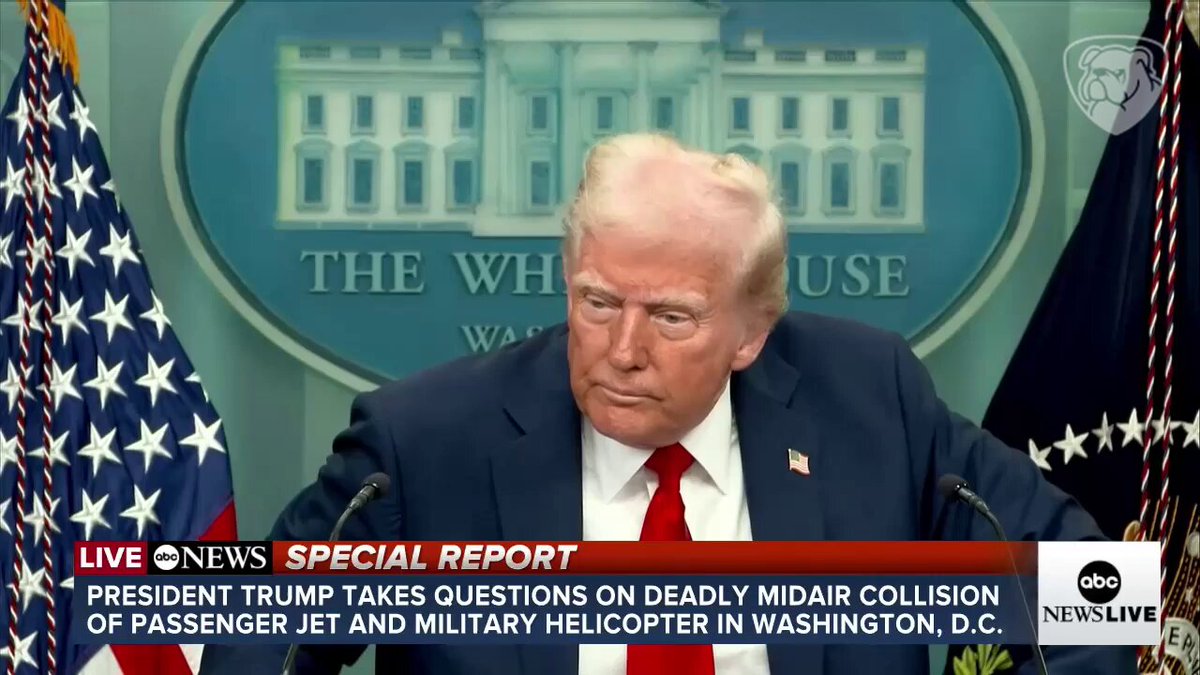
JACQUI TIME (Jacqui Heinrich): “Based on your analysis so far, do you have a sense of who is at fault? If it was plane, the helicopter, air traffic control? And can you assure people that it is safe to fly in and out of DC?” Trump: “Well, I've given you the analysis and the analysis was — was based on vision. You got a lot of people that saw what was happening. You had some people that knew what was happening. There were some warnings, but the warnings were given very, very late. You know, those warnings were given very late. It was almost as they were given a few seconds later, was a crash — should have been brought up earlier, but the people and the helicopters should have seen where they were going. I can't imagine people with 20/20 vision not seeing, you know, what's happening up there. Again, they shouldn't have been at the same — if you're going with — in reverse directions or sideways directions, obviously, you want to be at different heights. I see it all the time when I'm flying. I — you have planes going in the opposite. They're always lower or higher or — so if somehow there’s a screw up, there's not going to be a tragedy. It'll be close, but you know, there's never going to be a tragedy if you're in a different elevation. For whatever reason, they were at the same elevation and also from the American Airlines center, he's along the track that every plane is along. You say what was a helicopter doing in that track? Very sad, but visually, somebody should have been able to see and taken that helicopter out of play and they should have been at a different height.”

Curtis Houck

11,692 Aufrufe • vor 1 Jahr

From Dan Lorenc on the malware attack that almost took down the entire internet last year: “There’s a popular compression library that’s used in almost every piece of software. And it had been maintained by one person in his spare time for the last 20 years. And then a couple years ago, somebody just decided to start helping him. They jumped in, fixed a bunch of bugs, and did a lot of great work. And then that first person got tired of working on it. So he handed the whole project over to this other person. It turned out that other person was just a pseudonym and was not a real person. And within six months of getting control of the project, they had put in a carefully orchestrated set of malware that was really hard to detect and no one noticed. And because it was so widely used, the exploit would've basically given that person remote access to any computer running that piece of software, which was basically everything connected to the Internet. But because it was open source and the code was transparent, some random engineer just happened to be running some benchmarks on a weekend. And he noticed that program was a little bit slower than it used to be, and that it was making a weird cryptographic operation to check something. And right before this thing got widely deployed across every device, he dug in, and discovered that there was a backdoor put in. This was the closest thing to a full-blown internet crisis that we’ve ever had. And they still have no idea who did it. It was just an anonymous email account. No one ever traced it back to an individual. And that's the long game. This person spent years just doing good work and earning the communities trust.”

The Peel

47,683 Aufrufe • vor 1 Jahr

.Bari Weiss in her CBS Mornings debut, promoting her town hall tomorrow with Erika Kirk and taking aim at those who celebrated Charlie’s assassination and the conspiracy theorists claiming she had something to do it... “I think Erika Kirk is a victim of what could be a very, very disturbing version of America. In other words, her husband was speaking on a college campus. Whether you agreed with him or not, he was practicing the most fundamental of American rights, he was trying to persuade people with words and then he got a bullet to his neck as he was speaking to someone that disagreed with him. Someone, by the way, who was in the audience that night. In the days and weeks that followed, the number of people in this country and not just lunatics on the internet hiding behind anonymous accounts, but prominent people justified his death with the idea that words are violence rather than violence being violence signifies something quite alarming. The idea that he somehow had it coming because people disagreed with him.” “The second thing is that in — he was murdered three months ago. If you go on the internet and frankly it is leapt beyond the internet into real life and you talk to many seemingly sane people, they do not believe that the 22-year-old named Tyler Robinson that has been arrested and charged with his murder is the actual murderer. “They believe any number of theories. They believe Erika Kirk was his Mossad handler and he was killed by a foreign government. They believe she was tracked by Egyptian planes. They believe that the rings on her hand are signs of illuminati. The theories themselves are absurd. What matters is that because — she speaks about this in the interview, the brain rot that social media is allowing to spread, the way that it is detaching us from humanity, from our ability to talk to one another and our ability to discern the truth from just out and out lies is something that is incredibly important as a theme, I think. So, she was able to speak to both of those things in a way that’s incredibly compelling.”

Curtis Houck

78,679 Aufrufe • vor 7 Monaten

Elon Musk on raising capital: “You have to show investors that you’re all in” “Tesla almost died in 2008,” Elon explains. “The recession was particularly difficult for car companies, and in the summer of 2008 we had to raise a big funding round. But because of the collapse in the financial system, that funding round didn’t happen and we had to piece together money to keep the company going from myself and existing investors. We were able to complete a financing round that was just barely enough to keep the company going, and we closed it on the last hour of the last day that it was possible to do so. It was Christmas Eve 2008 at 6pm . . . and we would have run out of money a few days after Christmas.” Elon continues: “So while things are going really well these days, I think it’s always important to remember that when you’re creating a company, there are very dark times and it’s about getting through those dark times. That’s the difference between success and failure.” He offers the following advice to aspiring founders: “A company is a group of people gathered together to create a product or service. That’s really all a company is. So you have to really believe in what you’re creating and know in your heart and mind that this is something that matters and that the world ought to have.” Believing whole-heartedly in what your building is especially important for raising capital, Elon argues: “I think it’s important to show investors that you’re all in. For example with Tesla, the fact that I invested all the money I had and was all in — I literally had to borrow money from friends to pay rent in 2008 — made a huge difference to investors and convinced them to invest in Tesla at the same time that GM and Chrysler were going bankrupt. I think you have to show them that you really care, that you’ve got skin in the game, and that you’ve given it everything you’ve got. Then the other people at the company will follow suit, as will investors. I did that at both SpaceX and Tesla and think that’s really fundamental.” Elon also urges founders to only hire people who are passionate about what you’re building: “When you hire people, what you’re really trying to do is convince people to join you in the endeavor. You should hire people who are also passionate about what you’re doing . . . they need to really care about what they’re doing. Then they will stay during the dark times.” Source: Montana Jobs Summit (Nov 2013)

Startup Archive

22,401 Aufrufe • vor 27 Tagen

Marissa Mayer on scaling Google and the internal black market CEO Eric Schmidt created for new hires “One of the things that [former Google CEO Eric Schmidt] talked about a lot was that at every order of magnitude, you should expect every process to break—and you should expect to have to completely reinvent it. It’s very different to deal with tens of people versus hundreds of people versus thousands of people” Marissa shares a story of how one time Eric reinvented Google’s hiring process in a way that initially frustrated everyone: “We had closed the year at about 200 people, and we had a plan to double the size of the company over the coming year. Eric showed up in March, looked at the plan, and said: ‘there’s just no way you guys are going to be able to double the number of employees and keep the quality and culture the way you want it to be.’” Eric then told the company that he would let them collectively hire 50 people that year—versus the 200 they were planning on hiring. And to enforce this, he created 50 laminated dollar bills with Larry Page and Sergey Brin’s faces on them and distributed them to Google’s VPs. Every new hire that year would require one “Larry & Sergey” bill. Naturally, a black market for these “Larrys & Sergeys” developed, and as Marissa describes, it became surprisingly efficient: “What would happen is the Head of Sales would have one and he would really need a new feature to make a sale. So he would [say to the engineer]: ‘look, I’m going to give you this Larry & Sergey but you have to promise you’re going to use it to hire someone who is going to build this feature to secure this revenue.’” She continues: “As painful as it was because there was way too much work to slow down our hiring like this, [the new process] was actually a really good moment for the company because it made us be really thoughtful about how we were scaling and where we were putting our resources. We had to be that much more thoughtful about what to prioritize and where the opportunities were. Yes, hypergrowth is really fun, but you also need to realize that you want that hypergrowth to happen in terms of users and revenue—and not necessarily in terms of the size of the company.”

Startup Archive

162,101 Aufrufe • vor 2 Jahren

Marc Andreessen on what made Steve Jobs great “There’s basically two stories about Steve you hear. One is that he was a saint and perfect in all regards, which was somewhat true. The other story that you hear is he was a screaming lunatic and would just run around, yell at people in elevators, fire people in meetings, and all these awful, horrible things… I think the reality was somewhere in the middle.” Marc continues: “At least what I saw — and what I’ve heard from people who worked with him for a very long time — was he was absolutely intolerant of anything less than first class work. If you brought him first class work, and you were top in your field, super diligent, on top of everything, had all the details figured out, and knew what you were doing, he was the best manager you were ever going to work with and the best CEO you were ever going to work with. And the thing that comes up from people who worked with him closely was, ‘I did the best work of my life working for him.’ Part of that is because he really appreciated and understood the quality of great work. And the other part was he didn’t tolerate anything less than that, which meant that everybody around you also hit that bar.” People forget though that Steve matured a lot along the way too. He had failures like the Lisa, which came before the Macintosh, and of course, he was fired before coming back to Apple 12 years later. “He learned a lot from the failures,” Marc explains. “And now everyone has forgotten about the failures, but you can read about them on Wikipedia.” Marc believes it was the 12 years he spent building NeXT and Pixar where Steve learned to be a great CEO before coming back to Apple: “People who knew him better than I did said he learned how to be a great CEO, not at Apple, but at NeXT, because he spent 12 years doing it the hard way where he wasn’t being showered with praise. He didn’t have the magic touch. The product fundamentally didn’t take. He had to pivot.” Marc tells a great story of Steve insisting on the NeXT computer being a perfect cube even though it would double the cost. He got his cube, but it was slow, expensive, and completely flopped: “Nobody wanted it. He pivoted the company to software. Nobody wanted the software… Anyway, the point is that was really hard… He had to try to figure out how to optimize it the hard way and retain a team through basically 12 years of failure.” Marc concludes: “People say he had this incredible growth and innovation skillset from Apple phase one. And then he had an incredible management skillset from the sort of wilderness years. And so by the time he came back to Apple in 1997 he at that point a great CEO, but maybe he wouldn’t have ever become the Steve Jobs that we know had he not gone through the hard period.” Video source: a16z speedrun 🧊 (2025)

Startup Archive

86,840 Aufrufe • vor 9 Monaten

I remember taking a trip to Florida in my teens. We were sightseeing , new to the area. I was just enjoying the sun and the warm weather for once, I didn’t expect to see anything out of the ordinary. It finally hit me as we were enjoying a drink on the water, we see what looks like a floating log. Our friend who owned the boat said to keep our eyes open and don’t freak out, as long as we were in the boat we were fine. Just hearing that alone was almost panic inducing because he didn’t tell us what we were supposed to be careful of. When the “log drifted under the water, I finally understood what it was that we were looking at. Our friend had us piled in a boat on water infested with these gators. Being from up north, we didn’t see much of this. It made me believe I was in my own movie but I was going to be okay, I thought to myself if it was truly dangerous, our friend wouldn’t have brought us out there right? I stayed calm though, I never knew you could fish in areas that had gators, I assumed they would always go after your bait. All in all I would do it again, but I would never have taken anyone in the water and not tell them about the inhabitants, just in case they have a real phobia. Like I would never take my kids in there in case one panics and falls in. But looking back I’m thinking he may have been in the wrong for taking us there, would you take your friends in an area infested with these creatures not knowing? It’s a little messed up in my opinion but I’m over it.

SonnyBoy🇺🇸

64,473 Aufrufe • vor 1 Monat