正在加载视频...

视频加载失败

🚨March 21, 2024 | #RADAR: The Analytics Edition 🚨 Accelerated through AI, true data democratization is within reach—now is the time to take advantage and drive analytics adoption throughout your organization. Join a selection of the world's data and analytics leaders from Tableau, Alteryx, WorldBank, M&S, and more for...

11,529 次观看 • 2 年前 •via X (Twitter)

0 条评论

暂无评论

原始帖子的评论将显示在这里

相关视频

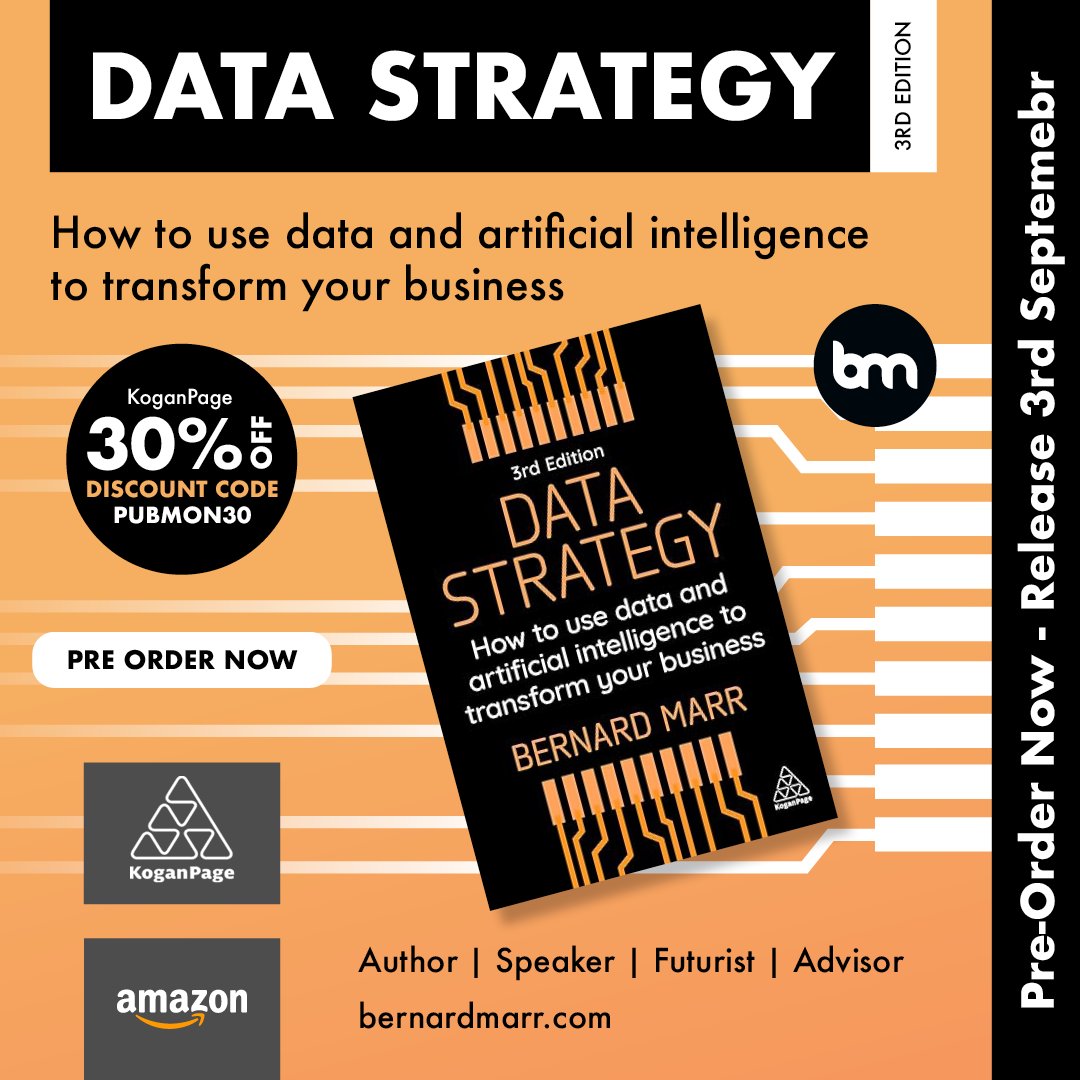
🚀 My New Book is Here: Data Strategy (3rd Edition) 🚀 I’m thrilled to share the release of my latest bestselling book, Data Strategy: How to Use Data and Artificial Intelligence to Transform Your Business. Every business today needs data to survive - but simply having data is not enough. What matters is how you use it. A well-designed data strategy is the key to unlocking value, driving insights, and giving your organisation the competitive edge it needs to thrive in the digital economy. From small organisations to global enterprises, I’ve seen first-hand how a data-driven approach can transform operations, improve decision-making, and unlock entirely new opportunities. That’s why I’ve poured my experience into this book — to help leaders and teams build strategies that don’t just talk about data, but actually deliver measurable impact. 🔍 In this third edition, I’ve expanded the book to reflect the latest developments in data and AI, including: ✅ Generative AI and its role in shaping business innovation. ✅ Synthetic data and how it can accelerate AI adoption. ✅ The potential of quantum computing and what it means for the future of data. ✅ Expanded guidance on cybersecurity, regulations, and ethics in a data-driven world. This isn’t just a theoretical framework - it’s a practical guide to collecting, managing, and using data effectively in order to drive growth, innovation, and long-term success. Whether you’re leading a start-up or a multinational, Data Strategy will equip you with the tools you need to stay ahead in a rapidly evolving landscape. 📖 Pre-order your copy today: 👉 Amazon - 👉 Kogan Page - I can’t wait to hear how this book helps you craft your own data-driven strategy and transform your business for the future.

Bernard Marr

10,980 次观看 • 11 个月前

It's 2030 and you are reviewing humanoid robots. A Tesla. A Google. An Apple. An OpenAI. A Meta. A Figure. And a bunch of Chinese-made ones. Which one is best, and why? I think the Tesla understands the world much better. Why? There were eight Teslas around me on the freeway today. Start there. No other robot company has that data. But my robot is parked at the local high school twice a day. Its cameras see humans in all of our weirdness. How we move. Where we go. Where we walk. Who we talk with. What you are wearing. Whether your hair was combed this morning. That data will lead to robotics breakthroughs. Apple might keep up with its Vision Pro data, but it is too freaked out by the privacy implications of using said data. (On the front are six cameras and a couple of TOF -- Time Of Flight -- sensors that can see everything in your home in great detail). Google has a lot of data, for sure. All my: 1. Email. 2. Calendars. 3. Photos. 4. TV watching behavior. 5. Contacts. 6. Documents and spreadsheets. 7. Files. 8. Location data. So I expect Google's robot will be attractive to many. But how do you see the others shake out over the next five years? Make some guesses. But remember what an AI pioneer told me years ago about AI: it's all about the data. The Chinese ones have huge advantages: the Chinese have more data on their citizens, and many more citizens to boot AND they can make robots cheaper than we can. But now that you know OpenAI is building its own robot you have caught wind of what I've heard from many in San Francisco and Silicon Valley: that humanoid robots are the real prize of AI and will be highly profitable for those that can make them and find customers willing to buy them. Here, too, I learned long ago never to bet against Elon Musk. Will you?

Robert Scoble

33,804 次观看 • 1 年前

Google just wired DeepMind and Earth Engine directly into the biggest geospatial dataset on the planet. For two decades, millions of people used Google Earth to scale the Himalayas or zoom in on their childhood neighbourhoods. In 2026, Google is basically trying to shift the entire platform toward professional execution. They turned a massive digital twin of the world into an agentic AI engine for global infrastructure. The technical foundation is (obviously) all about data. Google integrated 20-metre and 40-metre elevation contours globally. Engineers and urban planners now have instant access to the exact topographic context required for site planning anywhere on Earth. The data catalogue updates continuously to maintain the freshest imagery possible. Collaboration used to kill geospatial projects. Teams would lose momentum through stale materials or bad handoffs. Google fixed this by building frictionless data import systems. You can now drop KML, KMZ, and GeoJSON files directly onto the global map. Entire departments can align on a single source of truth, moving from a raw question to a definitive answer instantly. The biggest upgrade is the introduction of agentic geospatial intelligence. Users can open 'Ask Google Earth' and search massive satellite and Street View databases using natural language. You type a command, and the AI handles the manual data wrangling. It identifies new site locations and analyses infrastructure before you even open a spreadsheet.

Yohan

45,065 次观看 • 4 个月前

A Letter to Our Community: The Road Ahead for Robotics To our Community and Partners, As we step into 2026, our mission at Axis is clearer than ever: Constructing the definitive End-to-End Scaling Layer for Robotics. Our goal is to accelerate the transfer of diverse human intelligence into Robotics General Intelligence (RGI). By owning the critical path of intelligence creation, we are turning the physical limitations of robotics into a scalable, software-driven future. Here is our strategic outlook and roadmap for the year ahead. The Core Thesis: Simulation is the Only Way Out The path to RGI is currently blocked by Data Scarcity, Generalization Fragility, and Hardware Fragmentation. At Axis, we believe Simulation is the only way out. Our Simulation Data Platform and Data Augmentation Engine transform raw data into "Synthetic Gold". Backed by academic milestones like Roboverse, Skill Blending, and GraspVLA, we have proven that pure simulation can achieve the generalization required for the real world. We don’t just collect data; we architect it. The Engine: Why Crypto? We believe RGI should come from all, not a few. Crypto is not just a feature; it is the primitive that powers our entire ecosystem flywheel: - Incentive Mechanism: Democratizing contribution and rewarding the trainers and developers. - Assetization: Turning proprietary data and refined models into liquid, ownable assets. - Verifiable Workflow: We are opening the "Black Box" of AI. By bringing total transparency to the Task Generation → Data Collection → Model Training pipeline, we ensure every byte of intelligence is verifiable, traceable, and secure. 2026 Strategic Deliverables This year, we are committed to delivering three foundational pillars: - The World's Largest Training Dataset for Robots: A robot training set—diverse, high-quality interaction data at an unprecedented scale. - A Robotics Foundation Model: A universal robotic brain trained on our pure simulation and synthetic data, capable of robust cross-embodiment transfer and open-world adaptability. - Evolvable Robot Hardware: Robots deployed with Axis models that autonomously evolve through continuous interaction, turning every deployment into a self-improving node within our RGI network. The Ultimate Vision We are building more than models; we are architecting the Distributed Machine Economy. A future where every dataset, model, and robotic embodiment is a verifiable asset in a global, autonomous network. Thank you for building the future of intelligence with us✌️📷

Axis Robotics

27,858 次观看 • 7 个月前

🚀 Introducing EgoExo Forge - built on top of Rerun, Gradio, and Hugging Face hub (I’ll be in San Francisco July 21–29 — if you’re into robotics, egocentric AI, large-scale data collection, or just want to chat, DM me!) In my opinion, large-scale, diverse, and high-quality data is still the largest bottleneck for generalized robotics deployment. I believe that some version of imitation learning from human examples will be the most scalable + clean way to train humanoid robots 🤖 (similar to what Tesla did for Full Self Driving). Teleop is too expensive to collect a large enough dataset in a reasonable manner, so passive collection via egocentric (and in certain cases, exocentric) views feels like the right bet. Over the past few months, I've been trying to build out the scaffolding for this and using Rerun as my underlying infrastructure. Data being collected needs to be easily inspectable + time series and rerun provides the right tooling for this. My goal is to first build out a ground truth representative dataset from already existing open source data, generate some reasonable baselines, and then go out and collect my own data that adheres to the defined schema. 🔍 Starting with open-source datasets 1. EgoDex from Apple 2. HOCap from Nvidia and the University of Texas at Dallas 3. Assembly101 from Meta All these different datasets have different sensor configurations + annotations, so my goal with egoexo-forge is to have one consistent labeling scheme + data layout. I built a data pipeline that aligns all of the different datasets in one general schema assuming the COCO133 keypoint layout that allows for exo+ego, ego only, or exo only Since the scaffolding is already there, it becomes MUCH easier to add other datasets. So the next ones that I'll be including are HD-EPIC kitchens dataset, HOT3D, and finally my own personal iPhone + insta360 go collection method. Once I have a diverse variety of datasets, I'll double down on what I believe to be the key algorithms required to make useful data for imitation learning 📊 1. Camera Pose estimation via SLAM/SFM for ego perspective (and automatic calibration for exo) 2. Human pose estimation for both egocentric + exocentric views 3. Metric 3D reconstruction + object tracking I'll be setting up reasonable open-source baselines for each of these to validate that these datasets work, and then finally try to use the generated datasets for some imitation learning via the pi0-lerobot repo I've been working on. I plan on making a blog post + providing more info on all of this in the near future so stay tuned

Pablo Vela

32,085 次观看 • 1 年前