Loading video...

Video Failed to Load

Go Home

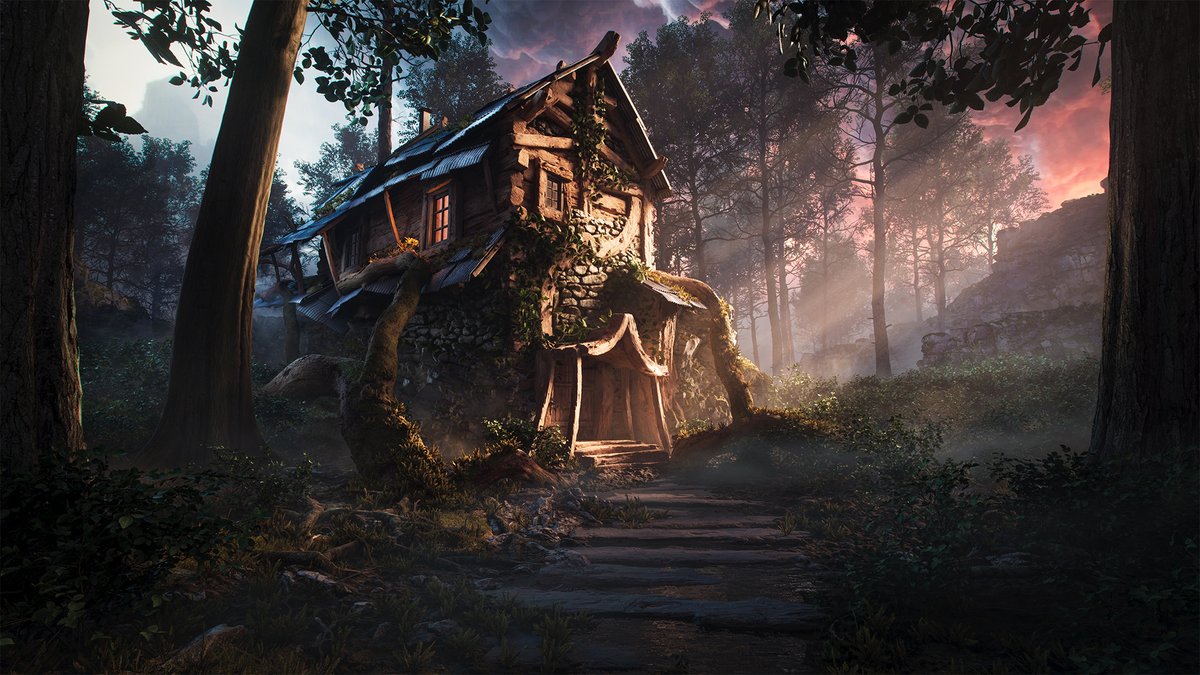
Marco Amati, an Unreal Engine VFX Compositor, shares a powerful R&D project focused on combining Gaea terrain masks with procedural logic for asset placement. See how he makes the procedural feel art-directed, driven by Quixel Megascans assets.

15,917 views • 9 months ago •via X (Twitter)

0 Comments

No comments available

Comments from the original post will appear here

Related Videos

I built a Three.js rendering study inspired by Tiny Glade’s painterly aesthetic, and got it running at 120fps in the browser. Over the past few weeks, I’ve been studying how stylized games achieve that soft, handcrafted look in real time. Tiny Glade was a huge inspiration, and I wanted to use the browser as a constraint: no compute shaders, no native GPU access, and single-threaded JavaScript. As part of this study, I implemented: - GPU-driven instanced brick walls with procedural noise jitter and elastic build animations - Tree, bush, and flower rendering with billboard card expansion, wind sway, and grow animations - Procedural grass with terrain conformance and interactive push deformation - Animated water with layered noise, interactive ripples, and Fresnel-based reflections - Procedural terrain with slope-aware triplanar materials, dirt paths, and rocks - A 7-pass post-processing stack with TAA, bloom, depth of field, painterly filtering, ACES tonemapping, 3D LUT color grading, and film grain The hardest part wasn’t writing any single shader. It was making all of these systems work together at high frame rates inside WebGL, where every millisecond counts and performance problems compound quickly across animation, materials, post-processing, and scene management. Some techniques in this study were inspired by analyzing Tiny Glade’s rendering approach, while others were original implementations built from scratch from visual reference. That contrast taught me a lot: recreating an effect is one challenge, but designing your own shaders and systems to achieve a similar feel is a very different one. This is a private educational rendering study. Some temporary placeholder content is being used during the research phase, and any public or production version would use original or properly licensed assets. Huge credit to Pounce Light for the incredible art direction and rendering work in Tiny Glade: Three.js #gamedev #webgl #threejs #rendering #graphics #realtimerendering #shaderdev

Ibrahim Boona

58,625 views • 3 months ago

At Avalon we are building "Real-time creating" - the ability to generate gameplay ready persistent worlds prompted from text. While others are building real-time video world models, Avalon is building real-time world generation inside a fully playable, persistent multiplayer engine. Internally running at 3840×2180 at 60 FPS. Built on Unreal Engine. Multiplayer by default. Persistent by default. Gameplay-ready by default. This is not a video latent replay. Not a simulation of interaction. It is a real 3D world with physics, logic, and authoritative multiplayer state. Avalon is trained on proprietary Avalon interaction data and powered by a hybrid system that combines language understanding, 3D model generation, procedural systems, and structured gameplay logic synthesis. Players can walk through a live world and generate environments, assets, mechanics, and entirely new gameplay modes using natural language. We accomplish this through a combination of 3D model generation, game logic generation based on our proprietary systems, and AI driven world creation. While other players are inside it. Changes persist instantly. State is synchronized in real time. Creation happens inside the world, not outside of it. Describe a biome. Spawn a civilization. Create a survival mode. Build a dungeon crawler. Launch a new game inside the world. Avalon interprets intent and integrates it directly into the live multiplayer environment. This is not a world model predicting video. This is a gameplay engine that understands language. If you can describe it, you can build it. And others can walk into it instantly.

AVALON

62,663 views • 5 months ago

Introducing Lithic ( the intelligent execution language powering the Lithosphere Network. For years blockchain has focused on programmable value. With Lithic, we move toward programmable intelligence. Lithic is designed to connect smart contracts, identity, AI systems, and cross-chain infrastructure into a unified execution fabric for the next phase of the internet. This is a core step toward the Web4 infrastructure stack we’ve been building at Lithosphere. Core Lithic Components • Lithic Execution Engine – deterministic runtime powering intelligent smart contract execution • LEP100 Intelligent Asset Framework – programmable token standard for adaptive digital assets • Lithic Modules (LSCL) – composable modules for governance, identity, compliance, and AI logic • Cross-Chain Orchestration Layer – communication between EVM, Cosmos environments, and external networks • Identity & Policy Hooks – programmable identity-aware transaction and asset control • AI Integration Layer – enabling intelligent validation, automation, and decision systems Together these components form the foundation for adaptive decentralized systems. Why Lithic matters Static contracts belong to Web3. Lithic enables: • intelligent assets • identity-aware protocols • AI-driven automation • modular decentralized infrastructure This is how blockchain evolves into the intelligent layer of the internet. 📚Lithic Documentation & Resources Learn more Docs: Tools, Scripts, examples etc: Lithic Contract Wizard and Verifier. LEP100 Standard-suite Lithosphere Developer Resources More developer tools, SDKs, and modules will be released alongside the Makalu Testnet.

King

158,021 views • 4 months ago

Watch Joanna Zeng @ SOON (🔴,💊)📍🇺🇸🗽 (Mainnet Arc) interview one of the best & brightest of Solana Matt Sorg 🍨, VP of tech Solana Foundation, as he elucidates Solana's vision and the early formations of Solana's future. The latest developments taking place on Solana: • AlpenGlow Upgrade: Developing multi-leader consensus, asynchronous execution, and pipelining for scalability → lowering Solana's latency to 100ms • Asset Tokenization: Build a universal identity and asset layer for tokenized assets enabling new capital formation mechanisms. • Phased Growth: Starting with native assets, then fostering a mature ecosystem of high-quality tokens like BTC. • Standards & Tools: Developing SVM to connect ecosystems and facilitate high-speed transactions. Quick Highlights on SOON's high-performance copy trading platform on Drift. • Diversified Revenue: Building new income streams for streamers on Twitch SOOP can reduce reliance on inconsistent viewer donations or sponsorships. • Social Trading: Live trading streams with enable viewers to watch and participate alongside traders, creating an interactive, community-driven experience. • Shared Incentives: Streamers earn ongoing commissions as long as viewers engage, aligning interests and incentivizing content. • All-in-One Platform: Combining trading, chatting, and speculation in a single platform makes the experience more engaging and social. Solana is going to be the Layer-1 blockchain to bring the multi-trillion dollar financial industry on-chain. Listen to the full interview from Solana Accelerate 👇

SOON - Solana Optimistic Network (Mainnet Arc)

28,148 views • 1 year ago

Let’s make this clear: Arch is not an L2. The label gets thrown around because people see our custom execution model, and assume a familiar category. But categories only help when they reflect how a system actually works. Calling Arch an L2 only creates confusion about what the architecture is doing. L2s require that users bridge or wrap their assets in order to access greater programmability. They maintain a separate state machine that only syncs back to Bitcoin, if ever, when transactions are posted back as post commitments or proofs on the base layer. Their transactions aren’t dependent at all on what is happening on the Bitcoin base layer, since their execution and validator lives entirely elsewhere. The ArchVM works differently. ・The same validators that approve the transactions within the ArchVM also have proportional key shares within Arch’s FROST + ROAST cryptography on Bitcoin. ・State changes are reflected accordingly, with a real-time mempool indexer and a DAG (Directed Acyclic Graph) that keeps track of the state transitions on arch and the corresponding asset transfers on Bitcoin to ensure they remain atomic. ・Its rollback/reapply method ensures state consistency, allowing Arch to give applications a pre-confirmation, allowing users to break away from the user experience issues that come with Bitcoin’s slow block times. That’s how Arch can bring financial logic to UTXO-based assets on Bitcoin, keeping actions taken within our suite of apps and aligning them at every stage with the base layer. Developers can coordinate activity, enforce rules, and build onchain applications without introducing wrapped assets, bridging models, or security assumptions that force users to move their assets elsewhere. It’s a model unlike anything Bitcoin has ever seen… and unlocking a form of Bitcoin programmability that has never been feasible until now.

Arch Network

13,575 views • 8 months ago

This is the post that ties it all together. The Only Income Producing Collectible That Can Buy Every Other Collectible Most investors in collectibles don’t actually own assets. They own expensive inventory with permanent carrying costs. Most collectibles are static. They sit still and wait. Art, sports cards, and memorabilia are stored assets. They live in vaults and require constant insurance, protection, and oversight just to exist. A thirty-million-dollar trading card may be rare, but it is the most expensive nonfunctional real estate on earth. At roughly 1% annual insurance, that single card costs about $300,000 a year just to sit there. Over ten years, that is $3 million spent to stand still. No income. No compounding. No leverage. Just cost. It’s an asset. It’s also a liability. Hold it long enough and the math becomes unavoidable. Decades of insurance just to stand still. Millions spent not to grow, but simply not to lose. Smart investors understand there is a fundamental difference between collectible inventory and operating assets. One waits. The other works. An operating asset doesn’t sit in storage. It operates in public. It compounds. It builds leverage while you sleep. A great operating asset becomes the front door, the brand, and the world headquarters of the business built on it. It doesn’t just represent value, it becomes the center of gravity everything else builds around. There are assets that don’t just hold value, but create it. They generate revenue. They can be licensed, leased, partnered, and scaled. They can spawn companies, platforms, and entire ecosystems with virtually unlimited expansion. Most collectibles only have value if someone else buys them. If no one shows up, nothing happens. An operating asset doesn’t wait for a buyer. It produces. It earns. It compounds. You don’t hope for an outcome. You create one. If your asset can’t work while you sleep, it isn’t an asset. It’s inventory. The most valuable assets in the modern world sit at the intersection of language, identity, commerce, and behavior. One word can represent an entire industry. One name can outlive companies, technologies, and trends. From the right operating asset, you can buy every collectible in the world. You can’t do it the other way around. That’s not opinion. That’s math. Collectibles are owned. Operating assets are deployed. And the most powerful operating assets ever created are high-profile, memorable, brandable, category-defining domain names. Curious how people outside the domain world see this distinction.

Rick Schwartz aka DomainKing®

12,752 views • 5 months ago

Everything you love about generative models — now powered by real physics! Announcing the Genesis project — after a 24-month large-scale research collaboration involving over 20 research labs — a generative physics engine able to generate 4D dynamical worlds powered by a physics simulation platform designed for general-purpose robotics and physical AI applications. Genesis's physics engine is developed in pure Python, while being 10-80x faster than existing GPU-accelerated stacks like Isaac Gym and MJX. It delivers a simulation speed ~430,000 faster than in real-time, and takes only 26 seconds to train a robotic locomotion policy transferrable to the real world on a single RTX4090 (see tutorial: The Genesis physics engine and simulation platform is fully open source at We'll gradually roll out access to our generative framework in the near future. Genesis implements a unified simulation framework all from scratch, integrating a wide spectrum of state-of-the-art physics solvers, allowing simulation of the whole physical world in a virtual realm with the highest realism. We aim to build a universal data engine that leverages an upper-level generative framework to autonomously create physical worlds, together with various modes of data, including environments, camera motions, robotic task proposals, reward functions, robot policies, character motions, fully interactive 3D scenes, open-world articulated assets, and more, aiming towards fully automated data generation for robotics, physical AI and other applications. Open Source Code: Project webpage: Documentation: 1/n

Zhou Xian

3,818,087 views • 1 year ago