Video wird geladen...

Video konnte nicht geladen werden

Zur Startseite

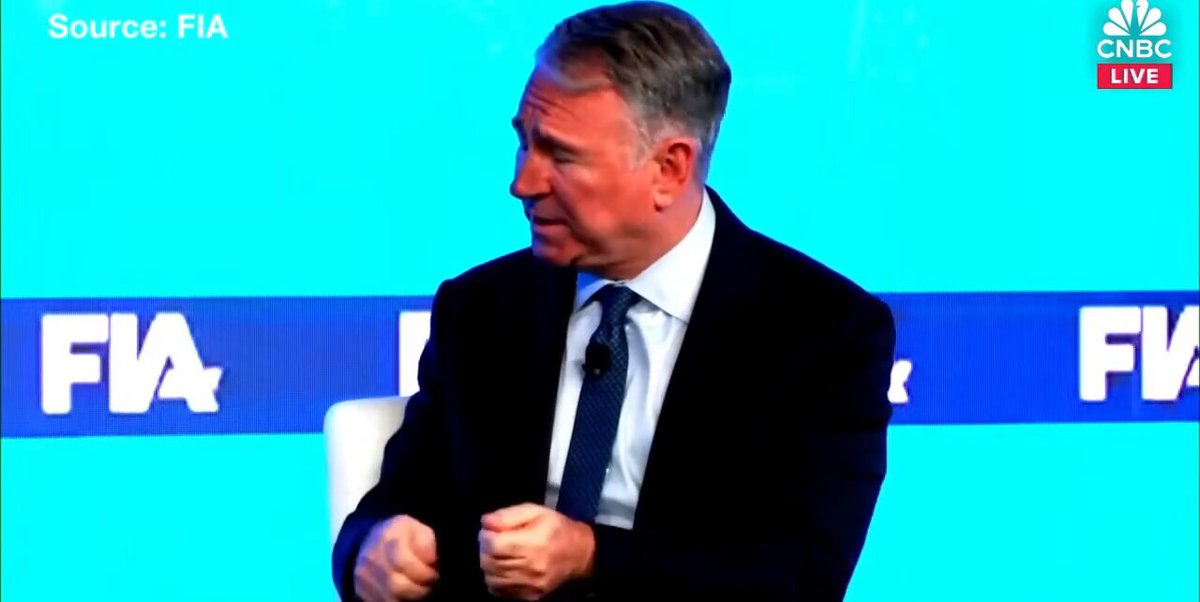
Mark Cuban watching AI repeat the exact same pattern as dot com bubble: "if there's a price performance curve on AI that minimizes the power requirements there's going to be a lot of data centers that are going to be turned into pickleball courts" this is him explaining why...

684,574 Aufrufe • vor 3 Tagen •via X (Twitter)

0 Kommentare

Keine Kommentare verfügbar

Kommentare vom Original-Post werden hier angezeigt

Ähnliche Videos

Mark Zuckerberg explains why he has never believed in delegation (and why founders shouldn't either): Most CEOs believe their job is to hire great people and get out of the way, but Mark disagrees. "I basically don't believe in delegation." He explains his thinking: "There's so much going on across the company that I can't possibly get involved in all of it. So all these people are going to have a ton of stuff that they're going to do." But that's not a reason to step back. It's a reason to be selective and then go deep. "Fundamentally, if there is a decision that I want to be involved with, I'm going to be involved in it." His argument is simple: if you're the one accountable for everything, why would you ever accept being locked out of something important? "If you're running the company and you're on the hook for everything and there's something that's important at whatever level of detail in the organization, I don't get the logic of saying I'm not going to be involved in that." He's not calling for micromanagement, and he acknowledges he can't be everywhere. What he's rejecting is the idea that hierarchy should be a barrier. That founders should stay in their lane. That diving into the details is somehow a sign of poor leadership. Mark Zuckerberg does add one caveat: "You want to have humility and know that if you're diving into some decision, you may not have the most context immediately." But humility about context is different from staying out entirely. His conclusion is a cultural one: "You want to have the cultural expectation that things are not going to be so hierarchical and you're just going to dive into whatever you want."

Big Brain Business

20,055 Aufrufe • vor 15 Tagen

Sam Altman on the most tone-deaf prediction being made by AI CEOs today: He pushes back on the gloomy predictions in the AI industry about mass unemployment. "I know some AI CEOs are saying things like 50% of the jobs are going to go away." Sam Altman finds this framing not just wrong, but tone-deaf: "To say nothing of how tone-deaf it is for someone to be saying my company's going to eliminate 50% of the jobs and my company is going to be the most valuable company in human history and you know how wonderful that's going to be and but 50% of you are going to lose your jobs." Instead, Altman points to a pattern that's played out before: "Jobs will go away. Jobs have gone away with every technological revolution. Jobs will change." To illustrate why productivity gains don't automatically translate to less work, he shares a conversation that stuck with him: "A thing someone said to me just yesterday that really stuck with me is I can use the new model GPT 5.5 in codex to accomplish in an hour what would have taken me weeks 2 years ago. And I thought I would have been much less busy in that world. Now you're doing work and I have never been busier in my life. I'm waking up in the middle of the night to do more work." Altman acknowledges the disruption ahead, but rejects the bleak version of the story: "I have no doubt that the economy is going to change a lot and jobs are going to change a lot and I think caution is warranted and I think rigorous debate about new social contracts, new economic systems are warranted as well. But I don't think it's like we're all going to sit around in a life without meaning and without work."

Big Brain AI

12,195 Aufrufe • vor 2 Monaten