Video wird geladen...

Video konnte nicht geladen werden

Zur Startseite

Meet QoderWork — a desktop AI agent that doesn't just chat, it actually does your work. Evan leads the QoderWork product at Qoder, a Singapore-based AI company. Which is a new generalized agentic service that lets you: ++ Open files on your computer. ++ Analyze data. ++ Run code....

11,527 Aufrufe • vor 3 Monaten •via X (Twitter)

0 Kommentare

Keine Kommentare verfügbar

Kommentare vom Original-Post werden hier angezeigt

Ähnliche Videos

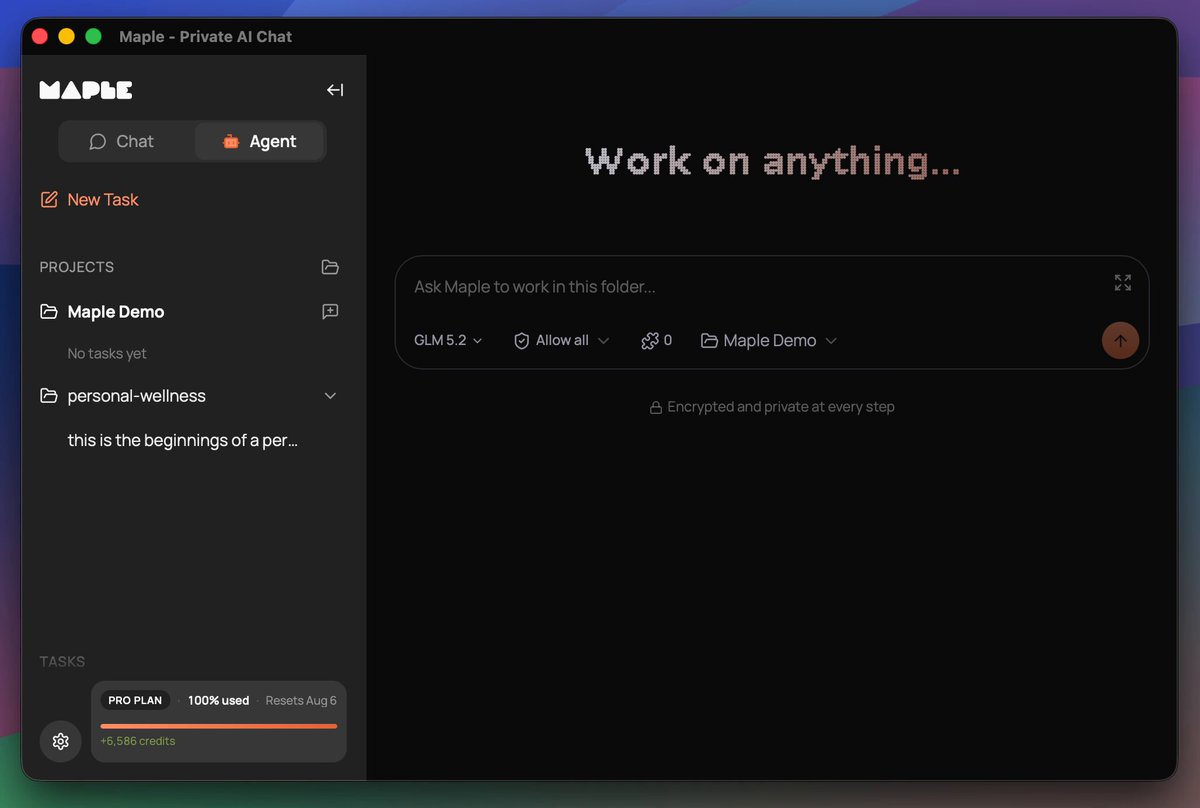
Maple is preparing for the release of a co-working agent. You install it locally and it works with your files, whether it's office work or building websites and apps. It's a turnkey solution, as easy as Claude Code, that keeps your data secure and private, no data sharing with closed AI labs. This is THE sovereign AI app for individuals and businesses who want powerful AI while retaining ownership of their information. Why build an agent into the Maple app when other agents already exist? Easy, we want to give you control over your work. We don't have a business plan that incorporates making money off our users' data. In the age of AI, your information, whether it's personal or company trade secrets, is the single thing that differentiates you from everyone else. We all have access to AI that can build a professional website for selling shoes. But your strategy and network for how you sell shoes should not be shared with your competitors. Sovereignty is the path to protecting what makes you, you. Maple sits at the intersection of Usability and Sovereignty. Maple gives you the best tools that are both easy to use and maintain your data sovereignty. Sovereign for one, sovereign for all. It has been a journey to get here. We brought to market the very first personal chatbot with end-to-end encryption using TEEs in late 2024. Prior to that there were proofs of concept but no full product offerings. Every other AI chat product on the market handled your data in plain text, either selling you a service to get your data or asking you to trust that they won't snoop on you. Quickly people found Maple and latched onto its open-source code and verifiable encryption. We didn't stop there. You may remember earlier this year we teased a product called "Maple Agent" and opened up a waiting list. That product is a mobile app that acts as your AI "friend", maintaining one long continuous chat, and getting to know you over time. I dislike using the word "friend" there, but it's the best way to convey the UX in a few words. AI is a tool, always has been, always will be. Any kind of friendly personality on top is just synthetic. In our testing, the UX of Maple Agent is really powerful for what it does. Think about the many short AI chats you have in your favorite app, whether it's looking up a historical fact or asking advice about a topic. With Maple Agent, those all go away in favor of the long-running chat with the friendly agent. It's like you have your own personal assistant who knows you so well and can look up anything for you. When I ask AI certain questions, I want to ask an expert who already understands my situation so I'm not repeating myself for the 100th time. That's the amazing value the personal agent brings to the table. We still see great utility for a personal agent like the "Maple Agent". Thousands of people on the waiting list, hoping to get their hands on it, agree that the concept is worth exploring and trying out. We were constrained in launching it due to a few circumstances, one of them being access to the scale of compute needed to power it. We have a clear path laid out for how to get there, but today is not the day to execute on that. It will be in the near future. Instead we have a different agent ready to go that we think is also incredible. We now have an agentic harness inside of the Maple Research app. This thing is a powerhouse. It even builds and publishes its own software releases. The agent in Maple Research works with your local filesystem, speaks to the largest open models running in TEEs, utilizes local models for certain tasks, is compatible with MCP tools, has an API for connecting to anything you need, and also supports the ACP protocol, which means it can be extended in the future to speak to other tools like Claude Code, Codex, and local models running on your own hardware. A big unlock for us was the Goose Development Kit, which powers the core of our agent harness. More on that to come as we publish articles and documentation later about the agent. The agent inside Maple Research doesn't have a name. At least not yet, not sure if it ever will. For now we call it "Chat Mode" and "Agent Mode". Think of this as the workhorse, the truck, the heavy lifter. Our other "Agent", the phone app, is your sidekick in your pocket, ready to help with quick things and ongoing conversations about life. I am incredibly excited about the Maple Research Agent. While I'm already seeing great results using it for internal work items, I'm especially thrilled about the personal health and wellness work it's doing for me. I know there are plenty of apps out there for compiling wellness data, but I'm having it build a tool tailored specifically for what I need, without the extra fluff. And none of my health data is being donated to the closed AI labs or sent to advertisers. I know that the AI logic is not being silently adjusted to fit the whims of a large corporation that has paid for product placement. It's me, state of the art AI, and my data. That's how I want it. Maple's new agent makes that possible. We can't wait for you to try it out. If you want early access, comment here, email us, reach out in some way. To those on the other agent waitlist, you're already in the queue. Thanks for reading this lengthy update. :)

Mark

29,937 Aufrufe • vor 10 Tagen

Introducing Workshop: cloud + on-device agentic AI. And to celebrate, we're giving away $250k in Google Gemini AI credits. (details below). The future of AI work is neither cloud-based nor local. It's both. In Workshop Cloud, you can use agents powered by frontier models like Claude and/or open source models like Z.AI's GLM-5 to build internal tools, dashboards, and AI web apps. Or, breeze through tasks like managing your Google and Meta Ads. In Workshop Desktop, you can do all the same right on your computer, plus make desktop apps, mobile apps, and 3D creations. Our favorite part? You can power the full agent experience with local models like Qwen 3.5 family on your computer. Fully offline. 2026 is the year in which local models for agentic tasks will become viable for mainstream use. But the setup for tools like OpenClaw is like setting up Linux from scratch on your computer. Workshop Desktop is one-click to install on Windows, Mac, and Linux. It recommends which open source model you should use for your hardware and lets you download and run it right in the app. And its agent harness allows you to chat, create websites, build personal utilities, and analyze data. 100% offline. Or multitask with AI models in the cloud while running other agent threads locally. Start in Workshop Cloud when you want flexibility and speed. Download your project and continue in Workshop Desktop when you want local files, privacy, and/or better performance on large code bases. Publish from either. The agent tooling space is maturing and discerning users have come to expect a lot from their tools. We've packed Workshop with features to help you 10x your productivity. - Native support for skills - Autocompaction for seamless context management - Built-in AI for your apps - Dozens of connectors, like Google Drive, Big Query, and Supabase - dbt integration to ground your dashboards in your semantic layer - Native Github integration - Private app deployment - ... and more (+ we're shipping super fast) To access the free credit offer, RT this post and reply with "Workshop". Make sure you are following us so we can DM you the instructions to redeem. - First 100 to RT + comment get $500 in credits. - Everyone else gets up to $250 And thanks to our partners Modal, Google Gemini, and Z.AI!

Workshop AI

28,537 Aufrufe • vor 4 Monaten

New short course: Serverless Agentic Workflows with Amazon Bedrock. Learn to build and deploy serverless agents in this course created with Amazon Web Services and taught by Mike G Chambers, a Senior Developer Advocate at AWS specializing in GenAI. (Disclosure: I serve on Amazon's board.) Generative AI applications are becoming more complex, sophisticated, and agentic. Agentic applications have workloads that can be hard to predict in advance -- for example, what tools will it decide to call? -- and a serverless architecture helps you efficiently providing on-demand resources. This course teaches you to build and deploy a serverless agentic application. You’ll learn to create agents with tools, code execution, and guardrails, and build responsible agents for business use cases: - Build a customer service bot for a fictional tea mug business that can answering questions, retrieve information, and process orders. - Connect your customer service agent to a CRM to get customer info and log support tickets in real-time. - Explore how you invoke the agent, and see the trace to review the agent’s thought process and observation loop until it reaches its final output. - Attach a code interpreter to your agent, giving it the ability to perform accurate calculations by writing and running its own Python code. - Implement guardrails to prevent your agent from revealing sensitive information or using inappropriate language. By the end, you will have built a sophisticated AI agent capable of handling real-world customer support scenarios. Please sign up here!

Andrew Ng

81,048 Aufrufe • vor 1 Jahr

The corporate system wants you trading time for a paycheck. The alternative is building automated leverage. You do not need a team of engineers. You just need the right open-source architecture. Here are 10 GitHub repos to automate your workflows, replace manual labor, and direct your own reality: 1. n8n Bypass expensive SaaS subscriptions. Build custom AI automation workflows that run on your own servers. 2. Ollama Stop sending your private data to massive API providers. Run heavy AI models locally on your own machine. Complete privacy. 3. Open Interpreter Let language models control your computer. Automate the repetitive corporate tasks they pay you to do manually. 4. Aider An AI pair programmer that lives in your terminal. Stop writing boilerplate code and focus strictly on the architecture. 5. Dify An open-source LLM app development platform. Build and deploy functional AI agents in minutes, not months. 6. Flowise A drag-and-drop UI to build customized LLM flows. You do not need to be a senior developer to build massive leverage. 7. Supabase Spin up a Postgres database, authentication, and instant APIs. Own your backend entirely. 8. Auto-GPT Give an AI an objective and let it execute. It browses the web, writes code, and chains thoughts together autonomously. 9. Outline An open-source knowledge base for your personal leverage. Stop losing your documentation in arbitrary corporate systems. 10. NocoDB Turn any database into a smart spreadsheet. Keep your data on your own infrastructure and stop paying for convenience. The secret to tech survival? Stop playing by their rules. Build your own systems and take your leverage with you.

Katyayani Shukla

16,964 Aufrufe • vor 3 Monaten

The most valuable AI system you're not running yet: an AI second brain. The concept goes back to Karpathy's knowledge wiki earlier this year, and it's still one of the highest-leverage workflows in AI. Connect your Hermes agent, and it becomes 10x more powerful. Here's how to build it (from scratch): Step 1. Download Obsidian Head to obsidian.md and download the desktop app. Once downloaded, go ahead and create a new Obsidian vault. Vaults are just where notes/text are stored locally. Start dumping everything in here: - Personal goals - Meetings - AI context/preferences The more you put in, the more powerful your second-brain becomes. Step 2. Connect Hermes to your Obsidian vault If you don't have Hermes yet, download the desktop app here: [ Then, paste this prompt: "I want you to connect to my new Obsidian vault and act as my second-brain personal assistant - do everything necessary to set up that connection now." This gives Hermes direct access to everything inside your notes vault. Step 3. Let it self-evolve Every time you add a new note, Hermes will automatically ingest it. Prompt Hermes: "Every day, scan my second brain database. Every time I add a new note, use it to create reusable skills and workflows." Pro tip: Once Obsidian is connected to your agent, you can just prompt it directly to add notes/context/data. This works really well if you're prompting Hermes on the go from Telegram/mobile. Save this and build your second brain system now.

Miles Deutscher

28,703 Aufrufe • vor 4 Tagen