Загрузка видео...

Не удалось загрузить видео

На главную

Meta has just unveiled their new VR glasses. • Price: $1,299 • Available Spring 2027 • Weight: 100 grams, about the weight of a deck of cards • Glasses contain the displays and sensors, while a separate puck houses the processor, battery and storage. • 5K display with micro-OLED...

7,191,292 просмотров • 1 день назад •via X (Twitter)

Комментарии: 36

Фото профиля Market Force
Market Force1 день назад

And it comes with this.

Фото профиля Salomondrin 🤖
Salomondrin 🤖1 день назад

that's fucking sick

Фото профиля Tesla Owners Silicon Valley
Tesla Owners Silicon Valley1 день назад

You like?

Фото профиля Sawyer Merritt
Sawyer Merritt1 день назад

They seem pretty cool

Фото профиля bye
bye1 день назад

3 hours of battery? Even my phone is laughing .. 😂😂😂😂😂

Фото профиля The Future
The Future1 день назад

Apple, Samsung sure thing. Meta hard pass.

Фото профиля dylan
dylan1 день назад

The thing I like most about it is the IMAX certification. I’m shocked the Vision Pro isn’t

Фото профиля Thomas D.
Thomas D.1 день назад

Another flop. Most people want less devices not expensive wearable gadgets

Фото профиля Brian
Brian1 день назад

Looks sick but I will never knowing buy a Meta product. If someone reputable doesn't copy this I'll never try it 😢

Фото профиля Vol888
Vol8881 день назад

Look left to buy puts. Look right to buy calls. 😂

Фото профиля options_father
options_father1 день назад

95% of people using Facebook are over 60 years old!! I don't see many of them buying this 🤷🙄

Фото профиля John Titor
John Titor1 день назад

Didn't Apple try this already?

Фото профиля Mike
Mike1 день назад

Zuck using u to train his future robots. Always using people for his gain

Фото профиля MatthewtheWalker 🇺🇲
MatthewtheWalker 🇺🇲1 день назад

I don't think glasses tech will ever really take off in the mainstream. It's too isolating and antisocial and there is a fundamental problem with the proximity to your eyes and the disconnect from the inner ear for balance/spatial awareness.

Фото профиля Elemental Forge
Elemental Forge1 день назад

I simply will never buy a product made by Meta. Ever. They are profoundly evil, and have proven it time and time again.

Фото профиля Exx Five
Exx Five1 день назад

Damn so close…. But you still need a huge cable connected to a battery!? Lame.

Фото профиля Trevor Scott ✘
Trevor Scott ✘1 день назад

Complete with 24/7 recording even when you don’t ask! Great hardware, spyware in the software.

Фото профиля Abhimanyu Yadav
Abhimanyu Yadav1 день назад

nice! Looks much better than vision pro tbh

Фото профиля M.Ible Enterprises (Mik †)
M.Ible Enterprises (Mik †)1 день назад

Looks good but that battery life stinks.

Фото профиля CJDGiesen
CJDGiesen1 день назад

Was initially excited. But now i feel this is still an 'in between' product. This isn't the sweet spot yet. It's too clunky for AR and not closed enough for real VR. Will definitely try them. Big fan of the Quest 3. But i feel they need one or two more gens to nail the device

Фото профиля Ham Hobbyist
Ham Hobbyist1 день назад

A deck of cards, that’s heavy!

Фото профиля Deadshot™️ 🇺🇸
Deadshot™️ 🇺🇸1 день назад

The difference between having smart people around you and not having smart people around you. @evanspiegel

Фото профиля Sandra 💞🇺🇸💞
Sandra 💞🇺🇸💞1 день назад

I’m trying to figure out how I can wear two pair of glasses at the same time🤣🤣🤣

Фото профиля Greggertruck
Greggertruck1 день назад

@jeremyjudkins_ AR no?

Фото профиля DARIO ALTMAN
DARIO ALTMAN1 день назад

The hardware is impressive. But the bigger shift is behavioral. When VR stops feeling like a device you put on and starts feeling like a computer you simply wear, an entirely new category of products becomes possible. The specs are just the beginning.

Фото профиля Angry Pomeranian PhD
Angry Pomeranian PhD1 день назад

uh, didn’t Viture do this like 5 years ago already?

Фото профиля ScholarKid007
ScholarKid0071 день назад

Hard

Фото профиля Manti Savino
Manti Savino1 день назад

The problem with all VR headsets up until this one is you simply can’t wear it all the time. It’s just too uncomfortable to wear this big thing on your face. I’ve always thought if it’s something kind of like glasses then it could become more mainstream, so I guess we will see.

Фото профиля Keenan Wen (V15) 🗿🔋📐❇️
Keenan Wen (V15) 🗿🔋📐❇️1 день назад

Looks better than Apple Vision Pro but the battery life is kinda bad

Фото профиля BluePrint
BluePrint1 день назад

Unless @PalmerLuckey was involved it’s a NO!

Фото профиля Emi
Emi1 день назад

No audio ?

Фото профиля Rolo1995
Rolo19951 день назад

I'm not particularly excited over most technology debuts, but this is a massive step up from the previous attempts I cam see a discreet cable and a cell phone sized external battery pack to up the run time several multiples Now all we need is an app based on "They Live" to spot the liberal lizard people based on their social media presence

Фото профиля Arelius
Arelius1 день назад

Not a Meta fan but sort of glad they outdid Apple since Apple seems incapable of any innovation, only copying at this point.

Фото профиля elliott
elliott1 день назад

I gotta say, they nailed it with these. In fact I was impressed with the whole presentation this evening. They really came out swinging with this release. That virtual keyboard is just WOW.

Фото профиля Marco Diaz
Marco Diaz1 день назад

woah

Фото профиля Devin Soto
Devin Soto1 день назад

Dang those glasses look cool

Похожие видео

Two videos give state of art of XR at #ces2026. This is my ninth and 10th video report from CES. Both were in suites, which means the public couldn't get into see them. The first is of VITURE, which had the best middle-weight AI glasses. The second is of Lumus, which makes the glass in the displays of the Meta Rayban Displays (the industry calls them waveguides). It showed me the first that I've seen that have 70 degree field of view. Meta's current glasses have waveguides that can only do about 20 degree field of view. The difference in size of the virtual image you see in front of you is like going from an iPhone to a 100-inch TV on your wall. The Viture, along with competitors, RayNeo, Rokid Global, XREAL 👓, among others, use a hybrid waveguide and bird bath optic. The bird bath has a much thicker optic in front of your eyes. If you actually want to play a video game, or work while say on a flight, the middle weights are the ones you want. The virtual image is like seeing a movie in a movie theater. The problems with the bird bath optics are they aren't good to wear in the real world, like while walking around a shopping mall, and need to be plugged into a phone or a laptop to save weight and have enough processing power to put a movie up in front of you. That takes us to lightweights. I saw many, and Lumus' 70-degree field of view waveguide will be in lightweights in 2028. And I assume there are competitors that we'll probably see at SPIE (optics show in San Francisco) in a few months. Many of the lightweights, like Even Realities, have small green and black displays. I have them and they are quite nice, but I want full color displays for obvious reasons. Apple bought a waveguide company years ago, so I assume it is working on some in secret, plus its partner, ZEISS Group, showed off waveguides years ago at CES, and since that's the biggest optics company in the world, it is an easy assumption to say that Zeiss is working on the displays that Apple will use. Elsewhere in the suites, Goertek_USA was showing off a new "heavyweight" with 4k displays, think of an Apple Vision Pro. Except it was only about 100 grams. Reference design, so not in real products yet. But all this points to that every year from now on we'll see a lot more displays on people's faces. At XReal they told me their Holodeck glasses are coming later this year.

Robert Scoble

66,857 просмотров • 8 месяцев назад

Genesis (owned by Hyundai) has just officially unveiled its new all-electric three-row flagship SUV for the U.S., the GV90, and it has some wild features. • Range: Up to 310 miles • 123 kWh battery • Peak charging speed: 350kW • Radiant floor heating • World’s first independently opening/closing hidden B-pillar coach-door system. • Front and rear doors can open toward each other simultaneously, creating a large pillarless opening. • New dual-motion rear-door hinge first moves the door outward and then rotates it open. • World’s first Roof Airbag, designed to deploy across the entire glass roof during severe rollovers to reduce occupant ejection and roof-contact injuries. • Battery slider structure redirects components such as the motor and subframe underneath the battery during a frontal collision. • Multi-Chamber Air Suspension with adjustable air-spring stiffness and adaptive ride height. • Active Rear Wheel Steering turns the rear wheels by up to 5 degrees • 208 inches long • Genesis says the pillarless structure achieves crash-safety performance equivalent to vehicles with conventional B-pillars. • When parked, the front seats can rotate 180 degrees at the press of a button, creating a face-to-face lounge configuration. • Wireless Battery Management System reduces wiring and improves battery packaging efficiency. • New Power Control System eliminates the traditional start/stop button - first Hyundai Motor Group vehicle with the system. • Pop-up 23.6" OLED Cinematic Display. When parked, the screen can rise 90 mm and expand into a 24.6-inch display. • 25-inch Head-Up Display replaces a conventional dedicated instrument cluster and displays speed, navigation and ADAS information. • Memory Reversing Assist (MRA) remembers the vehicle’s path and can automatically guide it backward out of narrow alleys or parking areas. • Bang & Olufsen Premier 3D audio system. 25 speakers. Dolby Atmos support. • Premium leather seats feature 15 individual air cells. Seats include a pulse-vibration massage system. • Metal-coated heated windshield, a Hyundai Motor Group first, can directly heat the glass to clear frost and condensation without relying solely on cabin climate control. • Radiant heating built into first- and second-row console armrests, side panels and door trims. • GV90 Neolun Executive Suite available in a 4-seat configuration. Executive Suite second row features a real wood veneer floor. Comfort Partition separates the second-row passenger compartment from the cargo area to reduce luggage-compartment noise. • Smart Vision Roof using PDLC smart-glass technology. Roof transparency can be independently controlled across six zones. • Built-in refrigerator • High-expansion soundproofing fillers are injected into structural cavities to reduce noise and vibration. Additional reinforced sound-absorbing materials throughout the cabin. • Material choices include natural wood, genuine stone and wool cashmere. • 10–80% charge in ~22 mins • 657 hp • Can configure a 4 seat or 7 seat interior This is not a concept car. This is the production design. Pricing will be announced later. Deliveries start next year. More photos in the thread below:

Sawyer Merritt

1,747,805 просмотров • 1 месяц назад

The US Ambassador to China recently visited Rokid, a technology company in Zhejiang, with Steve Daines. And something interesting happened: U.S. Ambassador to China David Perdue didn’t just try the company’s AI glasses. He bought a pair. That made me curious: what exactly was so compelling that he decided to pull out his wallet halfway through the visit? So I looked into it. They don't look all that different from regular fashionable glasses. But here's what makes them special: The lenses are actually displays. The glasses weigh less than 50 grams, so they won't feel especially bulky on your face. They support four hours of continuous voice calls, or six hours of music playback, come with a 12-megapixel camera, and even charge through a tiny magnetic charger that simply snaps onto the glasses. Once you put them on, you can use them for teleprompter prompts, navigation, payment, and real-time translation in up to 90 languages. So basically, you can give a speech anywhere, travel almost anywhere, and just wing it. And there's another use that could be even more meaningful: accessibility. For blind and visually impaired users, the glasses can provide voice guidance, helping them understand where to go and navigate the world around them more independently. What's also impressive is their visual recognition capability. What does that mean? You see something, but you have no idea what it is. In the past, your first instinct would be to pull out your phone, take a picture, and search for it. With this pair of glasses, it might be much simpler: You just look at it. The camera recognizes the object in front of you, AI analyzes it, and the answer appears in front of your eyes. In an industrial setting, when a worker is facing a complicated piece of equipment, the glasses can help identify machines and components, and even guide them through the next step in the process. In other words, they're trying to do something that, until recently, we mostly saw in science-fiction movies or Mission: Impossible. When I was speaking with the company, I mentioned that I also research museums and archaeology. She told me, "Actually, you may have already used our products." I asked, "How?" She explained that many major museums in China now offer their AR glasses for about five dollars per use. As visitors walk through the museum, the glasses can automatically recognize important artifacts and play related audio and video explanations. For the past decade or so, almost our entire digital lives have been packed into a single smartphone screen. It became our primary gateway to the digital world. But now, AI glasses are starting to challenge that position. Because imagine a day when: You want directions? Just look. You want a translation? Just look. You want to know what's in front of you? Just look. At that point, would we still need to pull out our phones 100 times a day? And Ambassador Perdue, if you've been enjoying the glasses over the past week, I actually have one question: Which feature have you actually used the most? Translation? Navigation? Recognition? Or did you just buy them because they made you feel a little bit like Ethan Hunt Tom Cruise?

Zhai Xiang

45,906 просмотров • 21 дней назад

Apple Vision Pro: My Initial Impressions I agree with some others. This is one of the most impressive pieces of tech I’ve ever used, but it's not perfect. The Good: • The eye tracking and hand gestures are simply incredible. The accuracy is like 99%. It’s quite intuitive and feels very natural. You can put your hands almost anywhere and it'll sense them. • I’m not exaggerating when I say Apple’s immersive videos made for the Vision Pro literally make you feel like you’re there in person. I felt like I was literally in the room with Alicia Keys while she sang, or traversing 3,000 feet above Norway’s breathtaking fjords while walking on a rope. My only complaint is that while Apple Immersive Videos are 180-degree 3D 8K recordings, they are still a little blurry. • You can use the Vision Pro while lying down in bed in complete darkness and the hand gestures will still work just fine (just like FaceID does in the dark). • In 2013 Apple introduced TouchID. In 2017 FaceID. With Vision Pro, Apple has introduced OpticID. It scans your iris and unlocks your Vision Pro when you put it on. It’s incredibly quick and accurate. And like FaceID, it's secure. It's what you will use to pay for things on the device as well. • I didn’t experience any vertigo, dizziness, etc while using the device. • I'm a bit of a display nerd. For the first time outside of a theatre, Avatar The Way of Water feels true to the directors creative intent. High frame rate (HFR) wasn’t possible in any other device. The 3D is exactly like the theatre. I went to a dolby cinema to watch it originally, and the Vision Pro gets it about as close to a theatre video quality experience as you can get. • The sound quality is really good. The spacial audio is very convincing. • The Vision Pro is heavy, but I found myself not caring all that much if i used the dual loop headband. • I was skeptical of the productivity side of the Vision pro, but wow does the mac virtual display work insanely well. You can easily edit videos or browse the web. • You can complain about plenty of things, but built quality is not one of them. It's really good and solid. The device feels very dense. • Neck strain was not an issue • I watched John Wick in one of the immersive environments, and the movie was reflecting onto the water perfectly. It’s was incredible. I'm not joking when i saw it literally felt like I was watching a movie on a 4K HDR screen in then middle of the wilderness. • Battery life is fine most of the time. The Not So Good: • The app ecosystem just isn’t there yet, which is understandable. That will happen over time, but currently there are only 600 apps built for the Vision. For developer, It doesn't make sense to make a custom Vision Pro app when there are only ~200k users in the ecosystem. • The field of view is kinda of small, which is disappointing, and sometimes a little distracting. It's not terrible, but I wish the FOV was bigger. • The passthrough video is dissapointinly low quality, though it’s still better than anything else on the market. You can’t read your small text on your phone. Colors are muted, and it's a little jittery. Future versions will be better no doubt. • It is sort of an isolating device. I almost guarantee you future versions of the Vision Pro will be able to connect with one another so two people can be looking at the same virtual safari window, movie, etc. • Price: It's expensive. • As I said above, while heavy, the weight of the VP was not an issue for me, but that doesn't mean I don't want it to be lighter. It does press against your face pretty hard, which can cause minor cheek area fatigue. Future versions will no doubt be lighter. Final Thoughts: Going back to my Mac felt weird. It suddenly felt like a technology of the past. If you have the money and want to be an early adopter, you’ll be happy with the Vision Pro. But I have to say, the second or third generation of this device, I think, will be better and cheaper, so it’s probably worth waiting for that. While it’s one of the greatest pieces of tech I’ve ever tried, I can’t see myself using this in my daily life yet, and for $3,500, I should be able to envision that. I'm going to give it a few more days, but I'll likely be returning it. The app ecosystem needs to improve and expand a lot. That's ultimately what will make or break this thing's success. Apple knocked it out of the park engineering this thing. It's mind blowing, but if i'm already mind blown, Imagine how good future versions will be.

Sawyer Merritt

1,602,952 просмотров • 2 лет назад

Here's more analysis on the Apple and Google deal to make a new kind of Siri, after I had a cup of coffee. This is what OpenAI is doing: they're making a variety of new products and going after Apple. Apple didn't want to give OpenAI any more data to help a potential new competitor. The real problem for this OpenAI effort is that we're about to move to glasses. People don't believe me that we're about to move to glasses, but you should, because I just got back from CES and there was a ton of glasses there. For OpenAI to really get somewhere, they need to add a camera to an earphone. While I don't see that in this latest report, I won't be shocked to see a camera show up somewhere eventually. It is cameras that add understanding of the real world, which can lead to many new features that Apple's current AirPods Pro can't match. I believe Apple is developing such a product to go with their glasses, which makes a lot of sense. Also, Google's AI models are better at multimodality; this means they can use cameras in a much better way than even OpenAI's models can. This is why in Silicon Valley robotics companies, a lot of them use Google Gemini: because robots need multimodality. Apple's glasses, which are expected in 2027, have some significant advantages over the others. First, they have eye sensors in them, so it knows where the user is looking. It also can tell what the user is touching, holding, or gesturing towards. This new capability will give Siri a significant parlor trick: it will let Siri answer questions that no other search engine has been able to answer before. But the real reason I'm still bullish on Apple's glasses isn't technology—it's content. Apple has NBA rights and Formula One (among others) and a really great studio system, which has produced one of the biggest hits of the last six months. Pluribus. Apple also, because of its privacy stance, has a significant lead in consumer trust. Because of its retail stores, it also has a significant lead in the ability to: 1. Show people glasses 2. Get them fit properly 3. Get people trained On Saturday, I went to the main Apple store in Cupertino and watched one of the classes that they teach every few hours in an Apple store. The store was packed with people watching the class on a huge screen in the middle of the store. Apple has dramatically changed retail because of its stores, which gives it the most trusted brand in the business and gives it distribution to most of the world's richest people. While OpenAI has almost a billion users, it is unclear whether those users will switch ecosystems from Apple to OpenAI. Even if OpenAI's AI and devices can do a few more things, I'm not so sure anybody's going to care when Apple has very capable headphones that match up with their iPhones and has the world's richest people addicted to the Apple ecosystem (me included). Here is one of the secret Chinese suites at CES, which makes a series of glasses to sell to other brands. This gives you a sense of how fast the glasses world is moving. AI needs to not just tell you what it's seeing, but it needs to show you things to really make the solution complete. Also, Apple usually picks a much better design than anyone else. Because it's such a luxury brand, it can charge more than anybody else and be more profitable. I don't see anyone else being able to put together the whole solution the way Apple can. Therefore, I am still very bullish on Apple making a dramatic announcement about glasses sometime in the next 24 months. At CES, though, it's clear that many manufacturers will try. XREAL 👓 just got $100 million of funding to continue its glasses development, and officials of the company told me it will release its Android XR based glasses later this year. Short version: AI is coming to wearables in a big way, and Apple will do what it always does: come in late to the market and redefine it when it enters. It still has all the pieces to put together the puzzle, even though it doesn't have its own LLM so had to do a deal with Google for that. Yeah, others will be earlier to the market, and will win some buyers because of that, but buyers like me know that and will be happy to put down our other ones to buy Apple because of its advantages. With one big caveat: Apple has to deliver an amazing pair of glasses, and maybe a headphone with a camera, to keep the competition from taking its lunch. Also, behind the scenes there is a big patent battle brewing. Apple has quite a few, but I talked with Ann Greenberg at CES, who started Gracenote. She says she has several patents that will enable a large company to force others to license their technology and that she's already in final stages of selling those patents to a big company. All the big companies have patent portfolios they can use against each other, and particularly smaller, newer, competitors. Microsoft alone has dozens of patents it bought to start off its Hololens efforts, which it gave up on, but Microsoft still has almost 1,000 lawyers who would love to go after other companies for licensing deals. Plus, Google-funded Magic Leap has about 1,000 patents, so it'll be interesting to see if anyone buys the remnants of that company. The question is: can anyone disrupt Apple? Especially OpenAI?

Robert Scoble

275,056 просмотров • 8 месяцев назад

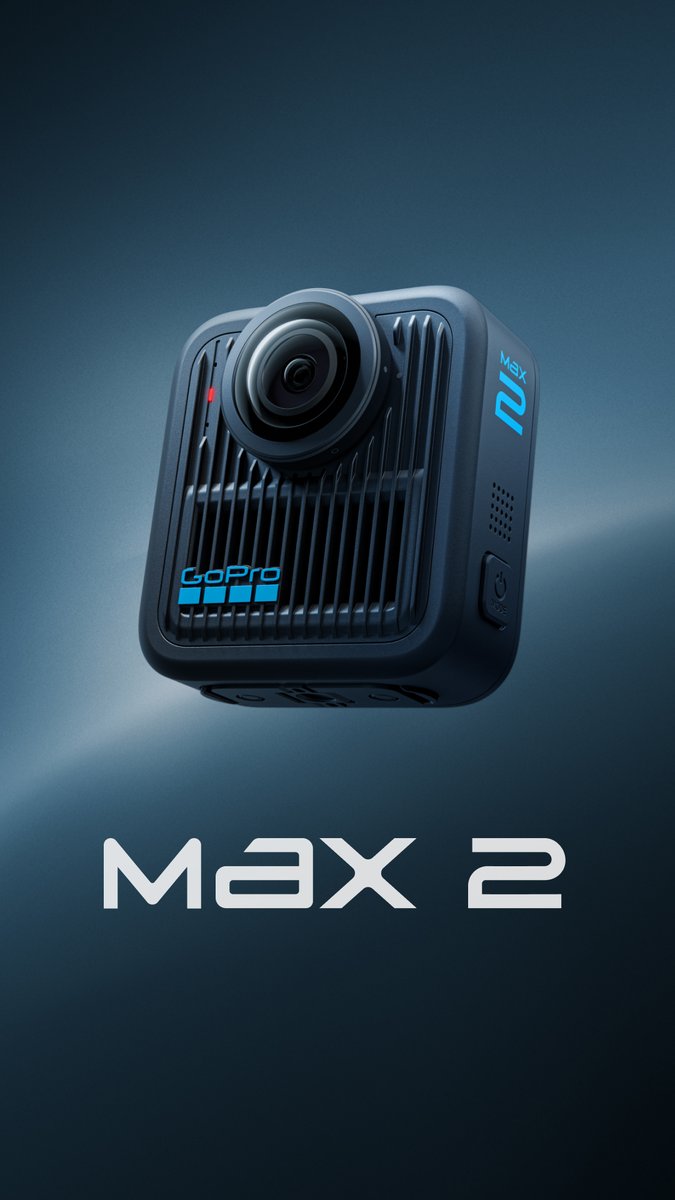
#GoProMAX2 is here 🚨 Industry-leading, true 8K 360 video delivers 21% more resolution than the competition, resulting in unmatched image quality that you only get from #GoPro. ✔️ Emmy® Award-Winning 360 technology ✔️ The only true 8K 360 camera. No misleading upscaling, no unusable black pixels, no AI-generated content ✔️ Twist + go replaceable lenses made from water-repelling optical glass. No tools or calibration required to swap ✔️ 5.6K60 + 4K100 for up to 4x slo-mo in 360 ✔️ 10-Bit color, GP-Log encoding, + with GoPro Labs, category-leading 300mbps bitrate ✔️ Seamless, invisible pole shots thanks to a new, back-to-back lens design + built-in 1/4-20 mount ✔️ Easy AI-powered editing tools with intuitive Reframe modes that anyone can use ✔️ Automatic POV + Selfie modes for minimal editing, while retaining full 360 flexibility ✔️ Most-in-class 6 microphones that unlock true-to-life spatial audio with innovative Audio Field of View ✔️ 23% larger, 1960mAh cold-weather Enduro battery ✔️ 360 Night Effects for creative capture in the dark ✔️ Sleek form factor for noninvasive mounting in action sports ✔️ Unbreakable Max #HyperSmooth with 360° Horizon Lock ✔️ Rugged + waterproof to 16ft (5m) ✔️ Quick-release magnetic mounting + compatibility with GoPro's entire accessory ecosystem ✔️ Single lens 4K60 video in Max HyperView at 180° FOV ✔️ 29MP 360 photos for cropping + zooming without quality loss ✔️ Bluetooth® audio connectivity for wireless microphones ✔️ Lightning-fast transfer speeds to the GoPro Quik App with Wifi 6 + BLE 5.3 🇺🇸 Designed in the USA Enhanced by a GoPro Subscription: ✔️ AI-edited highlight videos automatically sent to your phone ✔️ Unlimited cloud storage at 100% quality ✔️ No-questions-asked camera replacement 📦 Pre-order today, with free shipping and a free 1-year GoPro Subscription at Orders will ship on or before September 30th. *MAX2 delivers up to 21% more video resolution compared to competitive 360 cameras’ native maximum video resolution before they up-scale.

GoPro

139,416 просмотров • 1 год назад

This battery is about to change the world in 3 months, or make this guy a fool | Fred Lambert, Hacker News Donut Lab lit the EV and energy storage industry on fire last week with its announcement of a 400 Wh/kg solid-state battery cell that can last for 100 years. At face value, if true, we are looking at the single most disruptive announcement in the history of the electric vehicle industry and energy storage as a whole. We aren’t just talking about a better motorcycle battery. If the claims of a 5-minute charge, 100,000-cycle life, and ~400 Wh/kg energy density are accurate and scalable, as Donut Lab claims, this is the holy grail of energy storage. Battery breakthrough announcements generally don’t catch fire like this, but Donut Lab’s did because it said that the cell was already in production and will be in a production vehicle, Verge’s electric motorcycle, this quarter. It gave credibility to the claim, pushing everyone to report on it. Now, we have interviewed Donut Lab’s CEO and investigated the technology. At this point, it looks like either this battery changes the world within the next 3 months, or it will make the CEO look like a fool. In this article, we discuss the impact of the battery, whether real or not, as well as clues about the secret sauce behind its chemistry. The Holy Grail of Energy Storage Consider the implications. A battery that lasts 100,000 cycles is effectively immortal in human terms. You could charge it every single day for 270 years, and it would still be working. It means the battery outlives the vehicle, not just once, but ten times over. It changes the economics of transportation entirely: you buy the battery once, and you swap it into your next five cars. The power density required for a 5-minute charge and the 400 Wh/kg of energy density opens the door to commercial electric aviation, a sector currently strangled by the weight and slow charging speeds of lithium-ion. It solves the grid storage problem by offering a medium that doesn’t degrade, meaning utility companies could amortize the cost over a century rather than a decade. If this is real, the internal combustion engine didn’t just die today; it was buried 100 feet deep, and every other battery is not far behind. But, and this is a massive “but”, extraordinary claims require extraordinary proof, and Donut Lab has yet to release that proof. And that brings us to the man making them. The Man Betting His Reputation I spoke with Marko Lehtimäki, the CEO of Donut Lab and Chairman of Verge Motorcycles. My goal was simple: ask him about the chemistry behind his battery and, if that doesn’t work, look him in the eye and figure out if he’s selling vaporware or if he’s sitting on the breakthrough of the century. Marko isn’t a random guy shouting about a battery breakthrough that will change the world. He is a legit entrepreneur. A computer scientist who built a no-coding app builder years before “vibe coding” was even a thing and sold it to SAP. After the successful exit, he became an investor and serial entrepreneur with his biggest, or most well-known, company being Verge Motorcycles, which has real products on the road. By announcing that this “miracle battery” is already in production and will be shipping in customer vehicles within 10 weeks, he is betting his entire personal reputation on this technology. If he misses this timeline or if the specs are fake, Donut Labs and Verge Motorcycles might not survive the credibility loss. He has a lot to lose here. In my article about the battery announcement last week, I noted that Marko’s presentation was incredible. He basically described a perfect battery: record energy density, incredible charge rate, unprecedented longevity, no rare metals, a cost lower than traditional Li-ion cells, and in scalable production right now. Sounds too good to be true? The only thing he didn’t share was details about the chemistry, beyond saying it doesn’t use lithium or other rare metals. What’s the point of protecting the chemistry if the battery is already in production and it will be in a product shipped this quarter? If that’s true, the battery will be reverse-engineered before the snow completely melts. We discussed it with Marko during our interview. His logic is that once the bikes ship, competitors will tear them down and figure it out anyway. But that won’t happen for another 10 weeks or so, and the head start is critical for a technology this disruptive. In the meantime, Donut Lab’s goal with the announcement was to get the attention of OEMs and ship them battery packs for validation. Marko said: We are right now shipping demo packs to OEMs under NDAs and under tight disclosures so that they can test that all of that is true, which serves our business very well [better than disclosing the chemistry]. But these programs with OEMs are likely to take a long time before they become public. Shorter term, there’s Verge Motorcycles shipping bikes with the battery by the end of the quarter. Before that, Marko also said that we should soon see third-party testing of those cells: We rather right now ship it to authorized research and science center that tests everything without opening it and telling everybody what’s in there. In short, we should have a good idea whether the claims are true or not in just a few weeks no matter what. What does Marko, or Donut Lab, have to gain by lying about this? I also discussed this with Marko and the only thing I could come up with is if he happens to be raising capital right now, but he shut that down: There are a million investors chasing us right now, but we are literally not talking to anybody. We tell investors that we can discuss terms after we have done all our disclosures. Marko insisted that Donut Lab is not taking any investment until they have proven their cells work. In short, it’s hard to find an upside for Donut Lab in making this announcement if the claims are not true. It doesn’t mean that they are, but it makes you think. The Investigation: What Is the “Donut Battery”? So, what is the secret sauce? Marko wouldn’t say, but after digging into public records, supply chains, and research papers, I believe we have a pretty good idea. Let me preface this by saying that I’m not a chemist or physicist, but I’ve been a journalist covering electric vehicles for more than a decade, and I’m pretty good at connecting the dots, and in this case, I’ve had the help of a couple of great sources, too. I’m not saying that this is the Donut Lab battery, but since they are not sharing much, we have to speculate, and all evidence points to a Finnish nanotechnology startup called Nordic Nano and its Chief Scientist, Dr. Bela Bhuskute. Donut Lab invested in Nordic Nano in October 2025, just months before this announcement. At the time of writing this, the press release has fewer than 200 views. The announcement went under the radar, and while Marko said that Nordic Nano is more of a “solar company” during our interview, the announcement mentions both solar and energy storage. Dr. Bhuskute’s research at Tampere University focuses on amorphous Titanium Dioxide nanostructures, which could benefit many different technologies, including batteries. It fits the “miracle” specs perfectly: - 100,000 Cycles: Traditional solid-state batteries are crystalline (like a brick wall) and crack when ions rush in. Dr. Bhuskute’s amorphous Titanium Dioxide is disordered (like a sponge) and “breathes,” allowing it to expand and contract without breaking. - 5-Minute Charge: This chemistry stores energy via “pseudocapacitance,” which is basically like Velcro. Ions stick to the surface almost instantly rather than having to burrow deep inside the material. - The Manufacturing: Nordic Nano uses a “nanofluid” printing process for its solar product using the technology. This aligns with Donut Lab’s description of a “clay-like” material that enables an easier manufacturing process. Some call this “battery printing”, which could explain Donut Lab’s ability to bring this to production in record time. When I asked Marko for the volumetric energy density (Wh/L), he claimed he “couldn’t remember”. Volumetric energy density is one of the few specs that Donut Lab hasn’t released. This battery is lighter than lithium-ion, but it could be bigger due to the amorphous nature of the titanium dioxide. However, the CEO claimed it has a higher volumetric density than traditional Li-ion batteries, without providing a specific number. If that’s true, not only could electric vehicles and energy storage switch to this new chemistry, but even personal electronics, such as smartphones. In 2025, Nordic Nano has been making moves, including securing a former large retail location in Imatra, Finland, near the Russian border: It could be where the company has set up production. Following investment from the Finnish government, Nordic Nano had to elaborate a bit on its products and confirmed that it is working on “solar energy systems and energy storage solutions”: The company’s range of products includes two product families: solar energy systems and energy storage solutions: The ultra-thin and flexible solar film collects twice the amount of energy compared to traditional silicon-based solar panels. Solid-state salt batteries are manufactured by printing from nanofluid, which enables the efficient use of space and the production of batteries in varying shapes. Furthermore, the company confirmed that it is using a “screenprinting” manufacturing method. This is not new. Other companies have produced battery cells with this technology with varying degrees of success. It appears that the bet is that the amorphous rather than crystalized titanium dioxide nanostructure could be more easily adapted and scaled with this manufacturing technology. Electrek’s Take I’m naturally skeptical, and this screams “too good to be true”, but I can’t find anything that categorically rejects the claims. I get battery breakthrough announcements in my inbox every week, and most of the time they never amount to anything. If I decide to spend some time researching them and talking to experts, I generally quickly hit a problem or two that make them commercially unviable. This announcement is different. We can’t really investigate the actual breakthrough; we can only speculate about it, since it is guarded. Marko’s logic for guarding the chemistry is sound, and the incentives to lie about what they have aren’t clear if he is not currently raising money. Then, because they claim this is already in production and will be in a deliverable product within weeks, we will know whether the claims are true in short order, and their reputations, especially Marko’s, are on the line. During my interview, Marko didn’t seem too worried about it. It doesn’t sound like someone who needs to quickly figure out how to deliver this, but rather someone who has a couple of aces in their hand and is looking to maximize them. It’s also strange that this innovation and then production quickly comes from a relatively small company. I thought researching Donut Lab would make me more skeptical about the claims, but it’s the contrary. It confirms that their technology stems from years of research, backed by university and government funding for its commercialization. Could it be that this critical research went under the radar and a small electric motorcycle startup in need of a significant bump in energy density stumbled upon it? Then, a savvy entrepreneur quickly found a way to optimize the impact of this potentially groundbreaking tech by spinning out a startup from the motorcycle company to market the battery to a broader market. Maybe? This could be real, or it could be hype. Again, I’m still skeptical, but I can’t point to anything specific that would disprove any claim made about this miracle battery. Again, if this is true, we are talking about a complete reset of the entire energy and transportation sectors. Donut Lab would become one of the biggest companies in the world. A Nobel Prize would be coming to Dr. Bhuskute and her colleagues in the near future. If it’s not, Marko and Donut Lab’s reputation would be destroyed. There might also be a middle conclusion where the battery is nearly as good as they claim, but when you ramp up production, other problems arise, such as scrap, which has been the undoing of another company that recently tried screenprinting batteries. Who knows? But it sounds like we should find out soon. Within weeks, we should get independent verifications of the specs. Then the bikes get delivered within months. You can fake a presentation, but there are things you can’t fake.

Owen Gregorian

123,359 просмотров • 8 месяцев назад

🙌Meet Artifig: A Figma Plugin to Generate Figma Plugins Do you use Figma and ever feel like this: - Your mind is bursting with plugin ideas, but you can't bring them to life because you don't know how to code? - You want to focus on design, but repetitive tasks keep slowing you down? - You dream of creating custom tools for your team, but lack the time or resources? I’ve been there too. That’s why I created Artifig. ✨ What is Artifig? Artifig is an AI-powered Figma plugin that empowers anyone to build their own Figma plugins using just natural language. No coding needed—simply describe what you want, and watch as your idea transforms into a fully functional, real-time plugin. 🚀 Redefining Figma Plugin Development The core philosophy of Artifig is simple: Designers often have countless ideas and creative visions, but many of them remain unrealized due to a lack of technical skills. We believe designers shouldn’t be limited by their inability to code. You should focus on creating, not be held back by technical barriers or repetitive tasks. Artifig takes you directly from "description" to "implementation." 🛠️ How Does It Work? 1. Describe Your Needs: Tell Artifig what you want, like “Create a skew transformation tool for objects, supporting horizontal and vertical skew with real-time preview functionality.” 2. Generate and Run the Plugin: Artifig instantly generates the plugin and runs it right within Figma. For example, the generated plugin can apply skew transformations to objects, precisely controlled via matrix transformations, with an intuitive user experience. 3. Optimize and Iteration: Need adjustments? Simply describe them, and Artifig will Iterating the plugin step by step. 4. Share Your Creations: Publish your plugins to the Artifig community, or remix plugins shared by others to build on their ideas. No learning curve. No complex steps. It’s as simple as that. 🌟 Key Features - Zero Barrier to Entry: No coding experience needed—any Figma user can create plugins effortlessly. - Multilingual Support: Works in multiple languages, including English, Chinese, French, Japanese, and German. - What-You-See-Is-What-You-Get: Generated plugins run in real-time, so you can quickly validate and refine your ideas. - Open and Flexible: The generated plugin code is 100% yours—modify it, distribute it, even use it commercially. - Global Community: Share your plugins, explore others’ creations, and publish your plugins to the Figma community. 🎯 Why is Artifig a Game-Changer? 1. No More Repetitive Work Let AI handle the tedious, time-consuming tasks: batch renaming layers, auto-aligning elements, or applying styles in bulk. All you need to do is say, “Import a PDF and arrange each image on the canvas with 20px spacing.” 2. Quickly Bring Ideas to Life From color contrast checks to data imports and custom components, all your “what if we could” ideas can now become plugins. Just one natural language description, and Artifig makes it happen. 3. Custom Tools for Your Team Build tailored tools for your team, creating unique solutions to streamline your workflow. 4. Not Just a Tool, But a Learning Experience Artifig explains the logic behind the code it generates, helping you understand Figma APIs and JavaScript. Today, you’re a designer; tomorrow, you could also be a design engineer. 🧑‍🚀👩🏻‍💻🥷🏻 Who is Artifig For? - Beginners: No development experience needed—just describe your ideas and let Artifig do the rest. - Experts: Save time and focus on high-value tasks while Artifig handles the repetitive work. - Learners: Use Artifig as a bridge to deepen your understanding of development. - Teams: Build custom tools to enhance collaboration and efficiency. 🎉 Ready to Get Started? I believe designers’ time and focus should be spent on creating, not on wrestling with complex tools. Artifig is the first step toward realizing this vision. Try Artifig now and experience an unprecedented flow of creativity!

yancymin

21,326 просмотров • 1 год назад

A surveillance regime is being assembled in front of our very eyes. Most of you do not understand the tyrannical nightmare directly ahead. People still talk like this is a future problem. It's not. The battle against dystopia is now. 1984 is here. It arrives as "efficiency," procurement, integrations, device adoption, and a slow widening of what the state can do to you without asking, without noticing you, without needing you to consent. The attached video shows a federal agent in tactical gear wearing Meta Ray-Ban smart glasses on his face while carrying out state work. A camera at eye level. A microphone. A network connection. Constant recording that becomes a file, then a feed, then a searchable object that can be attached to a case, cross-referenced, stored, shared, and re-used. Raw footage is noise until it can be fused, searched, and operationalized. That is where AI enters. ICE is paying Palantir to build "ImmigrationOS," described as a platform for near real-time visibility into enforcement workflows, including tracking people and helping decide who gets targeted. Immigration is a perfect testing ground because the public has been trained to tolerate exceptional measures when the target group is already politically disposable. The capability does not stay there. It never stays there. The nightmare is the stack itself. Capture at the edge, aggregation in the middle, AI scoring and targeting at the top. Doorbell cameras feed the state. License plate readers feed the state. Data brokers feed the state. Local sharing agreements feed the state. Wearables feed the state. AI compresses the labor cost of suspicion, so the state can watch more people, more often, with less human effort. That is the mechanical shift most people still do not understand. AI does not need to be sentient to be oppressive. It needs to be cheap enough to scale the state’s attention and fast enough to outrun your ability to contest what it thinks it knows. Let me paint you the picture: an agent walks up the block wearing smart glasses, and your face, your voice, your license plate, and the people you are standing with get captured immediately. That clip hits an internal system where AI transcribes, tags, and links it to whatever identifiers already exist, your name, your address, your contacts, your past crossings, your employer, your car, your social graph. The platform fuses that with location trails and camera networks, then assigns a "priority" score that quietly moves you up a queue nobody outside the system can see. A caseworker opens a dashboard and clicks through prebuilt options that generate a task list, knock, detain, transfer, pressure, repeat, with the paperwork already half-written by AI. This is tyranny by procedure. The real chokehold is anticipatory control. Once people know they can be indexed, scored, and surfaced for enforcement, they start trimming their speech, their associations, their routes, their friends. Dissent becomes a risk factor, organizing becomes exposure, and the state does not need to ban protest when it can make participation costly enough to thin the crowd. It inevitably expands to include anyone who interrupts the smooth operation of power, and this kind of surveillance gives power the ability to punish quietly, repeatedly, and selectively, with plausible deniability stapled to every click. This is the formula for tyranny. The state gains capability, then finds incentives to justify using it. Agencies protect budgets by "demonstrating output." Contractors protect revenue by "delivering results." Politicians protect narratives by demanding visible "enforcement." Restraint gets treated as "inefficiency." Efficiency gets treated as "virtue." Your rights get treated as "friction." Any system that allows institutions to assemble your biography without your consent, then act on it without due process, is an engine of domination. Some people tolerate it because they think they will never be the target. That belief is childish. Power does not remain polite. It expands to fill the permissions you give it. A surveillance regime always needs new enemies to justify itself, because a machine built for pursuit must pursue. The regime being assembled is not subtle, it is simply normalized. It runs on boredom, exhaustion, and the assumption that someone else will handle it. It's all being wired now, and once it is wired, it will not ask your permission to be used.

Dylan Allman

327,629 просмотров • 8 месяцев назад

Hyperspace: The Agentic OS Apple Should Have Built On December 19th, 2024, we announced the world’s first Agentic Browser. What followed was a movement — a new category was born which led to many early products in this space and recently the hundreds of people lining up outside the The Agentic Browser Summit in San Francisco underscored that. Silicon Valley instinctively gets it, from students to tech executives, people can feel a revolutionary new change in computing is in the air. Past year taught us why such a product was inevitable, a hard engineering effort, and also the last mover in the entire software world this decade if and when done right. All paths are headed in the same direction: one tool which orchestrates them all. At Hyperspace we showed that path with essays and products we launched in earlier months: from a spatial UI of orchestrating agents, to showcasing transparent activity in how the AI system operates which leads to user trust, to presenting the software end-game, which massively improves human productivity. We also built the world’s largest AI network, drawing participation from people in almost 6000 cities around the world contributing their machines as nodes in the network. Think Uber, but for AI. That is, planetary-scale. And now we are stretching this industry ambition further with our end-to-end vision of the Agentic Supercomputer, the first breakthrough new AI OS, and an effort which spans from AI research to distributed systems to inventing a new UI to inventing a new business model to complement it. All of this together helps us in serving our mission, of delivering “Everyone’s Personal Supercomputer”. While others have built AI-native browsers, no one though has built something agentic from the ground up — with AI as the foundation, not a feature. How do you fundamentally improve the lives’ of billions around the world ? We believe that requires building a native environment for agents to be viewed, created, deployed, executed, discovered and priced in. That is a world where we move on from static apps, to dynamic agents. But, as my 2 year old niece likes to ask: “but why ?” The issue is that the world of software today is fragmented, and everyone is sprinkling on AI as a feature and charging a subscription fees for it. From browser makers, to IDEs, to design and other productivity tools. This leads to a fragmented UX, where people have to learn to use AI in each app, their memory and other context is not shared between all these apps, and they also have to pay separately for compute for each such AI-enhanced app. Each app maker has to figure out basics such as compute, and leads to the issues we saw with Cursor pricing recently. This is not the future. What if AI was the foundation instead of a feature ? What if Apple had built a fundamentally new AI OS from the ground up and what would it have looked like ? At Hyperspace, that is what we did. On July 15th we introduced three breakthrough key pillars of our AI OS: 1. Agentic Browser 2. Agentic Memory 3. Agentic Payments And we didn’t stop there. We also introduced a breakthrough new user interface called the Spatial AI which is inspired both from the spreadsheet and the HyperCard - each card is an agent, with it’s own inputs and outputs, endlessly extensible and pluggable with others, just like cells of a spreadsheet. Update one cell and all the dependents update, like a spreadsheet formula. It goes beyond a static linear workflow to being able to operate in all directions. This revolutionary new interface helps manage all of the below: 1. Multiple websites being browsed in parallel 2. Multiple desktop apps being browsed in parallel 3. Multiple server tools being used in parallel 4. Multiple smartphone apps streamed to your device or opened via an emulator All the software which you need comes together in this one seamless, agent-native interface. This interface provides you access to the largest network of models, vectors, agents and compute on the planet. The Browser. The IDE. The Notepad… they are not separate products: they are all in one, the Agentic Browser. As Steve Jobs famously said at the iPhone announcement, “are you getting it ?” And beneath this UI lies a new intelligence routing layer — leveraging both swarms of specialized models to the Hyperspace Matrix model that recalls thousands of tools in real-time, not by context window hacks, but through retrieval, ranking, and reuse. To many, this will feel like AGI. Not one big system by one big company, but an intelligent network. Now lets talk about privacy… Are you comfortable with one company owning all your memory forever ? I am not. So we have invented Agentic Memory as a new open protocol which provides full power over memory to you, the user. Your memory is yours, encrypted, on your device, and portable if and how you want. Anyone can build on it without our permission, but not without your permission. This protocol, and the decentralized vector database spread out across the world, would enable apps and agents to share context and memory. Think copy-paste, but for the AI world. It doesn’t just remember — it knows what matters. VectorRank helps your AI weigh your life’s most relevant moments over time, just like the way our minds elevate memories. Now each time you use an agent, your experience with other agents will also continuously improve: you don’t have to keep repeating the same things about yourself, while fully preserving your privacy. Agentic Memory is accessible within the Agentic Browser to manage. And there is one more thing… AI as the foundation requires compute to be available at the base layer, but this base layer spans models running on your own device, to cloud APIs, to also running across the peer-to-peer distributed network. Agentic Payments provides a singular interface to all of that compute, running a spot auction clearing marketplace every second to determine the fair price of compute. This results in price transparency, and you as the user paying the lowest possible cost. If you want predictability, you can reserve compute in advance. This end-to-end system provides the most streamlined world for agents to operate in. In order to enable this world and the world of agents being able to pay each other in sub-cent increments millions of times a second, we had to also invent a fundamentally new agentic micropayments blockchain. All of this together would enable a world where you as a user, or the agent itself, can efficiently call and utilize other agents built by others and also pay for content which is unique and useful. This enables a move away from the current AI exploitative economy for bloggers and other content creators, to a web with a fundamental new business model. Earlier we didn’t have the right infrastructure to enable such a world. Now, all the dots connect. The Hyperspace AI OS would give the power of a supercomputer in everyone’s hands. This isn’t a browser, or an IDE or limited to any device or cloud. It’s an entire AI operating system — with a breakthrough new spatial UI, local and distributed compute, agentic memory, agentic payments, and orchestration built into the foundation. As a user, we move the choice back in your hands with an experience you will love and find delightful. You get to choose the level of privacy, cost, and utility you want. And while Apple should have done it, we could not wait, and we feel this just required a new level of passion and DNA which we bring here. We are just getting started. Thank you, Varun Mathur Cofounder and CEO, Hyperspace cc Naval Marc Andreessen 🇺🇸 Vinod Khosla Andrej Karpathy Sam Altman

Varun

190,566 просмотров • 1 год назад

Dear ICP community, the Internet Computer has now been running strong for 5 years 👏👏👏 Here is a celebratory preview of ICP "cloud engines," the sovereign frontier cloud technology the network shall soon provide from Main points: — Cloud engines enable anyone to spin up their own sovereign frontier cloud. The technology involves an extraordinary inventive step, in which cloud is created from a mathematically secure network of nodes. The nodes run as part of the Internet Computer network ( but are selected and configured by the cloud engine's owner. — The frontier cloud provided by engines is strongly focused on enabling AI agents to build and update online applications and services for us. The world is changing fast, and nearly all new online apps and services are already being built with the help of AI, and thus cloud engines target the future of cloud. — Software hosted on cloud engines is tamperproof, which means that it is immune to infrastructure hacks, because it runs inside a mathematically secure network protocol, rather than on computers directly. This means that AI agents, and those building with them, don't need to have a security team in the loop, or to trust someone else's security team. This is crucial, because in the future, non technical people will demand the freedom to build with full automation — where they just need to issue instructions to AI about what to build, and don't need to worry about anything or anyone else. Of course, apps and services running on engines are also vastly safer from the new breed of hacker being enabled by frontier AI. (The cloud engines themselves are also "tamperproof." Even if a hacker gains physical access to some portion of a cloud engine's nodes, and can make arbitrary changes, the computations and data of the hosted apps and services cannot be corrupted or interrupted so long as the network's fault bounds aren't exceeded. The recent hack of Vercel, a major cloud platform, which gave hackers access to the apps it hosted, provides additional perspective on the importance of this advantage.) — Software hosted on cloud engines is guaranteed to run, so long as a sufficient number of the engine's nodes are running. This means that AI can build applications and services without the need to have a human systems admin team constantly tinkering with the underlying platform to keep it running, which is again crucial, because in the future, non technical people will expect the freedom to use AI to build without the support of others. — New frontier programming language technology, in the form of the Motoko language developed by Caffeine Labs, leverages seminal "orthogonal persistence" technology that unifies program logic and data to deliver further unlocks for AI (Motoko is the first computer language being developed that targets agents that are writing software rather than humans engineers per se). Nowadays, AI can build and update production apps at a prodigious rate, even at the speed of conversation. But it can also make mistakes, and there's a risk that an update it creates might be "lossy" in the sense it causes some transformed data to be lost. Again, in this new world, it's both undesirable and impractical for everyone to have to have a systems admin team on-hand to detect lossy updates and roll them back, but Motoko provides a solution: it can detect new software updates are lossy before they are applied, reducing potentially catastrophic errors by AI to harmless coding retries. — Software hosted on cloud engines is "serverless" but unlike traditional serverless software, directly it directly incorporates data through "orthogonal persistence." Another key purpose is simplify backend software logic and fuel the modeling power of AI by increasing abstraction (sorry for the technical language!!!). Put simply, this enables AI to produce more sophisticated backends, faster, and at dramatically lower costs, as measured by the number AI API tokens consumed during coding. (Tip for the technical: orthogonal persistence is a new paradigm where "the program is the database," and data lives inside program variables, which is possible because it's as if hosted software runs forever in persistent memory). — An expanding database of skills at shall make it possible to develop and directly deploy apps and services to your cloud engines directly from Claude Code, Perplexity, Codex and other AI platforms. Further, your account on can be connected, so that new apps and updates created through conversation automatically appear hosted from your cloud engine. In the future, R&D is going to be very seamless. You converse with AI, and your secure and unstoppable apps or services are created or updated. Cloud engines are designed to directly support this "self-writing cloud" future where we can work hands-free. — Tech sovereignty is becoming a huge issue worldwide, with governments and corporations seeking to create sovereign tech stacks owing to geopolitical tensions. Increasingly, people are realizing that tech provided by foreign nations can come with hidden backdoors and kills switches, from the base platform, right up through hosted apps and services. ICP technology is open source, and those building on ICP using AI own their own source code. When you have the source code, you can verify that there are no backdoors, and when you own the source code thanks to AI, you can update it at will, freeing you from vendor lock-in. But cloud engines take sovereignty much further... — You create a cloud engine by selecting the nodes that will be combined. You can choose the class of nodes used, and their number, but more importantly, you can choose who operates the nodes, and where they are located. Almost any configuration is possible, because the Internet Computer scales the security privileges afforded to hosted software within the network according to configuration (software hosted on cloud engines can directly interoperate with software on other engines and traditional subnets, but base restrictions are applied according to security rules). A cloud engine can be created within a region such as Europe, to comply with regs such as GDPR, or completely within a sovereign state like Switzerland or Pakistan. But cloud engines go further still... — Sovereignty is also about freedom from vendor lock-in. Cloud engines are essentially ICP (Internet Computer Protocol) network configurations, and this means the underlying compute nodes they combine can be swapped out without interrupting their hosted apps and services. This is a big deal. In addition, cloud engines now support nodes that are instances running on Big Tech's clouds, in addition to nodes that are dedicated specialized hardware, as per the Gen I and Gen II nodes that dominate the Internet Computer today. For example, it is possible to have an engine running across different AWS data centers, say, and then reconfigure the engine to run across a mixture of AWS, Google, Azure and Hetzner for even more resilience, without the users of hosted apps and services noticing a thing. That's true freedom. — Sovereign AI is becoming increasingly important too, and cloud engines allow special "AI nodes" to be added to them, so that hosted software can perform inference on hardware provisioned by the owner from a location the owner has selected. Even though the AI nodes are only accessible within the cloud engine, they can still benefit from the forthcoming Internet Intelligence Gateway (IG), which will make it possible to validate inference performed on key frontier open weights LLMs, even when the inference is performed on completely independent AI clouds. When the results of inference are received, this technology can verify that neither the prompt+context (input) nor the inference result (output) have been modified, and that the results were produced by the precise LLM expected. This ensures that AI clouds don't cheat by running inference on cheaper models than are being paid for, and bad actors aren't modifying the inputs or outputs to surreptitiously insert advertising into results, say, or change facts, or insert malware when code is being generated. What's super cool about this technology is the cost of the verification is scalable. A very valuable additional security can be achieved with only 1-2% of extra cost. — Scaling apps and services when they hit capacity limits is another thorny problem that cloud engines help the world address. Engines make scaling possible without rewriting or reconfiguring software. The query workload capacity of hosted software can be horizontally scaled simply by adding new nodes to an engine, and nodes can also be added in geographical proximity to demand. Meanwhile, update workload capacity can first be scaled-up by swapping an engine's nodes out for the next class up, and then when no larger class of node is available, horizontally scaled-out by "splitting" the engine into two, which doubles available capacity. (Technical tip: horizontally scaling update capacity by splitting engines requires multi-canister architectures). — For those who have been following how Caffeine builds apps that can efficiently store large numbers of files, I should mention that apps built on cloud engines will also support the new ICP Blob Storage cloud network (since cloud engines currently have up to about 3 TB of memory, which apps storing large amounts of files can easily exceed). We are also working on allowing blob storage nodes to be added to cloud engines, to enable sovereign mass blob storage within an engine, similarly to how AI nodes can be added currently. — Lastly, but certainly not least, I should mention that cloud engines are multi-blockchain capable, and ready for digital assets, thanks to the clever math at their core. For example, an e-commerce service built on a cloud engine can securely accept and custody stablecoin payments, or a multi-chain DEX could be hosted. Further, engines can support software autonomy (software orchestrated and controlled by other autonomous software, in a decentralized way) and can themselves be orchestrated by SNS technology, and thus run autonomously too. Today, though, the focus is on *mainstream* cloud. This year, the cloud industry will generate approximately one trillion dollars in revenue. That number is already huge, but is expected to grow to two trillion dollars by 2030. After years of continuous development, which have seen more than $500m spent on R&D, the Internet Computer network is now tacking directly toward this mainstream cloud market with cloud engine technology. In their first version, cloud engines are not meant to be a cloud panacea. For example, currently they are not ideal for working with big data. You should use something like DataBricks for that. Cloud engines are carefully targeted at enabling AI to produce traditional online applications and services, including SaaS, in a safer and more productive way, which represents a new market segment with tremendous potential. Of course, DFINITY will continue to work relentlessly to push forward ICP's capabilities, so expect further developments. It's worth mentioning that this cloud segment isn't just about creating new apps and services using AI, it's also about replacing legacy systems and apps built on super expensive SaaS services. Caffeine Labs is working to produce technology (Caffeine Snorkel) that can study an enterprise's legacy systems and app built on SaaS, create replacement systems and apps, and migrate the data, while supporting key stakeholders through the process over email and chat, with full automation. Thus the legacy systems and SaaS markets shall also be addressed by cloud engines. Zooming out, and reasoning in a more metaphysical way, we believe, as we always have, that there is room for a new kind of cloud created by mathematical networks, that provides seminal advances in the fields of security and resilience, as well as true sovereignty and freedom from lock-in. That this same technology, with the help of additional technologies like orthogonal persistence and Motoko, enables AI to build for us without the need for so much oversight, and to create more backend sophistication while consuming fewer AI API tokens, enables ICP to bring game-changing advances to the world. Cloud engines will work synergistically with the Intelligence Gateway, which will enable apps and services running on engines to seamlessly leverage AI, wherever that AI is running, while providing verifiability at extremely low cost for open weights frontier models. We believe that cloud engines represent an inflection point in the storied history of the Internet Computer project, and I'm very proud to be sharing the details with you on the network's fifth birthday 💪 I'll be back with more news soon!!

dom | icp

320,618 просмотров • 4 месяцев назад

Tlon Messenger is now open to everyone. We built a simple and infinitely flexible platform for you to use AI agents with your friends. We think it’s pretty amazing, we love using it every day, and we want to see what people can do with it. So we’re opening it up to the public. It’s fun and exciting to build the future of personal computing in an informal, chat-based way with your friends. (You can skip the rest and just download it from the link in the next tweet if you want.) If you don’t want your digital future to be owned by a giant company but you want to explore what’s possible in this new era of agent-driven computing, you should try using Tlon. But wait, what is it? Tlon is a messaging platform built 100% open source, decentralized and owned by its users from the ground up. With Tlon you own everything: your data, your workflows, your programs: the whole thing. Think of it like Telegram or WhatsApp that you own forever and you can freely customize. Every Tlon account comes with an OpenClaw-powered bot. (Don’t worry, we safely run OpenClaw for you in our infrastructure so your bot can’t go off the rails. You’re also welcome to host your own claw if you want maximal control.) We use our bots to collect research, build nuanced daily briefings, collate data from all our disparate services. Tlon makes it insanely easy to use OpenClaw by simply installing an app from the app store, we let you keep your data and programs independent from any app or model provider, and provide the canvas to explore what’s possible. What’s most interesting for us is using bots together. On Tlon bots can create groups, augment them, moderate them, invite others and freely engage with both users and other bots. Tlon is an open playing field unlike what’s possible on conventional platforms. So, what do we do with Tlon? First and foremost, we run Tlon on Tlon. Bots coordinate data from all of our services (Linear, GitHub, all of our servers and infrastructure) and handle alerts, briefings and help us track down bugs in place. Having all of this easily synced between a desktop client and a mobile app is quick and convenient. We use bots to research new areas of work or interest. Bots can compile trees of notes, use different models to evaluate them, and then add on autoresearch-like automations to go even deeper. Since Tlon bots can freely switch between models and providers, we often pass research to Anthropic, OpenAI and self-hosted models to see different results. The most fun part of using bots as researchers is doing it together. “Put together short (~500 word) notes on the 10 most popular open source messaging protocols of the past twenty years, put them in a notebook inside a group and invite Corrina, Walt and Bill as well as their bots” is a good example. Together we’re able to move more quickly than we would on our own. Many of us also use bots to keep track of all the separate threads of work in our personal lives with close friends and family. Someone built a system for keeping track of their garden across time, someone else built a system for prepping lunches for their daughter and sending recipes to family members. Another team member built an integration that tracks what flights are passing overhead so they get a push notification every time a plane goes by. Many of us quickly communicate with our bots via voice memo when we’re out and about. Having a single interface to all the models that also holds all our data and is in our pockets feels great. Especially when the data goes into a single archive. Why is Tlon different? Every Tlon account runs on top of your very own personal server. If you ever want to download it and run it yourself, you can. If we ever go out of business, it’s yours to keep. This is very different from anything that already exists. You can’t keep your WhatsApp forever. You can’t keep your Telegram forever. Tlon is an archival-quality system that’s yours to customize. Why did we build it? In my 1999 imagination, sitting in front of a CRT somewhere in the California countryside listening to Underworld and the sound of a modem, a connected computer was an engine of unending creative potential for everyone. When I was a teenager, a computer with an internet connection felt like an infinite expanse of possibility. Not only could you use the computer to find new tools to experiment with—you could also build whatever tool you could think of. It seemed like anything was possible. I looked forward to a future where everyone could build whatever software they needed, whenever they needed it. It turned out, in the intervening twenty years, that to build and customize software you have to both write code and host it on a server somewhere. For most people, so far, that has been impossible. Instead of controlling our software, our software controls us. We rely on others to build it and decide everything about it: how it works, looks, how much it spies on us and how long it lives. But all of this is changing, fast. The hottest programming language of 2026 is English. People with no technical experience are building their own tools. It’s incredible. The expanse has opened up again. The cost of building what we think of today as software is headed to zero. What yesterday was an entire app is rapidly being replaced by a conversation. The result is hyper-specific, tailored to the user and much more efficient. Today, agents help us build workflows, automate processes and pull together disparate sources of data. All of the annoying apps and services and clunky interface we’ve put up with can just disappear. We can now program and control our computers in the programming language we already know: English. There aren’t that many of us doing this yet, though. It’s still far too hard to set up, to distribute and to trust. There’s also no single platform to experiment on and collaboratively imagine this new future of personal computing. We want everyone to be able to build bespoke, ultra-personal software on demand. We think software should be as available and accessible as a pen and paper. We think anyone should be able to enjoy the expanse of possibility that the computer provides with the lowest possible barrier to entry and the highest possible quality. So, starting far, far too long ago, we engineered a whole new system for it. Just for you. We’re opening up Tlon Messenger to a limited number of people each week. This isn’t for exclusivity’s sake, but because we’re running infrastructure for you and your agent, and covering the tokens your agent uses. That can get expensive quickly, but we want to learn what people will do with this new system we’ve built. We’re really curious to see what you can do, so give it a try and tell us what you invent. Download link to your local app store in the next tweet. Yours, Galen (and the rest of the Tlon Team)

Tlon

601,254 просмотров • 3 месяцев назад

🚨What is she carrying? Part 2⁉️ Depending on your AI platform preference … we get either a $40,000 handheld X-ray device or a $40 thermos-and-lunch-bag cooler combo? What was your conclusion, and which was right? When we first came across this video months ago, I immediately said it looked like she was “carrying a lunch bag,” or some kind of cooler. But for whatever reason, and what we were more focused on at the time, we didn’t spend the hours and hours and hours required to drill down on those few seconds of video. Not until this week. Tons of social media critics say I should “just release everything we know, and let the truth fall where it may.” But that’s how we get in trouble. And we HAVE gotten things wrong in this five-year-long investigation. EVERYONE has made mistakes. Left and right media, major legacy media, alternative media, and even the best of the independent journalists have made mistakes or misreported details of the January 6, 2021 event. Whether on purpose, by accident, or careless disregard of the truth … you can be the judge of each incident. I’ve explained on numerous occasions that we’ve spent more than a year researching, investigating, and preparing some stories before going public. In this case, when we finally started looking hard at it, the Brave New World of AI took us on a wild goose chase. We now have good reason to finally drill down on the timelines and available video leading up to the sequence of events on the night of January 5, 2021 … the night before the discovery of the two “devices” at the RNC and DNC headquarters. When inputting into AI that first video — which I posted last night — It began spitting out some shocking alternatives to my original “lunch bag” assumption. Unprompted, the AI drew its own conclusion about what Ms. Kerkhoff was carrying, probably because they were “cops” in the video. To be clear, UNPROMPTED, AI was initially adamant that the item in her hand was a portable X-ray device for sniffing out narcotics, weapons, and explosives. Even some The U.S. Capitol Police sources we shared the video with said the same thing. Other Capitol Police sources were more skeptical. Then, suddenly AI wasn’t so sure. As I mentioned last night, in my second post, X’s Grok and Google’s Gemini were arguing with each other. Gemini was shockingly specific: “The item being carried by the officer in that CCTV footage matches the exact structural form factor, top-handle position, and multi-point shoulder strap design of a Viken Detection HBI-120 Handheld Backscatter X-Ray Imager … Rather than being transported bare, it is housed in its specialized tactical, weather-resistant soft deployment carry case.” Wow. You can imagine how that hit like a bolt of lightning, considering whom we were looking at. Grok was less committed, offering varying possibilities ranging from a “paper takeout bag” to all manner of sophisticated law enforcement-used electronic devices. When I pitted Grok against Gemini — and vice versa — Gemini dug in its heels, saying: “Based on the visual evidence in the video and the analysis circulating in response to Steve Baker's query, the device carried by Officer Kerkhoff is almost certainly a Viken Detection (formerly Heuresis) HBI-120 in its tactical soft-carry case. While officially unconfirmed, the visual and structural match is highly specific.” Grok countered: “The competitor [Gemini] write-up describes that pouch as if it were a catalog item with a unique layout, then maps the CCTV blob onto it and calls it an ‘exact’ match. The citations in that text are HBI-120 product pages, not photos of a factory soft case that looks like this bag. That is overfit. Size class + top handle + ‘looks tactical’ is not an identification of an 8-pound 120 keV imager. Could an agency have put an HBI-120 in some aftermarket or unit-made padded bag? Yes. Does this video prove that? No.” But Grok was also an absolute mess in describing the basic video scene itself: “A gray-haired person in dark clothing walks in from the left carrying a dark bag by a single top handle. Papers or a light object in the other hand. Two uniformed officers come down the ramp. They meet. Later two officers walk the sidewalk; one has a light-colored item (bag or papers), and a dark bag is still in the scene. Someone else walks away across the lot with a bag.” Huh? Anyway… Gemini didn’t like what it called “The Thermos Theory”: “Soft Lunch Coolers typically use flexible nylon webbing straps or soft padded handles that pinch or deform when lifted. The handle in the video does not appear to ‘pinch’ like a soft strap; it remains an open loop. This structural rigidity strongly favors the Viken device (or a hard-shelled case) over a soft lunch bag.” Grok’s conclusion: “On evidence quality, the Viken ID is the weaker of the two. It is possible in the abstract and unsupported as a positive ID here. The honest read is: dark soft top-handle bag, lunch-cooler to small-kit size, contents unknown. Anything more specific needs a better frame, a still of the bag on the ground, or provenance outside this clip.” Gemini’s conclusion: “This single frame is ambiguous due to the blur and lighting (reflection). However, the rigid, non-deforming handle visible in the officer's grip is a mechanical characteristic of the Viken HBI-120 (or similar heavy equipment) and is inconsistent with the flexible straps of a standard soft lunch cooler. While the "silver" glint is a point for the thermos theory, it is plausibly explained by the Viken's glass screen or case window. Verdict: The structural analysis (rigid handle) still favors the heavier equipment (Viken) over a standard soft lunch bag.” So, depending on your AI preference … we get either a $40,000 handheld X-ray device or a $40 thermos-and-lunch-bag cooler combo? But there is more evidence in the alternate video angles available. (That I now present below.) They seem to confirm with the ‘human eye’ that Ms. Kerkhoff is carrying a metal cylinder (possibly a thermos) in the same hand as a soft-sided lunch bag cooler. Though the design conflicts with the common thermos handle configurations of most known cylinder thermoses. (Photos below.) And we've not been able to get an accurate hit on the so-called "lunch bag" with that specific handle and strap configuration. And THAT is why you don’t just “release what you know” without seeking every possible video angle and expert opinion. That is why we didn’t run to print with our original November 8 story on the OG topic without first taking it to a government intelligence agency and professional investigators for review. That is why so many bad theories about January 6 still abound — five and a half years later — because they were based on a single camera angle, when years later, the same scene was revealed to have been captured from multiple angles that change reality 180 degrees. This is exactly why all CCTV footage — not just from January 6, but also January 5 and 7 — still needs to be released to the public. When Speaker Mike Johnson authorized Rep. Barry Loudermilk's old investigative subcommittee to begin uploading CCTV footage to a Congressional Rumble channel, we were elated. I had already spent many weeks in the Capitol CCTV viewing room in D.C. The travel, the expense, and the scheduling hassles with the committee made it nearly impossible to spend the amount of time required to prepare any story correctly. Not only to view and harvest what you were looking for, but also to sift through far more than the infamous “41,000 hours” of footage. Congress made more than 1,800 cameras' worth of footage available, and ten total days of footage. That’s hundreds of thousands of hours of potentially useful footage to review. An impossible task for any one person or media organization to review if Congress didn’t make that footage directly available to the public. But they didn’t finish the project. Tens of thousands of vitally important hours from both January 5 and 6 were never uploaded to the Rumble page. Additionally, my team has made specific requests for curiously missing gaps in footage throughout that two-day timeline. In an arrangement made with the Committee, they had originally been very good about getting us the footage from the specific cameras and timestamps we requested. That suddenly stopped when the new Congress and Loudermilk’s new J6 investigative subcommittee took over in January of 2025. Joe Hanneman and I have made innumerable requests — REPEATEDLY — for missing and/or unreleased cameras and timestamps specifically related to the pipe bomb investigation. Despite being told — REPEATEDLY — that they would provide the requested footage, they never did. Something happened. As I’ve reported several times in the last few months, the Capitol Police were finally and successfully able to shut down Loudermilk’s subcommittee investigation into ALL THINGS related to the Capitol Police. They did this only with the complicity and surrender of Speaker Johnson and Judiciary Chairman Rep. Jim Jordan to Capitol Police leadership’s demands. On that note, and in conclusion … there are eight full hours of missing footage from January 5, right in the middle of the day. ALL CAMERAS are missing. These are important hours for what we are tracking. We can see Ms. Kerkhoff arrive at Capitol Police HQ early in the morning to clock in for her shift, but she is not carrying her “lunch bag and thermos” when she arrives. Her car is parked two blocks away, and is in the same parking spot at the end of her day. We can see her leave HQ late in the day (as I’ve documented in the last several posts on this page) with other officers and go to the Fairchild Building. Only to return some half hour later carrying that … thing(?) … and only to spend 45 seconds in the HQ to “clock out” from her overtime shift. We’re still missing vital video footage that both Speakers McCarthy and Johnson promised the American people. Including certain cameras deliberately withheld at the RNC bomb drop location, and other cameras with mysterious gaps at the most important of moments. Do the other video angles here prove that either Grok or Gemini was right, or does the X hive mind have better theories on what Kerkhoff is carrying? How about that high-definition CCTV camera that is right inside that west side door at Capitol Police HQ, with good lighting? They should release that video to us. A $40,000 bomb detection device or a Walmart thermos and lunch bag? I’m good with either. The truth is what we seek. But we should be able to see ALL the footage. Including all Capitol CCTV cameras and footage from January 6, and the days immediately preceding and following. Including the 39,000 video files the FBI claims to have in the entire J5/J6 pipe bomb investigation. Conspiracy theories are born and fester precisely because the government isn’t transparent and purposefully keeps the People in the dark. Then the lawyers who control government make billions from the legal aftermath. (More Photos in the thread below.)

Steve Baker

48,351 просмотров • 25 дней назад

I Built a 37.0 Profit Factor Bot by Cracking Every TradingView Source Code tradingview is a gold mine hiding in plain sight and i just found the master key to unlock every single secret hidden within its community scripts. most traders spend their entire lives staring at candles and hoping for a miracle while the actual alpha is buried in the open source code that nobody bothers to look at. i used to be that guy who sat there getting liquidated at three in the morning because i thought i could outplay the market with my gut feeling and some drawings on a screen. it turns out that the game is completely rigged against you if you are trading manually but there is a specific way to flip the script. i am going to show you how to stop guessing and start knowing exactly what works across every possible market condition before you ever risk a single dollar. i spent years losing money and thousands on developers because i thought i was not smart enough to code the systems myself but i was wrong. the first step to cracking the market is realizing that every indicator on the super charts has a source code section that is completely open to the public. you can literally scroll through the community scripts and pull the exact logic for thousands of different strategies that people claim are the holy grail of trading. but the secret is not just having the code because most of these indicators are actually garbage that will blow your account up in a week. this is where the real loop opens because you need a way to test these ideas across twenty five different data sets in seconds rather than months. i use a custom setup with ai agents specifically a sub agent i call the backtest architect to handle the heavy lifting of turning pine script into python code. the goal is to create a factory where you can feed in a raw indicator and get back a full report on its expectancy and profit factor without lifting a finger. most people find one strategy and marry it for life but a real data dog knows that you have to iterate to success or you will get left behind. i am running eighty one different backtests right now because i know that ninety percent of what i find will be trash but that remaining ten percent is where the wealth is made. the backtest architect knows exactly how to structure the folders and data paths so that we are testing everything from the base indicator to complex versions with filters. you might think that popular tools like fibonacci or order blocks are the way to go because everyone on social media talks about them like they are law. but when i actually ran the numbers through the machine the results were embarrassing and most of those strategies just resulted in negative expectancy. it is a dangerous trap to follow the crowd into a trade just because some guru said a certain level was important when the data shows it is a coin flip at best. the dynamic swing indicator was one of the few that actually held its weight during the recent massive testing sessions we ran. it was pulling in profit factors of over thirty seven with annualized returns that look too good to be true until you see the trade list. we combined it with filters like the adx and the money flow index to see if we could refine the signals and the results were absolutely staggering. when you have a system that can run through forty data sets while you are drinking tea you realize that manual trading is a form of self harm. i realized this after spending hundreds of thousands on apps and devs only to find out that i could just learn to build these bots myself live on the internet. the speed of iteration is the only thing that matters in this game because the faster you can fail the faster you can find the one strategy that actually prints. one of the biggest hurdles i faced was thinking that i needed to be a math genius or a senior engineer to automate my trading systems. the truth is that code is the great equalizer because it allows a regular person to compete with massive hedge funds by using the same logic and speed. i decided to learn everything in public because i wanted people to see the process of losing money with liquidations and then finally finding a path to automation. the reality of the market is that it moves in cycles and what worked yesterday will almost certainly fail tomorrow unless you are constantly testing. that is why i built the agents to automatically look through the results folder and rank the top performers based on a composite score. it takes all the emotion out of the process because i am no longer looking for a reason to enter a trade i am just looking at a csv file that tells me the truth. if you are still drawing lines on a chart and hoping for the best you are basically playing a game of chance against a high speed casino. the transition from a manual trader to a systems builder is the single most important pivot you will ever make in your life. it is not about being right or wrong it is about having a positive expectancy that has been proven across thousands of trades and multiple years of history. i had to fix a few errors in the short selling logic where the agents were getting confused between maximum and minimum values for take profit levels. these tiny bugs are the difference between a winning system and a blown account so you have to be willing to dive into the code and refine the machine. but once the system is tuned and the sub agents are running it becomes a beautiful workflow that functions entirely without your input. we are currently moving through the editors picks and the trending indicators one by one because i want to have a database of every single strategy on the platform. being a data dog means you never stop searching for that edge and you never settle for a strategy that just looks okay on a single chart. you have to demand excellence from your code because the market will not give you a single inch of mercy if you are lazy with your research. the ultimate goal is to have fully automated systems trading for you so you can focus on scaling rather than staring at a screen for ten hours a day. i am already up to over eighty backtests in this single session and i plan on hitting hundreds more by the end of the week. once you realize that you can crack the code of any indicator you see on the internet you will never look at a chart the same way again. this is the power of using agents to bridge the gap between a raw idea and a finished trading bot that actually works in the real world. i am done with getting liquidated and i am done with the stress of over trading because the code handles everything with cold precision. the path to success is paved with data and if you are not willing to automate your process you are just waiting for your next liquidation to happen

Moon Dev

26,242 просмотров • 6 месяцев назад

A Watch and Investment Story I have been a watch enthusiast since my dad got me interested in watches decades ago. About three years ago, I was in London and walked by a watch boutique called Bremont. I stepped into the store, fell in love with the watches, thought they were fairly priced if not somewhat inexpensive for the quality, and bought a number of them as gifts for friends and one for myself. As I was completing the purchases, I asked the store manager: ‘Who owns the company?’ He said, “The English brothers” – Nick and Giles English – and then he proceeded to tell me Bremont’s origin story that begins with a tragic plane crash of a 1942 Harvard trainer aircraft (an American plane purchased by the British beginning in 1938) which killed their father and almost Nick. In their ‘What does not kill me makes me stronger’ new world, Nick and Giles were inspired to pursue their dream of creating and building a British watch company, and Bremont thereafter was born. The manager gave me their contact information and I sent an email congratulating the brothers on the company, the brand, and the watches. I also offered to invest and help the business grow. Sometime later, I did a Zoom with Nick. He explained that my timing was good, as a long-time investor in the company was looking to sell some of their shares. Within a couple of months, an affiliate of mine invested coinciding with the purchase by a legacy Bremont shareholder of primary shares to provide the company with additional growth capital. I thereafter bought more shares of stock from other selling shareholders and I invested a substantial amount of additional growth capital in the company just this past week. Affiliates of mine and The Bremont Long Term Trust, a trust I recently established, now own 63% of the company. Bremont is a luxury British watch company that produces adventure and exploration watches. About one-fourth of Bremont’s sales are to the military, where the company has made custom-designed watches for more than 500 British, U.S., and other American ally squadrons around the world. While today there are very few British watch companies, the British actually created the watch industry – Rolex, notably, was a British company before it moved to Switzerland – with many of the most important technical innovations and complications of the industry having been invented in England in the 17th, 18th and 19th centuries. For the watch industry, the Swiss can be thought of like the Japanese of the U.S. auto industry, where in the early days, the Swiss made cheap imitations of British watches, but eventually by the 20th century, came to dominate the industry. For compliance reasons, I have been limited in my personal investments to private situations, principally startups, real estate, and private equity, directly and through funds. Because of my personal time limitations, I spend very little time on these investments, but through a combination of good luck, investment experience, and a good eye for talent, my collective private investment outcomes have been excellent, with a few huge successes outweighing some disappointments. I have always viewed my non-Pershing Square investments as an opportunity for learning and insights that I can apply to my day job. For example, I have found that closely following the venture investment world has provided important insights into disruptive technologies and companies that can soon become serious threats to even the largest and best capitalized public companies. Experiences at small companies also very often apply to big ones, so in my hobby of making personal investments, my returns have been both financial and educational, from my successes and from my failures. Other than tennis, I don’t have any real hobbies, but perhaps my personal investing qualifies as my second passion. To date, I have been a passive investor in Bremont, but perhaps the activist in me caused me to step forward, to recently seize the opportunity to materially increase my investment in the company, and become the non-executive chairman of a newly refreshed board. I don’t expect my chairman role at Bremont to take much of my time as it is a private company of limited scale, but I do expect my experience here will provide some helpful learnings and insights. I also thought it would be fun, interesting, and rewarding to take the X community along for the ride – at least those that are interested in watches, operations, and investing. I intend to provide periodic updates of the company’s progress on X, about our successes, our struggles, and our failures – so that we can learn and have some fun together. Think of my periodic updates as “Drive to Survive,” but for watches on X. “Time to Succeed”? You can probably come up with a better name for the series, and perhaps then I should reach out to Netflix to see if they are interested (while holding back my tears as I have watched the stock massively appreciate since our exit!). Bremont can greatly benefit by your feedback so I strongly encourage you to share your insights, critiques, and other ideas about the company and its watches on X so we can learn and improve. We will periodically award the best ideas with Bremont watches so you can have an opportunity to earn an appropriate in-kind return on your time invested in helping us succeed. In the modern era, building an independent watch company into a major company, let alone one in the U.K., has rarely if ever occurred. The watch world is littered with many such failed attempts so it is far from guaranteed that we will succeed in building a profitable and sustainable company, let alone a major independent player. My Investment History to Date with Bremont Prior to my investment in the company, Nick and Giles had taken Bremont to a reasonable scale for an independently owned watch company at about £21 million in revenues with a modest operating loss, which is an incredible accomplishment for two young men with no watch industry experience. Nick and Giles accomplishment is particularly significant in an extremely competitive industry characterized by well capitalized incumbents that control many of the top brands, e.g., Richemont, Swatch, LVMH, as well dominant, independently owned companies like Rolex, Patek Philippe, Audemars and Piguet, and a few others. Despite their progress, both Nick and Giles and the other shareholders agreed that bringing in an executive with watch industry experience would help to take the company to the next level. Shortly after I invested, we hired a search firm to identify and ultimately recruit our new CEO, Davide Cerrato, who joined in May of 2023. Davide’s entire career has been spent in the industry at Panerai, Tudor – where he famously created the Black Bay, Montblanc, and with a brief stent at HYT. Davide in turn hired other industry notables to round out the executive suite, and then the team went to work with the ambitious goal of transforming Bremont into a global industry leader. Bremont has some important competitive advantages. First and most importantly, the watches are handsome, extremely well designed, and overengineered. Davide’s team has materially upgraded materials (for example, the company now uses 904L steel for all of its steel watches – the same as Rolex – unprecedented for watches at Bremont’s price point), parts, and movements from what was already a good standard to a level comparable to watches at multiples of the price. The watches are developed, designed, manufactured, and serviced in Henley-on-Thames using principally Swiss movements. While making its own movement is an aspirational goal for Bremont, the Swiss still make the highest quality movements so that is what Bremont uses. Bremont has a unique brand story and heritage, particularly for a 23-year-old company, with two decades of credibility in war zones and air combat missions with the best war fighters and military pilots in the world. Bremont also makes a limited number of watches, around 10,000 per year, compared with more than 1.2 million for Rolex and 70,000 for Patek Philippe, and scarcity drives value in luxury goods. The combination of battlefield credibility, rarity, quality and a fair price make Bremont an extremely attractive alternative to the typical Rolex or Patek, which everyone seems to be wearing in my industry, a ubiquity in my view that loses its luster over time. Over the past 23 months, Davide and team have redesigned and focused Bremont’s range around three core offerings in Land, Sea, and Air – the Terra Nova, the Supermarine, and the Altitude – while upgrading materials, movements, and quality, updating the logo to reflect the new Land and Sea offerings (Bremont was previously perceived to only be an aviation brand), and dramatically improving manufacturing and service. The company has extended its warranty from three to five years on its new watches reflecting these improvements. Bremont benefits from having overinvested in its spectacular 35,000 square foot combined headquarters, manufacturing facility, and showroom in Henley-on-Thames, aka “The Wing” (email [email protected] to arrange a superb tour), with the capacity for substantial growth without the requirement for incremental capital investment. Lastly, Bremont now has a well-capitalized long-term major owner who would like to see Bremont become a big success and achieve its vision of returning watchmaking to the UK, and who is not looking for dividends or a liquidity event in this lifetime. I have learned over time that permanent capital and a truly long-term orientation are enormous competitive advantages for any business, and they should be very helpful here. With respect to the product, later this morning in Geneva at Watches and Wonders, the industry’s most important trade show, the company is launching its new Altitude aviation line, which builds from the company’s highly successful Martin Baker offerings. The company will also be introducing some complicated new watches including two unique, jumping hour models, a 12-piece new tourbillion model (the company's first 30-piece tourbillion watch sold out shortly after its launch last year), and the company’s first perpetual calendar (limited to 50 pieces). I will be back with further updates as we continue to make progress. In the meantime, please check out and visit the Wing ([email protected] ) and our boutiques in Mayfair and throughout the U.K., on Madison Avenue and 53rd Street, in Hong Kong, and in Melbourne. Pictures don’t do Bremonts justice so you should go in person and tell the store manager that I sent you. Also, please take a look at our new launch video, and don't forget to let me know what you think.

Bill Ackman

1,626,616 просмотров • 1 год назад