Video wird geladen...

Video konnte nicht geladen werden

Zur Startseite

Millions of dollars have been lost to smart contract bugs. Hashgraph's consensus algorithm has a computer-checked math proof of correctness, verified by a Carnegie Mellon professor using Coq. That same method could extend to smart contract code. Leemon Baird Hedera

13,500 Aufrufe • vor 4 Tagen •via X (Twitter)

0 Kommentare

Keine Kommentare verfügbar

Kommentare vom Original-Post werden hier angezeigt

Ähnliche Videos

A world first: a demonstration of AI running *on* blockchain as a smart contract 🧠⚡️ The Internet Computer is used – the world's first 3rd gen. blockchain #ICP. AI will become the beating heart of our web3, multi-chain world, and this is only my first demo. Code will follow shortly. This is running on DFINITY's Internet Computer testnet, but you'll be able to take the code and run it on the public network as the NNS is expected to up the per-transaction instruction limit in the coming days. Some important notes. The inference engine used has not been optimized, and we will show vastly greater efficiency in subsequent demos, where the AI runs even faster, and consumes less gas/cycles. We will also propose to the NNS that smart contracts have access to SIMD instructions – which we have determined are deterministic – unlocking vastly more speed and efficiency. Lastly, currently the actor smart contracts ICP hosts run inside a 32 bit environment, which limits their main memory to 4GB. Within the next couple of months, we expect the Internet Computer to move to a 64 bit environment, allowing smart contract memory limits to be raised much higher – allowing for models with far more parameters, and thus power, to be run. Those of you who have followed my posts know that hardware optimization support is planned. Firstly this will involve WASM smart contracts shipping out matrices for processing by the CPUs on existing node machines (another advantage of the Internet Computer running on sovereign node hardware). Secondly, we plan to propose a new public node machine specification, which node providers can build to, for use in subnets specialized for hosting AI smart contracts, in which each machine will incorporate several GPUs. Naturally, this will be packaged with other technological developments that ensure smart contract determinism. This is part of our mission to enable powerful LLMs to run as smart contracts on the Internet Computer – in a forms that are tamperproof, unstoppable, and optionally autonomous (including under the exclusive control of DAOs). Our vision: you will be able to have a chat with a smart contract. A smart contract will be able to coordinate your organization (see my earlier tweet about a "Delphi"). ICP smart contracts will be able to audit Ethereum smart contracts, kitemarking those without backdoors and reentrancy bugs. And smart contracts will be able to do KYC autonmously, matching faces to driving licenses, and more. We will deliver new SDK enhancements, and work with partners, to turbocharge crypto AI developers. Secure and unstoppable AI and third generation blockchain will be two sides of the same coin. Security and AI will be indivisible. AI models will be traded as NFTs. Thanks to Internet Computer's chain key (trustless multi-chain) capabilities, all blockchains will be able to leverage AI smart contracts. The future is beyond exciting. Thanks for watching. Can't wait to give you more demos!

dom | icp

1,363,143 Aufrufe • vor 2 Jahren

Say hello to a massive acceleration of AI smart contracts 🧠 on the Internet Computer #ICP blockchain. Brilliant work by the DFINITY Foundation team has accelerated deterministic floating point instructions by 10X. We continue on our mission to run sophisticated LLMs as smart contracts 👊⚡️🔥 In the demo, image classification is now running 3X+ faster (across 3-4 blocks through consensus compared to 10-12 before). Naturally, the gas/cycles costs of AI inference has come down commensurately. The acceleration was achieved through broad low-level work, which includes commits to the public Wasmtime virtual machine implementation of WebAssembly. Coming optimizations will take us much further. The next optimization will include the integration of SIMD instructions into the smart contract execution environment, which will allow multiple floating point calculations to be performed in parallel through the execution of a single instruction. Something crucial: also in near sight, is the migration of the ICP smart contract environment from 32-bit Wasm to 64-bit Wasm, which will scale the number of AI model weights that can be loaded into contract memory from 2B to whatever is needed for sophisticated LLMs. Somewhat further away, is the provision of new APIs allowing canister smart contract code to export AI computations for accelerated processing on GPUs. This will require substantial work to address the challenges of achieving deterministic computation directly on the silicon, and for the community to agree a new public spec for node machines that pack GPUs, and to add compliant blockchain nodes to the network. Together, these improvements will unlock further orders of magnitude acceleration of AI smart contract inference (and potentially training). We believe that in the future vast numbers of AI models will run as smart contracts, which will prevent them being hacked (and thus the sensitive data they ingest being stolen), make them unstoppable, make them transparent, and where needed, allow them to run autonomously – for example for purposes such as KYC or EVM smart contract verification/certification. In the future, you will be able to have a conversation with a blockchain, and ask it to do reasoning for you. In this bright future, on-chain AI will be at the heart of Web3 – and to be clear, the Internet Computer's chain key technology will allow direct trustless integration with smart contracts on traditional chains such as Ethereum, Solana and NEAR. Join the #ICP mission to run the most impactful AI models on blockchain as smart contracts, and help make the Internet Computer the "everything computer." Join next week's Global R&D for details about the low-level deterministic floating point optimizations. Thanks for following 💪
2:03

Sensitive content

Say hello to a massive acceleration of AI smart contracts 🧠 on the Internet Computer #ICP blockchain. Brilliant work by the DFINITY Foundation team has accelerated deterministic floating point instructions by 10X. We continue on our mission to run sophisticated LLMs as smart contracts 👊⚡️🔥 In the demo, image classification is now running 3X+ faster (across 3-4 blocks through consensus compared to 10-12 before). Naturally, the gas/cycles costs of AI inference has come down commensurately. The acceleration was achieved through broad low-level work, which includes commits to the public Wasmtime virtual machine implementation of WebAssembly. Coming optimizations will take us much further. The next optimization will include the integration of SIMD instructions into the smart contract execution environment, which will allow multiple floating point calculations to be performed in parallel through the execution of a single instruction. Something crucial: also in near sight, is the migration of the ICP smart contract environment from 32-bit Wasm to 64-bit Wasm, which will scale the number of AI model weights that can be loaded into contract memory from 2B to whatever is needed for sophisticated LLMs. Somewhat further away, is the provision of new APIs allowing canister smart contract code to export AI computations for accelerated processing on GPUs. This will require substantial work to address the challenges of achieving deterministic computation directly on the silicon, and for the community to agree a new public spec for node machines that pack GPUs, and to add compliant blockchain nodes to the network. Together, these improvements will unlock further orders of magnitude acceleration of AI smart contract inference (and potentially training). We believe that in the future vast numbers of AI models will run as smart contracts, which will prevent them being hacked (and thus the sensitive data they ingest being stolen), make them unstoppable, make them transparent, and where needed, allow them to run autonomously – for example for purposes such as KYC or EVM smart contract verification/certification. In the future, you will be able to have a conversation with a blockchain, and ask it to do reasoning for you. In this bright future, on-chain AI will be at the heart of Web3 – and to be clear, the Internet Computer's chain key technology will allow direct trustless integration with smart contracts on traditional chains such as Ethereum, Solana and NEAR. Join the #ICP mission to run the most impactful AI models on blockchain as smart contracts, and help make the Internet Computer the "everything computer." Join next week's Global R&D for details about the low-level deterministic floating point optimizations. Thanks for following 💪

dom | icp

278,369 Aufrufe • vor 2 Jahren
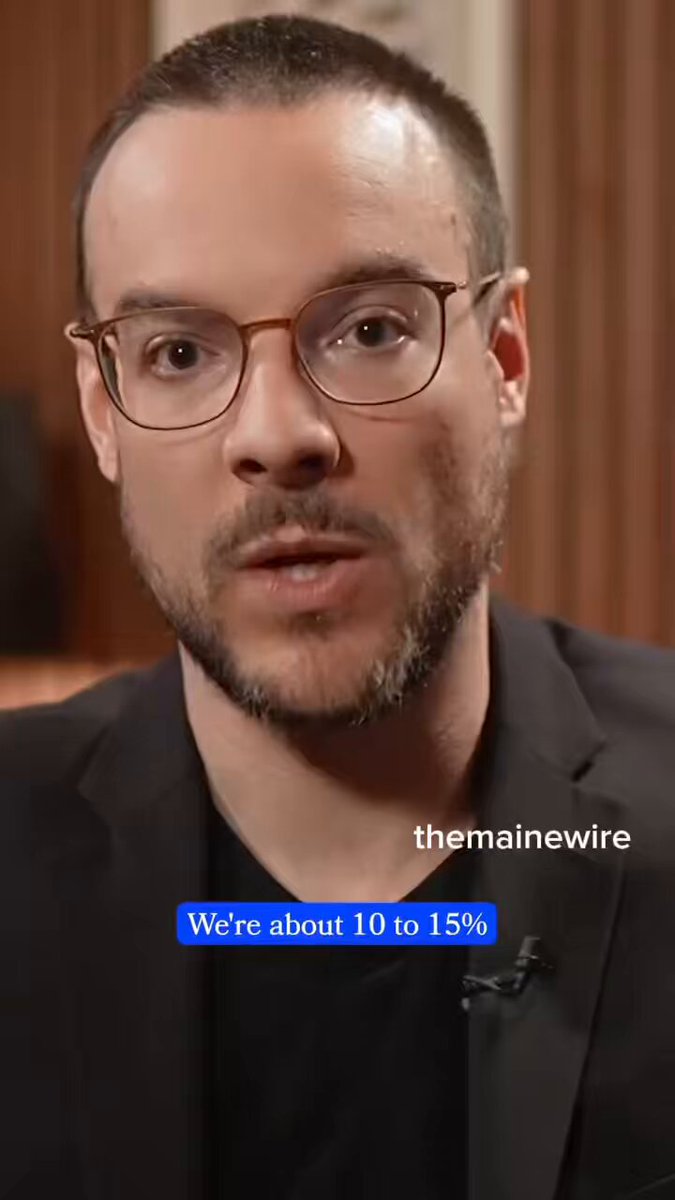
This is BIG 🚨 Documents reveal Democrats in Maine have been using USAID money to pay for their campaigns The Maine Wire “Governor Janet Mills administration has been using taxpayer dollars like the USAID Fund” “Were about 10-15% of the way through reviewing all 4,500 of these documents — The early story appears to be that the Governor Janet T. Mills administration has been using taxpayer dollars like the USAID Fund. They've been using no bid contracts to funnel money to nongovernmental organizations. And those NGOs are run by individuals who are friendly with their reelection efforts, friendly with what the administration is doing. And this money includes, by the way, federal dollars, Covid dollars, even emergency funding for Lewiston shooting response has been funneled to friendly NGOs.” More corruption out of Maine “We found that Attorney General Aaron Frey spent $60,000 on a no bid contract for soundproofing in his office in the Burton Cross office building. This was, of course, just a few months before it would emerge that he was having an affair with a subordinate. We found an $800,000 contract to the Bangor Daily News for marketing and advertising. The timing of that $800,000 payment to the Bangor Daily News is kind of interesting. October of 2022, that would have been right before the Paul LePage vs Janet T. Mills reelection fight. And then we've also found a ton of no bid contracts given to a who's who of non governmental organizations — the early story appears to be that the Mills administration has been using taxpayer dollars like the USAID Fund.”

Wall Street Apes

589,592 Aufrufe • vor 1 Jahr