Loading video...

Video Failed to Load

Go Home

Najam Sethi has little credibility left, having long blurred the line between political commentary and power brokering within Pakistan’s ruling ecosystem. It was telling that he was among the first to brand the Pahalgam massacre of 24 Hindus a false flag. He is now overreading S. Jaishankar shaking hands...

77,625 views • 6 months ago •via X (Twitter)

0 Comments

No comments available

Comments from the original post will appear here

Related Videos

A very harsh threat, made by Netanyahu toward Iran. What is behind the heightened tone? It is not only harsh, it is also unusual. The event that took place in recent months was a paralyzing fear of what is called miscalculation. They will think that we will attack first, even though that was not the intention, and then they will attack, and the entire region will be dragged into another round of confrontation. In a region where there is fear of miscalculation, you are not supposed to announce this kind of thing in the Knesset. I just want to make that clear. Yesterday, Naftali Bennett promoted his press conference on the conditions of soldiers, okay? He gets six million views because the timing looks like a countdown and he is a former prime minister, so the Iranians are in hysterics that he is actually announcing that they are going to attack. That’s the atmosphere. So when Netanyahu attacks like this and makes an unprecedented threat—not only harsh but also unusual—one can’t help but think that for Netanyahu there is a message, or something more problematic than miscalculation. And he wants to warn the Iranians. Now, what’s the issue? The issue is that if the Iranians come to the conclusion that their regime is on the verge of collapse, there is one thing that might save them. And that is an attack on Israel. Because we saw during the war what is called “rally around the flag.” Even those who were in the opposition rallied around the flag when their country was attacked. It is not only the Islamic Republic that is under attack, but also the Islamic Republic of Iran. That is essentially the issue, and that is what Netanyahu, in my opinion, is trying to stop with the threat he issued after the security discussion.

Amit Segal

41,392 views • 6 months ago

What is China's Secret and Dangerous Game? China, Pakistan, Qatar, and Turkey are collaborating to bleed India and trap America.. The Pahalgam terror attack was not just an assault on innocent civilians. It was the opening move in a larger global war. Desh Kapoor comes out with yet another powerful video, he talks about an angle that nobody is discussing and his analysis of the situation is not wrong at all. If India falls, the world order as we know it will collapse, and America will have no way to contain China’s imperial ambitions. When one initially looked at the massacre in Pahalgam, one thought it was just a terror attack. As one went deeper into the investigation and the evidence came out, it became clear that it was more than just bigotry and religious madness. When one woke up to that, the changes in the geostrategic landscape became self-evident. The Pahalgam terror attack has exposed a dangerous new dimension of asymmetric warfare facing India — the silent infiltration of Chinese-origin communication and navigation technologies into terrorist operations. Intelligence sources confirm that Pakistani-backed terrorists, particularly from Lashkar-e-Taiba (LeT) and its proxy, The Resistance Front (TRF), are now using sophisticated Chinese equipment like Ultra communication devices, Huawei satellite phones, and BeiDou satellite navigation systems. This is not just about Kashmir anymore. It’s about the future of freedom itself. Credit : Drishtikone/Desh Kapoor.

Augadh

375,392 views • 1 year ago

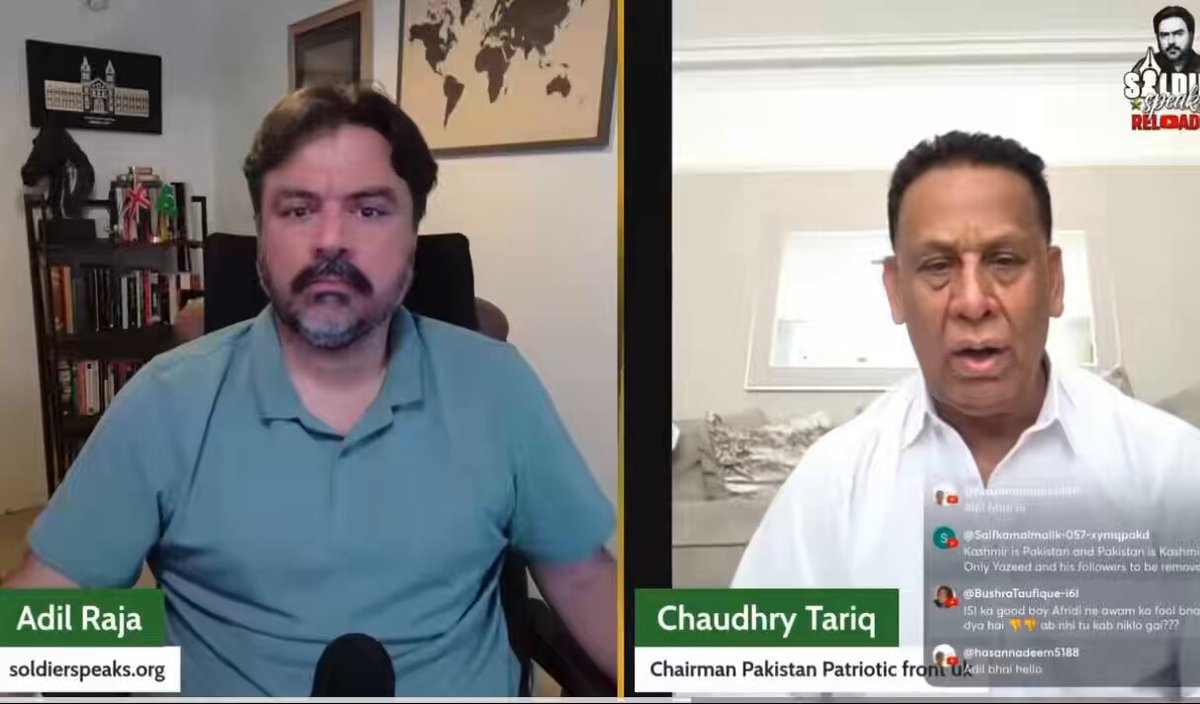
For decades, Chaudhry Tariq Mahmood, who is associated with the Pakistan Patriotic Front UK, has been a familiar face at sponsored protests outside Indian diplomatic missions in Britain. He has taken pride in participating in and helping to organise agitations attended by hundreds, often marketed as pro-Kashmir demonstrations but frequently featuring Islamists and Khalistani militants, some of whom are wanted in India over acts of terror and violence. Now, in an interview with ex-Pakistan Army Major Adil Raja, he says he regrets siding with the Pakistani military and organising events at its behest because ‘they use and then abuse people’. Adil Raja, who now lives in the United Kingdom and has become a vocal critic of Pakistan’s military, has himself faced legal and political controversies in Pakistan and abroad. According to Tariq’s account in the interview, he believes he was used by the very establishment he supported until days ago. The irony is difficult to miss. A man who spent years protesting outside the Indian High Commission in London and advancing causes aligned with Pakistan’s strategic interests now finds himself abandoned and vilified by the very same system. This is especially revealing because, in an earlier appearance on Adil Raja’s YouTube channel, Tariq repeatedly referred to Indian security forces in Jammu and Kashmir as ‘kafir forces’, language that reflects a deeply sectarian worldview and suggests that, for some activists, hostility towards India is not political but merely rooted in religious antagonism. Such rhetoric has long raised questions about whether these overseas protests, marketed as human rights or pro-Kashmir demonstrations, are, in reality, vehicles for a more divisive ideological agenda. And this is where the story becomes larger than one man. History is full of people who believed they were serving a cause, only to discover they were being used as instruments. Hatred can be a powerful mobilising force, but it is rarely a stable foundation for a life or a movement. Tariq has also been designated a terrorist by the Pakistani authorities. In the interview, he appears amused that India never did the same and takes credit for it, saying it was because he was innocent. Maybe, Tariq, you were not so innocent. India simply chose not to be as harsh on you as the people you served, even though you spent years protesting against it and vilifying its institutions. And perhaps that is the final irony of all: the people you hated so much as ‘kafirs’ were not, after all, the villains of your story.

Sonam Mahajan

20,847 views • 28 days ago

Siddhant Nagrath’s core line in that Oxford Union “India vs Pakistan” debate is that Pakistan’s structure and incentives make sustained hostility and even war with India politically and economically attractive for those who hold power there, and that this is stabilised not restrained by its nuclear posture. ​ Nagrath argues that for 77 years Pakistan’s ruling establishment has had strong incentives to maintain confrontation with India, including the possibility of military action. ​ He contends that Pakistan’s nuclear weapons do not create responsible restraint but instead enable aggressive behaviour under a protective umbrella. ​ He claims it is “politically infeasible” and “economically infeasible” for those who hold the money, power, and politics in Pakistan to avoid war, because conflict sustains their position. ​ According to him, when there is Indo‑Pak conflict, it is not Indian leaders like Narendra Modi whose electoral prospects improve most, but Pakistan’s power brokers, who gain legitimacy and resources from crisis. ​ Terrorism and security argument Nagrath asserts that Pakistan has systematically given terrorists a home, weapons, training, military aid, intelligence support, and guidance on where and how to strike India. ​ On this basis, he argues India faces a security environment in which Pakistan-backed terrorism and the threat of escalation are entrenched tools of state policy rather than aberrations. ​ Rebuttal to “nuclear stabiliser” claim Responding to the proposition’s portrayal of Pakistan as a “great nuclear” stabilising power, he suggests nuclear capability has not translated into responsible de‑escalation. ​ Instead, he frames Pakistan’s nuclear status as part of a bargaining strategy that allows it to internationalise crises and shield itself while continuing support to terror networks. Debate Context The event occurred amid prior Oxford Union controversies, including a collapsed India-Pakistan debate where Nagrath and peers like Viraansh Bhanushali participated after Indian leaders withdrew. Nagrath has debated Kashmir issues before, opposing independence motions. The video has garnered views on the Oxford Union channel, reflecting interest in India-Pakistan geopolitical discourse. Credit : Oxford Union.

Augadh

23,879 views • 6 months ago