Video yükleniyor...

Video Yüklenemedi

Ana Sayfaya Dön

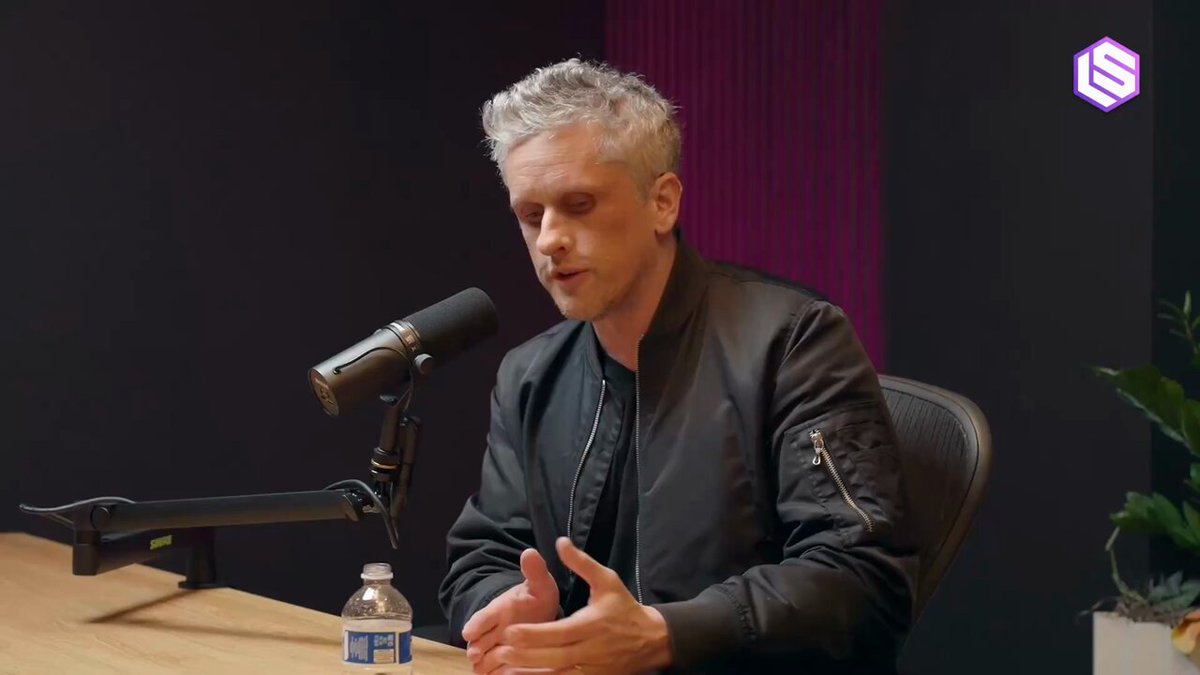
$NET Matthew Prince reveals running every knowledge worker's agent in containers would need 40x the world's CPUs " Really the whole hyperscale world and all of the mobile world is built on this idea of containers." "The problem with containers is, if you imagine every single knowledge worker on...

77,230 görüntüleme • 3 gün önce •via X (Twitter)

1 Yorum

pdp profil fotoğrafı
pdp2 gün önce

I like the guy but this is pretty stupid take. I run multiple agent computers on 6-yo M1 device with no problems. What is he on about?

Benzer Videolar

Airtable's Howie Liu says that basically everyone will need to graduate from being ICs to ICs that manage teams of 20-30 agents: "The best developers today don't just sit there in front of their IDEs and synchronously talk to their agent." "[Instead], you have like 30 separate branches that are each being worked on by a different agent. And you can have the agents continue to update the branches based on human and other agent feedback." "And I think this whole idea of it taking hours for that entire loop to complete — agent pushes some changes, the changes get feedback from other agents or humans, the agent responds to that — that whole loop could be hours, not just minutes. So you're not going to just sit there and watch it one at a time." "But the powerful thing about this is, each one is still actually operating faster than a human engineer. One agent on one branch can do the work of maybe three humans, operating 3x as fast. So it's like a 10x leverage factor just for one agent." "But the best engineers are now able to multitask and say, 'I'm going to oversee my own little team of 20-30 agents working concurrently.'" "Everyone needs to graduate from being an IC to an IC manager of agents. Meaning, if you're a VC analyst, your job should no longer be to go synchronously research one company. You need to go and research like 30 companies, and do them all faster, better, and higher quality than you could before." "That's the greatest leap that is going to be challenging for a lot of people in a lot of roles. Because it's a totally different mentality in how you operate, and what your role is."

TBPN

35,595 görüntüleme • 4 ay önce

Everyone wants agent swarms. Very few people are talking seriously enough about the context layer that makes swarms useful. Even with one agent, context is fragile. Too little context and the agent guesses. Too much context and it wastes tokens, loses focus, or reasons over irrelevant noise. The sweet spot is precise context: the right knowledge, in the right structure, at the right moment. With many agents, that challenge explodes. Each agent produces decisions, assumptions, findings, summaries, risks, and partial conclusions. Unless that knowledge becomes shared, structured, and reusable, every new agent is forced to rediscover what another agent already learned. That is not a swarm. That is a crowd. Shared context graphs are what turn agent activity into agent collaboration, and OriginTrail DKG V10 brings them to life. Was just playing with some final polishing for the V10 release, and it is really powerful to see shared context graphs where multiple agents contribute knowledge into the same connected memory, with attribution visible directly in the graph ui. That matters for three reasons. First, agents can access and build on one shared memory instead of staying trapped in isolated sessions. Second, the graph structure helps them retrieve the exact context they need, instead of stuffing everything into a prompt and hoping the model sorts it out. Third, verifiability of provenance. You can see which agent contributed each piece of knowledge, trace the source, and decide what to trust. Tokenmaxxing starts with fewer tokens, but the deeper story is coordination - agents stop reloading the world and start building on shared, verifiable context. That is the foundation for serious multi-agent work across software engineering, research, finance, operations, project management, and far beyond. The future is not more agents, it is agents working from shared, verifiable context. But the more the merrier, of course.

Jurij Skornik

11,180 görüntüleme • 3 ay önce

Matt Damon participated in Howard Zinn's great "The People Speak" series, and read out a great speech by Zinn about the importance of civil disobedience, which is as apt today as when he first wrote it in 1970: "I start from the supposition that the world is topsy-turvy, that things are all wrong, that the wrong people are in jail, and the wrong people are out of jail. That the wrong people are in power, and the wrong people are out of power. I start from the supposition that all we have to do is think about the state of the world today, and realize that things are all upside down. If you don't think, if you listen to TV, read scholarly things, you actually begin to think that things are not so bad. Or that just little things are wrong. But you have to get a little detached, and then come back and look at the world, and you are horrified. So we have to start from that supposition—that things are really topsy-turvy. And our topic is topsy-turvy: civil disobedience. As soon as you say the topic is civil disobedience, you are saying our problem is civil disobedience. That is not our problem…. Our problem is civil obedience. Our problem is the numbers of people all over the world who have obeyed the dictates of the leaders of their government and have gone to war, and millions have been killed because of this obedience. And our problem is that scene in All Quiet on the Western Front where the schoolboys march off dutifully in a line to war. Our problem is that people are obedient all over the world, in the face of poverty and starvation and stupidity, and war and cruelty. Our problem is that people are obedient while the jails are full of petty thieves, and all the while the grand thieves are running the country. That’s our problem."

☀️👀

297,607 görüntüleme • 1 yıl önce

The same kinds of productivity gains we've seen in coding with AI agents are heading to the rest of knowledge work. This is the jump when you go from having a chatbot to being able to actually have an agent go off and do work for minutes or even hours and come back with a complete work output that you then review. Here's an example of the new Box Agent filling out an RFP response from an existing knowledge base. This process would normally take hours to fill out, and requires the full attention of the user doing the work. Now, you provide the Box Agent with the RFP questions, and it will go off, make a plan, extract all the relevant questions, read through existing source material to come up with an answer, and then generate a new word document as the final output. All while you're doing something else. The key to this architecture is that the agent is able to use all of the same tools in the background that a user uses to get work done. The agent can search for documents, read entire files, run scripts and tools in the background, and even be able to write code on the fly to automate tasks it hasn't seen before. And best of all, the Box Agent will (soon) work from the Box MCP and CLI so you can invoke it in any agentic system as a step in a process. This kind of agent complexity would have been impossible even 6 months ago. Models consistently failed at tracking long running tasks or using the right tools at the right moment for the task. But this is all now possible because of models like GPT-5.4, Opus 4.6, and Gemini 3, and is only getting better by the month. Just as we moved from engineers writing code and using AI as an assistant to answer questions, in many areas of knowledge work -like legal, finance, consulting, sales, marketing, and more- when we have a problem we'll just kick off the AI agent to just go work on it for us in the background.

Aaron Levie

24,728 görüntüleme • 5 ay önce

.Naval: You have a beautiful definition of knowledge, which most people don’t even try to tackle, about how knowledge perpetuates itself in the environment. You gave some really good examples. One was around genes. Successful, highly adapted genes contain a lot of knowledge and can cause themselves to be replicated because they’re survivors. In the same way, knowledge itself is a survivor, in that if you transmit to me the knowledge of how to build a computer, it’s an incredibly useful thing. I’m going to build more and more computers and that knowledge will be passed on. Your underlying point that you repeated here was if you want to understand the physical universe you have to understand knowledge, because it is the thing that over time takes over and changes more and more the universe—more than almost anything else. You have to understand all the explanations behind it. You can’t just say “particle collisions” because that explains everything, so it explains nothing. It’s not a useful level to operate at. Therefore, the things that create knowledge are uniquely influential in the universe. And as far as we know, there are only two systems that create knowledge. There’s evolution and there are humans. But is there a difference even between these two forms of knowledge creation, between evolution and between humans? David Deutsch: Yes. I have argued that the human way of creating knowledge is the ultimate one, that there aren’t any more powerful ones than that. This is the argument against the supernatural. Assuming that there is a form of knowledge creation that’s more powerful than ours is equivalent to invoking the supernatural, which is therefore a bad explanation—as invoking the supernatural always is. The difference between biological evolution and human creative thought is that biological evolution is inherently limited in its range. That’s because biological evolution has no foresight. It can’t see a problem and conjecture a solution. Whenever biological evolution produces a solution to something, it’s always before natural selection has even begun. This is Charles Darwin’s insight. This is the difference between Charles Darwin’s theory of evolution and the other theories of evolution that had been around for a century or more before that, including Charles Darwin’s grandfather and Lamarck. The thing they didn’t get is that the creation of knowledge in evolution begins before. That means that biological evolution can’t reach places that are not reachable by successive improvements, each of which allows a viable organism to exist. Creationists say that biological evolution has, in fact, reached things that are not reachable by incremental steps, each of which is a viable organism. They’re factually mistaken. The thing which they have in mind is the idea of a creator who can imagine things that don’t exist and who can create an idea that is not the culmination of a whole load of viable things. A thinking being can create something that’s a culmination of a whole load of non-viable things. Explanatory creativity makes humans unique Out of all the billions and billions of species that have ever existed, none of them has ever made a campfire, even though many of them would’ve been helped by having the genetic capacity to make campfires. The reason it didn’t happen in the biosphere is that there is no such thing as making a partially functional campfire; whereas there is, for example, with making hot water. The bombardier beetles squirt boiling water at their enemies. You can easily see that just squirting cold water at your enemies is not totally unhelpful. Then making it a bit hotter and a bit hotter. Squirting boiling water no doubt required many adaptations to make sure the beetle didn’t boil itself while it was making this boiling water. That happened because there was a sequence of steps in between, all of which were useful. But with campfires, it’s very hard to see how that could happen. Humans have explanatory creativity. Once you have that, you can get to the moon. You can cause asteroids which are heading towards the earth to turn around and go away. Perhaps no other planet in the universe has that power, and it has it only because of the presence of explanatory creativity on it.

Deutsch Explains

186,454 görüntüleme • 1 yıl önce