Loading video...

Video Failed to Load

Go Home

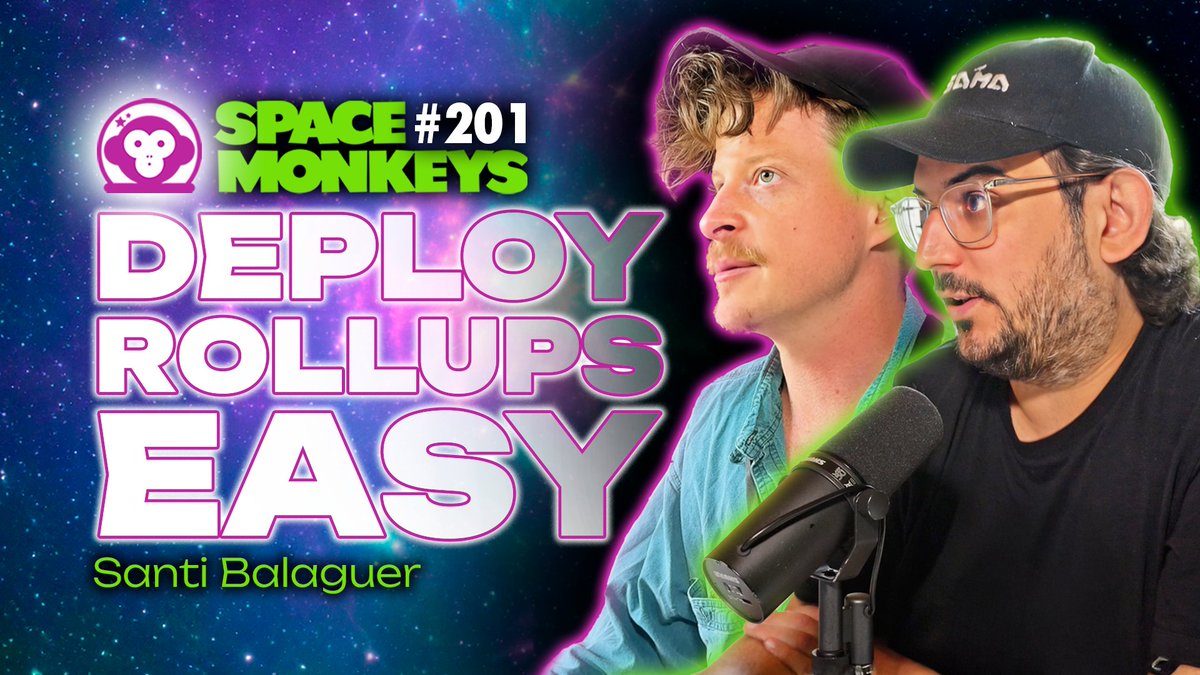
🚀 NEW EPISODE 🚀 The First 1 Gigagas/second Stack for Sovereign Rollups Friederike Ernst 🦉 chats with Hilmar | ser.eth about the limitations of Ethereum blockspace and why sovereign modular rollups are a much needed expansion to finally bring off-chain applications, on-chain. One of the most limited blockchain resources...

20,088 views • 1 year ago •via X (Twitter)

3 Comments

Epicenter Podcast's profile picture
Epicenter Podcast1 year ago

More listening options: ➡️ Streaming platforms: ➡️ Youtube: Thanks to our sponsors this week: 1️⃣ @GnosisDAO: builds decentralized infrastructure for Ethereum ecosystem, since 2015 (e.g. @safe, @gnosischain, etc.). This year marks the launch of @gnosispay, the world's first Decentralized Payment Network. 2️⃣ @ChorusOne: one of the largest node operators worldwide, supporting more than 100,000 delegators, across 45 networks, providing institutional grade security. The recently launched OPUS allows staking up to 8,000 ETH in a single transaction.

zimmah.ron 💎🙌's profile picture
zimmah.ron 💎🙌1 year ago

@tw_tter @hilmarxo 👋 🆕 🪙 ➡️ 🟥🟪🟦🟩🟨🟧 📈 🟥🟩 🔀 🐶😹🐸💩🤖 ⛪💪🧑‍🤝‍🧑🧑‍🤝‍🧑🧑‍🤝‍🧑🧑‍🤝‍🧑🧑‍🤝‍🧑🧑‍🤝‍🧑🧑‍🤝‍🧑🧑‍🤝‍🧑🧑‍🤝‍🧑🧑‍🤝‍🧑🧑‍🤝‍🧑🧑‍🤝‍🧑 🤙🙏 🟥🟪🟦🟩🟨🟧 (🟥🟩)

Divblaze.eth's profile picture
Divblaze.eth1 year ago

@tw_tter @hilmarxo Talking of Cross-Chain solutions talk about @Official_DCDAO now They have the best solution on Cross-Chain Smart contract and message port network

Related Videos

Just finished an absolute monster of a podcast with Justin Drake, and it’s packed with brain-melting insights on the future of Ethereum. Here are the juiciest takeaways from Part I 👇 Ethereum’s future could turn the L1 into a rollup itself and making it the best type of rollup. Justin lays out how the L1, L2s, and new designs like Beamchain, native rollups, and based sequencing all come together into a unified vision for Ethereum as the credibly neutral internet of finance. What’s Broken Today • L2s are siloed — synchronous composability is dead. • Most rely on centralized sequencers, multisigs & slow exit bridges. • L2-native assets break Ethereum’s trustless bridge model. • Governance delays, security councils, & EVM reimplementation = attack surfaces. The Fix: Ethereum-native Infrastructure • Based Rollups: Use Ethereum L1 validators as the sequencer. Removes centralization risk, restores censorship resistance. • Native Rollups: No more reimplementing the EVM. No more Security Council multisigs. They inherit Ethereum’s execution layer by design. •Preconfirmations: Users get fast UX (e.g., instant trading feedback) via ETH-backed inclusion guarantees from L1 validators, with slashing if they lie. • Real-Time ZK Proofs: Slot-by-slot proving is here. ZK-enabled rollups with instant finality are becoming possible. To get there, Ethereum is moving toward real-time, slot-by-slot proving using ZK SNARKs. This enables constant-time verification and removes the need for validators to re-execute blocks. Native rollups use a new EXECUTE precompile to introspect and reuse Ethereum’s state transition function. There is no EVM emulation, no governance lag, and no reliance on Security Councils. Preconfirmations offer ETH-backed execution guarantees per slot, priced to offset MEV opportunity loss, while based rollups decentralize sequencing by aligning with Ethereum’s validator set. Beamchain pushes this vision further: a clean-slate Ethereum L1 design that is post-quantum secure, radically simplified (validators could run on a Raspberry Pi), and ossified through optimality. It proposes gigagas/s throughput via ZK proofs, validator statelessness, and Attester-Proposer-Separation (APS) to maximize decentralization and censorship resistance, allowing Ethereum L1 to scale as a high-performance rollup itself. If you're building on Ethereum or betting on its future, this convo is mandatory listening. To be continued in Part II....

Luis

17,653 views • 1 year ago

🚀 NEW EPISODE 🚀 The Infinite Garden: Humanity’s Shared World Computer Friederike Ernst 🦉 chats with hww.eth | Hsiao-Wei Wang & Tomasz K. Stańczak, co-executive directors of Ethereum Foundation, about Ethereum.org's enduring commitment to its foundational principles and the pressures it faces in a rapidly evolving blockchain landscape. 💭As society evolves, so do its values and principles, but is that desirable for technology that seeks to build the most reliable, trustless and censorship-resistant global settlement layer? Ever since the surge in popularity of Solana due to its inflow of retail capital in the memecoin gold rush, Ethereum.org became even more criticized for sticking true to its core values despite the completely divergent demands of market participants. Moreover, the rollup centric roadmap seemed to further silo attention and cause liquidity fragmentation, driving away value from Ethereum mainnet. Ethereum Foundation's response, under its new leadership, is to double down on scaling both L1 mainnet and data availability through blobs, while improving UX and interoperability across L2s and the application layer. This suggests a pragmatic shift to address market demands without abandoning core values. Don't forget to RT & follow Epicenter Podcast! Topics discussed in this episode: 0:00 - Introduction 4:09 - Hsiao-Wei’s & Tomasz’ backgrounds 7:08 - How they became co-executive directors of Ethereum Foundation 11:39 - Ethereum Foundation’s role moving forward 20:31 - Decision making in Ethereum Foundation 24:08 - Shaping Ethereum’s narrative 30:15 - The layer 2 landscape 37:58 - Scaling Ethereum as the global settlement layer 44:41 - Sharding 47:56 - Rollup scalability & their trade-offs 56:36 - What values drive adoption 1:01:00 - L2 interoperability 1:06:10 - Future goals

Epicenter Podcast

15,803 views • 1 year ago