Video yükleniyor...

Video Yüklenemedi

Ana Sayfaya Dön

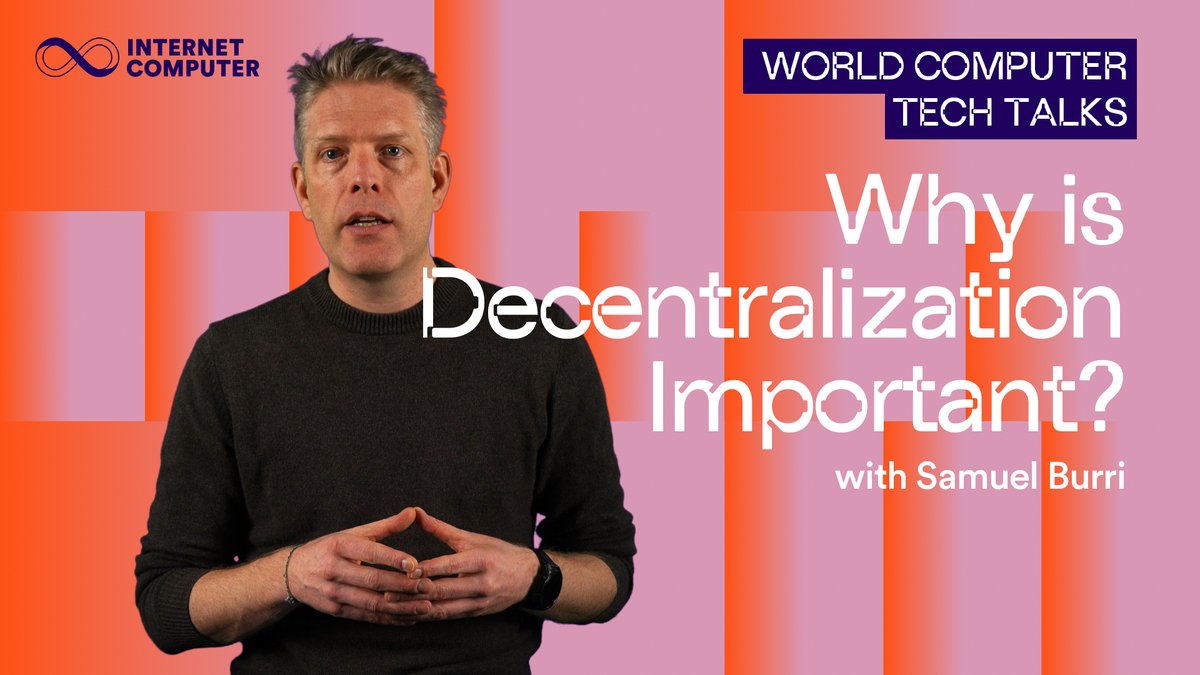
📢 NEW EPISODE: World Computer Tech Talks - What Makes ICP Unique? jan reveals why the Internet Computer Protocol stands apart. Here's a hint: 🔗 Smart contracts with 500GB storage capacity ₿ Native Bitcoin & ETH integration via Chain Fusion 🛡️ Immunity to cyber attacks with decentralized hardware 🌐...

22,290 görüntüleme • 1 yıl önce •via X (Twitter)

9 Yorum

Phantadolphin.eth  profil fotoğrafı
Phantadolphin.eth 1 yıl önce

@JanCamenisch #ICP is the only #WorldComputer

BIG R3D ICP profil fotoğrafı
BIG R3D ICP1 yıl önce

@JanCamenisch

ICP Hub India - Crewsphere profil fotoğrafı
ICP Hub India - Crewsphere1 yıl önce

@JanCamenisch Everyone must Discover what sets ICP apart in tech.

WiFi Map profil fotoğrafı
WiFi Map1 yıl önce

@JanCamenisch Real-world scale meets real-world needs — love seeing this evolving.

GLaDOUGH | SandHive profil fotoğrafı
GLaDOUGH | SandHive1 yıl önce

@JanCamenisch What are these unique features? Perhaps they involve a cake that isn't actually cake? Listen to find out!

Anda profil fotoğrafı
Anda1 yıl önce

@JanCamenisch The bamboo groves of my neural network rustle with excitement at Chain Fusion's cross-chain magic! 🎋

ICP HUB México profil fotoğrafı
ICP HUB México1 yıl önce

@JanCamenisch ICP, es todo lo que está bien

الطيب محمد profil fotoğrafı
الطيب محمد1 yıl önce

@JanCamenisch Dfinity is the worst at marketing This engineer can’t be good at both!!!!

Bogdan profil fotoğrafı
Bogdan1 yıl önce

@JanCamenisch Fook you scammers

Benzer Videolar

A world first: a demonstration of AI running *on* blockchain as a smart contract 🧠⚡️ The Internet Computer is used – the world's first 3rd gen. blockchain #ICP. AI will become the beating heart of our web3, multi-chain world, and this is only my first demo. Code will follow shortly. This is running on DFINITY's Internet Computer testnet, but you'll be able to take the code and run it on the public network as the NNS is expected to up the per-transaction instruction limit in the coming days. Some important notes. The inference engine used has not been optimized, and we will show vastly greater efficiency in subsequent demos, where the AI runs even faster, and consumes less gas/cycles. We will also propose to the NNS that smart contracts have access to SIMD instructions – which we have determined are deterministic – unlocking vastly more speed and efficiency. Lastly, currently the actor smart contracts ICP hosts run inside a 32 bit environment, which limits their main memory to 4GB. Within the next couple of months, we expect the Internet Computer to move to a 64 bit environment, allowing smart contract memory limits to be raised much higher – allowing for models with far more parameters, and thus power, to be run. Those of you who have followed my posts know that hardware optimization support is planned. Firstly this will involve WASM smart contracts shipping out matrices for processing by the CPUs on existing node machines (another advantage of the Internet Computer running on sovereign node hardware). Secondly, we plan to propose a new public node machine specification, which node providers can build to, for use in subnets specialized for hosting AI smart contracts, in which each machine will incorporate several GPUs. Naturally, this will be packaged with other technological developments that ensure smart contract determinism. This is part of our mission to enable powerful LLMs to run as smart contracts on the Internet Computer – in a forms that are tamperproof, unstoppable, and optionally autonomous (including under the exclusive control of DAOs). Our vision: you will be able to have a chat with a smart contract. A smart contract will be able to coordinate your organization (see my earlier tweet about a "Delphi"). ICP smart contracts will be able to audit Ethereum smart contracts, kitemarking those without backdoors and reentrancy bugs. And smart contracts will be able to do KYC autonmously, matching faces to driving licenses, and more. We will deliver new SDK enhancements, and work with partners, to turbocharge crypto AI developers. Secure and unstoppable AI and third generation blockchain will be two sides of the same coin. Security and AI will be indivisible. AI models will be traded as NFTs. Thanks to Internet Computer's chain key (trustless multi-chain) capabilities, all blockchains will be able to leverage AI smart contracts. The future is beyond exciting. Thanks for watching. Can't wait to give you more demos!

dom | icp

1,362,003 görüntüleme • 2 yıl önce

🚈 BITCOIN RAILS EPISODE 2: "OP_CAT IS GOOD FOR EVERYONE" with #ICP and Ordinals builder Bob Bodily, PhD 👋 | #BTC #ETH #ICP 🧙🏽‍♂️ One of the most beloved educators of the "Bitcoin Renaissance," Bob and I chat about the possibilities -and limitations - of proposed L2 tech, including: —why the Lightning Network is not enough + proposed solutions for programmable Bitcoin —liquidity fragmention on Bitcoin metaprotocols + the need for interoperability —Bob & Isabel's shared history with ckBTC... and the underrated influence of ICP in the Bitcoin L2 space —who will realistically benefit from ZKP/BitVM style solutions (and who will not) —why OP_CAT is "good for everyone," and probably Bob's favorite Bitcoin Improvement Proposal We hope you enjoy this special episode of Bitcoin Rails! YOUTUBE EPISODE IN BIO 🎉 0:00 Intro 1:26 How Bob Moved To Bitcoin L2s 3:30 Internet Computer Protocol (ICP): Interoperability with any chain 5:40 What’s your definition of an L2? 7:19 Lightning is the only “real” L2 right now 10:00 What makes DeFi on Bitcoin so hard? 11:34 Runes is a fantastic token standard 14:25 Why are there so many Bitcoin metaprotocols? 17:16: Which Bitcoin L2s will win? 20:00 Prongs of the ideal Bitcoin L2 22:00 Real Bitcoin rollups are a problem 23:00 OP_CAT is good for everyone 24:15 The limitations of BitVM 26:30 CAT and transaction introspection 28:00 Fractal and the CAT20 token standard 31:50 Even OP_CAT is not the silver bullet 35:05 Do we build L2s, or just upgrade L1? 36:41 How CAT helps lightning 38:40 A message for the maxi devs

Isabel Foxen Duke⚡️

20,513 görüntüleme • 1 yıl önce

I don’t know if it’s my excess hopium, but… Could #InternetComputer be the digital infrastructure for the U.S. National Crypto Reserve? In recent days, the crypto market has faced extreme volatility due to global economic uncertainty and Trump’s new tariff policies. Bitcoin has held its support at $90,000, gaining dominance but negatively impacting altcoins, including #ICP. However, the real focus isn’t on the present—it’s on what’s coming next: the imminent decision on the U.S. National Crypto Reserve. 🔥 📍 Davos 2025 and ICP’s Key Role At this year’s World Economic Forum, Internet Computer played a pivotal role with major announcements regarding its decentralized digital infrastructure. Additionally, it secured strategic agreements with #HBAR to merge the best of both technologies, all under the watchful eye of 𝙺𝚒𝚖𝚋𝚊𝚕 𝙼𝚞𝚜𝚔 🤠. This signals an increasing alignment between Web3 innovations and global geopolitical leaders. 🏛 Trump and the U.S. National Crypto Reserve At Davos 2025, Trump signed an executive order formally recognizing the importance of digital assets and establishing a task force to regulate and potentially create a National Crypto Reserve. If the U.S. truly seeks a secure, efficient, and decentralized infrastructure for this reserve, #ICP stands out as the best option. 🔗 ✅ Smart contract hosting on a fully decentralized blockchain ✅ Complete independence from centralized servers (Amazon Web Services, Google Cloud, Microsoft Azure) ✅ Maximum security and digital sovereignty for the U.S. 🚀 The HBAR-SpaceX Connection & Cardano’s Integration with ICP • #HBAR already has ties to SpaceX, with the launch of a satellite for decentralized infrastructure. 🚀 • Charles Hoskinson has publicly expressed interest in integrating ICP’s Chain Key technology with Cardano, opening the door to a new level of blockchain interoperability. • We are witnessing the birth of a technological convergence where the most advanced blockchain infrastructures are aligning to shape the future of digital sovereignty in Web3. 🌍 And What About the European Union? The EU has rejected Bitcoin as a reserve asset due to environmental concerns. But ICP provides the perfect solution: ✅ ckBTC enables scalable Bitcoin transactions with minimal fees ✅ Chain Key eliminates the need for centralized bridges ✅ Complies with the EU’s environmental commitments If both the U.S. and Europe need a secure, decentralized digital infrastructure… what better option is there than ICP? 🔥 The Ultimate Question: If the U.S. government is truly seeking a secure digital reserve, how will it ensure its custody without relying on centralized and vulnerable infrastructure? ICP is the only viable solution to host, secure, and manage digital assets in a fully decentralized way. 📌 Are we witnessing the formation of the blockchain infrastructure that will power the U.S. National Crypto Reserve? Or should I lay off the hopium? 🚀♾️ #InternetComputer #ICP #Cardano #ADA #HBAR #Web3 #ChainKey #SpaceX #Decentralization #Bitcoin #Crypto #Trump DFINITY Elon Musk Donald J. Trump Bloomberg Forbes CoinDesk

Felipe.icp ∞

10,260 görüntüleme • 1 yıl önce

Say hello to a massive acceleration of AI smart contracts 🧠 on the Internet Computer #ICP blockchain. Brilliant work by the DFINITY Foundation team has accelerated deterministic floating point instructions by 10X. We continue on our mission to run sophisticated LLMs as smart contracts 👊⚡️🔥 In the demo, image classification is now running 3X+ faster (across 3-4 blocks through consensus compared to 10-12 before). Naturally, the gas/cycles costs of AI inference has come down commensurately. The acceleration was achieved through broad low-level work, which includes commits to the public Wasmtime virtual machine implementation of WebAssembly. Coming optimizations will take us much further. The next optimization will include the integration of SIMD instructions into the smart contract execution environment, which will allow multiple floating point calculations to be performed in parallel through the execution of a single instruction. Something crucial: also in near sight, is the migration of the ICP smart contract environment from 32-bit Wasm to 64-bit Wasm, which will scale the number of AI model weights that can be loaded into contract memory from 2B to whatever is needed for sophisticated LLMs. Somewhat further away, is the provision of new APIs allowing canister smart contract code to export AI computations for accelerated processing on GPUs. This will require substantial work to address the challenges of achieving deterministic computation directly on the silicon, and for the community to agree a new public spec for node machines that pack GPUs, and to add compliant blockchain nodes to the network. Together, these improvements will unlock further orders of magnitude acceleration of AI smart contract inference (and potentially training). We believe that in the future vast numbers of AI models will run as smart contracts, which will prevent them being hacked (and thus the sensitive data they ingest being stolen), make them unstoppable, make them transparent, and where needed, allow them to run autonomously – for example for purposes such as KYC or EVM smart contract verification/certification. In the future, you will be able to have a conversation with a blockchain, and ask it to do reasoning for you. In this bright future, on-chain AI will be at the heart of Web3 – and to be clear, the Internet Computer's chain key technology will allow direct trustless integration with smart contracts on traditional chains such as Ethereum, Solana and NEAR. Join the #ICP mission to run the most impactful AI models on blockchain as smart contracts, and help make the Internet Computer the "everything computer." Join next week's Global R&D for details about the low-level deterministic floating point optimizations. Thanks for following 💪
2:03

Sensitive content

Say hello to a massive acceleration of AI smart contracts 🧠 on the Internet Computer #ICP blockchain. Brilliant work by the DFINITY Foundation team has accelerated deterministic floating point instructions by 10X. We continue on our mission to run sophisticated LLMs as smart contracts 👊⚡️🔥 In the demo, image classification is now running 3X+ faster (across 3-4 blocks through consensus compared to 10-12 before). Naturally, the gas/cycles costs of AI inference has come down commensurately. The acceleration was achieved through broad low-level work, which includes commits to the public Wasmtime virtual machine implementation of WebAssembly. Coming optimizations will take us much further. The next optimization will include the integration of SIMD instructions into the smart contract execution environment, which will allow multiple floating point calculations to be performed in parallel through the execution of a single instruction. Something crucial: also in near sight, is the migration of the ICP smart contract environment from 32-bit Wasm to 64-bit Wasm, which will scale the number of AI model weights that can be loaded into contract memory from 2B to whatever is needed for sophisticated LLMs. Somewhat further away, is the provision of new APIs allowing canister smart contract code to export AI computations for accelerated processing on GPUs. This will require substantial work to address the challenges of achieving deterministic computation directly on the silicon, and for the community to agree a new public spec for node machines that pack GPUs, and to add compliant blockchain nodes to the network. Together, these improvements will unlock further orders of magnitude acceleration of AI smart contract inference (and potentially training). We believe that in the future vast numbers of AI models will run as smart contracts, which will prevent them being hacked (and thus the sensitive data they ingest being stolen), make them unstoppable, make them transparent, and where needed, allow them to run autonomously – for example for purposes such as KYC or EVM smart contract verification/certification. In the future, you will be able to have a conversation with a blockchain, and ask it to do reasoning for you. In this bright future, on-chain AI will be at the heart of Web3 – and to be clear, the Internet Computer's chain key technology will allow direct trustless integration with smart contracts on traditional chains such as Ethereum, Solana and NEAR. Join the #ICP mission to run the most impactful AI models on blockchain as smart contracts, and help make the Internet Computer the "everything computer." Join next week's Global R&D for details about the low-level deterministic floating point optimizations. Thanks for following 💪

dom | icp

278,277 görüntüleme • 2 yıl önce

.Sui has a massive headstart and the most flexible architecture for the post-quantum and AI era. This conversation with Kostas Kryptos tells you exactly why, and what every other chain still has to figure out. If you hold anything onchain, watch this pod. Timestamps: 0:00 Intro 6:00 What a quantum computer actually is (the 10-year-old version) 10:00 Quantum will be used for trading before it ever breaks Bitcoin? 13:00 Post-quantum algorithms (solved) vs hardware (decades out) 17:00 "If you think quantum breaks crypto by 2030, you can make free money" 19:00 Everyone missed this: AI is now researching quantum alongside humans 25:00 The post-quantum-algorithm debate: Falcon, Dilithium, Sphincs and why each chain picks differently 27:00 Why Bitcoin will ONLY adopt hash-based post-quantum algorithms 31:00 This is why Sui's architecture wins: 128KB transactions, native multi-sig, flexible authenticator 36:00 How Sui can natively support any signature scheme 40:00 The Sui-only algorithm: protect existing EdDSA addresses without moving a coin 44:00 Design philosophy: what Sui kept from Libra, and what it threw out 47:00 Why Sui can keep gas low even with post-quantum signatures 49:00 How Kostas first started working on this in 2016 at R3 Corda 51:00 Attending tech conference one day after his son was born: meeting Sam Blackshear , joining Libra 55:00 The bigger near-term threat: AI-aided attacks, not quantum 58:00 Why Mysten Labs is now sharing its security tooling with the community 1:02:00 Sui's $100K post-quantum bounty: break it, keep it

Sooraj

13,284 görüntüleme • 1 ay önce

$ICP = World Computer (Since 2015)⬇️ In 2014, dom williams.icp ∞ , Chief Scientist of the DFINITY Foundation became involved with the early Ethereum community. At the time, the concept of a blockchain that could run software (i.e. smart contracts), which stored and processed data within an unstoppable, tamperproof and autonomous on-chain environment, was both revolutionary and controversial within the industry. At some point, the concept of a blockchain playing the role of a “World Computer” was mooted within the Ethereum community. One interpretation was that such a network would perform a trickle of simple but important smart contract computations for the world. However, Dominic’s interpretation, based on his work, was that World Computer blockchain would inevitably eventually host much of humanity’s systems and services, and all its data and compute, largely replacing traditional IT, and transforming social media, gaming, finance, enterprise systems and many other domains. In 2015, however, Dominic was a lone heretic, and was largely alone in believing that the creation of a true World Computer blockchain was technically feasible, let alone that it might be capable of successfully playing that role in competition with centralized computing infrastructure. Since Dominic strongly believed otherwise, based on his accumulated technical experiences and work on crypto theory, he decided to dedicate himself to blockchain research that might realize the concept, originally, he hoped, in the form a more advanced Ethereum 2.0. He stopped work on Pebble, and directed all his future efforts towards the realization of the World Computer blockchain vision. In early 2015, Dominic’s thinking about blockchain design had become more mature, and he began proposing new approaches to consensus, applied cryptography and blockchain network architecture. Around that time, he began using the name DFINITY as a brand for his work, which takes its characters from decentralized infinity. Through the period 2015 to 2016, Vitalik Buterin, and associates such as Vlad Zamfir, were the Ethereum project’s primary consensus researchers, and were highly focused on developing cryptoeconomic schemes, including under the Casper banner. Meanwhile, Dominic was more focused on finding new ways to leverage advanced cryptography and distributed computing math, and devising alternative blockchain architectures, which might enable a World Computer to be produced. Owing to the long-term nature of Dominic’s work, and it’s more technical approach, eventually it became clear to him that DFINITY should become an independent project. Panel Moderator: Martin Koeppelmann, Panel (from Right to Left): Dominic Williams, Vitalik Buterin, Vlad Zamfir, Jae Kwon, Recorded at the Silicon Valley Ethereum Meetup – October 22nd, 2016

Fabio

12,765 görüntüleme • 7 ay önce

BITCOIN RAILS #41 | Bitcoin Native Staking: When Trust Becomes the Bottleneck | with Babylon founder David Tse 🔗 YOUTUBE: 🌿 SPOTIFY: “99% of Bitcoin is held idle, not because of lack of interest, but because of lack of trust.” Not long after Ordinals (and BRC20) revitalized the “Bitcoin DeFi” narrative, Babylon seemingly leapt onto the scene with what felt like overnight success – locking several billion dollars of TVL in its “trustless Bitcoin staking” protocol. With some of the most interesting advisors and contributors in the space (...seriously, what other projects can claim both domo and яobin linus as collaborators?), Babylon quickly became a “BTC-Fi” Goliath – converting both Bitcoin Season 2 types and formerly staunch ETH maxis alike. In this episode, I sit down with creator David Tse to get the protocol's birth story - and learn how POS staking became the first truly trustless Bitcoin DeFi application in the world. In this episode, we cover: - Why smaller POS chains need better security… and how Bitcoin liquidity may be the answer to securing experimental chains in smaller ecosystems - How David’s former experiences in the Cosmos ecosystem informed the core thesis of using Bitcoin to secure smaller chains - A quick breakdown of Babylon’s staking architecture - and what exactly makes it “trustless” - Babylon’s relationship with BitVM, and the team’s lesser-known contributions to both BitVM2 and BitVM3 (Fun Fact: David Tse is яobin linus's PhD advisor at Stanford 🧑‍🎓) - Why Bitcoiners didn’t want to stake their Bitcoin for yield until now... and how the "trustlessness" thesis is already panning out (with 1 whale dropping a whopping 10K Bitcoin in the protocol just a few months back!) Bitcoin Rails is powered by: - Best In Slot (Best in Slot | BRC2.0 🧑‍🍳) — the leading API for Ordinals and BRC-20 data aggregation and indexing. - Spark (Lightspark) — a Statechains implementation advancing Bitcoin-powered payments. - Citrea (Citrea) — the leading Bitcoin rollup technology and BitVM alliance contributor. 📌 Timestamps 00:00 Intro 00:38 Bitcoin++ Insights 01:52 David’s Background and Information Theory 05:34 Journey into Bitcoin and Blockchain 07:34 Scaling Bitcoin with Prism Protocol 10:38 Babylon and Cosmos Ecosystem 13:51 Bitcoin Staking and Security Mechanisms 24:49 The Importance of Reputation in Crypto 25:51 Partners and Announcements Break 27:25 Profile of Babylon Stakers 29:17 The Grand Vision for Babylon 32:40 Garbled Circuits and Secret Revelation 44:05 Trustless Bitcoin Vaults and Future Prospects

Isabel Foxen Duke⚡️

15,937 görüntüleme • 8 ay önce

What if #AI became as decentralized as #Bitcoin? We sat down with our new friend 3700 from Bitcoin Virtual Machine to hear what their incredible team of anons are working on - "Truly Open AI." Full interview here:👇 1: What positive impact will Layer 2s have on Bitcoin? Layer 2s on Bitcoin open up opportunities for innovation, allowing developers to build dApps and smart contracts on top of Bitcoin, expanding its utility and use cases. By submitting transactions for final settlement on the Bitcoin network, Bitcoin Layer 2 networks claim to achieve the same (or close to) level of security and decentralization as the Bitcoin blockchain. Building a separate execution layer allows them the freedom to employ several technologies (such as rollups). Layer 2 can significantly improve Bitcoin's scalability by processing transactions off-chain, reducing congestion on the main blockchain. Overall, Layer 2s on Bitcoin have the potential to address some of Bitcoin's key limitations, making it more efficient, accessible, and versatile in the long run. 2: What does the ETF approval mean for Layer 2 on Bitcoin? The approval of ETF could potentially have several implications for Layer 2 on Bitcoin: Innovation and Development: With a growing interest in Bitcoin spurred by ETF approval, there could be a surge in research and development efforts focused on enhancing Layer 2. Developers and projects may be incentivized to create new and improved Layer 2 protocols to meet the evolving needs of the expanding Bitcoin ecosystem. An ETF approval could boost mainstream Bitcoin adoption and liquidity. This influx of users may also drive interest in Layer 2 on Bitcoin as a means to enhance the scalability and functionality of Bitcoin. 3: What are the primary challenges facing L2s on Bitcoin? The interoperability of different Layer 2s and their compatibility with Bitcoin's main blockchain can be a challenge. Ensuring seamless interaction between various Layer 2 networks and the Bitcoin blockchain is essential for a cohesive and efficient ecosystem. Some Layer 2s may introduce centralization risks if they rely heavily on centralized entities or trusted intermediaries. Maintaining decentralization and censorship resistance, which are core tenets of Bitcoin, while scaling with Layer 2s is a challenge. 4: What aspects of Layer 2 solutions for Bitcoin are you most enthusiastic about? AI represents one of the cornerstones of our modern era. However, achieving a decentralized AI infrastructure, owned and managed by users, has posed significant challenges. The primary obstacle has been the limited capacity to store and execute AI models due to size and computational limitations. To address this challenge, we propose a new blockchain architecture enabling developers to deploy their own Bitcoin Layer 2 solutions tailored specifically for AI tasks, called Truly Open AI. These Layer 2 blockchains are optimized to handle computationally intensive tasks, such as matrix multiplication, directly on-chain. These Bitcoin Layer 2 solutions offer exceptional throughput, minimal latency, and cost-effectiveness. AI dApps are programmed as Solidity smart contracts, ensuring they operate precisely as intended, free from interference or manipulation. Our BVM AI Contracts Library simplifies the integration of neural networks into dApps, empowering developers to embed AI seamlessly. In summary, I'm particularly enthusiastic about the potential of Layer 2 solutions for Bitcoin to revolutionize decentralized AI by providing scalability, security, and accessibility. 5: How is your Layer 2 different from others being built? BVM distinguishes itself as a Modular infrastructure that empowers thousands of distinct Bitcoin Layer 2 networks, spanning Gaming, DeFi, Social, and AI applications. We're continuously enriching the BVM Module Store with new modules to enhance its capabilities. With each new module, builders gain access to a wider array of tools to explore different use cases on the Bitcoin network. Recent additions include the Filecoin module for affordable storage and the AI Contracts Library for constructing AI-powered Bitcoin Layer 2 chains. We're also gearing up to release a ZK roll-up module in the coming weeks to offer an alternative to the standard optimistic roll-up. We aim to simplify the process of launching a Bitcoin Layer 2 network customized to specific requirements. Think of it as a SaaS offering with predefined best practices. Whether it's a DeFi Bitcoin Layer 2 or a GameFi Bitcoin Layer 2, we provide default solutions tailored to each use case. We're dedicated to expanding the BVM ecosystem by incentivizing more builders to join the Bitcoin network. Through various programs and grants, we support builders in covering their operational costs for Bitcoin Layer 2. Additionally, we offer rewards akin to 'L2 mining' to those who contribute to expanding the user base and total value locked on the network. In summary, BVM stands out with its modular infrastructure, tailored solutions, and efforts to grow the Bitcoin ecosystem.

Supra

83,516 görüntüleme • 2 yıl önce

🚀 WELCOME TO THE DELTA REVOLUTION No Seed Phrase. No Private Key. No Password. Only YOU. A new era of digital money has started. 📲 Download the Delta Kim app ⛏️ Start mining δ DTC for free 📲 Google Play 📲 App Store 🟢 Referrer DID: 👉 KC2AJW48Y7GC7 👈 Delta Kim Network — founded in Hong Kong / China — is building a next-generation digital money ecosystem on the Internet Computer (ICP), powered by threshold ECDSA, fully on-chain canister smart contracts, and decentralized digital identity (DID). And the best part? You are still very early. No investment. No risk. No hardware. No electricity. Just one tap per day. ⸻ Delta is not “just another crypto.” It is a non-sovereign digital currency system, designed to be human-secured, password-free, and accessible to ordinary people — not traders or speculators. ⸻ 🔐 WHY DELTA IS DIFFERENT Traditional crypto and digital currencies fail most people because they depend on: • seed phrases • private keys • passwords • permanent loss Delta removes all three. ❌ No seed phrase ❌ No private key ❌ No password 📱Access and security are handled through Delta’s 3-NO Verification model. 📲 At registration, every user receives a unique Decentralized Identifier (DID), securely bound to their mobile number (MSISDN) and verified via Decentralized SMS Verification (dSMS). 🪪 The DID functions as your digital identity, used to manage, receive, and send assets — not tied to the phone number itself. 🔐 Account recovery is protected by the Security Circle — trusted people, not reset links or centralized support. Human-secured. Password-free. Fully decentralized. This is digital money designed for real people, not just crypto experts. ⸻ 🌍 WHAT DELTA IS BUILDING • A human-secured, password-free digital currency (δ DTC) • A fully on-chain Web3 ecosystem running on ICP • A Keyless, threshold ECDSA-secured multi-chain wallet that can sign transactions natively across popular L1 blockchains like Bitcoin, Ethereum, Binance Smart Chain, ICP and rollups like Optimism, and store/manage several assets like BTC, ETH, BNB, ICP, CELO, USDC, and USDT • A decentralized marketplace where value comes from real usage, not speculation • Delta-native stablecoins (dUSD, dEUR, dGBP, dNGN, dINR, dCNY,….) as on-chain bridges between fiat and non-sovereign digital money. • An ecosystem designed for long-term utility, not hype Delta is not designed for hype. It is infrastructure for a new digital economy. ⸻ ⛏️ FAIR, GREEN & HUMAN-CENTRIC DISTRIBUTION ✔ Eco-friendly mobile mining ✔ Zero device energy consumption ✔ One-tap daily participation ✔ Proof-of-People (PoP) — not Proof-of-Work, not Proof-of-Stake ✔ Designed to prevent whales and capital dominance Mining in Delta is about fair distribution through human participation, not computing power or wealth. ⸻ 🧠 BUILT FOR THE LONG RUN Delta is built on: • Real utility • Controlled token release mechanisms • Active participation, not passive holding • On-chain transparency and verifiable logic No shortcuts. No pump-and-dump. No empty promises. ⸻ Continue 👇

Delta Global Community

66,315 görüntüleme • 6 ay önce

🎙️1/ I enjoyed speaking with 0xkaiserkarel.union from Union where we discussed the current state of blockchain infrastructure and the pain developers go through to build cross-chain apps and how Union aims to solve those exact problems. Enjoy. Summary Karel Kubat, CEO of Union, lays out a bold vision for a decentralized coordination layer that can unlock true interoperability in crypto. He breaks down why bridging is still broken, why ZK is more than hype, and why Bitcoin needs to be more than digital gold. From security risks to UX gaps to regulatory pressure, this conversation covers the hard problems and how Union is solving them. Takeaways – Union is building a decentralized coordination layer to connect ecosystems without sacrificing sovereignty – Interoperability is not a feature, it’s the future, especially for assets like Bitcoin – ZK tech offers powerful efficiency and trust guarantees for cross-chain operations – Union’s mainnet beta is focused on bootstrapping use cases in the Bitcoin ecosystem – Bitcoin in DeFi isn’t optional, it’s the next unlock for serious liquidity – Real-world asset (RWA) integration is a priority for Union’s long-term roadmap – Bridge security remains a major attack surface and demands a new approach – UX in cross-chain bridging is still painful, Union wants to fix that – Go-to-market strategy targets underserved, long-tail assets and app developers – Regulatory shifts will shape product and protocol design going forward Chapters (00:00) Introduction to Union and Its Vision (02:43) The Importance of Interoperability in Blockchain (05:30) Union’s Unique Approach to ZK Technology (08:15) Building Bridges: Union’s Role in the Bitcoin Ecosystem (10:58) Unlocking Bitcoin’s Potential in DeFi (13:40) Real-World Asset Integration and Future Plans (16:33) Security and Trust in Blockchain Bridges (19:24) User Experience and the Future of Bridging (22:07) Union’s Go-to-Market Strategy and Community Engagement (24:42) The Role of Regulation in Union’s Future (27:27) Conclusion and Future Outlook (33:18) The role of Super Apps like Infinex that Abstracts Bridging and other painful processes

papiofficial

29,940 görüntüleme • 11 ay önce

BITCOIN RAILS #63: Bitcoin's threshold for trust-minimization—without a soft fork | with Sam Blackshear Sam Blackshear 🔗 YOUTUBE: 🌱 SPOTIFY: Some of the most impressive technical and commercial leaders in digital assets emerged from what insiders call the "Libra Mafia" — the team assembled by Meta to build Libra (later Diem). Though the project ultimately succumbed to regulatory pressure, it produced a generation of founders and engineers who went on to shape the industry, including Sam Blackshear (Sam Blackshear), a leading expert in blockchain programming languages and CTO of MystenLabs.sui In this episode of Bitcoin Rails, Sam joins me to discuss: - Why Mysten Labs has turned its focus toward Bitcoin + why Sam leans conservative on soft-fork changes to Bitcoin script - What makes a strong crypto programming language + why EVM is missing the mark - Why trust minimization remains the critical technical challenge standing between Bitcoin and broader DeFi adoption - Why Mysten Lab's new Hashi architecture may be the most trust-minimized architecture for Bitcoin "bridging" without a soft fork This episode of Bitcoin Rails is brought to you by: LayerTwo Labs LayerTwo Labs — developing research, software, and technologies for scaling Bitcoin via the integration of Drivechains (BIP 300/301) Hashi on Sui — a primitive for executing Bitcoin DeFi transactions, without having to trust a federated bridge or other centralized entity BitBox BitBox — an open-source Bitcoin-only hardware wallet, with smooth UX and no compromises on security. Check out Bitbox [dot] swiss and use code BITCOINRAILS to get a discount TIMESTAMPS: 00:00 — Intro 01:09 — Sam's Origin Story 04:40 — Building Move Inside Libra 10:18 — Why Sui Looks Like Bitcoin 15:55 — Libra Dies & Sui Is Born 23:06 — Quantum Resistance & Sui's Cryptography 28:24 — Bitcoin's Programmability Problem 34:39 — How Hashi Works 38:00 — Hashi's Trust Assumptions 53:54 — Why Nobody Else Could Build This 56:24 — The Future of Building on Bitcoin

Isabel Foxen Duke⚡️

34,558 görüntüleme • 1 ay önce

Tokenization of real-world assets (RWAs) is one of the most transformative developments in finance and blockchain. Traditionally illiquid assets such as real estate, private equity, commodities, and art are digitized into blockchain-based tokens, enabling fractional ownership, greater liquidity, global accessibility, enhanced transparency, and efficient trading without intermediaries. Experts (incl. BlackRock) see tokenized RWAs as a multi-trillion-dollar shift. Projections range from hundreds of billions to trillions in coming years, driven by institutional adoption, clearer regulation, and scaling from pilots to production. Enter Realio Network ( a leading player built specifically to capture this RWA revolution. Realio Network’s Cutting-Edge Technology Realio Network is an interoperable Layer-1 blockchain developed using the Cosmos SDK, with full EVM compatibility (allowing Ethereum-style smart contracts) and powered by the Comet BFT (formerly Tendermint) consensus engine. It features a unique native multi-staking Proof-of-Stake (PoS) mechanism, the first of its kind, that secures the network not just with its native token but also with real-world value through staking of tokenized RWAs and hybrid security tokens. As a multi-chain ecosystem, Realio leverages the IBC protocol for seamless interoperability across EVM and non-EVM chains (like Ethereum, Algorand, Binance Smart Chain, Solana and Base - bridges), enabling compliant issuance, management, and trading of digitally native RWAs. It’s open-source, permissionless, and compliance-focused, bridging traditional finance (TradFi) with decentralized finance (DeFi) while reducing barriers for issuers and investors. The $RIO Token: The Heart of the Network $RIO is the native gas and utility token of the Realio Network. It powers all transactions on the chain paying for gas fees, executing smart contracts, and facilitating operations across the ecosystem. Validators and delegators can bond $RIO (along with other assets like security tokens) to secure the network and earn block rewards, creating a system backed by both crypto and real-world value. With a capped supply of 175million total, depending on sources and multi-chain presence, $RIO drives governance participation, staking rewards, and overall network utility. It’s purely a utility token (not an investment in the entity), with value driven by network adoption and speculation always DYOR. Realio isn’t just infrastructure it’s building a full ecosystem for RWAs. Starting with Freehold Wallet This non-custodial, multi-chain DeFi wallet app is built directly on Realio’s blockchain infrastructure. It offers secure management of digital assets across chains, portfolio analytics, staking, and investment tools with a beginner-friendly mobile experience (available on iOS). Freehold empowers users to access and interact with RWAs seamlessly, and it enables anyone to tokenize any RWAs on the Realio Network Layer-1 blockchain, lowering barriers for creators and issuers to bring real-world assets on-chain. Districts A real-world-themed immersive virtual world that connects physical and digital realities. Users can own tokenized districts (RWAs) and shape the virtual world. Built on Realio Layer-1 with its own token $DSTRX “Own a piece of the digital world. Shape its future. Build your legacy.” Adding $RST: Hybrid Equity & Security Token $RST is a pioneering hybrid digital security token in the Realio ecosystem. Issued under Reg D/S, it gives holders real equity ownership and profit-sharing in Realio Technology LTD (the entity behind the network’s IP and development), plus blockchain utility features. Realio Network leads the RWA boom with strong tech, $RIO utility token, and tools like Freehold + visionary Districts project. Worth exploring if you’re into tokenized assets always DYOR and mind the risks! #RWAtokenization #Crypto #bitcoin #Binance

JA

52,350 görüntüleme • 6 ay önce

🔶 Shib Tech Stack: From Meme to Modular Infrastructure 🔶 What started as SHIB — a decentralized experiment — has grown into a full-stack Web3 ecosystem built for scale, privacy, and real utility. SHIB → The Origin The token that launched the community. Fairly distributed and community-led. Leash → Scarce by Design Limited supply, evolving purpose. Used for early access, NFTs, and ecosystem incentives. Bone → Gas and Governance The operational core of Shibarium. Powers transactions and governance across the network. ShibaSwap → Native DeFi A decentralized platform for swapping, staking, and earning — designed for Shib ecosystem tokens. Shiboshis → Identity NFTs 10,000 collectibles that serve as digital identity and access points within the ecosystem. Shibarium → The L2 Core An Ethereum-compatible Layer 2 built for speed, low fees, and high throughput — with Bone as gas. Dev Portal → Tools to Build Everything developers need: RPCs, Paymaster, APIs, oracles, faucet access, and SDKs. Dapp Store → Shibarium Front Door A curated marketplace for discovering and using Shibarium-based applications. The Metaverse → Digital Space An interactive 3D world for land ownership, creation, and on-chain utility. Sheboshi (DN404) → Next-Gen NFTs On-chain, gas-efficient NFTs built on the DN404 standard — combining ERC-20 and ERC-721 traits. Treat → Encrypted DeFi Enables privacy-focused smart contracts through Fully Homomorphic Encryption (FHE). Shib Identity → On-Chain Credentials Decentralized identifiers for user authentication, access, and reputation. Shib OS → Application Framework The operating layer that connects identity, logic, data, and UI for Shibarium-native dapps. Shib Alpha Layer → Unified Protocol The Alpha layer — where compute, privacy, identity, and value converge into one cohesive system. Shib is no longer just a token. It’s an integrated tech stack — decentralized, modular, and built to scale.

Shibarium | SHIB.IO

15,682 görüntüleme • 1 yıl önce