正在加载视频...

视频加载失败

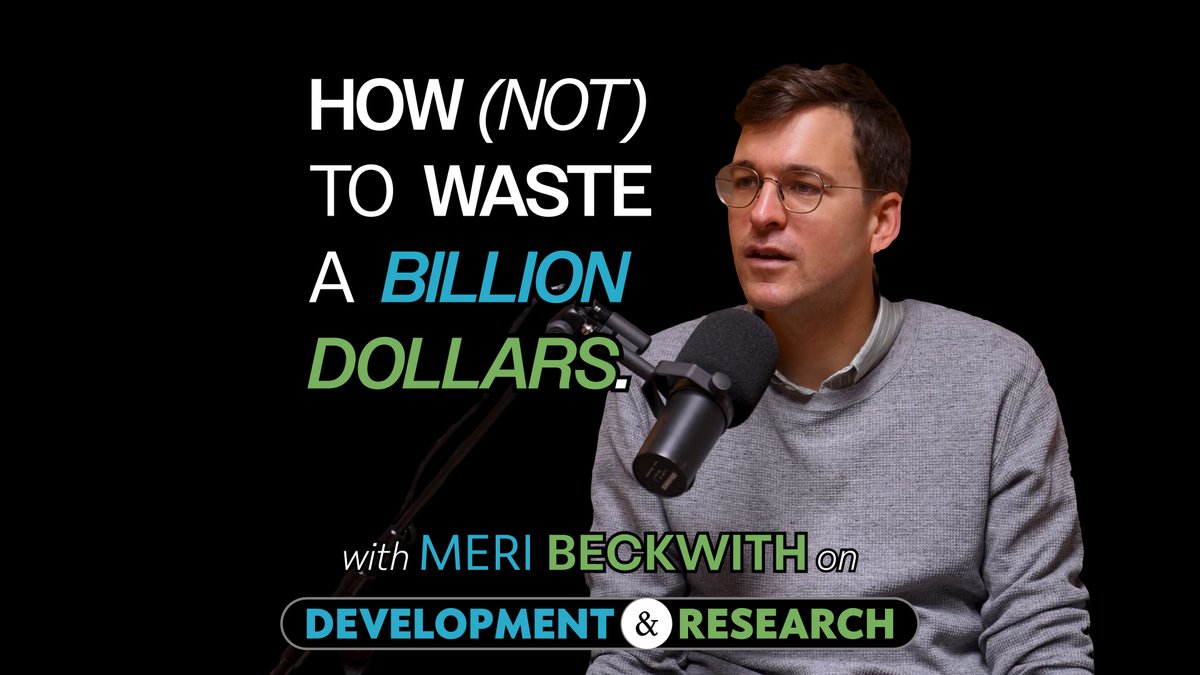
NEW episode! Drug development has never been more expensive, in terms of output per dollar spent. This trend, called Eroom’s law, is surprising, considering the incredible technological advances in drug discovery, from genome sequencing to engineering to microscopy. On a new episode of the Works in Progress podcast, Ben...

109,256 次观看 • 3 个月前 •via X (Twitter)

0 条评论

暂无评论

原始帖子的评论将显示在这里

相关视频

New episode with Dr. Konrad Kording (Kording Lab 🦖), professor of bioengineering and neuroscience at the University of Pennsylvania (Penn) and co-director of CIFAR's Learning in Machines & Brains program (CIFAR). Konrad works at the intersection of causality, machine learning, and neuroscience, building rigorous methods for causal reasoning when experiments aren't possible — and challenging how researchers interpret neural data and build AI. Konrad argues the most promising path to understanding how the brain works is to read the brain’s wiring directly, down to the molecular detail of each connection, and to build compilers and simulations to understand the brain’s computation directly. In this episode we go deep into how neurons work, how neurons wire together, and how organic and artificial neural networks differ. We discuss why organic neurons are doing much more; how a model of a single organic neuron can solve MNIST — computing more like a 3-layer artificial neural network; how the brain might learn by solving credit assignment with only local signals; how to approximate backprop without a global algorithm; why AI and humans are intelligent along different dimensions; why Konrad isn’t very worried about AI replacing us; economic models of intelligence and physical work; and much more. Konrad is a brilliant, contrarian thinker who explains complex concepts very intuitively. It is a solid computational neuroscience primer. I hope you enjoy this conversation as much as I did! Other links to this episode and references below. Chapters 00:00:00 Introduction 00:01:01 How organic neurons work 00:24:13 How the brain learns: circuits and credit assignment 00:45:29 Recording the brain 00:52:47 Why simulating brains is hard 01:05:00 A new approach: connectomes and compilers 01:21:00 Why simulate brains? 01:29:50 How AI and human intelligence differ 01:41:04 Evolution, intelligence and AI risk 01:52:42 Robotics, causality, and the roots of intelligence 02:05:53 AI for science and scientific rigor 02:13:05 The economics of intelligence 02:27:50 A hopeful future

Juan Benet

49,297 次观看 • 1 个月前

🚨New Episode: Please welcome Shiloe Bear to the Fort! As the founder of Creek Development, Shiloe has completed 63 commercial redevelopment projects and 5 land entitlement plays in the San Francisco Bay Area. Leveraging her deep construction expertise, she challenges project assumptions and incorporates impactful design to achieve remarkable outcomes for her clients and investors. We discuss: - Building Creek as an outsourced developer - Converting industrial buildings into biotech lab space - A deep dive into the Bay Area RE market - Why design is such an important aspect of development 00:00:00 - Intro 00:01:11 - Shiloe’s upbringing and journey to doing development in the Bay Area 00:08:25 - What are the projects you work on the most? 00:11:01 - Why is there such a demand for outsourced development? 00:11:47 - What makes your firm different? 00:16:50 - Minimum Viable Projects 00:21:47 - How early in a project do you need to be brought in? 00:25:14 - What are some obvious parts of a project where you can save money? 00:27:30 - How would you describe the Bay Area market right now? 00:33:35 - Office to Residential 00:37:46 - What’s the environment like for Oakland? 00:42:31 - How Shiloe is planning to pivot her business into doing their own developments 00:47:51 - How important are the relationships you’ve developed in The Bay over the past 10 years? 00:53:06 - The BioTech market and development strategy 01:00:55 - Why design matters 01:08:27 - How far out are labs looking for space? 01:09:46 - Lenders, Leases, and hold periods 01:12:36 - Why did this become your niche? 01:14:13 - Shiloe’s bird-watching skills & long-distance running

Chris Powers

64,474 次观看 • 2 年前

Yoshua Bengio thinks he knows how to make provably safe superintelligent agents. Bengio built the foundations of modern AI and is the most cited living scientist. He believes his alternative training setup would: 1. Guarantee honesty 2. Prevent unintended goals 3. Produce capable agents 4. Port over most data and techniques from current LLMs 5. Not be inherently more expensive, and perhaps be more intelligent Bengio claims the honesty and lack of unintended goals can be proven mathematically, at least given particular assumptions. And his new organization, LawZero, is aiming to build a scrappy prototype as soon as possible. The architecture is called 'Scientist AI' and it's based on training a model to explain empirical observations, including what people say, rather than training AIs that mimic human behaviour or seek our approval. (Bengio's frank assessment is that "reinforcement learning is evil" and that allowing AIs to independently train their successors is "the most crazy, dangerous bet that unfortunately we are on track to do.") But skeptics question whether Scientist AI really does solve the fundamental problem of 'eliciting latent knowledge' from AI models. And with the commercial race for superintelligence so intense, it's not clear whether the proposal will be able to compete or have time to bear fruit, even if it's sound in theory. On The 80,000 Hours Podcast, links below – enjoy! • Making AI honest and safe (00:00:00) • Scientist AI in plain English (00:02:27) • How Scientist AI differs from LLMs (00:06:32) • How the training data works (00:14:02) • Can this become an agent? (00:21:02) • Why Yoshua is now more optimistic (00:32:11) • Why companies can’t stop racing (00:36:35) • A working prototype won't take long (00:49:15) • Scientist models might be more capable (00:53:34) • “Reinforcement learning is evil” (01:01:27) • Scientist AI from guardrail to agent (01:08:37) • Can safe AI still be competent? (01:12:38) • How much will this cost? (01:19:29) • Can it generalise beyond maths and science? (01:23:26) • A multi-national push for superintelligence (01:39:19) • Want to work with or fund Yoshua? (01:51:16) • Why smart people ignore AI risk (01:54:45) • Don’t let AI build the next AI (02:01:33) • Why politicians miss the real risks (02:12:28) • Why Yoshua changed his mind about AI risk (02:21:27)

Rob Wiblin

65,088 次观看 • 2 个月前

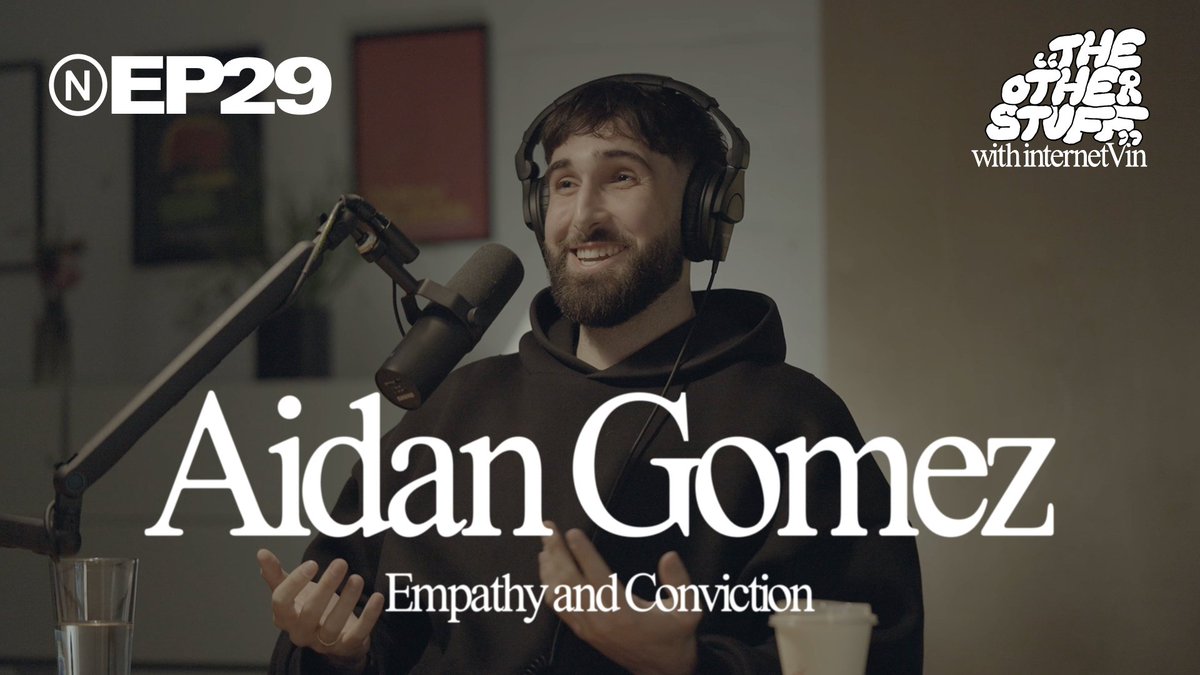
Aidan Gomez (Aidan Gomez) is a computer scientist, co-author of the seminal paper ‘Attention Is All You Need,’ and the CEO of Cohere. In this episode, we discussed his upbringing in the cabin his grandfather built in Codrington, a small town North of Brighton, and the values that were instilled in him through his family. We explored his path from Codrington to his undergraduate studies at the University of Toronto, emailing Geoffrey Hinton, and joining Google Brain where he co-wrote the paper on transformers. We discussed how he met his co-founders Ivan Zhang and Nick Frosst, and his insights on what it means to build a meaningful, successful company in Canada. Aidan shares his conviction about what is at stake — for Canada and for the world at large. This is a conversation about family, values, and what it means to live with conviction. The Other Stuff is hosted by internetVin — filmmaker, entrepreneur, and possibly the most curious man on Earth. Produced by New. The Other Stuff #29 — Aidan Gomez: Empathy and Conviction — Timestamps 00:00:00 Intro 00:03:10 The Malleability of Toronto 00:11:06 Growing Up in Codrington 00:13:50 The Story of Aidan Gomez’s Family 00:27:23 Introduction to the Internet 00:30:39 Values and Work Ethic 00:35:46 University of Toronto’s AI Scene 00:40:48 Emailing Geoffrey Hinton 00:42:16 Google Brain 00:45:15 Dropout: A Simple Way to Prevent Neural Networks from Overfitting 00:49:48 The Beauty of Research 00:54:24 One Model to Rule Them All 00:59:54 Meeting Ivan Zhang and Nick Frosst 01:04:00 The Birth of Cohere 01:06:56 Twitter Influencers and Alex Friedland 01:11:48 Being the CEO 01:12:51 Building for Canada 01:15:01 Three Fundamental Ingredients of Building a Company 01:21:39 Working with the Canadian Government 01:24:39 Reflexivity in Canada 01:36:22 What Is Evil? 01:42:40 The Role of AI in the World

The Other Stuff Podcast

45,297 次观看 • 7 个月前

AGI is coming. Reid Hoffman (Reid Hoffman) just wrote the book on how to prepare. According to Reid, every major tech breakthrough (the written word, the printing press, the telephone) triggered mass fear. But, contrary to our worries, new technology tends to enhance human agency—even more so, if you know how to use it well. Reid is the cofounder of LinkedIn, Inflection AI, and Manas, a partner at Greylock Partners, an award-winning podcaster, and an early backer and board member of OpenAI. We spent an hour talking about how to develop a compass for navigating AGI. Here are a few takeaways: - Our sense of human agency is not just about external control but an internal stance—how we approach uncertainty & new tech is crucial - In new technology waves, NO blueprint or plan will have the right answers. Instead, adapting to new technology requires broad access, an experimental mindset, and flexibility - In an AGI world most jobs will transform, not disappear—and how you can prepare with hands-on trial and error - How certain social norms and ethics should change as AGI changes the landscape—like individual access to personal data - Why now may be finally be the era where quantified self tools become valuable …and more, including everything in his new book Superagency, out this week. It was a pleasure to have him on the show for a second time. This is a must-watch for anyone who wants to help build a more human future with AI. Watch below! Timestamps: Introduction: 00:01:29 Patterns in how we’ve historically adopted technology: 00:02:50 Why humans have typically been fearful of new technologies: 00:07:02 How Reid developed his own sense of agency: 00:13:25 The way Reid thinks about making investment decisions: 00:20:08 AI as a “techno-humanist” compass: 00:29:40 How to prepare yourself for the way AI will change knowledge work: 00:35:30 Why equitable access to AI is important: 00:41:39 Reid’s take on why private commons will be beneficial for society: 00:45:15 How AI is making Silicon Valley’s conception of the “quantified self” a reality: 00:47:23 The shift from symbolic to sub-symbolic AI mirrors how we understand intelligence: 00:52:14 Reid’s new book, Superagency: 01:03:29

Dan Shipper 📧

47,209 次观看 • 1 年前