Loading video...

Video Failed to Load

Go Home

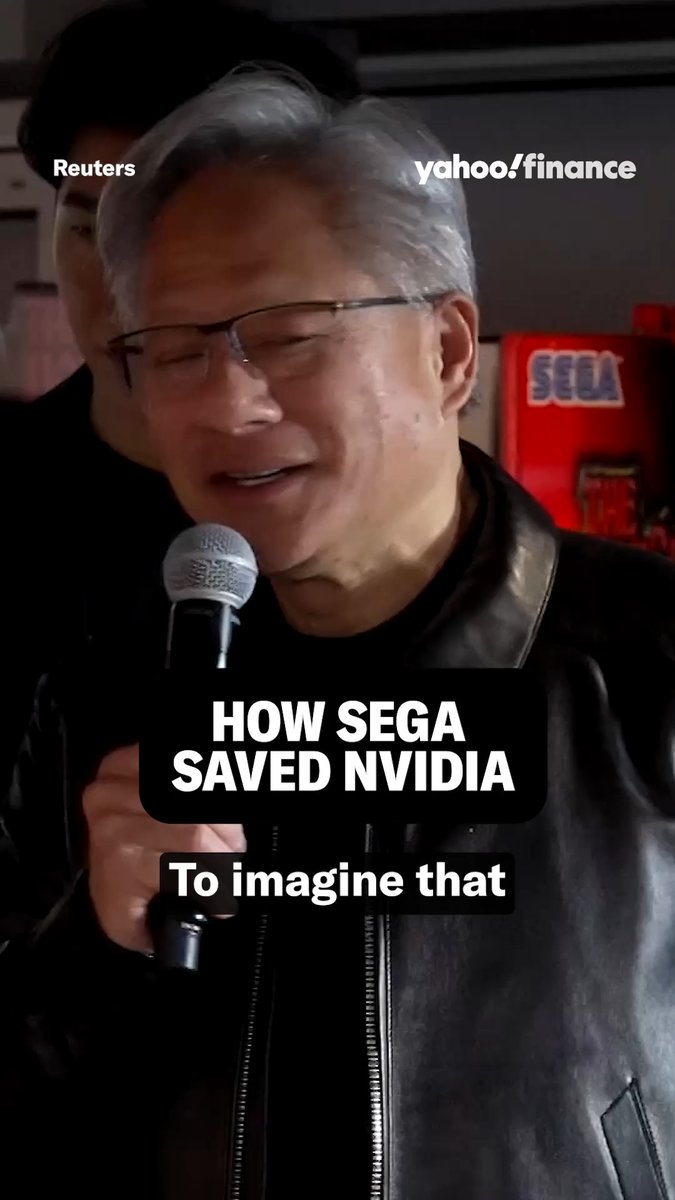
NVIDIA CEO JENSEN HUANG: IT ALL STARTED WITH GAMERS Jensen looked back on NVIDIA’s wild beginning, describing how the company’s rise to global tech dominance began with one mission, make games look incredible. He said the company wasn’t founded to chase every market, but to serve one audience with...

36,703 views • 8 months ago •via X (Twitter)

0 Comments

No comments available

Comments from the original post will appear here

Related Videos

Jensen Huang just told the story of how the AI revolution started with one customer, one box, and a second-floor room nobody thought twice about. Nobody on Earth wanted it. Huang: “When I announced this thing, nobody in the world wanted it. I had no purchase orders. Not one.” Nvidia had spent billions building the DGX-1. The first AI supercomputer purpose-built for deep learning. $300,000 per unit. The entire technology industry looked at it and passed. Every hyperscaler. Every research lab. Every Fortune 500 with a machine learning team. Not one purchase order. Then Elon Musk found Huang at a fireside chat in 2015. Huang: “He goes, ‘You know what? I have a company that could really use this.’” His first customer. His only customer. Then Musk finished the sentence. Huang: “He goes, ‘It’s a non-profit company.’ And all the blood drained out of my face.” Billions in R&D. A $300,000 machine. And the one person on Earth who wanted it could not pay for it. Huang built it anyway. Huang: “I boxed one up. I drove it up to San Francisco and I delivered it to Elon in 2016.” Not shipped. Not handed off to a freight company. The CEO of Nvidia personally boxed the first AI supercomputer and drove it to San Francisco himself. That is not a delivery. That is a bet. Huang: “I walked up to the second floor where they were all kind of in a room. That place turned out to have been OpenAI.” Pieter Abbeel was there. Ilya Sutskever was there. A handful of researchers, one supercomputer, and a room nobody outside that building could have named. No campus. No valuation. No infrastructure. Just raw talent and one machine the rest of the world had already rejected. Huang: “Just a bunch of people in a room.” That room built ChatGPT. That room triggered a $200 billion industry. That room forced every government on Earth to rethink national security. It started because one founder saw what the entire market refused to see, and one CEO drove the weapon there himself. The trillion-dollar AI industry did not begin in a boardroom. It began with a box in the back of a car, a non-profit that could not afford it, and a bet that every serious person in technology thought was insane. The market was unanimous. The market was wrong.

Dustin

25,119 views • 4 months ago

Jensen Huang: the character of a company is the most important thing “The character of a company is what makes it ultimately successful,” Jensen begins. “How resilient is it? How does it deal with adversity? How does it deal with learning when it’s presented with new assumptions? If the conditions change, how agile is the company?” Jensen elaborates on how you instill these values in a company: “You talk about it. You teach it. You live it. Nvidia’s really fortunate because we suffered so greatly in the beginning. For the first 15 years of our company, it was one adversity after another. Maybe 5-7 times it was existential.” It ultimately comes down to the character of the people. “It’s the people’s resilience,” He argues. “A company is made of people. It’s not made of the document that describes the culture. It’s not the inscription of the core values on the building. That’s not what makes the company’s culture. It’s the people and how the company overcame existential crises or incredible adversity — the agility, cleverness, creativity, ingenuity, will power, and incredible ability to suffer extraordinary pain — that is the corporate character.” Jensen once remarked, “my will to survive exceeds almost everybody else’s will to kill me.” He elaborates on what he meant by this: “It’s pretty hard to discourage me, and if I believe in something, I’m just going to keep doing it until it’s done and until we’re great at it. It’s hard to deter me. It’s hard to distract me. It’s hard to discourage me. In my mind, it’s always, ‘How hard can this be?’ And it turns out that every time it’s incredibly hard. But I’m surrounded by amazing people helping me.” Video source: Norges Bank (2023)

Startup Archive

24,941 views • 5 months ago

Jensen Huang on why China is innovating so fast: NVIDIA CEO Jensen Huang explains what's driving China's pace of innovation and it starts with a counterintuitive move on technology itself. "There's no sense keeping technology hidden. You might as well put it on open source. And so the open source community then amplifies, accelerates the innovation process." The result, he says, is a compounding effect: open source attracts talent, talent drives rapid iteration, and fierce domestic competition between companies pushes the ceiling even higher. "So you get this rapid incredible great talent, rapid innovation because of open source and just the nature of friends. Insane competition among the companies. What emerges is incredible stuff." But Jensen argues the technology layer is only part of the story. The deeper edge is cultural. It was decades in the making: "This is the fastest innovating country in the world today. And this is something that has… everything that I've just said is fundamental to just how the kids were grown. The fact that they have excellent education, the fact that their parents want them to do well in school, the fact that their culture is that way." In other words: a generation raised to value education and rigor showed up at exactly the moment the technology curve went exponential. Lex Fridman adds the cultural detail that ties it together: "Plus, culturally, it's pretty cool to be an engineer." That framing leads Jensen to his sharpest contrast. One about who actually runs each country: "It's a builder nation. Our country's leaders, incredible, but they're mostly lawyers… rule of law, governing. Their country was built out of poverty. And so most of their leaders are incredible engineers, some of the brightest minds."

High Signal AI

41,241 views • 3 months ago

September 2009. Jensen Huang walks onto a small stage at the Fairmont hotel in San Jose. About 1,500 people are in the room. He runs a company that makes chips for video games. He spends the next 8 minutes doing math on a whiteboard, explaining why the future of computing won't come from making CPUs faster. He calls it "CEO math" and apologizes in advance to every computer science professor in the audience. Then he lays out an argument that almost nobody took seriously at the time: the way to make computers dramatically faster is to pair a regular CPU with hundreds of tiny parallel processors, the kind that already exist inside graphics cards. One CPU for the sequential stuff. Hundreds of GPU cores for everything else. He calls it "heterogeneous computing." He shows the math. A workload that can be split into many pieces at once gets up to 200x faster on this combined system. A workload that has to run one step at a time loses nothing. "The most important thing in creating a new architecture," he says, "is to make sure it does no harm." This was the first GPU Technology Conference. NVIDIA had launched a software platform called CUDA three years earlier, in 2006, to let developers write programs that run on graphics cards instead of just regular processors. Almost nobody cared. GPUs were for rendering Call of Duty, not for scientific computing. The academic world was polite but skeptical. The enterprise world ignored it entirely. By this point, Huang had been making this argument for years. NVIDIA was a $7 billion company. It competed with AMD and Intel for market share in the graphics market. That was the whole business. Jensen kept saying the GPU wasn't just a gaming chip; it was a computing platform. He kept saying parallel processing would reshape every industry from medicine to finance to physics simulations. People kept nodding, then doing nothing. Then deep learning happened. Around 2012, AI researchers discovered that training a neural network, which means teaching a computer to recognize patterns by running the same calculation millions of times across huge datasets, was exactly the kind of workload Jensen had been describing. GPUs can train AI models 10 to 50 times faster than CPUs. The architecture he outlined in this 2009 talk, with one CPU handling step-by-step tasks while hundreds of GPU cores crunch through massive amounts of parallel data, is now the literal blueprint for every AI data center on earth. ChatGPT runs on NVIDIA GPUs. Claude runs on NVIDIA GPUs. Gemini, Llama, Midjourney, nearly every major AI model you've heard of was trained on NVIDIA hardware using CUDA, the software platform Jensen built for a market that didn't exist yet. NVIDIA was worth about $7 billion when Jensen gave this talk. It is worth over $4.4 trillion today. That's a 600x increase. Jensen Huang, who founded the company at a Denny's in 1993 with two friends, now has a net worth of over $160 billion. He made Forbes' list of the 10 richest people for the first time this year. GTC 2026 is currently ongoing. 17,000 people are packing a hockey arena to watch the same guy explain what comes next. In 2009, 1,500 people showed up at a hotel ballroom, most of them for gaming graphics.

Anish Moonka

413,645 views • 5 months ago

Jensen Huang reveals the trip to Japan that saved NVIDIA from vaporizing overnight "Our company was running out of money. If that contract would have been canceled, we'd be dead. We would have vaporized instantly." Jensen was in a contract with SEGA and owed them a game console. But the technology didn't work, and NVIDIA was out of cash. So he went to Japan to see the CEO of Sega, Shoichiro Irimajiri: "I said, listen, I've got some bad news for you. The technology that we promised you doesn't work. And second, we shouldn't finish your contract because we'd waste all your money, and you would have something that doesn't work. And I recommend you find another partner to build your game console." Then he made the impossible ask: "And third, even though I'm asking you to let me out of the contract, I still need the money. Because if you didn't give me the money, we'd vaporize overnight." "I explained to him why the technology doesn't work, why we thought it was going to work, why it doesn't work. And I asked him to convert the last $5 million to complete the contract, to give us that money as an investment instead." The SEGA CEO responded: "But it's very likely your company will go out of business, even with my investment." Jensen's reply: "I told him that if you invested that $5 million in us, it is most likely to be lost. But if you didn't invest that money, we'd be out of business." Two days later, the CEO came back and said: "We'll do it."

Jaynit

83,618 views • 3 months ago

Jensen Huang: I told SEGA we failed, but I still need the money or we'd vaporize overnight. "Our company was running out of money. If that contract would have been canceled, we'd be dead. We would have vaporized instantly." Jensen was in a contract with SEGA and owed them a game console. But the technology didn't work, and NVIDIA was out of cash. So he went to Japan to see the CEO of Sega, Iri Majori. As he puts it: "I said, listen, I've got some bad news for you. The technology that we promised you doesn't work. And second, we shouldn't finish your contract because we'd waste all your money, and you would have something that doesn't work. And I recommend you find another partner to build your game console." Then he made the impossible ask: "And third, even though I'm asking you to let me out of the contract, I still need the money. Because if you didn't give me the money, we'd vaporize overnight." He continues: "I explained to him why the technology doesn't work, why we thought it was going to work, why it doesn't work. And I asked him to convert the last $5 million to complete the contract, to give us that money as an investment instead." The SEGA CEO responded: "But it's very likely your company will go out of business, even with my investment." Jensen's reply: "I told him that if you invested that $5 million in us, it is most likely to be lost. But if you didn't invest that money, we'd be out of business." Two days later, the CEO came back and said: "We'll do it." That moment of radical honesty when the odds were 0% saved NVIDIA from instant death.

Jaynit

176,940 views • 7 months ago