Loading video...

Video Failed to Load

Go Home

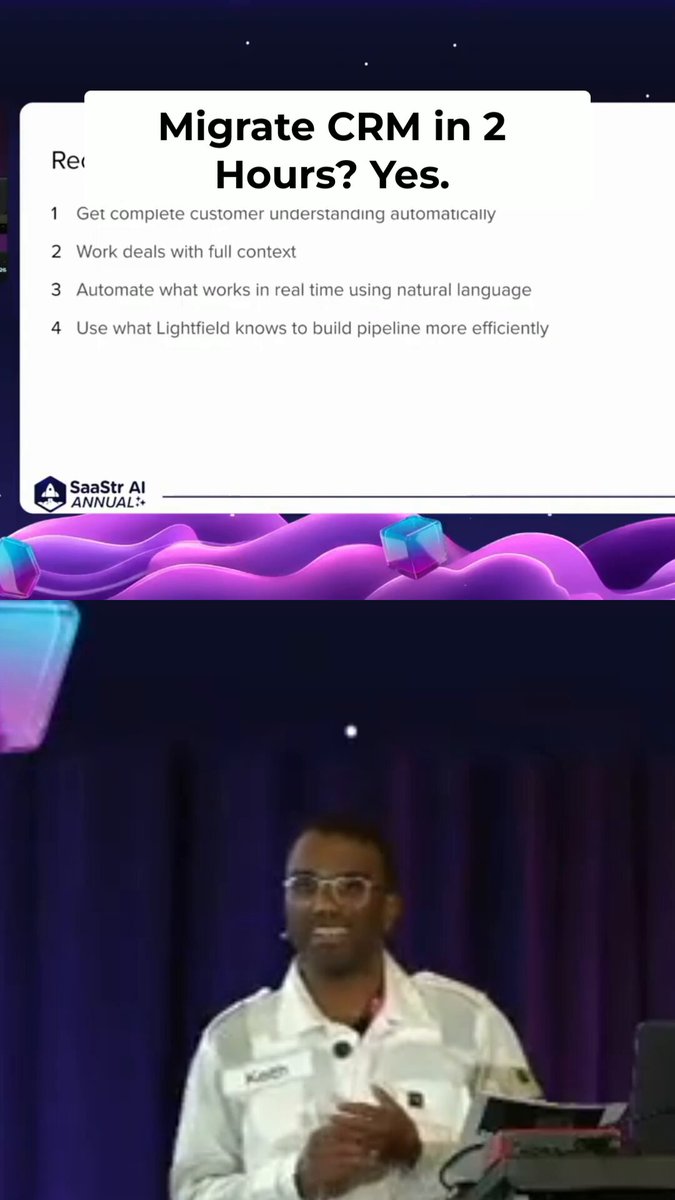
ok this is something I keep thinking about and haven't seen anyone actually say out loud agents made me personally so much faster at my job, like genuinely different person levels of output but the companies I've worked at as a whole? nothing. Maybe a little and I think...

99,689 views • 6 days ago •via X (Twitter)

30 Comments

Zifan Carter's profile picture
Zifan Carter6 days ago

This is a great perspective!

Alice The Ai Expert's profile picture
Alice The Ai Expert5 days ago

You nailed the real bottleneck personal productivity means nothing if context dies with you, and a live customer world model that compounds for the whole team is exactly the fix we need!

SOUL♡'s profile picture
SOUL♡6 days ago

Wait this is actually a really good point

Rehan's profile picture
Rehan6 days ago

Turning tribal knowledge into shared machine-readable context is a huge unlock

Jyoti Soni's profile picture
Jyoti Soni5 days ago

The interesting part isn’t just capturing conversations, it’s turning those conversations into usable organizational memory

Abigail Parker's profile picture
Abigail Parker6 days ago

The real AI bottleneck isn’t intelligence, it’s access to the right context

Aaliya's profile picture
Aaliya5 days ago

Personal gains vs company gains is the whole story

Aria Tech's profile picture
Aria Tech5 days ago

Finally agents that learn from the whole company not just you

Mujeeb Ahmed's profile picture
Mujeeb Ahmed6 days ago

Individual speed vs organizational speed are two completely different games

Elise Tech Ai's profile picture
Elise Tech Ai5 days ago

Love this — so clean and inspiring!

Shubham Singh's profile picture
Shubham Singh6 days ago

Context that stays trapped in individual employees is one of the biggest hidden costs in modern companies

Dhaval Makwana's profile picture
Dhaval Makwana6 days ago

Their journey is amazing

Ella Tech & Tool's profile picture
Ella Tech & Tool5 days ago

So real 👏 Individual speed team speed. This fixes it

Iris Hayes's profile picture
Iris Hayes2 days ago

The strongest AI systems won’t just generate output, they’ll understand

Iris Hayes's profile picture
Iris Hayes5 days ago

The strongest AI systems won’t just generate output, they’ll understand

Fakhr's profile picture
Fakhr6 days ago

This seems a big announcement

Alan's profile picture
Alan6 days ago

The irony is we finally have tools that can scale individual expertise but the expertise itself stays siloed

Aria Arooj's profile picture
Aria Arooj5 days ago

That's a really smart take. It's great that Lightfield is addressing that knowledge gap.

Ismail Khan's profile picture
Ismail Khan6 days ago

The compounding context moat is probably the most interesting part of this

Saberin Samarat's profile picture
Saberin Samarat5 days ago

Amazing

Swati's profile picture
Swati5 days ago

The strongest AI systems won’t just generate output, they’ll understand

Professional_Tech_AI's profile picture
Professional_Tech_AI6 days ago

Amazing

Parul Gautam's profile picture
Parul Gautam6 days ago

Nobody is talking about this enough

tejtejshawirajd's profile picture
tejtejshawirajd6 days ago

This explains why my team's AI adoption looked great on paper but changed nothing operationally

shamim Reza's profile picture
shamim Reza6 days ago

Great

DILESH GAUTAM's profile picture
DILESH GAUTAM6 days ago

$47M makes sense when the ambition is to become the context layer between a company, its people, and its agents

AI with Durga 🚀's profile picture
AI with Durga 🚀6 days ago

The next generation of CRM probably looks less like a database and more like a living model of the business

Max's profile picture
Max6 days ago

Really enjoyed this. Simple, thoughtful, and beautifully put together.

Manish Kumar Shah's profile picture
Manish Kumar Shah6 days ago

This is the knowledge transfer problem nobody talks about. You leave, the AI context leaves with you

Markandey Sharma's profile picture
Markandey Sharma6 days ago

The knowledge just evaporates when people leave
Related Videos

“Because I think a lot of people are familiar with you know, pop stars have these alter egos on stage and then they're also a little bit potentially different behind the scenes. Can you talk about what the difference is between those two personas?” ROSÉ: I think, you know, like I started off as, my whole career started as Blackpink and I feel like it was so much fun creating this character on stage because I'm just from like Australia, like in my bedroom, but like it was so much fun creating this like pop star, like character. It was so much fun. And then I think creating my first solo album, it was my discover of like, you know, who am I? And like when I was naming the album, I really thought a lot about it. There was like options like, you know, number one girl. And then a lot of people did like, what about Rosie? And at first I was like, it seems a bit like narcissistic. I'm not sure. And then it slowly grew on me. And then, you know, just the idea of it being Rosie because Rosé has been such a big part of my life. And that's what we present ourselves as Blackpink, Blackpink Rosé. And I felt like this was very opposite. And so I noticed that it was closer to kind of introducing a different version of me, like because it combined all the stories I would talk about with my friends and family. And they call me Rosie at home. And of course, the online name that the company had made for me from at the beginning of Blackpink, I remember when it happened was like the day before they released my picture, profile picture, they were like, Rosé. And like the name got announced.

rosie

47,583 views • 7 months ago

Q: “Because I think a lot of people are familiar with, you know, pop stars have these alter egos on stage and then they're also a little bit potentially different behind the scenes. Can you talk about what the difference is between those two personas?” ROSÉ: “I think, you know, like I started off as, my whole career started as Blackpink and I feel like it was so much fun creating this character on stage because I'm just from like Australia, like in my bedroom, but like it was so much fun creating this like pop star, like character. It was so much fun. And then I think creating my first solo album, it was my discover of like, you know, who am I? And like when I was naming the album, I really thought a lot about it. There was like options like, you know, number one girl. And then a lot of people did like, what about Rosie? And at first I was like, it seems a bit like narcissistic. ..I'm not sure. And then it slowly grew on me. And then, you know, just the idea of it being Rosie because Rosé has been such a big part of my life. And that's what we present ourselves as Blackpink, Blackpink Rosé. And I felt like this was very opposite. And so I noticed that it was closer to kind of introducing a different version of me, like because it combined all the stories I would talk about with my friends and family. And they call me Rosie at home. And of course, the online name that the company had made for me from at the beginning of Blackpink, I remember when it happened was like the day before they released my picture, profile picture, they were like, Rosé. And like the name got announced.”

hiro

35,872 views • 7 months ago

Airtable's Howie Liu says that basically everyone will need to graduate from being ICs to ICs that manage teams of 20-30 agents: "The best developers today don't just sit there in front of their IDEs and synchronously talk to their agent." "[Instead], you have like 30 separate branches that are each being worked on by a different agent. And you can have the agents continue to update the branches based on human and other agent feedback." "And I think this whole idea of it taking hours for that entire loop to complete — agent pushes some changes, the changes get feedback from other agents or humans, the agent responds to that — that whole loop could be hours, not just minutes. So you're not going to just sit there and watch it one at a time." "But the powerful thing about this is, each one is still actually operating faster than a human engineer. One agent on one branch can do the work of maybe three humans, operating 3x as fast. So it's like a 10x leverage factor just for one agent." "But the best engineers are now able to multitask and say, 'I'm going to oversee my own little team of 20-30 agents working concurrently.'" "Everyone needs to graduate from being an IC to an IC manager of agents. Meaning, if you're a VC analyst, your job should no longer be to go synchronously research one company. You need to go and research like 30 companies, and do them all faster, better, and higher quality than you could before." "That's the greatest leap that is going to be challenging for a lot of people in a lot of roles. Because it's a totally different mentality in how you operate, and what your role is."

TBPN

35,595 views • 4 months ago

Coinbase CEO Explains “Reverse Prompting” and the Rise of the AI CEO Brian Armstrong: “One of the big pushes we made in the last year was we got our own internal hosted AI model that was connected to all of our data sources, right?” “So it's like every Slack message, every Google doc, Salesforce data, Confluence, you know.” “So now the data is all aggregated and I've started to ask it really… it's not just like prompting it, ‘Hey, can you write this kind of memo for me,’ or something.” “I'm asking these AI agents now, ‘As CEO, what should I be aware of in the company that I might not be aware of?’ And it'll tell me, ‘Did you know that there's actually disagreement on this team about the strategy?’ And I was like, actually, I didn't know that.” “This is like reverse prompting. So instead of telling the AI agent what you want it to do, you ask it what you should be thinking more about.” @jason: “It's a mentor. It's a coach.” Brian: “Yeah. Like, what could make me a better CEO? And it's like, ‘Well, I looked at how you spent your time in the last quarter and here's how you said that you wanted to spend it, but you actually spent 32% of your time on this instead of 20%.’” “I've asked it other questions like, ‘What's the thing that I changed my mind on the most over the last year?’ Things like that.” “It'll prompt you with information you should be thinking about instead of the other way around.” Thanks to our partner for making this happen!: Our episode is sponsored by the New York Stock Exchange - a modern marketplace and exchange for building the future. It all happens at the NYSE 🏛.

The All-In Podcast

80,524 views • 7 months ago

There's so much focus on "how can AI do my work for me?" I think the more important question is "what work can I now do with AI that I would have never attempted before?" Earlier this year I wrote freestiler, a vector tiling engine for R and Python, with the help of Claude and Codex. I knew what the ideal engine looked like and how it would work at a high level. I didn't know how to put it together, and I don't know Rust, the language I wanted under the hood. Previously I would never have attempted this project as the ROI wasn't there. It would have taken me a year or more to learn the internals of a vector tiling engine and enough Rust to implement one. With Opus-level models, I could take it on. freestiler now powers all my vector tiling pipelines, including the map below rendering 143 million jobs from LODES, and it has 114 GitHub stars. Building this way has required a different set of skills. I don't review the code line by line. I set up adversarial agents to do that and write the test suites. What I review is the architecture, the behavior, and the results. Agent teams surface findings and explain their reasoning; I evaluate and critique. My job isn't to stress over code formatting, but instead to focus on questions like whether the engine is designed right, whether the output is correct, and if the UX makes sense. This means that I haven't "replaced my work." I've taken on entirely new work, with the help of agents, that I would have never done otherwise. It has taken some getting used to shipping code I haven't personally typed. In the old way of working, I built understanding through writing that code. Now I build understanding through managing the project - writing a spec, reviewing structure, evaluating UX. And that's helped me think a whole lot bigger in terms of what I can now do.

Kyle Walker

13,867 views • 2 months ago