Loading video...
Video Failed to Load
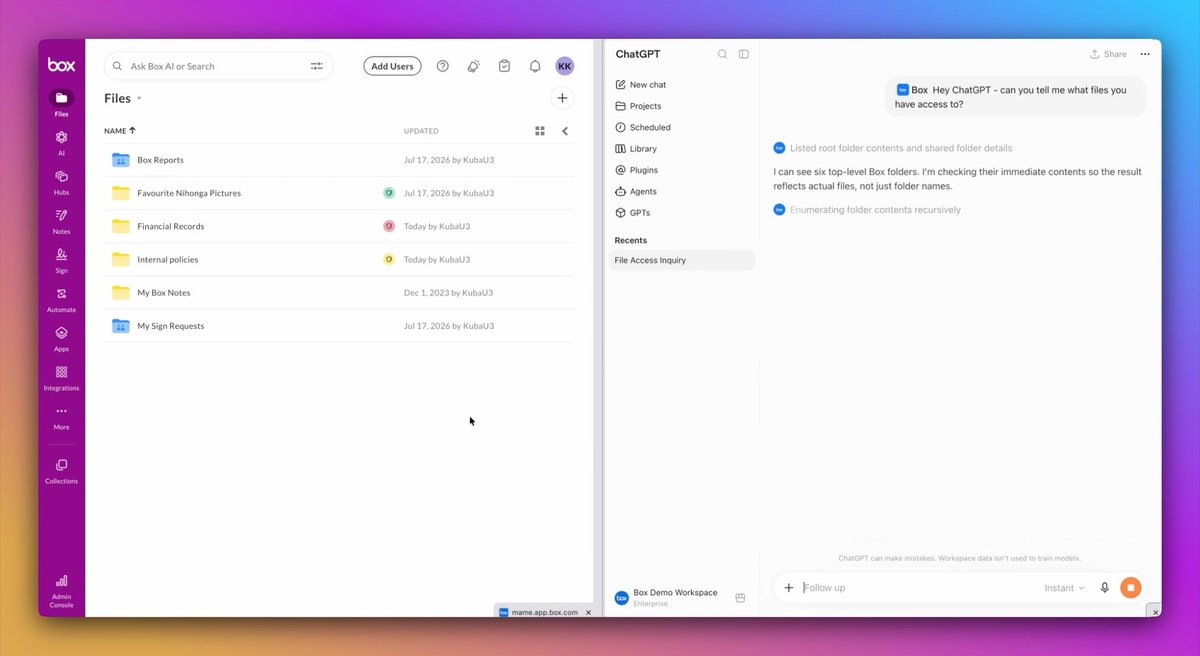
🆕 OpenAI Developers Agents API gives developers a hosted sandbox where agents run tools, coordinate work, and handle complex tasks. Box Mount brings enterprise content directly into that sandbox as files the agent can read, reason across, and produce new work from, using normal shell commands and file paths... show more

227,650 views • 3 days ago •via X (Twitter)
12 Comments

@OpenAIDevs After ~20 years of cloud infra built around web servers, databases and APIs, it's amazing to see the Cambrian explosion of v2 cloud infra in the age of agents. Props to @OpenAIDevs for shipping compatibility with other sandboxes on Day One 😇

@OpenAIDevs Mounting real storage into an agent sandbox raises a question I got wrong for a while: which writes count as done. A tool call returning 200 is true about the call, not about whether the write landed. Reconcile from the store.

@OpenAIDevs the audit trail is the quiet casualty. once agents write back into the same folders, the history fills with machine edits and the person reading it cannot tell a fix from a mistake

this is not “another Box tool for the agent.” It’s a POSIX layer over enterprise content inside OpenAI’s hosted Agents API sandbox. Box Mount exposes a Box folder as a normal filesystem (/workspace/deal-room/...) with two-way sync. The agent reads and writes with cat, find, and ordinary paths instead of custom file-transfer logic. Permissions, versions, and audit stay on Box. In the demo a lead agent mounts a deal room, reads 5 markdown sources, launches 3 specialist agents in parallel, and writes 4 reports back. When the MSA is updated in Box (v2), the mount syncs into the same sandbox and the agents reassess automatically. What’s interesting: harness + multi-agent + live mount instead of RAG/MCP per file. Watch-outs: sync latency and conflicts, “write completed” vs the write actually landing in the store, and private preview with no production SLA.

@OpenAIDevs I think you'll like this @jxnlco

@OpenAIDevs @grok 素人でも分かりやすいように解説して

@OpenAIDevs 把企业资料直接接进沙盒,省掉来回搬文件这一步了

@OpenAIDevs Box mount sounds huge for enterprise use

@OpenAIDevs Read with inherited ACLs is the right default. Write-back is a different grant. If produce-new-work lands in the source of truth, the mount is not a sandbox. It is a second employee with the user's files.

@OpenAIDevs Great point!

@OpenAIDevs watched mounted files go stale during long sessions; version checks matter more than orchestration

@OpenAIDevs Enterprise content in an agent sandbox raises the same question every time: what the audit trail looks like when the agent edits a file four teams depend on.