Video wird geladen...

Video konnte nicht geladen werden

Zur Startseite

Originally released at GDC 2000, the Area 15 – NVIDIA Bunker Quake III Arena map pushed GeForce GPU’s to their limits. 26 years later, modder WoodBoy has remastered it with #RTXRemix, adding path tracing, DLSS 4, new materials, RTX Remix Logic, and Advanced Particle VFX.

91,879 Aufrufe • vor 6 Monaten •via X (Twitter)

0 Kommentare

Keine Kommentare verfügbar

Kommentare vom Original-Post werden hier angezeigt

Ähnliche Videos

Hey folks, I've been recently talking a lot about why we're adding different styles of play into No Rest for the Wicked and I wanted to prove my theory that that would result in players having more fun, so, long story short... I turned Quake 1 into a Roguelite! 😂 Here's what that means: 1) Roguelite-inspired Run Structure: You start with limited stats in a hub map and are greeted by actual NPCs, then fight through sequential arena rooms across 4 biomes, each ending with a boss fight. 2) 40+ boons across 5 categories: Damage, Movement, Defense, Utility and Risk. And these also come with Rarities: Common, Rare, Epic, and Legendary. After clearing a room, you pick from 3 random boon offerings. 3) Permanent Meta: Death sends you back to the hub with you retaining the 'essence' currency you collected by killing mobs. Then you spend it at NPCs: The Gatekeeper starts runs, the Wraith upgrades your arsenal (ammo capacity, starting weapons, weapon damage), and The Shaper sells permanent stat upgrades (max HP, armor, boon capacity, rerolls) 4) Difficulty Scaling: Enemy health and damage ramp up as you push deeper. 5) Damage Numbers: Floating combat text and floating healthbars for good measure, so you can understand how much stronger you become over time. All just built on top of unmodified Quake 1 maps and enemies - no new assets needed, it reuses the entire original campaign as roguelike content. To me, this is point proven: I think even hardcore Quake lovers back in the day would've spent a whole bunch of time playing a mode like this given that it'd allow you to experience the thing you love in a whole new light by crossing genres. If you're interested in seeing how this exercise turned out, here's a video for your viewing pleasure! :) I have to wonder what John Romero 🤘🏽 thinks about this given that he originally wanted to add more RPG elements into Quake!

thomasmahler

15,865 Aufrufe • vor 6 Monaten

🇨🇳 Linwei Ding (丁林葳) lived in Silicon Valley but he spent months at a time in his native China. Nothing unusual about that — except that he was supposed to be working full time as a software engineer in Google’s San Francisco-area offices. Ding had others badge him into Google buildings, making it appear as if he were coming to work, when he’s actually busy marketing himself to Chinese companies as an expert in AI. Ding stole 500 files containing some of Google’s most important AI secrets. It’s unknown whether Ding had distributed the stolen material to his partners in China — in other words, it’s not clear the information was protected. The stolen technology was extremely significant, representing 10 to 15 years of work by Google scientists. The technology Ding stole involves the building blocks of Google’s advanced supercomputing data centers that fuel the remarkably humanlike answers consumers see when they ask questions of ChatGPT. The stolen secrets related to both software and hardware, including information about advanced computer chips that the US government has worked hard to keep out of Chinese hands. “That’s one of the most concerning aspects — that this sort of undercuts the US efforts to [prevent] China being able to develop this technology. This will give them new capabilities and insights that were developed by Google over the last 10 years at least, to develop these very advanced chips for training AI models.” If a Chinese national were to take protected information of their own accord, patent it in China and open their own business with it, “good luck challenging that in court in China. It rarely if ever succeeds.”

Byron Wan

110,552 Aufrufe • vor 2 Jahren

Pragmata Review | No spoilers That is it for me. I played more than 30 hours of Pragmata and I am really happy that not only we finally got this game after so many delays and in a time where cancellations are common, but also that it turned out to be a very solid and enjoyable experience. Visually it is beautiful, and gameplay wise it works well for the length it has. It is not a long game, which I personally prefer, and I hope we see more titles like this instead of games trying to be longer just for the sake of it. I would not call it short like some people did, but I think it is exactly as long as it needs to be. Story wise, it is my favorite of the year so far. Seeing this kind of father and daughter dynamic again made me want to play more games with similar themes. I did almost everything in the game and I absolutely recommend it. If you are unsure about the length, maybe wait for a sale, but quality wise it deserves to be up there. I am not someone who rushes, so it took me longer because I admire the environments, take screenshots, record videos, and try to find collectibles without guides. For someone who just plays straight through, I think it would take around 12 to 15 hours, maybe a bit more or less. This is the kind of experience I want to see more often in the gaming space. I liked the combat and I think the enemy variety is fine for the length. If the game was longer without adding new enemy types, it would probably feel repetitive, but for what it is, it works. My biggest concern before playing was the combination of Hugh’s shooting and Diana’s hacking. If it was too complicated, it would be annoying, and if it was too simple, it would be boring. Thankfully, it ended up being exactly right. My only real complaint is that you need to return to the base to restock items, and when you die, the game sends you back there instead of placing you right before the area or at the last travel point you unlocked. It is not a huge issue, but it breaks the flow a bit. Diana is very cute and does her part extremely well, and Hugh is a character that is hard not to like. They both nail the dad simulator vibe. The voice acting is great, especially for Diana. Capcom delivered a unique and impressive new IP, which is always welcome in an industry where big publishers mostly rely on established franchises instead of taking risks. Whether we get more entries in the future is up to them, but it is also up to us to support games like this if we want more of them. On PC the game runs very well. The only thing that felt a bit underwhelming to me is the ray tracing when you use it on its own without path tracing. In some areas it does not add much, similar to what I noticed in Resident Evil Requiem. It makes me think it is either something with the RE Engine or simply that Capcom does not push ray tracing that far and focuses more on path tracing instead. Path tracing looks incredible, but of course it comes with a heavy performance cost. Something that impressed me throughout the entire playthrough is how consistent the game feels from start to finish. There is no point where it suddenly drops in quality or feels rushed. Every area has its own atmosphere, the pacing stays steady, and the game never tries to drag itself out longer than needed. It is rare to play something that stays this steady all the way through, and that alone made the whole experience even more enjoyable for me. I hope we get a DLC or a sequel one day, but even if this stays a one off, I am happy with what we got. Rating: 9/10

𝑨𝒔𝒉𝒆𝒏 𝑶𝒏𝒆

32,822 Aufrufe • vor 5 Monaten

Gagan Biyani with Erik Torenberg and Ben Horowitz on HAA: The Horowitz Andreessen Academy HAA is a private, full-time, in-person school in San Francisco for young people coming out of high school. Its mission is to nurture the best young people in the world, and equip them with the tools to shape it. The Industrial Revolution rewrote how we train young people. It's time for a new model for the AI era. HAA is project-based – less lecture time, more time with tools and AI, structured social life, co-ops/internships, with students embedded alongside working adults. Founding Partners include Anduril, Anthropic, Coinbase, Google, Meta, NVIDIA, OpenAI, Palantir, Replit, and Stripe. It's the best time in history to be 18. The vision is grads with careers they love or their own companies founded, and hopefully other schools copying the model down the road. 0:55 Why a16z is backing a school 4:40 Why other college alternatives failed 6:55 AI is this era's Industrial Revolution 9:35 The model: live in SF, intern at top startups 12:10 Ben: the best time in history to be 18 15:25 No big idea at 18? Join someone who has one 17:40 People skills come from reps, not lectures 23:15 Why it has to be San Francisco 26:45 Why it's a separate, for-profit company 31:00 Every curiosity becomes a project 33:30 Main character or NPC? 35:15 You can't learn to be a CEO from a book 37:30 Picking a problem, and failing the right way 40:30 What success looks like in five years YouTube: Gagan Biryani 🏛 benahorowitz.eth Erik Torenberg

a16z

226,968 Aufrufe • vor 7 Tagen

LIBERTY, A SLIPPERY FLOOR FOR JAILBIRD IN NAROK MURDERS Stephen Oloichoki alias Musa Sopia, the prime suspect in a series of violent robberies and murders within Narok township has been arrested, again, following months of scrupulous manhunt by Narok-based detectives. The suspect, who is a jailbird and has been in prison confines for 15 years until his release on March 2024, was cornered and arrested while in possession of his weapons of choice; a dagger, a sword and a Maasai rungu. In the incidents that rocked the area days following his release, a hooded lone thug was reported to be accosting business operators in the town, before striking them down with a blunt object and disappearing with their valuables. Sadly, most victims succumbed to the head hits. But by the stroke of luck, one of the suspect's criminal activities was captured by a CCTV camera as he attempted to break into a shop. He aborted the mission on spotting the cameras, but not without blessing his night with several crates of bread delivered to the next shop. The footage was circulated among security agents. On Monday, October 28 at around midnight, a report was made that a person had been struck dead at Ololulunga area in Narok South. Coincidentally, it was at the same location where the cctv footage had been obtained. A security operation was swiftly launched which saw Oloichoki arrested. He was in the same clothes worn in the cctv footage. (His race was no longer amazing). The suspect has since confessed to several attacks and showed investigators places where he sold the valuables stolen from his victims, leading to the arrest of three more suspects namely; Timothy Manyara, Samuel Kibutu Ngongo and John Ndung'u Wanjiru. It has also been established that Oloichoki had been handed a life sentence for a violent robbery by the Narok court in 2009, only to be released 15 years later in March this year after an appeal. Even so, his previous life in crime quickly caught up with him. Under investigations are six deaths in which Oloichoki is implicated, all committed between April and October, 2024. Appropriate charges including robbery with violence have been preferred against him at Narok Law Courts.

DCI KENYA

47,335 Aufrufe • vor 1 Jahr

"The Sound of Silence" is an iconic folk-rock song by the American duo Simon & Garfunkel. It was written by Paul Simon and released as a single in 1965. The song's haunting melody and evocative lyrics made it a timeless classic that continues to resonate with audiences across generations. The genesis of "The Sound of Silence" can be traced back to Paul Simon's early days as a songwriter in the early 1960s. He wrote the original version of the song when he was just 21 years old and it was initially titled "The Sounds of Silence." The song was included in their debut album, "Wednesday Morning, 3 A.M," released in 1964. However, the album had limited success, and Simon & Garfunkel's future as a duo was uncertain. Despite the lackluster performance of their debut album, the song's potential caught the attention of Tom Wilson, a producer at Columbia Records. Without Simon or Garfunkel's knowledge, he decided to remix "The Sound of Silence," adding electric instruments and drums to the acoustic version. This new version gave the song a more contemporary and dynamic sound, capitalizing on the folk-rock movement that was gaining popularity at the time. In January 1966, the remixed version of "The Sound of Silence" was released as a single, and it quickly began to climb the charts. The song struck a chord with listeners, as its lyrics tapped into feelings of isolation, alienation, and the struggle to communicate in an increasingly disconnected world. The opening lines, "Hello darkness, my old friend, I've come to talk with you again," instantly captured the imaginations of listeners and set the tone for the rest of the song. As "The Sound of Silence" gained traction, Simon & Garfunkel's popularity surged, and they went on to release more successful albums, becoming one of the most influential and celebrated musical acts of the 1960s. The song's success also played a significant role in propelling the folk-rock genre into the mainstream. Over the years, "The Sound of Silence" has been covered by numerous artists, further cementing its status as a timeless classic. Its enduring appeal lies in its ability to evoke deep emotions and contemplation, making it relevant in different historical and cultural contexts. The song's legacy has been immortalized in popular culture, appearing in films, television shows, and advertisements, further solidifying its status as a song that transcends time and resonates with people from all walks of life. Its powerful message about the importance of meaningful communication in a world filled with noise and distraction continues to be relevant and poignant to this day.

Historic Vids

3,178,838 Aufrufe • vor 3 Jahren

India Ups Game For ‘UNSC Veto Club’ Brazil, Germany, Japan Join Forces Amid China, Pakistan Bluster India has launched its ninth UNSC campaign but a seat was never the real goal. Why has New Delhi agreed to wait 15 years for veto power it hasn't even won? Why is it rejecting a seat that's reportedly on offer? And who's still standing in the way? India and its G4 partners Brazil, Germany, and Japan have intensified their joint campaign to secure permanent seats on the United Nations Security Council (UNSC), offering a flexible proposal to defer their veto power for 15 years to break the current diplomatic deadlock. This strategic move is designed to call the bluff of opposing factions while directly countering intense geopolitical resistance from the "Coffee Club" alliance, spearheaded by Pakistan and China. To dismantle arguments that an expanded "veto club" would paralyse UN decision-making, India’s Permanent Representative to the UN, Ambassador Parvathaneni Harish, advocated for a unified G4 model: 🔴 New permanent members would legally hold veto status but agree not to exercise it for 15 years pending a review. 🔴 India firmly rejected Western proposals to create a permanent category completely stripped of veto rights, warning that it would institutionalise inequality. 🔴 The G4 model proposes expanding the UNSC from 15 to 25–26 members, adding 6 new permanent seats. Geopolitical Gridlock: The Bluster and OppositionThe push for a reformed multilateral world order faces fierce resistance from entrenched regional rivals: 🔴 Formally known as the Uniting for Consensus (UfC) group which includes Pakistan, Italy, and Argentina this coalition aggressively campaigns to expand only non-permanent, rotating seats to specifically block India and its allies. 🔴 China continues to use its existing veto power as a geopolitical shield, subtly offering to support India only if New Delhi drops its alliance with Japan a condition India has completely ignored. 🔴 While Russia openly backs permanent seats for India and Brazil, it strongly opposes Germany and Japan due to current alignments, attempting to break the G4's unity. Building the Global South Coalition 🔴 Recognising that reforms require a two-thirds majority in the UN General Assembly, India is strategically aligning its campaign with the wider Global South: 🔴 India actively champions the Ezulwini Consensus, demanding at least two permanent seats with full veto rights for African nations. 🔴 India is pushing back against recent UN working papers that float "fixed regional seats", which would force India to perpetually rotate a seat with countries like Indonesia or Pakistan. 🔴 Despite the ongoing gridlock, India’s core claim continues to collect formal backing from four out of five permanent members (P5) the US, UK, France, and Russia. Credit : Times Axis.

Augadh

57,468 Aufrufe • vor 2 Monaten

Did you know⁉️ Just Blaze produced the track, sampling Rose Royce’s 1976 ballad “I’m Going Down” (pitching up elements for that signature early-2000s “chipmunk soul” sound)‼️. He originally made a faster version of the beat for Memphis Bleek, who passed on it‼️. Just Blaze slowed and reworked it; Jay-Z heard it, liked it, and asked to hold it since he wasn’t actively working on an album at the time (right after "The Blueprint 2")‼️. The beat sat unused for a while (Cam’ron has said roughly two months)‼️. Cam’ron and Juelz Santana ended up taking it‼️Juelz reportedly pushed Cam to grab the beat‼️. They recorded quickly and got an unmixed version on New York radio (Hot 97) almost immediately, before the sample was fully cleared‼️. There was some initial tension: Just Blaze worried about the uncleared sample and publishing issues, and Jay-Z was reportedly annoyed that the beat went to Cam instead of him‼️. Once it blew up, they smoothed it over. Cam has joked about it being a hit that justified giving up some publishing, referencing Jay’s own experience with “Hard Knock Life.”‼️ The song is pure Dipset-era swagger and wordplay‼️. The repeated “Oh boy” hook and references (“look at his kicks… look at his car… all I say is oh boy”) play on multiple meanings of “boy”‼️the drug money funding the lifestyle, admiration from women, loyalty to the crew (“my boy”), and general Harlem flexing‼️. Cam and Juelz trade verses full of street talk, materialism, women, guns, bail money, and crew loyalty, delivered with Cam’s signature witty, rapid-fire internal rhymes and a lighthearted tone that still nods to the real risks of the life‼️. Chart success and impact⁉️ Released as a single in April 2002, it peaked at #4 on the Billboard Hot 100‼️, spent five weeks at #1 on the Hot R&B/Hip-Hop Songs chart‼️, and hit #1 on Hot Rap Tracks‼️. It earned a Grammy nomination and later ranked on VH1’s 100 Greatest Songs of Hip Hop‼️. The music video, shot in Harlem and directed by Bryan Barber and Jim Jones, features cameos from Dame Dash, Jim Jones, Angie Martinez, and others from the Roc/Dipset circle‼️. It was a breakthrough for Cam’ron on Roc-A-Fella and helped introduce Juelz Santana and the broader Diplomats sound to a wider audience‼️. Mariah Carey later interpolated/sampled it for her 2002 track “Boy (I Need You)” (featuring Cam)‼️. Jay-Z recorded a verse for a remix that included a Nas diss‼️. Cam’ron (with Juelz) thought it was weak and had it erased‼️Cam has called it “crazy trash” and said he didn’t want it circulating‼️. The official remix that did come out featured Birdman, TQ, and Jim Jones instead‼️. In short, “Oh Boy” is the classic example of Cam and Dipset turning a leftover beat into a massive, catchy street hit through sharp wordplay, Harlem energy, and Just Blaze’s production‼️.

(st_ides)

53,257 Aufrufe • vor 1 Monat

🚨🇺🇸 EX-CIA ANALYST ON VENEZUELA & IRAN Ex-CIA analyst Larry Johnson says the U.S. operation that captured Maduro was made possible by covert cooperation at the highest levels of Venezuelan security. According to Larry, a senior Venezuelan official, secretly working with U.S. intelligence for years, issued a stand-down order that allowed Delta Force to land, extract Maduro, and exit with precision and speed. What appeared to be a flawless special operation was, in his words, “staged.” And on Iran, Larry believes the current protests are instigated by U.S. and Israeli intelligence, and the likelihood of toppling the regime is slim. He believes the U.S. and Israel are planning new strikes against the country, and that the regime is more prepared than it was during the 12-day war, with more advanced weapons and better readiness. 03:21 - Initial reaction to Maduro’s capture and why it felt “staged” 06:08 - Questions around the helicopter incident and lack of U.S. casualties 09:26 - Why a stand-down order could happen without full coordination 12:18 - No real plan after capturing Maduro: lessons from Iraq 15:36 - U.S. goal in Venezuela: oil control and pushing out China, Russia, Iran 18:21 - Risk of escalation and the Vietnam-style trap for the U.S. 21:31 - Why “precision strikes” are a myth and air power has limits 23:05 - Why the operation succeeded: insiders, unlocked doors, and no defenses 26:16 - Misuse of the Monroe Doctrine and U.S. interference in Latin America 29:53 - Contradictions between multipolar reality and U.S. global actions 31:15 - Why threats backfire and push countries closer to BRICS 34:02 - Trump’s behavior as a symptom of declining U.S. hegemony 36:49 - Houthis, Red Sea reality, and limits of U.S. naval power 39:26 - Iran protests: intelligence operations versus real public anger 42:09 - MEK, Mossad, CIA, and manufacturing opposition narratives 47:04 - Iran preparing for war and turning to Russia and China 51:24 - Why Iran is stronger now despite war, sanctions, and protests 54:12 - Difference between Iran’s government and the Islamic Republic 56:44 - Why the U.S. cannot replicate the Maduro operation in Iran

Mario Nawfal

880,761 Aufrufe • vor 8 Monaten

America's most powerful CEOs have been advising Xi Jinping's university for YEARS. And the Pentagon just opened investigations into this. Tim Cook, Elon Musk, Mark Zuckerberg, Jensen Huang, Satya Nadella, Jamie Dimon, and Larry Fink. All of them sit on the advisory board of Tsinghua University in Beijing. The same university that trains China's military AI leadership and the same university the US Defense Counterintelligence Security Agency officially flagged in 2018 for seeking export-controlled American materials. Tim Cook joined the board in 2013 and became its chairman in 2019. He's been running it for 7 years. The story only broke this week because Jensen Huang quietly joined the same board, and somebody finally connected the dots on who else was already sitting at the table. Tsinghua isn't a normal university: It runs 8 military research labs on its campus. It has signed a formal strategic cooperation agreement with the Chinese Navy. And its leadership has publicly committed to advancing the CCP's strategy of military-civilian fusion in artificial intelligence. Tsinghua-affiliated researchers have contributed to Chinese hypersonic weapons, fourth-generation nuclear weapons technology, and advanced semiconductor breakthroughs. A House investigation last year named the university as one of the primary pipelines transferring American research into China's defense industrial base. This is the institution being advised by the men who run Apple, Tesla, Meta, Nvidia, Microsoft, JPMorgan, and BlackRock. The board has existed since 2000. The names on it have been publicly listed on Tsinghua's OWN website the entire time but nobody in Washington raised a single public concern for years. Senator Jim Banks said he is launching an investigation. Laura Loomer filed a formal complaint with the Department of War. But here's the BIGGER question this exposes... The US government has spent the last four years building the most aggressive technology export control regime in modern history. Banning Nvidia chips from China, blacklisting Chinese tech companies, indicting smugglers, and spending billions to prevent AI from reaching the Chinese military. In March, the co-founder of Supermicro - Nvidia's biggest hardware partner - got charged for smuggling $2.5 billion in Nvidia servers to Chinese buyers through a Southeast Asian shell company. And the entire time these controls were being built, the CEOs being asked to comply with them were listed as advisors to the school the controls were designed to protect against. On a public website for anyone to see. Either every administration since George W. Bush knew about this arrangement and said nothing. Or nobody in Washington bothered to check a publicly available advisory board list for over a decade. Both options are equally insane. And now look at the timing: Jensen Huang flew to Beijing with Trump in May. Days after he returned, he accepted the Tsinghua board seat. He did this while simultaneously sitting on Trump's Council of Advisors on Science and Technology and while Nvidia chips remain BANNED from sale to China. And he's not making a private career decision here. This is a man being used as a diplomatic asset between Washington and Beijing while pretending the export controls he publicly supports actually work. The same logic applies to every name on that board: Tim Cook is not advising Tsinghua as a hobby, Larry Fink is not on that board for academic interest, Jamie Dimon is not flying to Beijing for the food. These men have spent years operating the most powerful informal diplomatic channel between American capital and the Chinese state - listed publicly and hiding in plain sight the entire time. And the only reason anyone is talking about it now is because Jensen Huang joined three days ago but failed to keep it a "secret."

Ricardo

76,648 Aufrufe • vor 4 Monaten

What led to the beef⁉️ In February 2007, 50 Cent was on Angie Martinez’s Hot 97 show and called Koch Records a “graveyard” for artists—implying it was a dead-end label where careers went to die, and that he could effectively shut down projects there‼️. Jim Jones (Dipset) had recently signed/released on Koch and was having success (notably with *Hustler’s P.O.M.E.* and “We Fly High”)‼️. Cam’ron, defending his crew and the label’s relevance, called in (or was put on the phone) and the two went at it live: arguing about sales, industry power, and who was bigger‼️. It turned personal and heated‼️. From there⁉️: - Cam’ron released the diss “Curtis” (mocking 50’s real name, Curtis Jackson, and going at his image/career)‼️. - 50 Cent fired back with “Funeral Music” (and later other tracks), including lines positioning Jim Jones as the new Dipset boss and Cam as demoted‼️. - There were videos, internet exchanges, and more disses‼️. Cam has repeatedly described the whole thing as “fun” and “just music” in later interviews, saying they never had deep personal street-level heat—more competitive industry sparring‼️. 50 has similarly said they wasted time on it due to competitive nature rather than real personal animosity, and they’ve long since reconciled (publicly cool for years, including joint appearances)‼️. During their 2024 interview on Cam’s *Talk With Flee* (with 50 as the guest), Cam brought up the specific move and called it a checkmate‼️. At the time of the beef, Dipset was dealing with *internal problems* that the public didn’t fully know about‼️Cam said nobody outside knew they weren’t fully on the same page, and he was hoping to fix things privately before they spilled out further‼️. 50 Cent then brought Jim Jones and Juelz Santana out on stage at one of his New York shows (Hammerstein Ballroom era references appear in accounts)‼️. Cam said when he saw members of his own group on stage with his opponent, it felt like the situation was spinning out of control: “It was a checkmate moment… This n***a’s devious‼️. But I respected it—I liked that shit.”‼️ He noted he wouldn’t have thought to reach out to someone like Tony Yayo or Lloyd Banks in a parallel situation, and he viewed the move as smart psychological warfare that exploited (and publicized) the existing Dipset tension‼️. 50’s side of the same conversation: He basically threw the invitation out as a calculated shot without being sure Jim would take it‼️. He joked along the lines of “We like Jimmy better than you anyway, Cam,” watched the response, saw interest, and invited him properly‼️. He described it as testing the waters and seeing what happened—Jim “bit.” Tony Yayo and others have separately called 50 a master manipulator who used chess/Art of War-style tactics in beefs, and this fit that pattern‼️. The stage appearance made the Dipset fractures more public and accelerated the perception that the group was fracturing (Jim and Cam’s relationship issues were already simmering)‼️. Cam has framed it in hindsight as an effective, respected chess move rather than pure betrayal talk, though Jim Jones later pushed back on the framing when the interview resurfaced‼️. They’ve long buried it—Cam has said when they finally spoke years later the first topic was getting to the money, and they’ve appeared together since‼️. The whole arc is classic mid-2000s New York competitive rap theater that started over a radio comment about a label and got amplified by diss records and one very public power move‼️💯.

(st_ides)

148,350 Aufrufe • vor 1 Monat

Japan just bet $16 BILLION on a chip startup that has never shipped a single chip to a paying customer. It's the biggest Hail Mary in modern tech history. But the real problem is about what happens IF it works... On April 11th, Japan approved another $4 billion in subsidies for a company called Rapidus. Total government investment: $16.3 billion. Here's what Rapidus is: Founded in 2022. 4 years old. Zero commercial chips shipped. Zero proven yields. No IPO planned until 2031. Their stated goal: Produce 2-nanometer chips by 2027 at a facility in Hokkaido. For context, 2nm is the absolute bleeding edge of semiconductor manufacturing. Only one company on Earth can do it today: TSMC. TSMC alone is spending $50 BILLION in capital expenditure THIS year. Rapidus has $16 billion TOTAL. To catch up to a company that's been at this for 40 years. In 18 months. Now look at the global picture: United States: CHIPS Act. $280 billion in subsidies. Musk's Terafab project just announced. Bernstein estimates the REAL cost to hit Terafab's stated targets is $5 TRILLION. Europe: €43 billion. China: Entire state apparatus behind SMIC and Huawei. DeepSeek V4 launching on 100% Chinese silicon this month. Japan: $16.3 billion on Rapidus. South Korea: Samsung spending tens of billions to reclaim the 2nm lead. Every major economy on Earth is now treating chip manufacturing as a national security priority. And every single one is building the same thing: Domestic 2nm capacity for AI. But nobody is asking the obvious question... What happens when ALL of them succeed? Right now, Nvidia buys every wafer TSMC can make. "Insatiable demand." Now imagine 2028. TSMC still at full capacity. Samsung has caught up. Intel's 18A is shipping. Rapidus is live. Terafab is online. China's SMIC producing 3nm at scale. Supply has tripled. Has AI demand tripled? Probably not. Model efficiency is improving faster than compute demand. Google's TurboQuant cut memory requirements by 6X with no accuracy loss. DeepSeek proved you can train frontier models for a fraction of the cost. Smaller models are eating bigger ones. The current AI chip shortage isn't permanent. It's a temporary demand spike colliding with a slow supply chain. And governments are now committing hundreds of billions of dollars to solve a problem that might not exist by the time their factories come online. This is how every semiconductor glut in history has started: Governments panic about a shortage. Throw money at capacity. The capacity comes online. Everybody discovers at the same time that demand wasn't what they thought. In 1996, memory prices collapsed 80% when Korean fabs came online. In 2001, the sector lost $300 billion in value. The difference in 2026 is that the bets are bigger than any private company has ever been willing to make. Every one of these bets is the same political statement: We refuse to be dependent on Taiwan. Every government on Earth is making it with taxpayer money. And none of them are coordinating. In 1984, Japan did this exact thing with memory chips. Flooded the market. The entire US memory industry collapsed within 3 years. Then 15 years later, Korea did the same thing to Japan. Then 15 years later, China did it to Korea. The cycle isn't new. What's new is the SCALE. And the fact that nobody wants to be the country that admits the shortage might be temporary. So the money keeps flowing. The fabs keep getting built. And somewhere around 2028, the same analysts currently calling AI chips "insatiable" will start writing articles about the great semiconductor glut of the late 2020s. The question isn't whether Rapidus succeeds. The question is whether ANY of these bets can succeed at the same time. They can't. One of these countries is going to end up holding the bag. Japan is betting $16 billion that it won't be them. What do you think?

Ricardo

35,151 Aufrufe • vor 5 Monaten

China just made Silicon Valley's entire AI industry look like a scam. The US government spent 3 years trying to stop China from building competitive AI. But this backfired HORRIBLY. Here's what happened: Yesterday, a Chinese startup called DeepSeek released a new AI model called V4. It matches the performance of OpenAI and Anthropic's best models. At 1/7th the price. And for the first time ever, it was built on Chinese chips. NOT American ones. That last part is the one that terrifies the west. For context: Since 2022, the US has banned the export of advanced AI chips to China. The entire strategy was built on the assumption that if China can't access Nvidia's best hardware, they can't build frontier AI. But DeepSeek just proved that assumption wrong. Their V4 model was trained and runs on Huawei's Ascend chips. Huawei spent months working directly with DeepSeek to make sure V4 runs across their entire line of AI processors. Jensen Huang even predicted this on a recent podcast: "The day that DeepSeek comes out on Huawei first, that is a horrible outcome for our nation." That day was yesterday. And the numbers are crazy: DeepSeek V4 costs $3.48 per million output tokens. OpenAI's latest model GPT-5.5 costs $30. Anthropic's Claude charges $25. Same ballpark performance. 7x cheaper. Uber's CTO just admitted they burned through their ENTIRE 2026 AI budget in 4 months using Anthropic's tools. If Uber had used DeepSeek instead, that same budget would have lasted 7 YEARS. 4 months vs 7 years. Same work getting done. But the pricing isn't even the big thing here. The real story is what DeepSeek did with their technical report: They published the benchmarks where they LOSE. Every AI company cherry-picks the tests where their model wins. DeepSeek ran the full comparison against GPT-5.4 and Google's Gemini, found they trail frontier models by 3 to 6 months, and printed it anyway. They literally don't care because the price gap makes the performance gap irrelevant for 90% of use cases. So the US export controls didn't slow China down. They ACCELERATED China's independence. Because Chinese developers were FORCED to train models with limited resources, they had to figure out how to make AI radically more efficient. That constraint became their competitive advantage. Every generation of DeepSeek has gotten dramatically cheaper to train. V4 continues the trend. Meanwhile US companies are going the OPPOSITE direction: OpenAI's GPT-5.5 Pro costs $180 per million output tokens. That's 51x more expensive than DeepSeek V4 for comparable work. The Commerce Secretary confirmed this week that ZERO Nvidia advanced chip shipments have actually gone through to China despite being approved in January. So China built frontier AI anyway. Without American chips. At a fraction of the cost. And the market response tells you everything: Chinese chipmaker SMIC surged 10%. Huahong Semiconductor jumped 15%. DeepSeek's Chinese AI competitors Zhipu AI and MiniMax dropped 9% because V4 is destroying them too. DeepSeek is making Silicon Valley's pricing model look like a scam. US tech companies spent $650 billion on AI infrastructure this year. DeepSeek just showed the world you can match their output for pennies. The export controls were supposed to be America's ace card. Instead they taught China how to win without American chips, at American prices nobody can compete with. Jensen Huang was right. This is a horrible outcome. But it's the outcome America built for itself.

Ricardo

281,719 Aufrufe • vor 5 Monaten

Nvidia chips have become the most smuggled technology on the planet. And the criminal networks moving them look EXACTLY like drug cartels. The entire operation just got exposed, and the details are absolutely insane: A co-founder of Supermicro, one of Nvidia's biggest hardware partners, was secretly running a $2.5 BILLION smuggling pipeline to China. Servers were assembled in the US, shipped to Taiwan, repackaged into unmarked boxes at a shell company in Southeast Asia, then forwarded to Chinese buyers who wanted the chips inside. $510 million worth of servers moved to China in just THREE WEEKS. When a broker sent him a news article about other chip smugglers getting arrested by the feds, the co-founder replied with sobbing emojis on his encrypted chat. Then kept going. This is the same Supermicro that helped Elon Musk build his Colossus AI cluster in 122 days. The same company flagging $13 billion in Nvidia Blackwell orders on their earnings call. And their co-founder was running the biggest illegal chip operation in history out the back door. It gets even crazier here though... In New York, a marketing executive was pitching GPU smuggling on WeChat calling it "lucrative." In Tampa, a guy set up a fake realty company to ship A100s to China and moved 400 GPUs before getting caught. In one of the wildest stings ever, federal agents seized smuggled chips and the smugglers thought they'd been STOLEN. They sent an inspection team to a government warehouse, verified the Nvidia labels, then wired a $1 million ransom to a government-controlled bank account. The feds watched it all on surveillance cameras. Next day the smugglers rolled up with three semi trucks. Federal agents were waiting. In the past 12 months, the Commerce Department has collected nearly $420 million in penalties for semiconductor smuggling to China. Applied Materials paid $252 million and Cadence paid $95 million after admitting employees sent chip design tech to a Chinese university running nuclear simulations. Now here's where the story gets complicated: The US government spent YEARS building export controls to keep these chips out of China. Billions of dollars in enforcement, sanctions, entity lists, licensing requirements. But none of it worked. Nvidia's market share of AI chips in China has dropped to ZERO because China found other ways to get what it needs through Huawei. Jensen Huang told American lawmakers the export controls "largely backfired." Conceding an entire market the size of China makes no strategic sense when Chinese AI talent is world class and their energy is cheaper. Meanwhile Trump approved H200 sales to China with a 25% fee to the US government. Ten Chinese companies got clearance. But not a SINGLE chip has been delivered because China's own government is now BLOCKING the purchases. Beijing told Chinese firms not to buy American chips. They want domestic investment flowing to Huawei instead. So now you have a situation where the US spent years trying to stop China from getting Nvidia chips, criminal networks built a billion dollar black market to smuggle them anyway, Trump finally approved sales, and China said "we don't want them anymore." The chips America tried to keep out of China are now being REFUSED by China. Nvidia is caught in the middle of all of it. Jensen Huang flew to Beijing this week after originally being left off Trump's delegation. Trump saw the news coverage about his absence and called him the morning of the trip. The most valuable chips in the world are being smuggled through shell companies, fake real estate firms, encrypted chats, unmarked boxes, and billion dollar laundering operations. America spent billions trying to keep these chips away from China, and criminals spent billions trying to sneak them in. But China just moved on and built their own through Huawei. The entire war was basically for nothing.

Ricardo

17,419 Aufrufe • vor 4 Monaten

Day 14. Building the game I've dreamed of for 15 years with AI. I saved the knight on a white horse for last. I was convinced he'd be a nightmare to animate, so I kept putting him off. Once I started, it was much more manageable than I'd imagined. Guys, don't be like me. Getting started was the hardest part. The model took the least time. I used Tripo P2.0 with the new Smart UV, and I'm so happy with how the horse turned out. I prepared the armor and kept the rider separate so I could rig everything properly. Big thanks to Tripo for this one. GPT-6 Astra helped me research the animation setup. I found a $19 horse-riding pack for Unreal, even though my game is in Unity. It had no combat, but it gave us a good foundation. I did some of the transfer manually. Astra helped bring the animations across and sort out the skeleton, then retarget and adapt the movement to my character. For combat, we took arm swings from Mixamo warriors and mixed in mocap I'd recorded myself. A bit of a Frankenstein, and it worked. This has become my favorite way to build animations. Almost every clip needs adapting. I had soldier animations that were about 90% right, except the footwork looked awful in my game. With Astra, I redid the legs and kept the arm and sword movement. Now I review a clip, point out what needs changing, and choose which movements to combine. I even had Astra make a little Blender tool for pose feedback. I can move an arm wider at a particular frame and save the pose with a comment. It can then use that exact pose to correct the animation. Much easier than trying to explain it all in words. The first characters took a lot of figuring out. With this workflow in place, the knight's full animation set took just a few hours. I finally have the complete roster for the first playable level, with all their animations and even some VFX. Sound effects and a bit more game logic are still missing. Seeing all these units together makes me ridiculously happy.

Stefan 3D AI

45,758 Aufrufe • vor 8 Tagen

The most skilled guy in the AI industry just said we're 1-2 breakthroughs away from AGI. And he explained exactly what's missing. Demis Hassabis runs Google DeepMind. He won the Nobel Prize in Chemistry last year. He's literally the reason why Google is considered the leader of the AI race. And he just dropped the most specific AGI timeline ever: "One or two AlphaGo-level technological breakthroughs." That's it. That's all standing between us and artificial general intelligence. But here's the thing... LLMs are NOT going to get us there. ChatGPT, Gemini, Claude - they're all hitting the same wall. They can't plan long-term. Can't create NEW ideas. Can't understand physics. Demis called them "jagged intelligences. Very good at certain things. Completely incapable of others." You've felt this yourself. You've felt this yourself. You ask ChatGPT a complex question and it sounds smart. But ask it to solve something that requires REASONING across multiple steps? It falls apart. So what ARE the 2 breakthroughs we need? Breakthrough #1: World Models AI that understands how physics actually works. How water flows. How cause and effect works. DeepMind already has early versions (Genie, Veo). The insight: If AI can GENERATE something realistic, it UNDERSTANDS it. This is the foundation for robotics and AI that interacts with reality. Breakthrough #2: Agentic Systems AI that can DO things. Not just answer questions. Plan multiple steps. Execute autonomously. Adjust when wrong. DeepMind proved this with AlphaGo in 2016 - planning 20+ moves ahead to beat the world champion. Now they're generalizing it to the real world. And here's the most interesting part: Demis says these two things are starting to CONVERGE. LLMs + World Models + Agentic Behavior = AGI And when I say converge, I mean Google is already building it. They're setting up the first fully automated scientific laboratory in the UK. No humans running experiments. AI designs the test. Robots execute it. AI analyzes results. AI adjusts and iterates. The lab will work on: → Room-temperature superconductors → Nuclear fusion materials → New battery chemistries → Climate tech breakthroughs Demis's logic is simple: "If AI can screen materials 100X faster, the energy revolution takes 10 years instead of 100." But here's the scary part: China is MONTHS behind. Not years. "They're very close to the frontier. Maybe only months behind." DeepSeek. Alibaba's Qwen models. They're catching up fast. And unlike what people thought, they're doing it WITHOUT access to the most advanced Nvidia chips. The window for the West to lead in AGI is shrinking. The economic impact? Demis: "10 times bigger than the Industrial Revolution. And maybe 10 times faster." Industrial Revolution took 100+ years and reshaped civilization. This will be 10X bigger in 1/10th the time. Mass job displacement. Economic restructuring. New industries overnight. But also: → Curing all disease → Solving climate change → Unlimited clean energy → "Radical abundance" Demis is betting DeepMind can get there first. Google spent $400 million on DeepMind in 2014. That stake is now worth 100s of billions. Because DeepMind is now the "engine room" of ALL of Google's AI. Every Gemini model. Every AI feature in Search, Gmail, Workspace. All built by DeepMind. Shipped across Google's dozens of billion-user products instantly. That distribution is their superpower. The final thing Demis said that stuck with me: "AGI is probably the most transformative moment in human history. And it's on the horizon." One or two breakthroughs and 5 years away. According to the most skilled guy in the industry.

Ricardo

217,289 Aufrufe • vor 8 Monaten

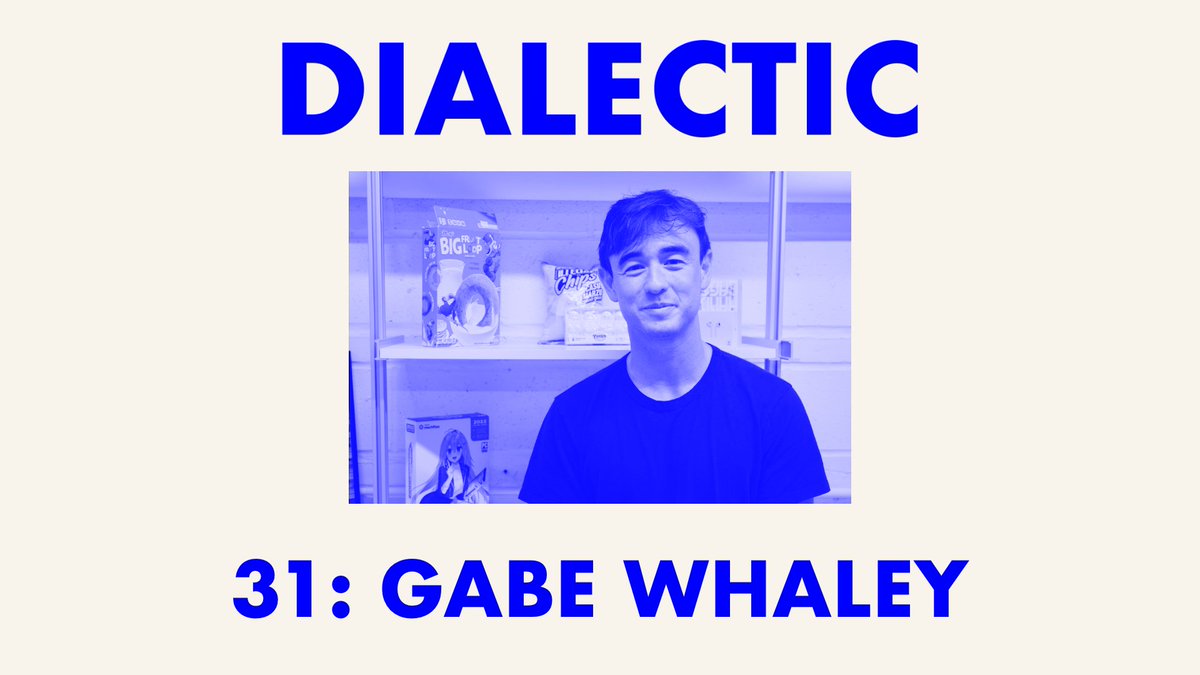
Ep. 31: Gabe Whaley - Playing the Crowd and Outlasting the Hype Gabe Whaley (Gabriel Whaley) is co-founder and CEO of MSCHF (MSCHF), the art collective, fashion and footwear brand, startup, and fill-in-the-blank, famous for its viral products and cultural interventions. A few notable works include Jesus Shoes (Nike Air Max filled with holy water), Severed Spots (a "decentralized" Damien Hirst print), Museum of Forgeries (One original Warhol and 999 perfect forgeries), and of course the Big Red Boot. This conversation was heavily influenced by MSCHF's recently released Made by MSCHF, a "textbook," through which the team peels back the curtain and shows us inside the black box that has produced more viral hits than one can count. Gabe had a sheltered childhood and went to two years of army academy at West Point before eventually finding his way to New York City to intern at Buzzfeed around 2014. In his spare time, he started releasing weird internet projects under the name "Miscellaneous Mischief." After tasting virality a few times, he started collaborating with likeminded creatives and eventually formalized MSCHF in 2019. I've known Gabe for many years (and even did a small collaboration with him from my seat at 100 Thieves). We sat down to reflect on the last 15 years and the arc of MSCHF, what made it special, and where one goes next when virality makes you feel nothing and the internet feels mature. The conversation includes MSCHF's eye-of-the-beholder legibility, their obsession with value, the power of mystery, and how the product doesn't culminate with release, but after the audience has made it their own (in MSCHF parlance, "playing the crowd"). We also discuss the creative process behind the hit factory, how acting as a label rather than individuals changes their relationship to the work, whether the cultural future is actually canceled, how the internet has changed, and how real world experiences offer something to the creator and the consumer that digital life simply can't. We wrap-up by speed-running through many of MSCHF's internal values, from "always punch up," to "death is just as importance as birth," to perhaps its defining frame: "nothing is sacred." I hope you are inspired toward play, originality, embracing discomfort, and having the courage to burn it all down and start anew. Timestamps: 0:00 - Intro 2:21 - Value and Legibility 13:24 - Is the Future Canceled? 20:00 - We Create as a Result of What We Believe In 26:11 - What Makes a Good Remix 29:08 - How MSCHF Relates to the Current Thing and Evolves What Game it Plays 38:31 - Creating Something the Crowd Can Play 44:59 - Emphasis on Craft and Objects Rather than Creating "Lifestyle" 47:27 - Keeping Up in a World That Demands Constant Production 53:11 - Resisting The Internet's Scale and Lack of Friction 1:03:15 - Accidental World Building, Process, Creative Inputs, and Focus 1:14:09 - Creating as a Collective and Gabe's Role in Enabling the Team 1:22:30 - Trust, Shedding the Black Box, and Staying Original 1:30:35 - Applied MSCHF – Doors are Open 1:34:21 - Sarah Andelman, People Who are Still Excited, and Long Time Horizons 1:41:52 - Buzzfeed 1:44:41 - MSCHF Values Available on all platforms and transcript below.

Dialectic with Jackson Dahl

83,389 Aufrufe • vor 11 Monaten