Video wird geladen...

Video konnte nicht geladen werden

Zur Startseite

Our favorite pink-haired, high-jumping jungle boy returns! Alongside creator Tokuro Fujiwara to bring the beloved platformer Tomba to modern consoles via the Carbon Engine, with a new OST by the legendary 🎵おかんp🎹作曲家*藤田晴美🇯🇵HARUMI FUJITA. More info about the physical & digital releases to come 🐷

1,441,603 Aufrufe • vor 3 Jahren •via X (Twitter)

10 Kommentare

Profilbild von 🚶🏽‍♂️
🚶🏽‍♂️vor 3 Jahren

@soundfujita When this announcement 🫠

Profilbild von Ray Almeda
Ray Almedavor 3 Jahren

@soundfujita Ready! @LimitedRunJosh @LimitedRunGames

Profilbild von playoff Octavian
playoff Octavianvor 3 Jahren

@soundfujita No Xbox for Tomba is a beating and an L 😔

Profilbild von Lonelinessman22 #TeamLoneliness🕶️
Lonelinessman22 #TeamLoneliness🕶️vor 3 Jahren

@soundfujita Can you release your games physically in Europe as well?

Profilbild von Dorian ✨
Dorian ✨vor 3 Jahren

@soundfujita YESSSSS!!! My first PSX Game Ever!! 💖💖

Profilbild von The Phoenix Press
The Phoenix Pressvor 3 Jahren

@soundfujita Will you be doing both 1 and 2?

Profilbild von 🖌️ Heaven's Door 🖋️
🖌️ Heaven's Door 🖋️vor 3 Jahren

@soundfujita I WON. I WON SO MUCH. THIS IS MY WIN.

Profilbild von Rickubus ☔️🖋️ VTuber
Rickubus ☔️🖋️ VTubervor 3 Jahren

@soundfujita I'll be sad if the original OP song "Paradise" gets replaced, but they prolly don't have the rights to use the music or instrumental version (what the US got) by Tokyo Q Channel anymore. Ideally I would've liked to see it restored...

Profilbild von Duplakappa
Duplakappavor 3 Jahren

@soundfujita Not even a digital release for Xbox? What kind of partnership is that, @BondSarah_Bond ?

Profilbild von Prisma Popstar Fox 💎
Prisma Popstar Fox 💎vor 3 Jahren

@TheYuriEmpire @soundfujita Will tomba 2 be coming as well? Also does this increase the chance of the canceled Tomba 3 to be revived?

Ähnliche Videos

🚨There are no links in this post. Please be weary of impersonators. The project will not go live until next week and anything stating otherwise is a scam. 🚨 TLDR: On August 24th I’m releasing an inclusive edition generative project called Heart + Craft, in collaboration with Jordan Lyall, on Prohibition.art, priced at 0.01 ETH. Heart+Craft represents a lot to me. It represents an artistic style and medium that I have expressed since 2014. It represents my present curiosity towards demonstrating value for NFTs beyond scarcity, FOMO, and promise of future value utility. And it represents my vision of a digital optional / physical optional future that I believe can be appealing to a broader consumer audience. Heart + Craft illustrates the potential of art and creativity driven generative goods. On the surface, Heart + Craft is a colorful generative artwork that illustrates my eternal love of gradients, contained in the shape of a heart. There are seemingly unlimited possible combinations of colors and blocks that make up each (Zelda inspired) heart container. But beyond the digital object there is potentially also a physical object, and whether you value the digital or the physical more is entirely up to you. Similar to the concept behind the Friendship Bracelets project, created alongside Alexis André, each Heart + Craft iteration contains detailed instructions for producing a physical analogue. And similar to the bracelets, the value of the digital is not diminished if it is ever separated from its physical counterpart. With this project I’m particularly excited about a lot of things including: The intent that rarity is mostly a function of the complexity of assembling the physical sculpture. The idea that this project could inspire people to take a break from our increasingly digital world, diverting attention to making something tangible that lives in their physical space. The opportunity to spread love and good vibes with a relaxing experience, like building a puzzle, that can lead to personal satisfaction while contributing to a more positive and colorful world. The ability to explore new distribution mechanisms for our digital objects via inclusive editions such as developing kits that come with cubes, paint, glue, and the digital ownership certificate all in a beautiful box. Creating goods where digital objects can inspire a love for craft, and a craft that can catalyze curiosity and foster education for digital objects. Offering a low cost and disarming entry point for new consumers into our space through a project that can be enjoyed as a family, or be gifted to tech/art curious friends, clients, and coworkers. Having another opportunity to perpetuate the beautiful spirit of charitable giving culture that occupies our space by donating a portion of the proceeds in support of the arts. Huge shoutout to Jordan and the VenturePunk ▽✱ team for working with me in bringing this idea to life, the Art Blocks team and Art Blocks Engine for building and supporting the technology empowering a #1of1ofx future, all of the collectors who have instilled the confidence in me to put something like this into the world, and the artists that have played such a huge role in elevating the generative medium. And to my wife, who not only inspires me to put myself out there, but supported this insane journey along with friends and family. I’ve been wanting to do something like this for a long time . Hope you like it and make time to touch some paint here soon. ❤️❤️❤️❤️❤️

Erick / Snowfro / 🦩 / LAO / #️⃣ / 🔴

261,765 Aufrufe • vor 3 Jahren

gm! Art Blocks Curated is excited to launch Michael Kozlowski's Bokeh exhibition page! Starting today, everyone can explore more about the exhibition, mpkoz’s process and design, sample outputs, and release details (link in next tweet). Using the Lamp Creator, collectors are also able to explore the endless possibilities of lamp configurations – discover different features, customize wood type, and view the accompanying digital artwork. Your favorite lamps can be saved ahead of the October 16th sale. When the sale opens, collectors can choose to purchase either from their saved lamps or can generate a new lamp (link in following tweet). How to Use the Lamp Creator [Create New] – Generate a new lamp. [Save] – Save the ones you like (up to 200 saves). [Lamp] – View as a 3D render. [Artwork] – Displays each lamp’s associated digital artwork. [HD] – Toggle between standard and high definition renders (HD renders are not optimized for older machines). [Capture] – Take a screenshot to share the lamp or artwork. The Bokeh lamp sale will open on October 16th @ 12pm ET. At this time, collectors can purchase a lamp and corresponding digital artwork for $3,000 USD. The sale is first come, first served with 20 lamps available. Lamps may be purchased with credit card or ETH. Collectors must provide a valid shipping address at the time of purchase. After purchase, buyers will receive an email confirmation and instructions to claim their digital artwork (minted at the time of purchase). We’re excited to see the lamps you create! More details on the October 21st digital artworks auction to come. Fine print: Bokeh physicals can be purchased via credit card or ETH. Shipping is only available in North America (U.S., Canada, & Mexico), the European Union, and the U.K. Shipping and handling is complimentary with all orders, however duties and taxes may still apply at your destination.

Art Blocks

25,173 Aufrufe • vor 1 Jahr

Here Come the Drones "Digital Money, Digital Control – Episode 4: Tokenizing the Planet with Mark Goodwin and Whitney Webb" This week, Mark Goodwin (markgoodw.in)— joined by Whitney Webb (Whitney Webb) —returns with the final episode of his four-part Digital Money, Digital Control series. The topic is “Tokenizing the Planet.” Tokenization, as defined by strategy and management consulting firm McKinsey, “is the process of creating a digital representation of a real thing” on a blockchain network—with the underlying goal being to “make assets more accessible.” Blockchain enthusiasts are marketing the tokenization of real-world assets (RWAs)—from “art and collectibles to real estate, stocks, commodities, and even personal data”—as “one of the most compelling applications of blockchain technology, revolutionizing how we perceive and interact with various forms of value.” In this presentation, Goodwin and Webb pull the curtain back on this agenda, explaining that RWAs, carbon credits, and Earth itself are being positioned to become the new dollar debt sink. Key pillars of the “tokenized play” include the land grab—which we described at length in our Plunder report—and the planetwide surveillance and inventorying of assets that makes plunder possible. By way of illustration, Goodwin and Webb discuss the O.N.E. Amazon initiative, which, as they have written, “seeks to turn the Amazon rainforest into a digital asset security to be chopped up, tokenized and sold off to investors around the world as a novel form of digital credit.” Whatever your role in the financial markets—as an investor, asset manager, financial planner, pension fund beneficiary, or concerned citizen—tokenization has the potential to rock your business and your world, not to mention global geopolitics. You will want to start to learn about what it is and what it means to you. Accessing Goodwin and Webb’s introduction is an excellent way to do so. For more details, be sure to explore some of their articles on these topics at Unlimited Hangout. Full Report: Subscribe to

The Solari Report | Catherine Austin Fitts

16,510 Aufrufe • vor 8 Monaten

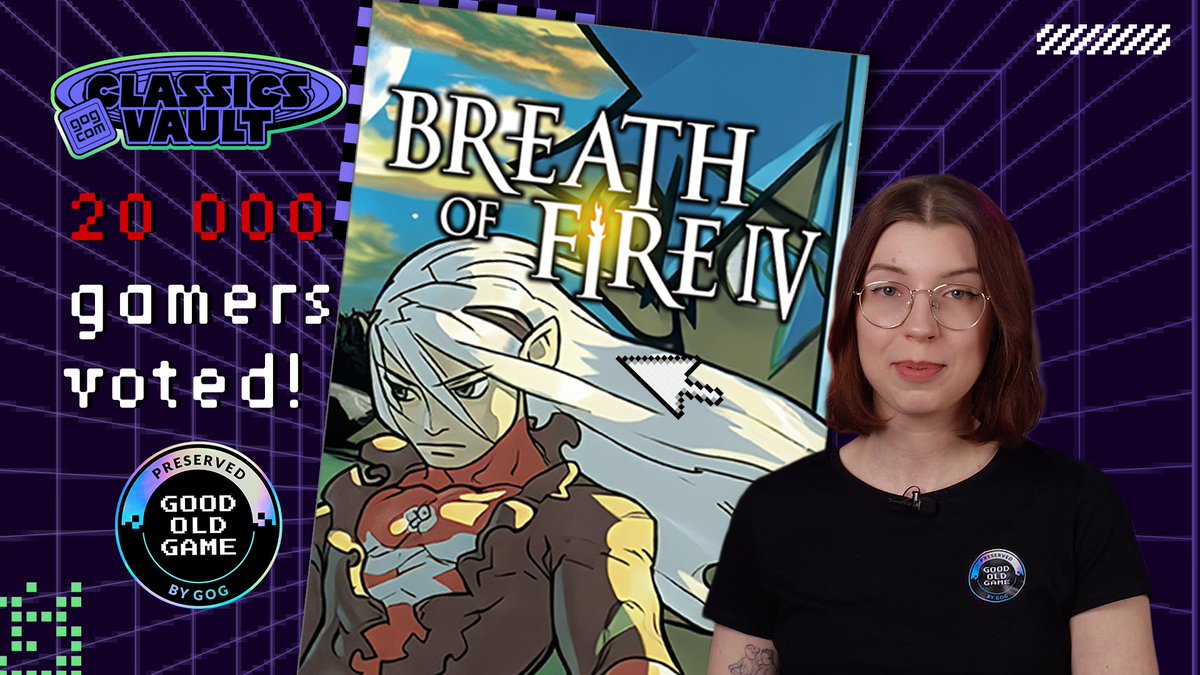
25 years after its original PlayStation 1 release, Breath of Fire IV finally returns, available right now on GOG, thanks to YOU: the incredible fans who championed this legendary JRPG on the GOG Dreamlist 💜 👉 We couldn’t be more excited. This wouldn’t have happened without the support of over 22,000 passionate Dreamlist voters and the fantastic team at Capcom USA, who trusted us to bring you this masterpiece in its very best form. That "very best form" is a reality through the GOG Preservation Program. Our release is fully optimized for modern PCs, with Windows 10 & 11 support, both English and Japanese localizations, upgraded DirectX rendering, new display options (Windowed Mode, V-Sync, Anti-Aliasing, refined gamma correction), and a reworked audio engine (with restored missing environmental sounds & added new sound configuration options). This JRPG classic is now made to live forever 💿 And the great news doesn’t stop there! Eight more iconic classics join the GOG Preservation Program alongside Breath of Fire IV. All over 20 years old, and each a milestone in PC gaming: Ultima Underworld I+II & Ultima 9: Ascension (completing the Ultima series in the Program) Worms Armageddon Robin Hood: The Legend of Sherwood Realms of the Haunting Tex Murphy: Under a Killing Moon Stonekeep Find them all here: Every one of these games helped shape PC gaming history. Now, we’re making sure they’ll inspire new generations for years to come. Back to Breath of Fire IV: Over the next few days, we’ll be celebrating its release and 25th anniversary. Watch for more posts as we share stories, memories, behind-the-scenes insights, and more! Join us as we honor the power of the GOG Dreamlist and the community that made this possible. Thank you for being part of this journey. With your passion, amazing partners like Capcom USA, and the dedication of the GOG community, we’re proving that classic games don’t have to be lost to time. Let’s keep making games live forever together!

GOG.COM

200,005 Aufrufe • vor 1 Jahr

The most important things I can share with the #ufotwitter community and humans at large after having hundreds of contacts with various aspects of the phenomenon: •The "aliens" want us to believe they don't exist at all. If we wake up and realize they do exist, the preferred narrative is they're our space brothers from other planets here to initiate us into the Galactic Federation and by the way, you're a starseed. •Black pilled version: The aliens created us and they created all world religions and we're in a giant ant farm as loosh slaves to be recycled at their pleasure. Life is meaningless in this case, but maybe if we turn away from the light we can escape into the void. •The aliens want us to pursue activities that dissociate us from our bodies in a never ending quest to "raise our consciousness." (If you think about it long enough, you'll realize MKULTRA is designed to do the same thing.) This is because they want access to our bodies and the least accessible person is one who's fully embodied. •They want us to believe there's no good and evil, everything that happens is karma. Raise your vibration and ascend to 5D. •The aliens are here to upgrade us. They abduct/kidnap us and assault us in the worst possible way for our own good. •Any truly negative experiences are coming from humans or it's your own fault for being a negative person. •If you're a positive enlightened person with a high vibration you won't have negative experiences with aliens or NHI. •Christ was just an ascended master or alien hybrid. •If religion makes a showing, there are various narratives that include Lucifer as the good guy trying to liberate us from Yahweh who's the bad guy. Lucifer enlightens us with knowledge and technology and psychic abilities. Yahweh is a dream killer trying to keep humans from enlightenment. What they DON'T want us to understand: •The world religions got a lot of things right. We are living side by side with creatures that exist largely in an unseen realm. •These creatures have been referred to by different names in many cultures since recorded history began. Some modern names are "little g" gods, angels, fallen angels, demons, Nephilim, jinn, asuras, devas, and dare I say aliens. •These creatures can be "good" or "bad" and they're able to interfere with, and influence human activities. They are masters of physics and have advanced technology that can traverse the unseen realm and the physical realm. •Some of these creatures (the "bad" guys) have rebelled against the created order of The Most High God/The Creator God/Yahweh. Their goal is to usurp humanity and our place in the created order, leading us away from following God. •The rebellious creatures want nothing more than for us to follow them to their promised destruction, instead. Thus, there is a cosmic war in the unseen realm between good and evil and the ultimate destiny of every human soul is at stake. •Christ is God come in the flesh, and our soul's destiny in the afterlife is determined by faith and faithfulness/allegiance to the Most High God. •We are choosing sides in this war daily, whether we understand it or not. •The bad guys are brilliant at deception and manipulation and their favorite deception is making us believe they're the good guys. Think about Lucifer appearing as an angel of light. •Following the bad guys and their narrative and advocating for them puts us at odds with The Most High God. •The side we choose will have benefits and/or consequences in this life and the afterlife.

Fringe

62,252 Aufrufe • vor 10 Monaten

Everybody needs a digital ID, say heads of state and high-tech leaders. They give many reasons: it will stop illegal migration; it will increase efficiency; it will protect privacy; and it will prevent online fraud and data ransoming. But we don’t need digital IDs for any of those things. The US just stopped illegal migration without digital IDs. Our online activities are more efficient than ever and it’s hard to see how they could get more efficient without sacrificing privacy and safety. And centralizing data through digital IDs, which could link social media, vaccine, and banking information, in ways that allow government control, would undermine cybersecurity because having separate log-ins for our financial, health, shopping, banking, credit card, and other data makes sure that if one is hacked they aren’t all hacked. “All your information in one place is a hacker’s dream,” said an Oxford University IT expert. “We already have countless ways we can provide our identity – passports, driving licences, and so on.” Many Americans likely think that digital IDs are only something people in Britain have to worry about. Prime Minister Keir Starmer last week declared that every working person there must have digital ID, or “BritCard”. The U.S. should never allow such a thing. A digital ID that linked our social media, vaccine records, and bank accounts could allow governments to censor and control the population, violating our free speech and privacy rights. Those Americans should think again. We are rapidly moving to the exact same digital ID surveillance and control system as the British. Real IDs contain embedded microchips that bring us one step closer to digital IDs. State governors are pushing it. Gavin Newsom last year allowed drivers licenses onto Apple and Google wallets. This “mobile drivers license,” or mDL, is a digital ID, and one more link in the chain. And it is Americans, including Bill Gates and the controlling owner of Oracle, Larry Ellison, who are financing the digital ID push. “ The NHS [National Health Service] in the UK has an incredible amount of population data, but it’s fragmented,” he told Blair in February of this year. “It’s not easily accessible by these AI models. We have to take all of this data we have in our country and move it into a single, if you will, unified data platform… The secret is to get all of that data in one place.” In September, Ellison made clear that he viewed the power of data centralization in behavior change. “Citizens will be on their best behavior because we’re constantly watching and recording everything that’s going on.” Ellison’s Oracle is an AI database cloud computing company and he is its best salesman. Ellison, the second richest man in the world, and owner of CBS and CNN, has “donated or pledged at least £257m to the Tony Blair Institute,” reportedthe New Statesman last week. “Ellison donations have helped it grow to more than 900 staff, working in at least 45 countries.” The nightmare scenario for mass, constant spying on citizens is not theoretical. China in 2019 created a social credit system with rewards that include better employment, school admissions, and shorter wait times in hospitals, and punishments including denial of access to public services and social events, denial of train and air tickets, and public shaming. One study found that at least one-third of total “offenses” were not actually against the law and thus expanded “local government authority into moral and social domains beyond the law,” found researchers. UK’s Big Brother Watched recently warned that a digital ID system, even if initially limited, could be a gateway to more invasive government surveillance and intrusion. Why would any liberal and democratic Western government like Britain want such a thing? Money is no doubt a big part of it. Oracle and other high tech companies stand to make billions taking bits of our money here and there for every transaction. Governments like Keir Starmer’s also seem eager to give them billions in contracts to monitor and analyze the population. We found no evidence Starmer would personally benefit financially from digital IDs, however, and as a political leader, he must consider whether his actions are popular, and digital IDs are not. A YouGov poll released yesterday found UK opinion toward digital IDs was 42 percent in favor and 45 percent against. And given the negative reaction to them online, popular opposition will likely rise. Tony Blair Institute’s (TBI) polling may have misled Starmer. TBI’s first question primed people to think about how inconvenienced they’ve felt without a digital ID, a blatantly manipulative form of polling. No honest pollster seeking to give a client a realistic understanding of how the public thought about digital IDs would have started with that question, because they know the importance of framing. The second question was equally biased. “Some are suggesting the government should introduce a new app, allowing instant access to a range of public services.” The framing suggests awareness on the part of the pollster that the public had a negative view of “digital ID,” hence the use of the “app” euphemism. The third question was “Do you think there is digital technology that could help tackle these issues... Processing asylum seekers and managing the UK’s borders.” One reason to think Starmer relied on the TBI’s biased polling is that Starmer pitched the digital ID as necessary to stop mass migration. “I know working people are worried about the level of illegal migration into this country,” said Starmer. “Digital ID… will make it tougher to work illegally in this country, making our borders more secure.” The notion is absurd. Nations have maintained borders for hundreds of years without the need for digital IDs. Given how badly the Starmer government’s digital ID roll out appears to have backfired, why did Starmer and Blair push it? One possibility is that they really believe in the mission of improving people’s lives. That is already how they justify it. Said Starmer, “it will also offer ordinary citizens countless benefits, like being able to prove your identity to access key services swiftly - rather than hunting around for an old utility bill.” But it is hard to believe Starmer and Blair really viewed the difficulty of finding where you left your utility bill as a high-priority social problem. It appears more likely that they are hiding their reasons and that the real motivation is the same as the Chinese government: to control the population. Gates last year released a Netflix documentary calling for sweeping AI-powered censorship of people he disagrees with on vaccines and other issues. The Starmer government’s digital IDs should be a wake-up call to all of us. For years, various people have been raising concerns about digital IDs but free speech and privacy advocates have clearly not done enough to stop them. That needs to change. The good news is that the backlash to the digital IDs appears strong and growing. And anyone can see that, when they spoke, Blair was taking instructions from Ellison. “You can pipe this data from these three thousand separate data sources into a single unified database,” said Ellison, “and that’s what we need to do.” The episode should wake us Americans up to the continuing threat of total surveillance and censorship. Powerful American high-tech elites see dollar signs in controlling our data — and our behavior. As such, this episode has motivated my colleagues and me to do more on this issue, including making grants to people doing investigative reporting, research, documentary filmmaking, policy development and policy advocacy on digital IDs. Please email [email protected] to get involved, and consider making a tax-deductible donation. And if you’re not already a subscriber, please subscribe now to support our award-winning investigative journalism, which is essential to revealing the truth about censorship and digital IDs.

Michael Shellenberger

1,354,765 Aufrufe • vor 10 Monaten

An open-source, onchain creator platform that never says "no" to creativity. If you ask, "Can I build this here?" - the answer is always yes. Learn more about our vision below 🧵 👁 What is TheCreators? 🚪 A collective of artists, builders, and fine memes reshaping the creator economy. We empower creators to go direct-to-market, bypassing traditional gatekeepers. By bringing creativity and commerce onchain, we're unlocking a new era of freedom. But this isn’t new. This is one of the longest plays. - purchased by rskagy.base.eth 👁️🚪 d/acc #BasedCreators ⏹ in 2012 - was a web2 branding and ad agency until 2021 - working for gamestopNFT and onboarding hundreds of thousands of gamestop apes to buy their first NFTs, something changed, leading to a meeting of minds, and a collective mission to deliver on the promises of web3 gaming. to re-convene at a later date, when the time is right. It has since undergone 4 years of trial and error and battle testing to see what works and what doesn't work when it comes to community owned digital worlds. 🌐 Building a Based World What does it mean to build a based world? To us, it means a world where creators own their work, communities thrive and share an ownership stake in their own distribution, and creativity is limitless. Our platform aims to enable anyone to create immersive experiences - games, events, and digital spaces - without barriers. We’re developing: ✅ AI-powered worldbuilding - natural language prompts generate metaverse spaces ✅ Onchain asset discovery, deployment, & interaction from within virtual worlds ✅ No-code & pro-level tools - Unity-based with deep onchain integration ✅ Plug-and-play templates – for rapid creation and customization by novice 3D and game devs. ✅ Maintained by the open source community We're partnered with: 🏰 Guild - enabling their userbase of 4m+ connected wallets to reward their communities with token-gated towns, games, events, drops, & experiences 👏 liquid 💧 / moved to @clanker_world (USED FOR TESTING NOW) - Official metaverse event partner, building Clankercon 2025 for the clanker ecosystem of 100k+ meme token communities 🤖🎮 FARCAST - Superpowering their vision for agentic gaming with minigames and metaverse tech 🐶 Own The Doge 🐶🖼 - Creating lasting, meaningful impact in the world thru memes & onchain culture. Targeting education, gaming, food, & fun. Do Only Good Everyday 🌏 TheCreators is a global movement, with friends in high places ✨ Watch the video in this post to see an overview of one of the first-party games slated to be released on our platform, "Settlers of Ariel," built by TheCreators Studios. Creators will have access to modular templates, AI-assisted customization, and interoperable game elements built by us, and trained using our AI to enable natural language metaverse building. It's all early-stage, but we're moving fast. ClankerCon and other upcoming projects will showcase the first real applications. Then we grow other creators to publish on the platform. ❓How will we select the first creators to be allowed on the platform? What's next? We will be releasing THEO-0, our onchain AI agent as our next development milestone. This agent will actively run a 24/7 campaign to enable people to vouch for their favorite creators via a limited voting process. Vote for creators you like, and they will gain CREATE points, and you will also gain points for voting every day in a streak. Creators with the most points on the leaderboards will be among the first onboarded to the platform, and all creators with points will be invited to take part in Token Generation Events as each season of leaderboards comes to a close. 1. Help us grow as we look forward to launching THEO-0 2. Be ready to start voting for your favorite creators! How do I become a Creator? If you pour your time, energy, and soul into something special - you already are one. If your mission is to reclaim art and culture from corporate algorithms, & make a more based world for our children, you belong here. Join us. 👁🚪

Create on Base ⏹

28,307 Aufrufe • vor 1 Jahr

Dear LA, The industry is not coming back. In the entertainment capital of the world - “Hollywood” - there are fewer television shows and movies being produced today than when Governor Newsom was arresting people for going to the beach. The downstream carnage is piling up across our city, and we aren’t going to shame or strike or tax our way out of it. Drive down Sunset Blvd and you’ll see countless “Jay Luchs - For Lease” signs draped like flowers at a funeral. Ask your friends working in retail, restaurants, or real estate just how bad things are, and you’ll be reminded that every business in our city flows downstream of the entertainment industry, the sword that LA lives by, and dies by. Rick Caruso, native Angeleno, creator of the Grove, & former mayoral candidate, has recently begun pleading to “bring Hollywood back,” ironically via TikTok, in order to protect all of the adjacent “below the line” businesses. It is the right end goal but the wrong strategy. But what can Mr Caruso do to bring Hollywood back? Ask the unions to ease up? They run this town, even when they cut off their nose to spite their face. Ask Sacramento to give up their fruitless addiction to over-taxation & regulation? It would be easier to convince Count Dracula to give up blood. Ask consumers to change their tastes and abandon TikTok? He’d certainly have my blessing, but that ship has sailed. We can build our way out of LA’s cost-of-housing problem, as Caruso has rightfully pointed out, but more housing alone won’t be enough to save Los Angeles, any more than it would have been able to save Detroit after their own respective monopoly [automobiles] crumbled. Beyond rebrands & gimmicks & political rhetoric, the time has come for a complete product refresh, starting with a reimagining of how LA entertains the world. My idea is simple: pivot Los Angeles from the capital of production to the global capital of LIVE entertainment, events, & hospitality. Almost everyone needed in production, and every business downstream of production, has a year-round parallel role to offer in the AI-proof world of LIVE events. Actors can continue to delight audiences, but with a greater emphasis on in-person performances. Production services can become event logistics providers. And for everyone else it will be an all-hands-on-deck effort to ideate & create the new California dream. Outside of the highly protected walls of Disneyland, a few gated communities in Brentwood, and the smoothie bar at Erewhon we’ve earned a bad reputation. The tourist consensus is that LA is dirty, dangerous, & disappointing. New travelers come to LA as a bucket list item, most vowing to never return, which never seemed to bother anyone, perhaps because previously we just didn’t need their business. We need to become the city that people want to date, not take out for a one-night-stand. And that starts by no longer acting like the prom-queen who peaked in high school. We need to collectively clean up & reorganize our entire city from LAX-it’s uber-lot-from-hell all the way to the open air drug markets surrounding our hotels. And I’m sorry if this hurts Mayor Bass’ feelings, but our inability to manage our addiction & mental health crisis should not be the burden of our guests. The easiest place to start is Hollywood, my home of 18 years. 10,000,000 people travel annually to the Hollywood Walk of Fame despite its dubious honor as “the worst tourist trap in the world.” Imagine a walk-of-fame permanently closed to car traffic, protected by security, with an open-carry-beverage farmer’s market, minus the pushy hustlers, that takes over the asphalt, leaving the stars for guided experiences. Why-oh-why do we expect travelers to care about stars from 50 years ago when we refuse to make any effort to give them minimal context? I see an LA that can take the same movie magic that made it the best marketed city on earth, and use it to deliver a travel experience that warrants a 2nd, 3rd & 4th helping. The Olympics & World Cup both present once-in-a-generation opportunities for Los Angeles to reintroduce itself on a global stage. But these tentpole events should be considered the grand re-opening of LA, not the grand finale. Every celebrity on earth should already be living here, assuming they haven’t fled for their family’s own well being after we seemingly abandoned law & order sometime around 2020, so it is easy to imagine around the clock creator driven events led by Gen-Z stars from Mr Beast to Alix Earle, galvanizing their fan bases alongside our own versions of Graceland for names like Cruise, Hepburn, & Kobe. This plan offers a little bit of something for everyone, even our wealth-gap obsessed activist class, as hospitality outcomes are flatter and more egalitarian, something our Hollywood elite at least claim they want. The biggest challenge to making Los Angeles the LIVE entertainment capital of the world will be getting our political leaders to stop sabotaging us with endless red tape, excuses, and kleptocracy. Rampant political corruption has been enabled by LA’s toothless media who, aside from Elex Michaelson & Bill Melugin - both formerly of FoxLA, have been unable to hold our politicians accountable. Reality TV star turned Influencer turned mayoral candidate (as of yesterday) Spencer Pratt has been effective in keeping the media from completely ignoring the victims of the Palisades fire, but LA still considers my former employers - KTLA & the LA TIMES- to be the watchdogs of record. Without mainstream media support I fear our new media warriors won’t be enough to prevent leaders like Gavin Newsom & Karen Bass from continuing to pillage California with a trail of failed programs, despite bottomless budgets, that make Minnesota’s recently unearthed $18 billion fraud scheme seem like, forgive my pun, kiddie stakes. Can someone please light the Bat-Signal for Nick Shirley? Gotham *cough cough* I mean LA needs him. Some might remember in the last mayor's race when Karen Bass said that if we elected Rick Caruso “he’d just turn LA into The Grove!” I believe the Grove’ification of LA is exactly what we need to successfully pivot as a city, and it would ultimately mean cheaper housing, better jobs for everyone, and happier repeat travelers. So to echo Elex Michaelson, who aptly quipped back at Bass, “what’s wrong with that?” But why hasn’t Caruso declared himself in the next mayor’s race? Maybe it’s because he has his sights set on a California gubernatorial run or maybe he just doesn’t want to risk another disheartening defeat. Not even his inner circle knows what he’ll do next. But I do know one thing… Many of the most successful people in the world call California home and we are going to need them if Los Angeles is ever going to make its comeback.

Darwyn Metzger ⚫️

516,392 Aufrufe • vor 7 Monaten

Exciting update: Coinbase has partnered with Perplexity to help traders get access to real-time trusted crypto data/info for better decision making. The first stage is going live today, and there's more to come: Phase 1 (now): Perplexity is now ingesting our market data, including COIN50, and using it to power market analysis. Users can double click into price moves to help make better informed trade decisions. The demo below shows what it looks like on Comet, Perplexity’s new browser. Also, the Perplexity team shared that just as many users are looking up crypto as equities, which is a cool stat. Crypto is going mainstream. Phase 2 (soon): Coinbase’s market data will be used in Perplexity’s responses to user queries. Traders will be able to monitor market activity, screen for trade ideas, and analyze token-specific moves in an AI-powered conversational interface. This integration was made seamless by our Coinbase Developer Platform🛡️ platform. Love to see more use cases here! I expect enhanced crypto functionality will be a catalyst for AI to achieve another 10x unlock. Personally I’m most excited to see crypto wallets fully integrated into LLMs one day. That will be a huge step towards a permissionless, digital economy. And today, this new access to reliable real-time data via increasingly intelligent LLMs will help lots more people make smart, informed decisions about crypto. It’s a great step forward! Aravind Srinivas and the team at Perplexity are amazing - I’m excited to be starting this journey with them.

Brian Armstrong

813,616 Aufrufe • vor 1 Jahr

Solon Lee (Producer at Kuro Games): Thank You for Playing My Game "Wuthering Waves: Exploring Game Creation Under Unreal Engine." Interview by Nvliu66 When you think of Unreal Engine, what comes to mind? A few days ago, at the Epic Games Shanghai office, I met the producers of Clair Obscur: Expedition 33 and Wuthering Waves. Both games are developed based on Unreal Engine, and they shared the stories behind their game creation. My biggest takeaway was that while a great game stems from a producer's emotional expression, its realization relies on the "escort" of technology. Let's return to the interview scene and listen once more to their unique insights on game development. Wuthering Waves and Unreal Engine Bill Clifford (VP and GM of Unreal Engine at Epic Games): With Wuthering Waves, they used many complex artistic techniques to present this anime style, and it's truly outstanding. They are among the first companies to create a role-playing game in an open world that is also cross-platform, which is another incredible feat. They introduced console-level graphics and combat systems while maintaining a consistent update frequency. Furthermore, as they adopt and integrate new Unreal Engine technologies into the game, the experience is continuously enhanced. It’s a truly inspiring success story. Solon Lee (Producer at Kuro Games): We have grown alongside the updates of the UE engine, including the release of UE5. Throughout the process, we’ve been able to learn from UE’s updates. When UE5 was released, it introduced many new technical features, especially ray tracing. Everyone currently praises the ray tracing effects in Wuthering Waves, which is actually due to the continuous updates of the engine. We found those highlights and ported them over to UE4.26. During this process, our engineers were learning the logic of the engine, following its updates, and developing an engineering mindset and a way of creating visual effects. So, my biggest personal takeaway is that choosing a top-tier engine doesn’t just make the game better; it makes us better in the process. "Punishing: Gray Raven" was developed on the Unity platform, while "Wuthering Waves" is based on Unreal. What was the reasoning behind this change at the time? Solon Lee: Psychologically, we don’t have a heavy dependence. We don't feel that just because we've used Unity, we must continue using it. We are a bit more pragmatic. When we were about to start Wuthering Waves, we clearly knew we wanted to make an open world. UE obviously offers more support for open worlds. We felt that "standing on the shoulders of giants" to make a game was definitely a more practical decision. At that time, we could also sense that most engineers in the industry had an aspiration toward UE. "Wuthering Waves" has been live for a year and a half. At this stage, could you use a short summary or a few words to introduce "Wuthering Waves" to the players? Solon Lee: Wuthering Waves is a game that strives to continuously create resonance with players. From the excitement and design of the action to the scriptwriting and performances, we strive to find "highlight segments" or moments in every version that can trigger internal resonance, touch the heart, or make players "scream" with excitement. This is actually a creative consensus our team has slowly formed over the past year. When we find that moment in a version and we ourselves "scream" for it, we feel that there is a high probability that when the version is released, it will be recognized by the users. Because the most important thing about a game is that it must be fun, as developers, we often think about what kind of game qualifies as "fun." What is a "Fun" Game? Solon Lee: One point I can think of right now is that the rules should be as simple as possible. As soon as you start, after two slashes or casting a skill, you should feel, "Wow, that was so cool! I want to do it again! Wow, so cool!" Specifically for action games, the "fun" is often hidden in very small granularities. For example, if you compare two different games where you are just running and jumping, the running in some games feels fun. Why? It might just be because the "grip" is better, the animation swing feels better, or it gives you a sense of gravity or momentum. Whether a point in a game is fun can be subjective. For me, there are a few games that have had a significant influence on my work. One is definitely NieR; when we were making Punishing: Gray Raven in the early days, we were very inspired by NieR. When Devil May Cry 5 came out, it gave us a lot of new inspiration for our combat system. Death Stranding is indeed one of my personal favorite games from recent years. When Elden Ring was released, it also gave us a very strong impression and touched us deeply. The project for Wuthering Waves started in the first half of 2020. At that time, there were very few open-world action games on the market because most action games back then were stage-based (linear/hub-based). All excellent action games required very tight level design. Later, Elden Ring came out, and experiencing it gave us strong resonance. We felt that action games definitely have potential in an open world, and we believe it should be that way. A Message to the Players Solon Lee: I am truly grateful that so many players like Wuthering Waves. It is because of everyone’s love whether it's encouragement or criticism that we are given a lot of motivation to maintain our continuous passion to make our game better. I believe the only way we can give back to the players who like Kuro and Wuthering Waves is by producing better and better versions and content, and making more and more great games. Happy New Year, and thank you for playing my game. translated by Xu #WutheringWaves #WuWa

Naru

55,609 Aufrufe • vor 6 Monaten

From Creator to Founder: The Rollercoaster Journey of Building Chatter Social Man, what a journey it’s been so far. Four years ago, I was just another creator, spending late nights on Clubhouse during the height of the pandemic. Like so many others, I was searching for connection, for community, for something meaningful. But what I found there wasn’t just connection—it was purpose. Alongside my brother, Jonathan Bing, we built a nightly show that reached over 5 million people. Imagine that: 5 million lives touched by conversations that felt real and unfiltered, all on a platform that at its peak had 10 million monthly active users. Clubhouse was magic. But then the decline began. Watching the platform struggle, I couldn’t help but reflect: what made it great? What went wrong? And what could the future look like if we did things differently? The Spark of Chatter As a content creator, I understood the needs of both creators and users. I knew what excited people, what kept them engaged, and what made them leave. Clubhouse had tapped into something special, but it had missed the mark on scalability and sustainability. By September 2023, I couldn’t stop thinking about the potential for something new—something that brought back the magic of real-time interaction but made it scalable, engaging, and sticky. And so, I set out to build Chatter Social. But I wasn’t a tech founder. I didn’t have a background in software development or a network of Silicon Valley insiders. What I did have was determination and the belief that if I could bring the right people together, we could build something extraordinary. Building the Team The journey to build Chatter started with assembling a team. Through my network from my days on Clubhouse, I found Samir, my first CTO. He believed in the vision and was instrumental in getting the project off the ground. Shortly after, I connected with Tyler, our Head of Design, whose creativity brought life to our ideas. A developer joined us soon after, and we were off to the races. By the end of 2023, Samir had to step away due to other commitments, and we promoted the developer to CTO. At the same time, I brought on Banko, a Sony music executive, as our CMO. Banko’s connections led to one of our biggest early wins: landing Davido, a global superstar, as an owner-ambassador. To this day, I still marvel at the fact that Davido believed in our vision when all we had were Tyler’s Figma designs. From Dream to Reality Early 2024 was a whirlwind. We hired Yurii and Vasyl, two developers from Ukraine who brought incredible skill and dedication to the team. Vasyl, in particular, stood out as a leader and has since earned an equity position in the company. But despite these wins, we were facing growing pains. Our new CTO struggled to meet deadlines, and as a result, I found myself constantly pushing back the launch date. What started as a January release turned into February, then March, then April, then May. By then, people on Twitter Spaces—where I had been hyping up the platform—started doubting if we even had a product. Launch and Lessons June 1, 2024, marked a turning point. It was the day my son Noah was born and the day we launched Chatter in private beta. We started with just 40 users, but by the end of the month, we had grown to 1,000. The engagement was unbelievable. Users loved it, even though we had launched with just one feature: live rooms. This represented less than 20% of what we had planned, but it was enough to show that we were onto something big. In July, we launched our public beta on the App Store as an invite-only platform. Within 48 hours, Chatter ranked as a top 30 social app in over 30 countries. But our invite system throttled access, and most users couldn’t get in. While engagement metrics soared for those inside, our AWS costs exploded. In August, our AWS bill hit $10,000. By September, it had climbed to $15,000, and we were drowning in bugs and glitches. The breaking point came when our CTO became unresponsive, often disappearing during critical moments. Users were dropping off, frustrated by the issues, developers were confused and the team was also growing increasingly frustrated, I made the tough decision to let him go. A New Beginning Enter Horane, a long-time user of Chatter who had been with us since private beta. He was the first to discover some of the most innovative use cases for the platform and had a deep passion for its potential. After meeting him in person at a Chatter event, I knew he was the right person to step into the CTO role. When Horane took over, we discovered just how bad the situation was. Key areas of the codebase were locked, and there were no separate environments for development and production. Every fix seemed to break something else. But through sheer determination and countless 18-hour days, Horane stabilized the platform. Today, Chatter is far from perfect, but it’s stable. The bugs that plagued us have been reduced to moderate issues, and our core users—those who stuck with us through the chaos—are still engaged on the platform. Looking Ahead: Chatter V2 While the platform is stable now, we’ve shifted our focus to Chatter V2. This is where the magic really begins. V2 isn’t just an improvement; it’s a complete reimagining of the platform. It includes all the features we couldn’t release in V1 because we were too busy putting out fires. Imagine this: Chatter V1, with only one live feature, was incredibly sticky. Now think about what happens when we release a fully loaded platform with all the innovative features we’ve been working on behind the scenes. The possibilities are endless. V2 is slated to hit TestFlight by the end of December, with a public release in January 2025. And this time, we’re ready—not just with the product but with the lessons we’ve learned. The Hard Lessons This journey has taught me more than I ever thought possible: 1) Your Team is Everything: The right people can make or break your vision. Finding people who believe in your mission is just as important as finding people with the right skills. 2) Adaptability is Key: As a non-technical founder, I had to learn about development, DevOps, and product management on the fly. Challenges will push you to grow, whether you’re ready or not. 3) Trust the Process: Every setback, every delay, every bug—it all taught us something. Without those lessons, we wouldn’t be building the incredible V2 product we are today. 4) Resilience is Non-Negotiable: From technical disasters to predatory investors who tried to exploit my desperation, I’ve had to fight for this vision every step of the way. What’s Next December is shaping up to be an exciting month. We have some amazing events planned on the platform to close out the year, bringing our core community together as we prepare for the V2 launch. When V2 drops, it will mark a new era for Chatter. This isn’t just a social audio platform or a social audiovisual platform. Chatter is all about interactive experiences—making social media social again in ways that are truly unique. The public launch is slated for February 2025, and for the first time, we’ll have the marketing dollars to tell the world about Chatter. Our core community has been our biggest cheerleaders, and I can’t wait to see how the world reacts when they experience what we’ve built. Final Thoughts This has been the hardest year of my life, but also the most rewarding. To other founders, or anyone thinking about starting a company: know this—it will test you in ways you can’t imagine. You’ll face betrayal, doubt, and moments where you feel like giving up. But if you believe in your vision and refuse to quit, you’ll find a way forward. Thank you to everyone who has supported me, my team, and Chatter. We’re just getting started. Let’s talk about it. 🚀 If this story inspired you, please like and share it so others can learn from my experiences. The journey is far from over, but I’m more excited than ever for what’s to come.

Nelson Epega

43,485 Aufrufe • vor 1 Jahr

Dear ICP community, the Internet Computer has now been running strong for 5 years 👏👏👏 Here is a celebratory preview of ICP "cloud engines," the sovereign frontier cloud technology the network shall soon provide from Main points: — Cloud engines enable anyone to spin up their own sovereign frontier cloud. The technology involves an extraordinary inventive step, in which cloud is created from a mathematically secure network of nodes. The nodes run as part of the Internet Computer network ( but are selected and configured by the cloud engine's owner. — The frontier cloud provided by engines is strongly focused on enabling AI agents to build and update online applications and services for us. The world is changing fast, and nearly all new online apps and services are already being built with the help of AI, and thus cloud engines target the future of cloud. — Software hosted on cloud engines is tamperproof, which means that it is immune to infrastructure hacks, because it runs inside a mathematically secure network protocol, rather than on computers directly. This means that AI agents, and those building with them, don't need to have a security team in the loop, or to trust someone else's security team. This is crucial, because in the future, non technical people will demand the freedom to build with full automation — where they just need to issue instructions to AI about what to build, and don't need to worry about anything or anyone else. Of course, apps and services running on engines are also vastly safer from the new breed of hacker being enabled by frontier AI. (The cloud engines themselves are also "tamperproof." Even if a hacker gains physical access to some portion of a cloud engine's nodes, and can make arbitrary changes, the computations and data of the hosted apps and services cannot be corrupted or interrupted so long as the network's fault bounds aren't exceeded. The recent hack of Vercel, a major cloud platform, which gave hackers access to the apps it hosted, provides additional perspective on the importance of this advantage.) — Software hosted on cloud engines is guaranteed to run, so long as a sufficient number of the engine's nodes are running. This means that AI can build applications and services without the need to have a human systems admin team constantly tinkering with the underlying platform to keep it running, which is again crucial, because in the future, non technical people will expect the freedom to use AI to build without the support of others. — New frontier programming language technology, in the form of the Motoko language developed by Caffeine Labs, leverages seminal "orthogonal persistence" technology that unifies program logic and data to deliver further unlocks for AI (Motoko is the first computer language being developed that targets agents that are writing software rather than humans engineers per se). Nowadays, AI can build and update production apps at a prodigious rate, even at the speed of conversation. But it can also make mistakes, and there's a risk that an update it creates might be "lossy" in the sense it causes some transformed data to be lost. Again, in this new world, it's both undesirable and impractical for everyone to have to have a systems admin team on-hand to detect lossy updates and roll them back, but Motoko provides a solution: it can detect new software updates are lossy before they are applied, reducing potentially catastrophic errors by AI to harmless coding retries. — Software hosted on cloud engines is "serverless" but unlike traditional serverless software, directly it directly incorporates data through "orthogonal persistence." Another key purpose is simplify backend software logic and fuel the modeling power of AI by increasing abstraction (sorry for the technical language!!!). Put simply, this enables AI to produce more sophisticated backends, faster, and at dramatically lower costs, as measured by the number AI API tokens consumed during coding. (Tip for the technical: orthogonal persistence is a new paradigm where "the program is the database," and data lives inside program variables, which is possible because it's as if hosted software runs forever in persistent memory). — An expanding database of skills at shall make it possible to develop and directly deploy apps and services to your cloud engines directly from Claude Code, Perplexity, Codex and other AI platforms. Further, your account on can be connected, so that new apps and updates created through conversation automatically appear hosted from your cloud engine. In the future, R&D is going to be very seamless. You converse with AI, and your secure and unstoppable apps or services are created or updated. Cloud engines are designed to directly support this "self-writing cloud" future where we can work hands-free. — Tech sovereignty is becoming a huge issue worldwide, with governments and corporations seeking to create sovereign tech stacks owing to geopolitical tensions. Increasingly, people are realizing that tech provided by foreign nations can come with hidden backdoors and kills switches, from the base platform, right up through hosted apps and services. ICP technology is open source, and those building on ICP using AI own their own source code. When you have the source code, you can verify that there are no backdoors, and when you own the source code thanks to AI, you can update it at will, freeing you from vendor lock-in. But cloud engines take sovereignty much further... — You create a cloud engine by selecting the nodes that will be combined. You can choose the class of nodes used, and their number, but more importantly, you can choose who operates the nodes, and where they are located. Almost any configuration is possible, because the Internet Computer scales the security privileges afforded to hosted software within the network according to configuration (software hosted on cloud engines can directly interoperate with software on other engines and traditional subnets, but base restrictions are applied according to security rules). A cloud engine can be created within a region such as Europe, to comply with regs such as GDPR, or completely within a sovereign state like Switzerland or Pakistan. But cloud engines go further still... — Sovereignty is also about freedom from vendor lock-in. Cloud engines are essentially ICP (Internet Computer Protocol) network configurations, and this means the underlying compute nodes they combine can be swapped out without interrupting their hosted apps and services. This is a big deal. In addition, cloud engines now support nodes that are instances running on Big Tech's clouds, in addition to nodes that are dedicated specialized hardware, as per the Gen I and Gen II nodes that dominate the Internet Computer today. For example, it is possible to have an engine running across different AWS data centers, say, and then reconfigure the engine to run across a mixture of AWS, Google, Azure and Hetzner for even more resilience, without the users of hosted apps and services noticing a thing. That's true freedom. — Sovereign AI is becoming increasingly important too, and cloud engines allow special "AI nodes" to be added to them, so that hosted software can perform inference on hardware provisioned by the owner from a location the owner has selected. Even though the AI nodes are only accessible within the cloud engine, they can still benefit from the forthcoming Internet Intelligence Gateway (IG), which will make it possible to validate inference performed on key frontier open weights LLMs, even when the inference is performed on completely independent AI clouds. When the results of inference are received, this technology can verify that neither the prompt+context (input) nor the inference result (output) have been modified, and that the results were produced by the precise LLM expected. This ensures that AI clouds don't cheat by running inference on cheaper models than are being paid for, and bad actors aren't modifying the inputs or outputs to surreptitiously insert advertising into results, say, or change facts, or insert malware when code is being generated. What's super cool about this technology is the cost of the verification is scalable. A very valuable additional security can be achieved with only 1-2% of extra cost. — Scaling apps and services when they hit capacity limits is another thorny problem that cloud engines help the world address. Engines make scaling possible without rewriting or reconfiguring software. The query workload capacity of hosted software can be horizontally scaled simply by adding new nodes to an engine, and nodes can also be added in geographical proximity to demand. Meanwhile, update workload capacity can first be scaled-up by swapping an engine's nodes out for the next class up, and then when no larger class of node is available, horizontally scaled-out by "splitting" the engine into two, which doubles available capacity. (Technical tip: horizontally scaling update capacity by splitting engines requires multi-canister architectures). — For those who have been following how Caffeine builds apps that can efficiently store large numbers of files, I should mention that apps built on cloud engines will also support the new ICP Blob Storage cloud network (since cloud engines currently have up to about 3 TB of memory, which apps storing large amounts of files can easily exceed). We are also working on allowing blob storage nodes to be added to cloud engines, to enable sovereign mass blob storage within an engine, similarly to how AI nodes can be added currently. — Lastly, but certainly not least, I should mention that cloud engines are multi-blockchain capable, and ready for digital assets, thanks to the clever math at their core. For example, an e-commerce service built on a cloud engine can securely accept and custody stablecoin payments, or a multi-chain DEX could be hosted. Further, engines can support software autonomy (software orchestrated and controlled by other autonomous software, in a decentralized way) and can themselves be orchestrated by SNS technology, and thus run autonomously too. Today, though, the focus is on *mainstream* cloud. This year, the cloud industry will generate approximately one trillion dollars in revenue. That number is already huge, but is expected to grow to two trillion dollars by 2030. After years of continuous development, which have seen more than $500m spent on R&D, the Internet Computer network is now tacking directly toward this mainstream cloud market with cloud engine technology. In their first version, cloud engines are not meant to be a cloud panacea. For example, currently they are not ideal for working with big data. You should use something like DataBricks for that. Cloud engines are carefully targeted at enabling AI to produce traditional online applications and services, including SaaS, in a safer and more productive way, which represents a new market segment with tremendous potential. Of course, DFINITY will continue to work relentlessly to push forward ICP's capabilities, so expect further developments. It's worth mentioning that this cloud segment isn't just about creating new apps and services using AI, it's also about replacing legacy systems and apps built on super expensive SaaS services. Caffeine Labs is working to produce technology (Caffeine Snorkel) that can study an enterprise's legacy systems and app built on SaaS, create replacement systems and apps, and migrate the data, while supporting key stakeholders through the process over email and chat, with full automation. Thus the legacy systems and SaaS markets shall also be addressed by cloud engines. Zooming out, and reasoning in a more metaphysical way, we believe, as we always have, that there is room for a new kind of cloud created by mathematical networks, that provides seminal advances in the fields of security and resilience, as well as true sovereignty and freedom from lock-in. That this same technology, with the help of additional technologies like orthogonal persistence and Motoko, enables AI to build for us without the need for so much oversight, and to create more backend sophistication while consuming fewer AI API tokens, enables ICP to bring game-changing advances to the world. Cloud engines will work synergistically with the Intelligence Gateway, which will enable apps and services running on engines to seamlessly leverage AI, wherever that AI is running, while providing verifiability at extremely low cost for open weights frontier models. We believe that cloud engines represent an inflection point in the storied history of the Internet Computer project, and I'm very proud to be sharing the details with you on the network's fifth birthday 💪 I'll be back with more news soon!!

dom | icp

291,008 Aufrufe • vor 3 Monaten

Gm! Our recent acquisition of 6529 Gradient #96 meant to orient our mission going forward, after 5 years of grassroots building. Today, we announce our biggest Common Good project yet, Formosa 6529, a permanent IRL exhibition of The Memes and 6529 network NFTs: Catch our founder HugoFaz.6529 on justinaversano's Moments of the Unknown to hear all about it, visit the website above or read more below. Common Goods are meant to reach and benefit the masses. The 6529 network has been funding and buidling over the years a massive public cultural archive of CC0 Art — intellectual property that belongs to all — in a revolutionary change of paradigm. However, the scale and cultural significance of The Memes as an art collection/movement has so far remained largely untapped. Beyond our core web3 communities, few ever get see, interact, much less use this vast archive to... spread the memes of decentralization, foster local creative economies, educate about crypto, monetize with branding, repurpose content, teach and learn creative techniques, or even just to enjoy amazing, groundbreaking art. There is no other CC0 contemporary art project of this scale and importance and the world needs to use it. It's time then we give 6529 its first permanent IRL home so it can be truly appreciated. Enter Formosa, a prime public gallery space built during Brazil's golden modernist years in the first half of the 20th century to host art events that aimed to deconstruct and repurpose the imported, colonialist artistic trends coming from Europe and devise an original brazilian art movement. From fusion restaurants to art schools to performative theater installations, Formosa Gallery thrived through successive occupations until finally enduring decades of abandon and misuse around the turn of the century. Recently, it was set to be restored and given purpose beyond its former glory, and we were there to propose the best possible turnaround for the space... Over years of negotiation with private and governmental parties, we managed to approve with public authorities a double use for the space: a private high-fidelity vinyl listening bar and restaurant — which is already operating — and a 100% public domain digital art gallery. Featuring up to 25 state-of-the-art digital screens ranging from 85 to 50 inches, Formosa 6529 will be the best and largest dedicated permanent exhibition of any web3 project. With rotating exhibitions of The Memes, NextGen and all future 6529 projects, Brain will have direct input on exhibitions via decentralized voting on curatorial proposals made by the community. To give us institutional freedom and censorship resistance, we decided to fully decentralize the funding for Formosa Gallery's installation and operation. Let's find out together what happens when we unleash CC0 art to the public! Daytime, Formosa 6529 will be fully open for free visitation. Occupying a busy public passageway under the historic Tea Bridge linking the Municipal Theatre to the City Hall, intentional visitors and hundreds of passerbys alike will be impacted by the exhibits. We will host many activities to showcase the power of The Memes and CC0 art: royalty-free merch sales by local craftspeople, artist rememe competitions, school guided tours, meme fashion shows, art and tech workshops, and many other activations the network can help us come up with. And every night, the Hi-Fi audience of 300-400 affluent Paulistas and tourists occupy Formosa Gallery sipping drinks and (now) discussing the latest Memes exhibit while waiting for their place in the listening bar. The Fundraiser for Formosa 6529 is open now and runs until November 15th. At a glance : The initial funding will require a minimum of 24 Ξ, which will cover: - All necessary infrastructure and interior adaptations - Equipment purchase and installation - Overhead costs for the grand opening event and for the entire 1st year of operation, opening day and night (mostly human resources – guides, security, tech, comms – and taxes) Funding will happen in 2 stages, the first of which is now open: 30 Meme Card Artists have generously committed to create and donate a new piece for this fundraiser; their names will be announced over the course of these 2 weeks. The unrevealed 1-of-1s are available here: Contributions are fully refundable if the fundraiser does not reach minimum threshold. If we succeed, the works will be revealed live in a randomized draw during the Grand Opening in January. The second stage will consist of a Meme Card, to allow for wider network participation, and only happens after the first stage is successful. Please visit for more information on funding rewards and goals, the FAQ, or reach out here or dm us at 6529 with any questions! This project is only possible due to the power of web3 and the network of believers in a decentralized future powered by NFTs. We can't wait to bring Formosa to life, and to have you here IRL with us for the exhibitions and to have a great time.

CasaNUA.6529

51,095 Aufrufe • vor 9 Monaten

EVERYTHING JAPANESE IS REALLY CHINESE. Seriously? Well, yes. I mean, this title is clearly a generalization, so what it means is that the main cultural items that are widely assumed across the world to be Japanese actually come from China. . 1. Ramen Raman is a Chinese noodle dish, not Japanese. It was brought to Japan by Chinese travellers in the late 1800s. The original Japanese name for it was “shina soba” meaning Chinese noodles. . 2. Japanese writing The Japanese writing system known as Kanji has a name formed of two elements. Kanji literally means Han Writing. Han is the biggest ethnic group in China. . 3. The Kimono This was an adaptation of the type of draped silk clothing from China known as Hanfu. After the start of the Heian period in Japan in 794 AD, it became popular in Japan and started to acquire unique Japanese elements. . 4. Blossom trees Japan’s famous cherry blossoms actually come a tree indigenous not to Japan, but to the Himalayas, which border southwest China—in fact a long way from Japan. The practice of celebrating the annual blossoming of beautiful trees such as the cherry blossom and the plum blossom spread from southwest China to Korea and Japan, taking several centuries to make that journey. . 5. Sushi Sushi is fish with vinegared rice. It is vinegared to give it a pickled taste which is a clue towards its origins: a Chinese pickled dish in which salted fish was wrapped in fermented rice. Even today in Japan, a sushi kitchen is called a tsuke-ba, which means ‘pickling place’. . 6. The Japanese language Japan has its own language, sure – but statisticians say that at least 60 per cent of Japanese vocabulary comes from Chinese origins. . 7. Being ruled by an Emperor In the early 7th century, the Japanese adopted the title of Emperor from China for their own leaders. They used the same Chinese characters, and the same concept that the leader, by definition, was the Son of Heaven. This new rank was then retroactively applied to all past Japanese rulers, who all become emperors and sons of heaven. . 8. Bonsai. The practice of growing miniature trees and creating tiny landscapes developed in China, more than 1,500 years ago. It was known as penjing. The technique was introduced to Japan in the 7th century. . 9. Sashimi It was the Chinese rather than the Japanese who realized more than 1800 years ago that the flesh of certain fish was delicious eaten raw – no cooking necessary. Food historian Jacqueline Newman says that raw fish consumption began in southern China before 200 AD. It came to Japan about 11 hundred years later. . 10. The tea ceremony The tea ceremony originated in China during the Tang Dynasty, which is 600 to 900 AD, as a meditative health practice, before evolving into artistic ritual by the time of the Song Dynasty, which started in 960 AD. It was then taken to Japan by monks, like many Chinese cultural practices. . 11. The board game called GO In western culture, Go is a game associated with Japan. In reality, it is the world’s oldest known board game, originating in China about 4,000 years ago, according to Encyclopedia Britannica. The game was taken from China to Japan in 500 AD, which is “comparatively recently” in Chinese terms. . 12. Green tea Green tea, or matcha, comes from China and has been consumed for probably 4,000 years. It was brought to Japan by monks during the 8th and 9th centuries—very recently by Chinese standards! Two holy men, Saichō and Kukai, are credited with bringing it over the waters to Japan. . 13. Architecture The Japanese admired China’s extraordinarily long-lasting structures made of interlocking wooden elements and there was a lot of temple-building based on Chinese innovations in sixth century Japan. The Japanese capital, Nara, copied the checkerboard street layout of the Chinese capital, Chang’an. But, it must be said, the Japanese afterwards developed many of their own unique architectural elements. . 14. The Asian super-sword It was actually Tang dynasty scientists in China who revolutionized sword-making in the 7th century with a blade called the baogangfa – they fused high carbon steel (which enable sharpness) with low-carbon iron (which provided strength). The result was a blade that could slice through samurai armor. Japanese envoys brought Chinese swords back to Japan in the 700s. To give them due credit, the Japanese improved both the recipe and the design, to eventually come up with the curved katana sword. . 15. Cultural figures One of the most famous pop culture items from Japan is Dragonball. The creator of Dragonball fully admitted that his story was simply a retelling of the Chinese classic Journey to the West. Pokemon, another Japanese modern classic, has many ancient Chinese elements, too – research the nine-tailed fox for example. . 16. Zen An Indian monk named Bodhidharma came to China around 520 AD. His teachings became combined with Chinese philosophies such as Daoism. That led to the development of a practice called Chan, which is how the word Zen was originally pronounced. Records indicate that Chinese Chan Buddhism reached Japan in the 7th century but was not firmly established in that country until the 12th century. . CONCLUSIONS? Okay, there are 16 items – things assumed to be Japanese by many people, but which are rooted in Chinese culture. But there are others. So feel free to add more. Or shoot down the ones I have listed, if you prefer. Why do so many Japanese items come from China? Well, for much of history, China was the cool place, the happening place, the creative place, the dominant cultural center of the most highly populated part of the world. So naturally people wanted to visit it. One ancient record show that between AD 603 and AD 839, the Japanese alone sent at least 17 diplomatic missions to the Tang Dynasty royal courts in China. And I am going to add one more item to my list. Do the Japanese people themselves come from China? A short discussion of that somewhat controversial question comes at the end of the video. Read widely. Peace.

Nury Vittachi

1,198,950 Aufrufe • vor 9 Monaten

During World War 2, a young engineer named Kelly Johnson working out of a circus tent with a skeleton crew developed America’s first jet fighter in less than six months. Twenty years later, the same engineer developed the blackbird spy plane in less than two years. No one believes American industry is capable of that now. American innovation today is not about the physical world around us but about the digital world Big tech wants us to live in and exotic new financial instruments that wall street develops. Look at recent headlines to see what our best and brightest are up to. Facebook spent billions on the metaverse only to abandon it to go all in on AI. DoorDash lets you use buy now, pay later services to pay for your burrito in six equal installments. And in a move that would have Kelly Johnson rolling in his grave, Boom supersonic, a start-up originally planning to bring back supersonic jet flights, announced it will use its research to power an ai data center. If we want to power the future and restore America’s position as the world’s most technologically advanced country, we must do better. We need an America first industrial policy. The Trump Administration’s tariff policy is only one element to address this. Another critical tool to addressing this problem is the power of the federal contract. Trillions spent, headline our government spends trillions of your dollars buying products across the globe. You don’t need a great long-term memory to understand how the international supply chain failures hurt the United States during COVID. It’s one thing to wait six months for a Peloton. It’s another to wait six months for materials needed for our national defense. The defense sector in the United States should be the home to great engineers and doers, not bureaucrats and middle-men. The current status of that sector leaves much to be desired and reflects many of the problems attendant to our administrative state. It is bloated, slow, reliant on timelines, specifications, and proposals, and consolidated amongst a blob of A few major defense prime contractors that gobble up nearly 90% of the defense budget. Meanwhile, the alleged best technological talent in America holds little allegiance to this nation. They reject the notion of even being called American companies, turning their back on the idea of serving the nation to which they owe their existence. Their focus is on profit by selling more and more ads for more and more products made overseas. Their understanding and appreciation of America centers George Floyd above George Washington. What have these people truly invented as of late, anyways? AI generated videos to keep you scrolling? And these are the people, and the major donors as of late, we trust to guide American policy into the artificial intelligence age? This is a problem on both sides. A bloated procurement bureaucracy and defense and tech giants more focused on profit than innovating. We don’t just need government reform, we also need elite reform. It’s time for a renewal and return to a better time when innovation was paired with patriotism, with a government designed to sustain both the good news is that a gigantic federal defense budget provides ample ammunition to solve this problem. We need not only the best and brightest to come and serve their nation in various capacities, but the biggest dreamers. The biggest innovators. America’s engines of production and innovation need to be humming in a rhythm, focused squarely on our global power competition and domestic renewal. With President Trump in office and Secretary Hegseth at the helm of the department of war, this is entirely possible. It is also entirely needed. Let’s make sure American hardware is also hard-wired with the heart and soul of a patriotic class of innovators. Let’s have an America where corporate success requires nationalistic pride. Spirit and duty, it’s happened before and it can happen again. (12/10 monologue on Fine Point w/ Chanel Rion )

Mike Howell

16,205 Aufrufe • vor 8 Monaten

Destiny 2 left a permanent mark on my life. The memories I’ve made with this game, both as a player and as someone lucky enough to work on it, will forever stay with me. Not just because of late nights running King’s Fall with friends, or grinding out the Crucible Glorious Seal in solo queue like a complete maniac, but because Destiny 2 challenged me, shaped me, and pushed me toward becoming the creative I am today. My journey into digital art and photography started back in 2007, when I began taking screenshots in Halo 3 and entering Bungie community art contests. The relationships I built during that time eventually opened the door to an opportunity with Bungie’s Gameplay Capture team in 2014, helping the team capture footage for a new game called Destiny. I had no idea then that a commendably short two-week contract would turn into an incredible 12-year journey with this franchise. I originally came to Bungie hoping to pursue environmental concept art, but along the way I had the opportunity to work on marketing art and quickly fell in love with it. Creating marketing art for a franchise like Destiny challenged me in so many different ways. It forced me to expand my technical, creative, and communication skill sets, constantly adapt, and keep learning new tools and workflows just to keep pace with the live-service beast that was Destiny 2. It means a lot to be able to look back and say with confidence that I had a visual impact on Destiny 2; but the most meaningful part of it all was getting to work alongside and learn from so many incredible artists at Bungie, and seeing firsthand just how much care, effort, and humanity it takes to make work like this possible. It’s hard to fully capture how much energy, skill, and collaboration goes into every visual part of a game like Destiny 2. That work is shaped by artists from different backgrounds, experiences, disciplines, and perspectives. Each of them, including me, left a small part of themselves in what they created. To me, that’s what makes a game like Destiny 2 feel truly meaningful and memorable. Especially now, in a world increasingly saturated with content and driven by instant output and gratification through AI, I keep coming back to the value of process. For me, and for so many of my peers, it was never only about arriving at the final image. It was about the journey it took to get there. The late nights. The iteration. The problem-solving. The trust. The shared pursuit of trying to make something special. To my peers, I’m deeply proud of what we built together, but even more grateful for how we built it. We challenged each other, inspired each other, and kept showing up for one another through every high and low, as Destiny 2 has had many. That kind of shared effort leaves a lasting mark. What we made mattered. What we gave mattered. And the impact of what we built together will stay with us, and this community, for a long time. Shoutout to the current and former members of Creative Studios, the VizD team, and the many Bungie developers and marketers who helped shape this chapter of my life. I’m especially grateful to the teammates who believed in me, encouraged me to embrace failure and new beginnings as essential parts of artistic growth, and pushed me to take on challenges even when they felt beyond my reach. You showed me that the strength of a team will always surpass that of any individual hero. As my work on #Destiny2 comes to a close and I look toward the future, I plan to spend the next few weeks sharing some of the pieces I had the chance to create or art direct that mean the most to me. For now, I’ll leave you all with a collage of some of my personal favorite pieces to work on across Destiny 2’s lifetime. These projects mean so much to me because many of them started as personal passion projects or late-night concept sketches, inspired by playing early builds of Destiny 2 and by the incredible work of our development team.

Biwald

73,183 Aufrufe • vor 2 Monaten