Video wird geladen...

Video konnte nicht geladen werden

Zur Startseite

✨ Pearlescent clouds spotted over Finland — a rare atmospheric phenomenon Officially known as polar stratospheric clouds, they form in the lower stratosphere at extremely low temperatures — around –78°C. Drop your beautiful sky photos in the comments.

45,381 Aufrufe • vor 6 Monaten •via X (Twitter)

0 Kommentare

Keine Kommentare verfügbar

Kommentare vom Original-Post werden hier angezeigt

Ähnliche Videos

Created with Seedance 2.0 on BudgetPixel AI **Format:** 9:16 Vertical | 4K Ultra HD | Hyper-Realistic Fantasy | Epic Cinematic | Fast-Paced | FPV Action **Prompt:** The world's first flying horse race unfolds high above the clouds among massive floating islands suspended in the sky. Thousands of spectators fill floating grandstands and airborne platforms, cheering as majestic winged horses line up at the starting gate. At the signal, the riders launch forward at incredible speed. The camera becomes a high-speed FPV drone, flying directly behind the leading horse as it dives between towering floating cliffs and races through glowing cloud tunnels. Powerful wings beat through the air, scattering mist and sunlight. Rival riders perform breathtaking aerial maneuvers, barrel rolls, steep dives, and near-miss overtakes around ancient sky temples and giant floating waterfalls. The race intensifies as the camera weaves between competitors at extreme speed, capturing dramatic close passes and turbulent air currents. Golden sunlight breaks through the clouds while the floating islands cast enormous shadows across the sky. In the final seconds, two horses battle neck-and-neck above a sea of glowing clouds. The camera surges forward alongside them as they dive toward the finish line suspended between two colossal floating towers. A spectacular photo finish at sunset, golden skies, cinematic lens flares, cheering crowds, epic scale, ultra-realistic details, dynamic motion, volumetric clouds, seamless action, masterpiece fantasy cinematography.

Ai Doctor

27,314 Aufrufe • vor 2 Monaten

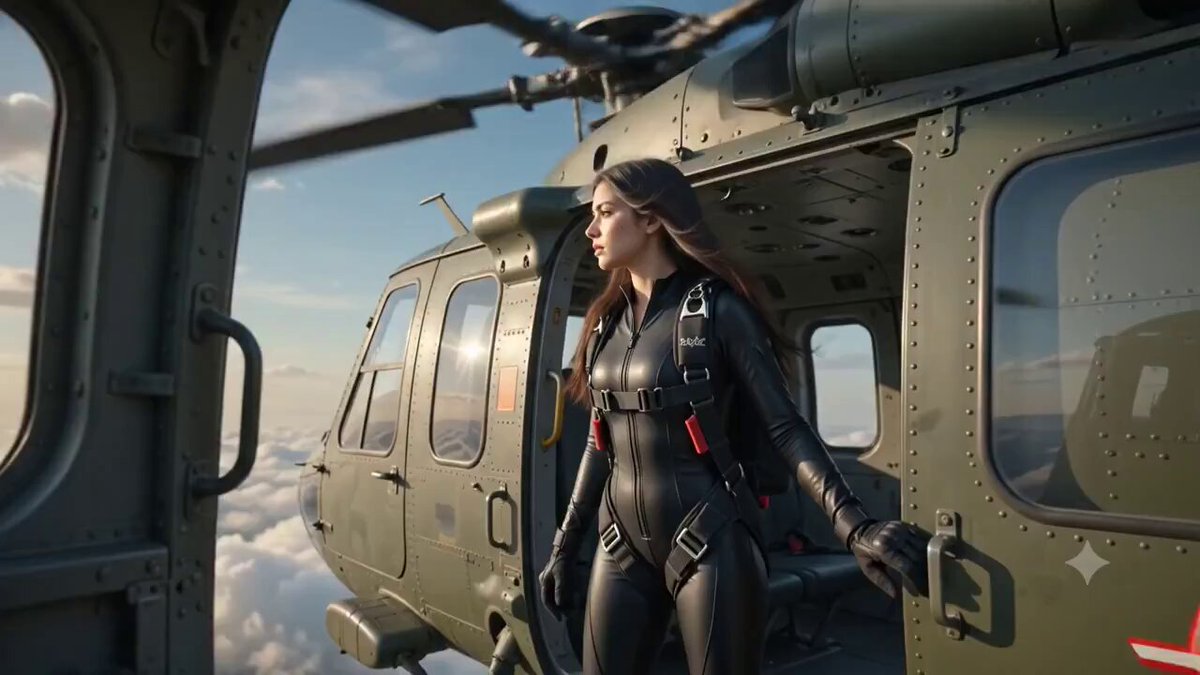
Created with Gemini Nano Banana Pro Prompt: A breathtaking cinematic skydiving sequence begins inside a military-style helicopter flying at 15,000 feet above a sea of clouds during golden hour. The camera slowly moves through the helicopter cabin, revealing a fearless young woman skydiver wearing a sleek black wingsuit-inspired jumpsuit, professional parachute harness, tactical gloves, and aerodynamic goggles. Her long dark hair moves gently in the wind coming through the open side door. The helicopter's powerful rotor blades spin overhead, creating realistic motion blur and dynamic vibrations. Sunlight streams through the cabin, casting dramatic rays and cinematic shadows across her determined face. The camera captures an intense close-up of her eyes as she looks toward the endless horizon. As epic orchestral music builds, she steps to the edge of the helicopter. The camera switches to a dramatic low-angle shot showing the vast sky and breathtaking world below. In slow motion, she leaps into the open air. Time seems to freeze as she exits the aircraft, with tiny particles of dust and sunlight sparkling around her. The camera follows her from multiple cinematic angles: front-facing tracking shots, side-profile action shots, over-the-shoulder aerial perspectives, and wide drone-style views. Her body glides smoothly through the atmosphere as clouds rush past. Her hair flows dynamically in the wind while realistic fabric physics animate her suit and parachute straps. Below her lies an incredible landscape of towering mountain ranges, turquoise lakes, winding rivers, deep valleys, dense forests, and snow-capped peaks stretching endlessly to the horizon. Volumetric clouds cast moving shadows across the terrain. The sun creates golden highlights on the mountains and sparkling reflections on the water. The camera circles around her at high speed while she performs controlled aerial maneuvers and graceful spins. Tiny water droplets and cloud mist pass the lens, creating immersive realism. Lens flares, atmospheric haze, HDR lighting, and cinematic depth of field enhance the visual impact. As the music reaches its climax, she bursts through a layer of clouds into brilliant sunlight. The camera captures a stunning 360-degree orbit around her, revealing the entire world beneath. She smiles confidently while freefalling at high speed. Near the end, she reaches for the parachute cord. Time slows dramatically. A close-up shot shows her hand pulling the release handle. Instantly, the parachute deploys with a powerful burst of motion. The colorful canopy opens above her against a vivid blue sky. The final scene shows her peacefully gliding through the sky as the sun sets on the horizon, painting the clouds with orange, pink, and gold colors. The camera pulls back farther and farther until she becomes a tiny silhouette floating above the majestic landscape. Epic cinematic ending, ultra-realistic visuals, Hollywood blockbuster quality, National Geographic aerial cinematography, 8K HDR, hyper-realistic lighting, realistic wind simulation, volumetric clouds, smooth camera movements, masterpiece, viral social media quality.

Yashal Ai

17,581 Aufrufe • vor 2 Monaten

Beyond the clouds is a fascinating world. What you see here is a picture of a red sprite over a thunder cloud that I took as part of the Thor-Davis experiment from DTU Space ⚡Red sprites are part of the rare phenomena known as Transient Luminous Events, often shortened TLEs, that can appear over thunder clouds. The red sprites form around 40 to 80 km above ground and as you can see in the video from the Davis camera, the red sprites appear after the thunder has struck and much higher up. The Davis camera is special in that it does not take a picture like a regular camera, but like the retina in our eyes that is sensitive to changes in light, allowing it to take up to the equivalent of 100.000 pictures per second. This brings back memories of the blue jet I caught on camera on my first mission in 2015. / En verden over skyerne Det her er et billede af en rød fe over en tordensky, som jeg tog som en del af Thor-Davis-eksperimentet fra DTU. Røde feer er en del af de sjældne fænomener kendt som Transiente Luminous Events, ofte forkortet TLE'er, der dannes over tordenskyer. De røde feer dannes cirka 40 til 80 km over Jorden, og som du kan se i videoen fra Davis-kameraet, kommer tordenen først, hvorefter den røde fe opstår højere oppe. Davis-kameraet er specielt, fordi det ikke tager billeder som et almindeligt kamera, men som nethinden i vores øjne, der er følsom over for ændringer i lys og med det kan Davis kameraet tage op til hvad der svarer til 100.000 billeder pr. sekund. At se en rød fe minder mig om det blå lyn, jeg tog et billede af under min første mission i 2015.

Andreas Mogensen

67,151 Aufrufe • vor 2 Jahren

Y'all see this swirl over the Mediterranean passing south of Benghazi? That's not a hurricane – it's a Medicane. Yes, that's a real term. The word is a portmanteau combining "Mediterranean" and "hurricane." The Mediterranean is too small to support barotropic (tropical cyclones) the scale of conventional hurricanes AND is too far north to support a truly tropical cyclone anyway. Moreover, water temperatures are too cool. (Most tropical cyclones exist over sea surface temperatures of 78 degrees or warmer; the current water temperature off the coast of Libya is about 63 degrees.) Medicanes can and occasionally do reach hurricane strength. The strongest on record was Medicane Ianos, which impacted Greece between September 17-18, 2020. It briefly became the equivalent of a tiny Category 2 hurricane with winds of 95 mph. On rare occasions, a nontropical low can meander over the Mediterranean, and a storm can form that takes on some tropical characteristics. Unlike nontropical cyclones, which are common at the mid-latitudes, medicanes feature a warm core. That requires warm sea surface temperatures. A 2016 study found that medicanes are likely to become significantly stronger by the end of the century in response to warming sea surface temperatures. Tthe researchers found a likelihood for "a higher number of moderate and violent medicanes.” Since 1980, Mediterranean sea surface temperatures have increased between 1 and 2 degrees.

MyRadar Weather

36,923 Aufrufe • vor 5 Monaten