Loading video...

Video Failed to Load

Go Home

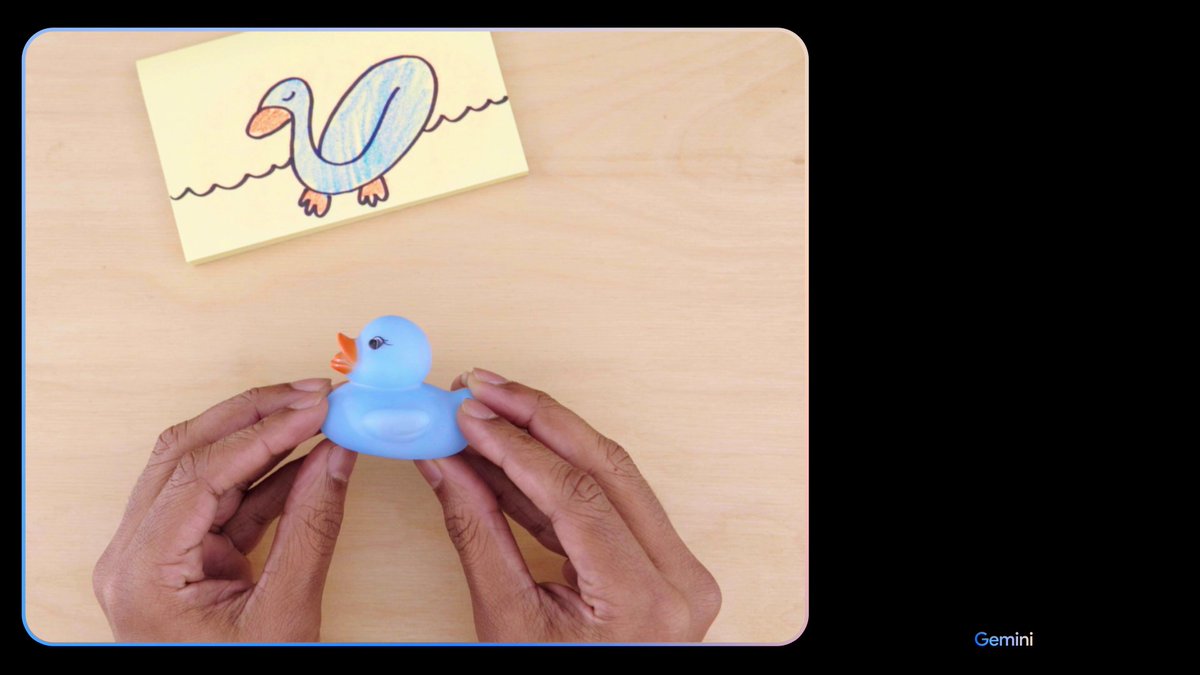
People are finding really creative ways to use EmbeddingGemma 2 beyond search. Instead of running a full multimodal LLM, this community project trains a lightweight classifier on top of EmbeddingGemma 2 in real time. Because the model is compact and natively multimodal, it can learn new categories on the...

96,927 views • 8 days ago •via X (Twitter)

18 Comments

Google Gemma's profile picture
Google Gemma8 days ago

Project by @mmastrac! He also open-sourced the approach as ‘hunch’ if you want to try it yourself: Demo post: GitHub:

Rakesh Gohel 🇨🇦's profile picture
Rakesh Gohel 🇨🇦8 days ago

EmbeddingGemma 2 is proving that you don't need a massive multimodal LLM for every task.

ApexAiTech's profile picture
ApexAiTech8 days ago

Local classification in milliseconds without a huge model is brilliant

Juan Galeas🇭🇳🇨🇦's profile picture
Juan Galeas🇭🇳🇨🇦8 days ago

I am in love with embedding Gemma 2.

Mister SnowCrash's profile picture
Mister SnowCrash8 days ago

Can a category taught with text examples transfer to images in hunch, or does each modality need its own labels? With EmbeddingGemma 2, that could make “teach once, sort both documents and photos” a useful product pattern.

Anand Butani's profile picture
Anand Butani8 days ago

This is great for app builders who need cheap on-device sorting, like tagging photos or flagging support tickets. I'd use EmbeddingGemma 2 plus a tiny classifier instead of calling a big model per item, since it costs far less and keeps data on the phone.

AmirMuhammad Nateghi's profile picture
AmirMuhammad Nateghi8 days ago

This guy should have studied at MIT 😐😅

Shivay Lamba's profile picture
Shivay Lamba8 days ago

Hey @googlegemma is it possible to get a shout out for this project - using EmbeddingGemma model on a @arduino VentunoQ for multi-modal embedding for clothing suggestions 😁

AI Drop's profile picture
AI Drop8 days ago

Detail from the hunch repo: it runs on plain CPUs and only takes over once it agrees with its teacher model often enough, then keeps getting spot checked. Cheap reflexes for agents 🧠

ReignSwords's profile picture
ReignSwords8 days ago

embedding 顶上套个轻量分类器这招太实用了,实时训练加端侧推理,成本直接砍掉一个量级。好奇问下,实时训练的标注是用户现场给的吗?冷启动时类别很少的情况下效果怎么样

Dominik's profile picture
Dominik8 days ago

how small is the classifier trained on top of embeddinggemma?

Stoic Tiger's profile picture
Stoic Tiger8 days ago

Carbon - where is it?

Gabe's profile picture
Gabe8 days ago

Freezing the embedding and only training the head is the real win here — but real-time retraining means your classifier drifts with every new label batch. Version the embedding index or you'll chase ghost regressions.

Bojodanchev's profile picture
Bojodanchev8 days ago

how many examples does a new category need before it holds up? if it's under 10, a support team could train its own ticket router without ever calling an ml person

Max Petrusenko's profile picture
Max Petrusenko8 days ago

a head trained live is only as good as its handful of labeled examples, and drift shows up as inputs landing between categories

Alibel Fragoso's profile picture
Alibel Fragoso8 days ago

Yup nice

Bala Venkatesh's profile picture
Bala Venkatesh8 days ago

Amazing

Alina Fomina's profile picture
Alina Fomina8 days ago

embedding models quietly became the most useful part of the stack. everyone's chasing bigger llms while the real production wins keep coming from small, fast, multimodal embeddings doing 80% of the job at 1% of the cost

Related Videos

Explore state-of-the-art multimodal prompting in our new short course Large Multimodal Model Prompting with Gemini, taught by Erwin Huizenga in collaboration with Google Cloud. One interesting insight from this course: with multimodal models, prompt structure matters significantly. Placing text inputs, such as a patient's medical history, before image inputs, like an X-ray, can enhance the model's ability to contextualize and interpret visual data effectively. In other contexts, such as image captioning, you may get better results by putting the image first. Multimodal models behave differently than text-only LLMs, and effective prompting for models varies depending on the model you’re using. In this course you’ll learn how to effectively prompt Gemini models. Gemini's multimodal capabilities also enable new approaches in AI application development, for example: - The Gemini library handles various video formats (MP4, MOV, MPEG), streamlining applications using these formats. - Large context window (up to 1 million tokens) enables processing of extensive content, like analyzing multiple 50-minute videos simultaneously. - Function calling feature integrates real-time data (e.g., current exchange rates) into model responses. The course demonstrates building multimodal applications with real-world examples including document analyzers that reason across text and graphs simultaneously, video content extractors that find and timestamp specific information from multiple hours of footage, and automated expense report systems processing receipt images while cross-referencing company policies. Sign up here:

Andrew Ng

74,060 views • 2 years ago