正在加载视频...

视频加载失败

Pep Guardiola on the tactics board explaining how to exploit a double pivot by creating overloads in central areas. The key is positioning players between the lines while maintaining width through the half spaces, forcing the opposition to shift and protect one side of the pitch before attacking the...

70,188 次观看 • 3 个月前 •via X (Twitter)

0 条评论

暂无评论

原始帖子的评论将显示在这里

相关视频

Hexagons and Octagons Those who follow football and coaching will be well aware that there are trends that emerge and become the great break through in coaching, only to vanish quite quickly. A few stick around and become a staple. Such as the rondo, or the 4v4+4 Guardiola rondo variation. One that did not stick around in the coaching collective consciousness that possible should have was Thomas Tuchel’s use of hexagonal and octagonal playing areas in training sessions. Tuchel explained that cutting off the corners and angling the pitch forced “sharp diagonal” passes that would help break the press. The positioning of players outside the hexagon/octagon or players close to the edges will be manipulated into an open body shape by the angles of the pitch. Players are impacted by environmental constraints and embodied cognition, where the geography of the playing area influences their actions. This influence spreads to the creation of triangles and diamonds within the playing area due to the “funnel” like nature of the playing area. We can use the cut outside angles by placing bounce or target players on the exterior, influencing the movement and organisation internally. The inside players will not have to move wide as those areas are occupied. The internal players will seek to create passing angles using the positioning of the outside players and their internal team mates. The diamonds and triangles will appear. If we leave the spaces on the outside empty players can move to fill the spaces. These act as free spaces to receive from the goalkeeper or open spaces for attackers to overlap into, encouraging attacking combination play and crosses. A different way of using the space is to remove goals and goalkeepers from the ends and place bounce/target players on the outside. Players now can combine with the outside players, when they do so they are then free to finish into the outside goals. The condition can be extended to combining with the target player in the opposite side of the pitch before scoring, adding an element of switching play. The hexagon and octagon are versatile spaces that help to replicate aspects of the game. By funneling the spaces we impact players body shape, ability to play forward quickly, team shape (or small group shapes), players cutting in, defending centrally, the types of combination used and the angles of line breaking pass (diagonals). The angles are hugely significant for teams that value combinations and possession football, Straight passes and receiving angles are much easier to intercept and carry high risks for being counter attacked. Short diagonals can bypass players and attacking shapes, creating angled connections. If an angles pass is given away there is still a risk of being counter attacked but there is more chance of having players around the ball to regain possession. To counter press. The question that emerges is should we then be using hexagons and octagons more? If they are of greater benefit than squares and rectangles, why use them? Should all pitches, including those of a small sided nature be hexagonal? Can the rondo square be replaced by the rondo octagon?

TheBeardedCoach

13,461 次观看 • 8 个月前

I encourage attackers to drive at the hips of defenders for a few reason; — 1v1 is a duel of footwork (momentum) & angles, the avenue to space is through an angle which can disrupt the opponent’s footwork (momentum) — It offers big-space players a reference to be successful in small spaces — Directly confronting the defender (driving/touching the ball towards their hips [centre]) means you’re moving into their ‘personal space’, which naturally makes humans uncomfortable, increasing the probability for the defender to make an impulsive reaction to your action. • We know Garnacho’s relationship with the ball isn’t watertight, a consequence of his narrow footwork, which reflects in his dribbling & shooting actions —> more specifically, his inability to make many multi-directional touches in his stride + his loose connections with the ball. Because of this he’s more likely to pose threat in bigger spaces, as he’s a willing goal-getter & has fair speed, but struggles to manufacture big enough space for his key actions when the opponents congest space deeper. • What trumps all of this is Garnacho lacking methodology in his dribbling, which would help him maximise his strengths & minamise the affect of his weaknesses. Garnacho drives towards the goal with the intention to cut inside and open an angle on his strong foot, but this angle of approach keeps the defender parallel to the ball (good momentum & maintain footwork) and closer to the space inside that Garnacho wants to take If he had driven at the hips (squared his man up) he could’ve; = pushed the opponent’s momentum onto back foot = reduced the need for sharp COD touches to access the inside angle (his weak point) & maintain his own momentum = kept open bigger space either side of him If you want big space, you have to make it. Targetting the defender’s central point within their personal space can support this.

.

20,569 次观看 • 1 年前

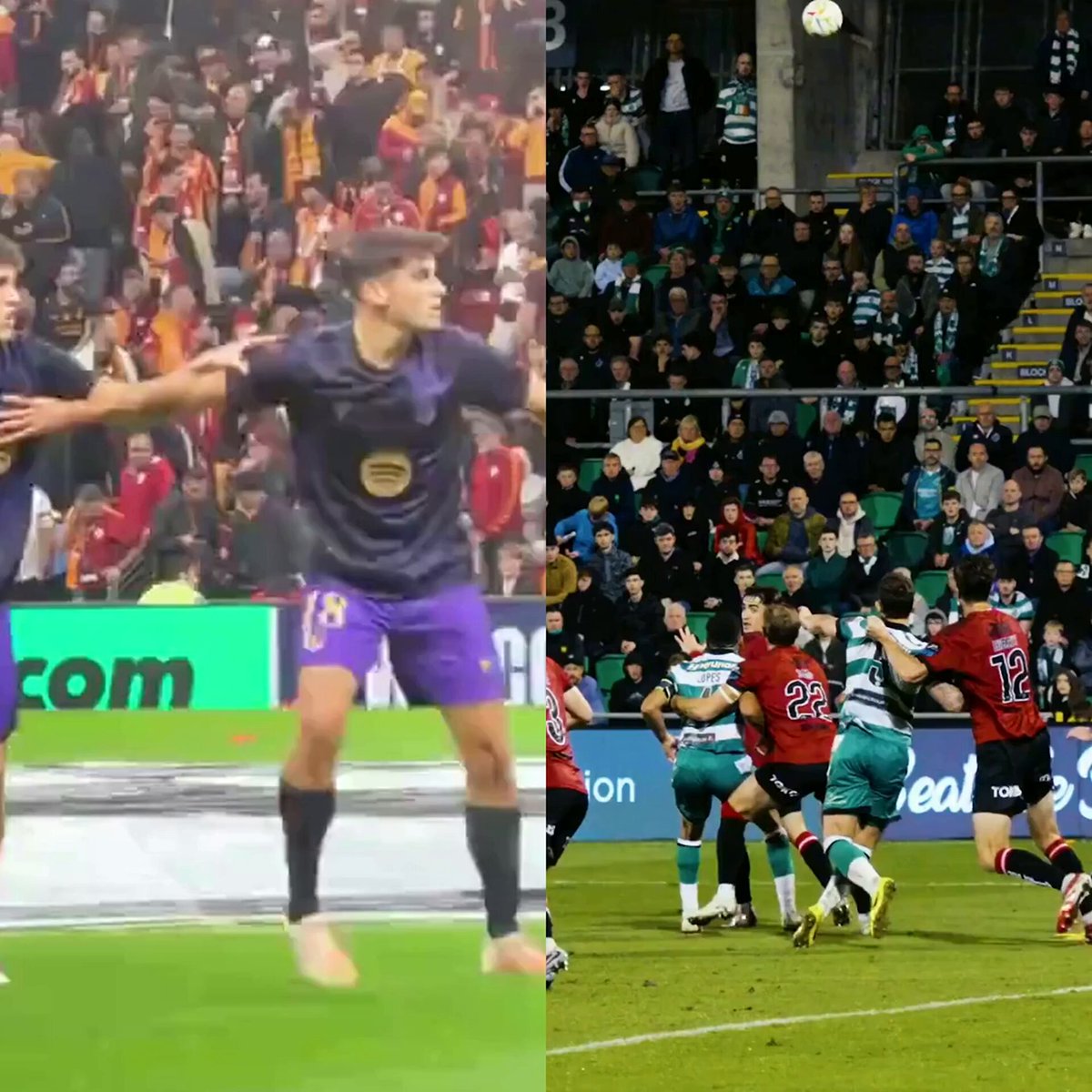
DETAIL IS LEVELS. Monday night’s title race clash in Ireland between Shamrock Rovers and Bohemian FC showed how defensive details decide huge moments. Bohemians conceded directly from a throw in, the most basic goal you can imagine. The ball travelled past three defenders, none able to intervene because they got too close too soon! Watch the contact, not just the finish. The first defender Todd is unbalanced by Lopez’s subtle right arm nudge. The second is pinned, unable to adjust his feet. The third is similarly fixed as the ball reaches the scorer. We hear it constantly: “Get tight. Lock onto your man in the box.” But proximity is not always control. Commit too early and the attacker can brace, lower their centre of gravity, use their arms, absorb your pressure or draw a foul. Meanwhile, you lose the freedom to move. You'll see some of it in the clip. The detail? Distance, balance and timing. Touch tight does not mean physically attached body to body. Use an arm as a legal reference to judge distance. Keep your feet active, your weight balanced and your body free to adjust. The arm prevents you being pinned. Then time your engagement when the ball’s arriving!. The attacker is naturally judging the balls flight, speed, their receiving surface and their next action. Their weight may shift onto one leg, their hips open or their centre of mass move in preparation for that action. Well timed, legal contact from a defender can shift that centre of mass enough to force a balance correction during the forwards technical action. That's intelligent defending! It's way more detailed than simply "get tight!" Now in that scenario a forward must recover balance! The forwards, ankle position, hip alignment and first touch can all change from the timing of that contact being correct. A touch or header intended to travel six inches can suddenly travel eighteen. There is a cognitive detail too. A forward anticipating contact on arrival must have some attention to the defender as well as the ball. That added demand can compromise execution. The key is not how close you get. It is whether you can still move, and when you choose to engage. At the highest level, detail is the difference. Interestingly FC Barcelona include this detail in their pre match heading actions. Not always the most physical side, but one often the most intelligent educated in the fine details when it comes to the art of defending.

Keepitonthedeck

16,225 次观看 • 1 个月前