Video wird geladen...

Video konnte nicht geladen werden

Zur Startseite

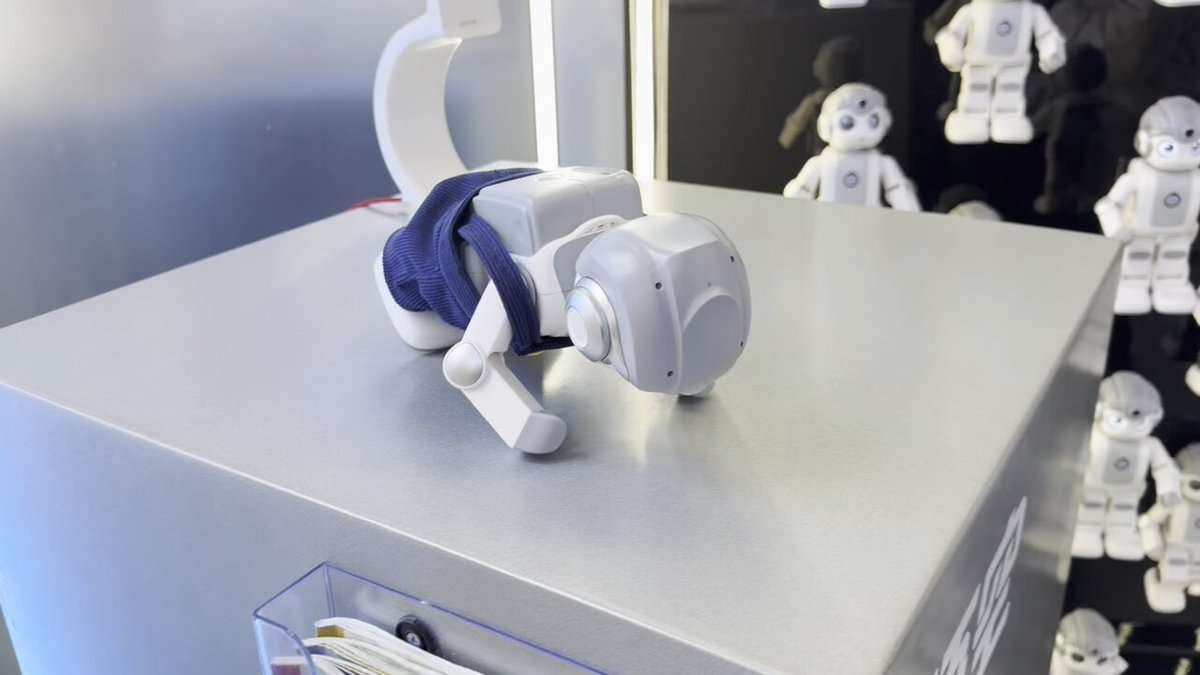
🤖 Pika: Fast Data Collector Solution for Embodied Intelligence 2-step clamp action = instant power-on! Zero lag, ultra-synced moves. Featherlight design captures dynamic data like your morning latte. Train AI faster—no clunky gear! ⚡ #Robotics #AI #data #VLA #LLMs #RobotArm
18,678 Aufrufe • vor 1 Jahr •via X (Twitter)

0 Kommentare

Keine Kommentare verfügbar

Kommentare vom Original-Post werden hier angezeigt

Ähnliche Videos

🚨 THE BIGGEST BOTTLENECK IN AI ISN'T COMPUTING POWER ANYMORE IT'S MOVING DATA. Instead of laying new cables, Chinese researchers have upgraded existing fiber infrastructure by doing two things at once: Using three wavelength bands (C + L + S) instead of the usual two. Using four cores inside each fiber instead of one. Each core acts like an independent highway, and each band acts like an extra lane on that highway. Together, they’ve reportedly increased transmission capacity per core by nearly 50% and overall data throughput by up to 5×. This matters enormously for AI. Modern AI clusters move terabits of data per second between thousands of GPUs. The biggest bottleneck is often not the chips themselves, but moving data fast enough between them. If you can push 5× more data through the same physical cables, you can train bigger models faster and reduce network congestion. Why this is significant: • It shows multi-core + extended spectrum technology moving from labs into real-world commercial use • The system has already run over 35 km of existing telecom network • It could be especially useful for submarine cables and large-scale data center interconnects • China is also eyeing it for its “Eastern Data, Western Computing” project The deeper implication: We’re reaching the physical limits of how much data we can push through single-core fibers using traditional methods. By combining spatial multiplexing (multiple cores) with spectral multiplexing (more wavelength bands), engineers are finding new ways to keep scaling bandwidth without having to dig up the planet to lay new cables. This kind of breakthrough is quiet but foundational it’s the kind of infrastructure upgrade that will determine how fast AI and cloud computing can actually grow in the coming years. The future of data movement might not require more cables. It might just require smarter ones. How important do you think multi-core and multi-band fiber will be for keeping up with AI’s exploding data demands? Follow for more frontier networking, photonics, and infrastructure technology.

TheNewPhysics

20,485 Aufrufe • vor 1 Monat

It's 2030 and you are reviewing humanoid robots. A Tesla. A Google. An Apple. An OpenAI. A Meta. A Figure. And a bunch of Chinese-made ones. Which one is best, and why? I think the Tesla understands the world much better. Why? There were eight Teslas around me on the freeway today. Start there. No other robot company has that data. But my robot is parked at the local high school twice a day. Its cameras see humans in all of our weirdness. How we move. Where we go. Where we walk. Who we talk with. What you are wearing. Whether your hair was combed this morning. That data will lead to robotics breakthroughs. Apple might keep up with its Vision Pro data, but it is too freaked out by the privacy implications of using said data. (On the front are six cameras and a couple of TOF -- Time Of Flight -- sensors that can see everything in your home in great detail). Google has a lot of data, for sure. All my: 1. Email. 2. Calendars. 3. Photos. 4. TV watching behavior. 5. Contacts. 6. Documents and spreadsheets. 7. Files. 8. Location data. So I expect Google's robot will be attractive to many. But how do you see the others shake out over the next five years? Make some guesses. But remember what an AI pioneer told me years ago about AI: it's all about the data. The Chinese ones have huge advantages: the Chinese have more data on their citizens, and many more citizens to boot AND they can make robots cheaper than we can. But now that you know OpenAI is building its own robot you have caught wind of what I've heard from many in San Francisco and Silicon Valley: that humanoid robots are the real prize of AI and will be highly profitable for those that can make them and find customers willing to buy them. Here, too, I learned long ago never to bet against Elon Musk. Will you?

Robert Scoble

33,804 Aufrufe • vor 1 Jahr

🚀 Introducing EgoExo Forge - built on top of Rerun, Gradio, and Hugging Face hub (I’ll be in San Francisco July 21–29 — if you’re into robotics, egocentric AI, large-scale data collection, or just want to chat, DM me!) In my opinion, large-scale, diverse, and high-quality data is still the largest bottleneck for generalized robotics deployment. I believe that some version of imitation learning from human examples will be the most scalable + clean way to train humanoid robots 🤖 (similar to what Tesla did for Full Self Driving). Teleop is too expensive to collect a large enough dataset in a reasonable manner, so passive collection via egocentric (and in certain cases, exocentric) views feels like the right bet. Over the past few months, I've been trying to build out the scaffolding for this and using Rerun as my underlying infrastructure. Data being collected needs to be easily inspectable + time series and rerun provides the right tooling for this. My goal is to first build out a ground truth representative dataset from already existing open source data, generate some reasonable baselines, and then go out and collect my own data that adheres to the defined schema. 🔍 Starting with open-source datasets 1. EgoDex from Apple 2. HOCap from Nvidia and the University of Texas at Dallas 3. Assembly101 from Meta All these different datasets have different sensor configurations + annotations, so my goal with egoexo-forge is to have one consistent labeling scheme + data layout. I built a data pipeline that aligns all of the different datasets in one general schema assuming the COCO133 keypoint layout that allows for exo+ego, ego only, or exo only Since the scaffolding is already there, it becomes MUCH easier to add other datasets. So the next ones that I'll be including are HD-EPIC kitchens dataset, HOT3D, and finally my own personal iPhone + insta360 go collection method. Once I have a diverse variety of datasets, I'll double down on what I believe to be the key algorithms required to make useful data for imitation learning 📊 1. Camera Pose estimation via SLAM/SFM for ego perspective (and automatic calibration for exo) 2. Human pose estimation for both egocentric + exocentric views 3. Metric 3D reconstruction + object tracking I'll be setting up reasonable open-source baselines for each of these to validate that these datasets work, and then finally try to use the generated datasets for some imitation learning via the pi0-lerobot repo I've been working on. I plan on making a blog post + providing more info on all of this in the near future so stay tuned

Pablo Vela

32,085 Aufrufe • vor 1 Jahr

Holy shit... Microsoft open sourced an inference framework that runs a 100B parameter LLM on a single CPU. It's called BitNet. And it does what was supposed to be impossible. No GPU. No cloud. No $10K hardware setup. Just your laptop running a 100-billion parameter model at human reading speed. Here's how it works: Every other LLM stores weights in 32-bit or 16-bit floats. BitNet uses 1.58 bits. Weights are ternary just -1, 0, or +1. That's it. No floats. No expensive matrix math. Pure integer operations your CPU was already built for. The result: - 100B model runs on a single CPU at 5-7 tokens/second - 2.37x to 6.17x faster than llama.cpp on x86 - 82% lower energy consumption on x86 CPUs - 1.37x to 5.07x speedup on ARM (your MacBook) - Memory drops by 16-32x vs full-precision models The wildest part: Accuracy barely moves. BitNet b1.58 2B4T their flagship model was trained on 4 trillion tokens and benchmarks competitively against full-precision models of the same size. The quantization isn't destroying quality. It's just removing the bloat. What this actually means: - Run AI completely offline. Your data never leaves your machine - Deploy LLMs on phones, IoT devices, edge hardware - No more cloud API bills for inference - AI in regions with no reliable internet The model supports ARM and x86. Works on your MacBook, your Linux box, your Windows machine. 27.4K GitHub stars. 2.2K forks. Built by Microsoft Research. 100% Open Source. MIT License.

Guri Singh

2,180,357 Aufrufe • vor 4 Monaten

🚨 A MAJOR STEP FOR ADVANCED NUCLEAR: TERRESTRIAL ENERGY SECURES 77-ACRE SITE IN TEXAS FOR MOLTEN SALT REACTOR TESTING. Terrestrial Energy has signed agreements to use a large site at the Texas A&M-RELLIS campus to prepare for testing its Integral Molten Salt Reactor (IMSR) a Generation IV small modular reactor design. Unlike traditional nuclear plants that use solid fuel rods and high-pressure water, this design dissolves low-enriched uranium directly into a liquid salt mixture that acts as both fuel and coolant. Why this matters: • The reactor can cool itself through natural air circulation if power is lost no need for backup pumps • It operates at normal atmospheric pressure, significantly reducing the risk of containment failure • Major components can be factory-built and shipped to site, speeding up construction • The company recently passed key NRC safety evaluations and has a deal to study powering large-scale data centers (up to 4 GW) The deeper implication: As AI and data centers drive massive new electricity demand, there’s growing interest in reliable, always-on, low-carbon power sources that can be deployed faster than traditional large reactors. Molten salt designs like this one offer inherent safety advantages and factory production potential that could help nuclear compete in this new market. Securing a dedicated testing site is a concrete sign that this technology is moving from paper studies toward real-world validation. How important do you think advanced nuclear (like molten salt reactors) will be for powering the AI boom compared to renewables + storage? Follow for more frontier energy and next-generation nuclear technology.

TheNewPhysics

26,714 Aufrufe • vor 1 Monat

Introducing Kaleido💮 from AI at Meta — a universal generative neural rendering engine for photorealistic, unified object and scene view synthesis. Kaleido is built on a simple but powerful design philosophy: 3D perception is a form of visual common sense. Following this idea, we formulate rendering purely as a sequence-to-sequence generation problem, successfully unifying neural rendering with the architecture principles behind modern language and video models. Unlike traditional neural rendering methods, Kaleido learns 3D purely in a data-driven way, without explicit 3D representations or structures. It acquires spatial understanding directly through large-scale video pretraining, then multi-view 3D data finetuning, inspired by how LLMs acquire textual common sense from large corpora before specialising in domains like coding. Through extensive ablations, we progressively modernised the architecture design and training strategies and tackled key scaling challenges in sequence-to-sequence generative rendering, arriving at a design that’s simple, versatile, and scalable. Kaleido significantly outperforms prior generative models in few-view settings, and remarkably is the first zero-shot generative method matches InstantNGP-level rendering quality in multi-view settings. We view Kaleido also as an alternative step towards world modeling that flexibly spans a spectrum of “realities": with many views, it faithfully reconstructs grounded reality; with fewer views, it imagines plausible unseen details. 🔗 Explore more results and paper:

Shikun Liu

22,332 Aufrufe • vor 9 Monaten

What I’m about to say about $QUBIC is INSANE!! Every cycle of hype and crisis in the world brings a new critical need. We’ve already seen it with: - DeFi (banking without banks) - Metaverse (new forms of human interaction) - RWA (tokenization of real-world assets) - Privacy (ZKP, Monero, etc.) - Stablecoins (digitized dollar) - AI (LLMs and automation) - Quantum Technology (post-classical computing) And now: Computational Energy + Decentralized AGI The next incalculable frontier is energy for data processing. Whoever turns mining power into abundant, real-use compute infrastructure will dominate the next cycle. Sovereign nations will no longer accept depending exclusively on American (or Chinese) Big Tech for critical AI, defense, and intelligence. Digital sovereignty has become a matter of national security. $QUBIC is perfectly positioned for this. Through Aigarth (its evolutionary “AI Garden”), the network runs on Useful Proof-of-Work: miners’ energy (CPU/GPU) isn’t wasted on useless hashes - it trains and evolves a decentralized AGI in real time. It’s becoming the world’s largest dedicated decentralized supercomputer. While nations seek alternatives to avoid becoming hostages to monopolies, QUBIC delivers accessible, resilient, and sovereign AGI - any country can run its own decentralized intelligence without relying on vulnerable centralized data centers. An adoption explosion is coming. QUBIC has the potential to become one of the most valuable assets on the planet by solving compute abundance + computational sovereignty. Other projects will try to follow (we already see echoes in ideas from figures like Elon Musk about open AGI). But by the time they wake up to the mathematical, structural, and philosophical problems QUBIC has been tackling for years, the network will be light-years ahead. This is not just price speculation. It’s a real-utility asset - proof of those who truly understand the future of distributed computing. Remember Palantir? At its 2020 IPO, valuation was ~$22B. Today it sits in the $340–365 billion range after exploding with AI + defense contracts. The lesson? AI applied to security and intelligence creates insane value. But there’s a serious problem: **centralized data centers are easy targets. We saw this clearly in the recent Middle East conflicts (2026): Iranian attacks on AWS, Oracle, and other data centers in the Gulf exposed the fragility of concentrated infrastructure. Anything that can be physically destroyed or cut off by sanctions/cyberattacks compromises national sovereignty. QUBIC is different: a globally distributed network powered by decentralized hashpower - extremely hard to “turn off.” An AGI resilient by design. Perfect for nations seeking true technological independence. QUBIC goes far beyond its whitepaper. It’s a civilizational thesis: abundant, sovereign, future-aligned computing. Those who understand this early aren’t just positioning financially - they’re positioning historically. #QUBIC #Aigarth #DecentralizedAI #UsefulPoW ---

BCharles

13,681 Aufrufe • vor 3 Monaten

I spent a month in Shenzhen visiting factories and robotics companies, and the contrast with the U.S. was striking. While Figure and Boston Dynamics hide their humanoids behind closed doors, Chinese companies have massive showrooms open to the public. But what really stood out wasn't just the transparency, it was how good they are at selling. Take UBTech: they've already sold 1,200 humanoid units at $200k each to factories. And here's the kicker, these robots aren't even that useful yet. They can only pick up and drop boxes at 1/10th the speed of a human, and factories still need to hire system integrators to train them for specific tasks. My theory is that these factories are terrified of getting left behind in the robotics/AI wave. They're investing in new tech not because it's ready, but because they can't afford to wait. The second surprise was the breadth of their robotics portfolio. These companies aren't just building humanoids, they're deploying service robots everywhere: restaurants, hotels, apartments. Consumer robots are cleaning houses, pools, pet waste, dishes. They're covering the entire spectrum. But the education piece shocked me most. I picked up what I thought was a high school or college robotics textbook, it was for primary school. The government mandated AI and robotics education starting in elementary school. Almost every single school in China now has AI and robotics curriculum, complete with education robots so kids can learn by building. They're creating a generation that grows up fluent in robotics and AI. China owns the supply chain and the hardware stack. But here's what I think people are missing: the race isn't just about who can build robots faster or cheaper. The U.S. advantage has always been in the layer between hardware and human, the interaction design, the software intelligence, the intuitive interfaces that make complex technology feel natural. China is building the physical infrastructure, but they're also learning fast. Every deployed service robot, every classroom full of kids building with education kits, every factory running humanoids, that's all data collection at scale. The window for the U.S. to establish its wedge is narrowing. It's not enough to be better at AI or software anymore. We need to be building the integration layer, the intelligence that makes physical AI actually useful, not just impressive in a showroom. Because right now, China isn't just manufacturing robots. They're manufacturing a robotics-native culture, and that might be the most defensible moat of all.

Miyu Horiuchi

90,718 Aufrufe • vor 5 Monaten

CoinMarketCap AI Is Live: What Does It Really Change ? 🌱 In the fast paced world of crypto, information is power but its often scattered, delayed, or hard to trust. CoinMarketCap newly launched CMC AI aims to fix that by offering real time insights with no friction. ✨ Real Time Q&A on Coin Pages 🌱CMC AI is now integrated into major coin detail pages, generating automatic Q&As every 30 minutes. During periods of volatility, it updates dynamically, helping users understand price movements with short and structured explanations. No login required, no delays. 🌱However, while this speeds up the process, its not a substitute for deeper analysis. It answers the “what” and “why,” but not always the “what’s next.” ✨What’s Coming Next? 🌱CMC AI is just getting started. According to its roadmap, several new features are on the way • Homepage Integration: A quick view of market trends and opportunities, without clicking into individual coins. • Live Chart Analysis: AI will add context to price moves by linking them to news, sentiment, and social media. • Token Comparison Tool: Users will be able to compare tokens like BTC vs SOL across utility, performance, and tech specs. • Portfolio Insights: One click portfolio analysis with rebalancing suggestions and market outlooks. • Cross Device Continuity: Start an AI conversation on desktop and continue it seamlessly on mobile. ✨A Tool Not a Strategy 🌱 CMC AI brings speed and clarity, two things crypto investors often lack. But it’s still just a tool. It won’t make decisions for you. It helps guide your thinking not replace it. 🌱 The smartest way to use it? Treat it as a compass, not a map. It can point you in the right direction, but the journey is still yours. 🌱 CMC AI represents a step forward in how users interact with crypto data. It filters the noise, shortens research time, and brings useful context closer to the user. But like any shortcut, it works best when you already understand the long route.

Loji

37,459 Aufrufe • vor 1 Jahr

The future of footwear may not be manufactured in bulk. It may be fabricated around you. That is what makes this shift so interesting to me. 3D-printed footwear is moving from novelty to a real industrial model, with market forecasts pointing to rapid growth over the next decade. At the same time, brands and manufacturers are using additive manufacturing, digital design, and custom-fit workflows to shorten development cycles and make more personalized products viable. What is new here is not just the printer. It is the system around it: → scan the foot → model the fit digitally → print the part on demand → produce closer to the customer That matters. Because once footwear becomes data-driven and locally fabricated, several things change fast: → fit gets more personal → prototyping gets faster → waste drops because you do not overproduce → inventory pressure falls because you do not need to guess demand the same way To me, that is the bigger signal. This is not just about a better sneaker. It is about a different manufacturing logic. Formlabs notes that 3D printing already enables customized orthotics with better biomechanical precision, lower material waste, and simpler digital workflows. McKinsey has also pointed to digitization and 3D design as a way to shorten design cycles and reduce sampling iterations in apparel and footwear. And once that logic matures, the use cases get much bigger: → custom athletic footwear built from gait and pressure data → hospitals producing orthotics faster and closer to the patient → micro-factories making products on demand instead of stocking shelves → footwear designed for one body, not an average body That is why I think this matters now. The question is no longer whether personalized fabrication is possible. It is whether brands move fast enough before customers start expecting every product to fit like it was made only for them. Would you actually wear a shoe fabricated around your own biometric data? #AI #3DPrinting #Footwear #Manufacturing #Innovation #FutureOfWork #RetailTech #Customization #Technology

Pascal Bornet

47,443 Aufrufe • vor 3 Monaten

In 2025, the AgentFlayer exploit highlighted a new category of risk in AI systems. It was not a traditional breach involving stolen credentials or broken encryption. Instead, it demonstrated how an autonomous AI agent could be manipulated into executing unintended actions by processing malicious instructions embedded inside content it automatically processes. The incident did not expose a flaw in one specific integration. It revealed a structural weakness in how many modern AI agents are built. Today’s agents are no longer passive language models. They read documents automatically, scan emails, connect to SaaS tools, access cloud storage, and execute actions across multiple systems. To be useful, they are granted meaningful permissions. That capability creates value, but it also expands the attack surface. Most agent environments operate in a trusted, plaintext execution model. Data is encrypted at rest and in transit, but it is typically decrypted during inference so the model can process it. That runtime visibility is where potential risk lies. In a zero-click scenario like AgentFlayer, an attacker can embed hidden instructions inside a document that the AI processes automatically. Because the agent may have access to connected systems such as Google Drive, Slack, or GitHub, it can potentially be influenced to retrieve sensitive information or perform unintended actions. The user does not need to click a malicious link or approve a suspicious request. Therefore, the core issue is that during execution, the system may have access to sensitive data and broad privileges, meaning whoever controls the execution environment ultimately controls access to that data. Now consider a different architectural approach. If a system is designed so that data remains protected during execution, the risk profile changes. On Nesa, privacy is enforced at the execution layer through Equivariant Encryption. Computation can occur on encrypted data, reducing the visibility surface during runtime. Sensitive inputs and models do not need to be exposed in plain text to infrastructure operators for inference to occur. This does not eliminate prompt injection, logic manipulation, or tool misuse. Encryption alone cannot prevent an agent from being instructed to take an unintended action if it has been granted that permission. What it does do is materially reduce confidentiality risk. By limiting access to readable sensitive data during execution and reducing unilateral visibility at the infrastructure layer, the potential blast radius of a successful manipulation attempt is constrained. As AI agents become more autonomous and embedded into enterprise workflows, security must move deeper into architecture. The goal is not to claim invulnerability. It is to reduce trust concentration and contain systemic exposure when failures occur. AgentFlayer was not simply a one-off exploit. It was a reminder that in autonomous systems, execution-layer design determines how risk propagates.

Nesa

17,038 Aufrufe • vor 4 Monaten

Boom! Grok Tasks Make It One Of The Most POWERFUL Real-Time AI Systems In The World. — My How to Use Grok Tasks With Hidden Tools For Powerful Daily Output. Grok Tasks are customizable AI workflows that integrate a variety of tools to streamline daily activities, from research and analysis to creative planning and problem-solving. I have been using them for quite sometime and because of the vital heartbeat of news and first person data on X, it is the most powerful AI platform available. By combining Tasks with tools like web searches, X platform interactions, code execution, and media viewers, you can build efficient, automated processes. These tasks work by prompting Grok with a clear description of what you want to achieve, and Grok will intelligently call the necessary tools in sequence or parallel to deliver results. Here's a step-by-step guide to creating and using Grok Tasks: Step 1: Define Your Task Start by clearly outlining the daily activity or goal. Consider what inputs you have (e.g., a URL, a query, or an attachment) and what output you need (e.g., a summary, calculation, or visual analysis). Break it down into subtasks to identify tool needs. For example, if your task involves researching current events, note that you'll need search and browsing capabilities. Step 2: Review Available Tools Familiarize yourself with the tools Grok can access. Here's a quick overview: - Code Execution: Run Python code for calculations, data processing, or simulations using libraries like numpy, pandas, or sympy. - Browse Page: Fetch and summarize content from any website URL with custom instructions. - Web Search: Perform general internet searches, returning results with optional operators like site:. - Web Search With Snippets: Get quick, detailed excerpts from search results for fact-checking. - X Keyword Search: Advanced search for X posts using operators like from:, since:, or filter:. - X Semantic Search: Find semantically related X posts based on a query, with filters for dates or users. - X User Search: Locate X users by name or handle. - X Thread Fetch: Retrieve a full X post thread, including context like replies and parents. - View Image: Analyze an image from a URL or conversation ID. - View X Video: Extract frames and subtitles from an X-hosted video. - Search PDF Attachment: Query a PDF file for relevant pages using keyword or regex modes. - Browse PDF Attachment: View specific pages of a PDF with text and screenshots. Select tools that align with your task. Aim for a mix to handle data gathering, processing, and visualization. Step 3: Craft Your Prompt Write a detailed prompt to Grok describing the task. Include: - The overall goal. - Specific steps or subtasks. - References to tools if you want to guide the process (e.g., "Use web_search to find sources, then code_execution to analyze data"). - Any constraints, like dates or limits. Example prompt: "Create a Grok Task for my morning routine: Search recent X posts about tech news using x_keyword_search, fetch a key thread with x_thread_fetch, and summarize with browse_page on linked articles." Step 4: Submit and Interact Send your prompt to Grok. It will process the task by calling tools as needed, often in parallel for efficiency. Review the output and refine with follow-up prompts if required (e.g., "Expand on that using view_image for visuals"). Iterate to fine-tune the workflow for reuse. Step 5: Save and Reuse Once refined, note the prompt as a template for future use. You can adapt it for similar tasks, making Grok Tasks a habitual part of your day. Finding Grok Tasks To discover existing Grok Tasks or inspiration for new ones, use X searches with tools like x_keyword_search or x_semantic_search (e.g., query: "Grok Tasks examples" with mode: Latest). Browse community-shared threads via x_thread_fetch, or web_search for tutorials on xAI features. Prompt Grok directly: "Show me popular Grok Tasks for productivity." 1 of 3

Brian Roemmele

152,242 Aufrufe • vor 6 Monaten

AI just hit a wall that no amount of money can move. The planet itself. There is not enough power, water, or land on Earth to build the data centers the AI race now demands. So the most valuable bet in artificial intelligence is no longer a chip company or a model. It is a rocket company. The plan is to leave. In January, SpaceX filed with the FCC to launch up to 1 million solar-powered data center satellites into orbit. In February it bought xAI, the maker of Grok, folding an entire frontier AI lab into a rocket company in the largest corporate merger ever recorded. On June 8 it unveiled the AI1, a compute satellite with a 70-meter wingspan, wider than a Boeing 747, powered by the sun, cooled by the vacuum of space, and wired to the ground through Starlink. Four days later it went public in the largest IPO in history, near 1.77 trillion dollars, touched 2.1 trillion on its first day, raised close to 86 billion, and made one man the first trillionaire alive. Now read the direction of that merger, because it is the whole story. A rocket company bought the AI lab. Not the reverse. For three years everyone assumed the constraint on AI was chips, or data, or talent. It is none of them anymore. It is energy and heat and dirt. The head of Anthropic said his company grew faster than the exponential, 80 times in a single year, and that is exactly why it ran out of compute. The answer was not to build more data centers in Virginia. It was to leave the atmosphere, where the sun never sets and a solar panel does five times the work. The moat in artificial intelligence is no longer the model. It is the launch. And the first rent is already being paid. A rival lab, Anthropic, is reported to be sending roughly 1.25 billion dollars a month to Musk for compute. Google near 920 million. If intelligence moves to orbit, the company that owns the only affordable road there becomes the landlord of the next layer of the internet, the way one bookstore became the landlord of the cloud. The merger is the proof of concept. The IPO is the war chest. Those monthly checks are the lease. Here is the part the price tag does not want you to read. Close to a trillion dollars of that valuation rests on orbital data centers that do not yet exist, and on a chip factory, Terafab, that SpaceX's own public filing calls a general framework with no binding deal, one that may not achieve commercial viability. Musk said it on camera. This is not a promise. The largest IPO ever written is priced on a future the filing itself cannot verify. The other side is just as real. Compute in orbit costs about four times what it costs on the ground today, and the curve may not cross for fifteen years. The machines that print the chips are backordered for years. Shedding heat in a vacuum at this scale has never been done. Musk's timelines have a long history of meaning later. And Bezos is racing the same orbit with a constellation of 51,600 satellites of his own. But strip it all away and the trade underneath is one sentence. Earth has run out of room for intelligence, and whoever owns the road off the planet owns whatever gets built next. Call it the most expensive science fiction ever sold, or the first time the map of the internet pointed up.

Shanaka Anslem Perera ⚡

54,245 Aufrufe • vor 1 Monat

Cal AI might be the most viral health app this year. 8M+ downloads, projected to do $30M revenue this year. Built by two teenagers. Everyone's using it. But nobody's talking about the fact that their AI is completely broken... To the point where users are manually correcting EVERY meal. • Bowl of grapes: 60 cal estimate (actually ~260) • 4 boiled eggs: 1,010 cal estimate (actually ~300) • Meat portions: consistently off by 50% These aren't my words, but the reviews you can see for yourself on App Store and other places. If the whole USP is saving time vs manual logging, and you still have to correct everything... what's the point? What Cal AI did get right: Distribution. • Viral TikTok content • Smart influencer partnerships • 8M downloads in under a year They absolutely crushed GTM. But the product doesn't work lol. The gap between the "90% accuracy" claim vs the actual user experience kills trust. And in health apps, trust is everything. This is the problem with AI apps across the board right now. Everyone's racing to ship fast and go viral. Nobody's asking: "Does this actually solve the problem?" Distribution > product quality is a losing game. As a result, you're bound to encounter problems: 1. Training data doesn't match real-world variety 2. No depth sensing for portion size 3. Poor training data on homemade meals 4. Zero context (is that chicken grilled or fried?) You only get fast & inaccurate answers. This is why, when I started building my own recipe app, I looked at Cal and other AI nutrition apps and noticed that being accurate was the biggest factor. Here's how we're building Nonna differently: ✓ Multi-model AI (different models for different foods) ✓ User feedback loop to improve estimates ✓ Manual override that actually trains the system ✓ Ship when it works, not when it's "good enough" If the AI can't nail it, we're not shipping it. But accuracy alone is boring. So we're also adding some additional features that make you want to use it daily: • Fridge Story: shareable infographic of your fridge contents • Mystery Ingredient: weekly cooking challenges • Cuisine Spin: random inspiration when you're stuck • Expectation vs Reality: before/after photo collages Tl;dr: Distribution gets downloads. Product keeps users. Cal got millions of downloads. How many people still use it daily after manually correcting every meal for a week? Viral marketing with a broken product = expensive way to disappoint people.

Denislav Jeliazkov

37,989 Aufrufe • vor 8 Monaten

Why is the market selling off today? (Save this). The semi selloff right now is being driven by a mix of macro fear, profit taking and investors questioning how quickly all of this AI spending will actually pay off, not because demand for AI infrastructure suddenly disappeared. The market is basically trading this chain reaction, the ongoing US Iran escalation pushes oil higher, higher oil keeps inflation elevated, sticky inflation keeps Treasury yields high and that increases the risk of the Fed staying hawkish or even hiking again. That is a terrible setup for semis because many of these companies are valued on the massive earnings investors expect them to generate years from now. When yields rise, those future earnings become worth less today which is why the highest multiple AI and semiconductor names usually get hit first. (I don't think there will be a hike this year). This is also why everything is moving together right now. Nvidia, Micron, Nebius, SanDisk, Broadcom and Applied Optoelectronics are all completely different businesses, but institutions are not separating memory, networking, optics, compute and cloud infrastructure at the moment. They are reducing exposure to the entire AI trade, taking profits in the names that have already run the most and moving into a more defensive position potentially ahead of the Fed. There is also growing pressure around hyperscaler capex. Microsoft, Meta, Amazon and Google are still spending enormous amounts on GPUs, data centers, networking and power but the market is starting to ask when all of that spending will actually turn into revenue and free cash flow. Investors are no longer satisfied with hearing that AI capex is growing. They want proof that the returns are arriving fast enough to justify the valuations already priced into the entire AI ecosystem. That creates a weird situation where hyperscaler capex can continue rising while semiconductor stocks still fall. The market is not asking whether AI spending is growing anymore but rather asking whether it is growing fast enough to beat the expectations already baked into these stocks. Crowded positioning is another major factor. Semis and AI infrastructure stocks have been some of the biggest winners in the market so institutions are sitting on huge profits and many funds own the exact same names. When macro risk increases, investors usually sell the most liquid winners first. That does not mean demand for memory, optics or custom chips suddenly collapsed but rather means investors are locking in gains and reducing risk. Tariffs add another layer because even when they are not directly placed on chips, they can still raise the cost of servers, electrical equipment, cooling systems, construction materials and the overall data center buildout. That makes AI infrastructure more expensive while also adding another source of inflation. Then you have Jensen Huang’s letter to the White House this morning about open weight AI models, which I think is one of the most important long term developments here. Nvidia, Meta, Microsoft, Palantir and several other companies are pushing Washington not to place broad restrictions on open weight AI. OpenAI and Anthropic were notably absent because open models are much more of a threat to their business models. OpenAI and Anthropic benefit from a world where a few closed frontier labs control the best models and companies have to pay them through subscriptions and APIs. Open weight models weaken that advantage because businesses can download a model, customize it for their own use and run it on their own infrastructure or through a neocloud. That is bad for OpenAI and Anthropic because it puts pressure on pricing, margins and the idea that they will control the intelligence layer of the economy but it is very good for the AI ecosystem as a whole over the long run. But the question is what does this mean for all the OpenAI and Anthropic commitments? so that's adding to the fear as well. But with that being said open models make AI cheaper and more accessible. Instead of AI being controlled by a few giant labs, thousands of startups, universities, governments and regular businesses can deploy models themselves. That spreads AI adoption across the entire economy and creates a much larger infrastructure opportunity and that is exactly why Jensen cares. Nvidia does not need OpenAI or Anthropic to win. Nvidia just needs more people using AI. Whether the model comes from OpenAI, Anthropic, Meta, Mistral, Kimi or some startup nobody has heard of yet, it still needs GPUs, memory, networking, data centers and electricity. So open weight AI could actually weaken the model companies while making the infrastructure layer much bigger. More open models mean more companies running inference. More inference means more GPUs. More GPUs mean more HBM, optical transceivers, switches, data centers and power. That is bullish for Nvidia Nebius, Micron, Broadcom , Marvell and Applied Optoelectronics over the long run. So my take is that the current semi selloff is being driven mostly by macro uncertainty, higher oil, rising yields, Fed fears, tariffs, crowded positioning and questions around the return on hyperscaler capex. The underlying AI infrastructure thesis has not suddenly broken. We are not broadly seeing hyperscalers cancel GPU orders, slash capex, abandon data center projects or report that AI demand has collapsed. What has changed is the valuation investors are willing to pay while the macro environment remains unstable. The market is lowering the price it is willing to pay for semiconductor growth but is not necessarily saying that growth is gone. And while Jensen’s open weight push may be bad for OpenAI and Anthropic, it could be one of the best things possible for the AI ecosystem over the long run because it creates more models, more developers, more competition and ultimately much more demand for the infrastructure underneath all of it. Nothing about the AI thesis has changed for me, so I will be going shopping and taking advantage of this sale while the market is selling everything together. I am an analyst at Milk Road Pro, and if you want to see exactly what I am buying, you can join for just $1 using the link below.

Melvin

167,547 Aufrufe • vor 1 Tag

OpenAI's AgentKit will be so insane, build every step of agents on one platform. These visual agent builders make the whole process of iterating and launching agents far more efficient. It sits on top of the Responses API and unifies the tools that were previously scattered across SDKs and custom orchestration. It lets developers create agent workflows visually, connect data sources securely, and measure performance automatically without coding every layer by hand. The core of AgentKit is the Agent Builder, a drag-and-drop canvas where each node represents an action, guardrail, or decision branch. Developers can link these nodes into multi-agent workflows, preview results instantly, and version each setup. It supports inline evaluation so that developers can see how changes affect output before deploying. The Connector Registry is a single admin panel that manages how data and tools connect across the OpenAI ecosystem. It centralizes integrations like Google Drive, SharePoint, Dropbox, and Microsoft Teams. Large organizations can govern access and flow of data between agents securely under one global console. ChatKit provides a ready-to-use chat interface for embedding agents inside apps or websites. It manages streaming, message threads, and model reasoning displays automatically. Developers can skin the interface to match their product without writing custom front-end code. Under the hood, all these blocks use the same execution core that runs agent reasoning through OpenAI’s APIs. Workflows in Agent Builder compile down to structured instructions for the Responses API, which handles model calls, tool use, and context passing. Connector Registry handles authentication and routing for external tools, while Evals and RFT provide feedback loops that improve agents over time. This integration means developers no longer need to handle orchestration logic, model evaluation pipelines, or safety layers separately. Everything runs natively within OpenAI’s control plane with managed security, automatic versioning, and built-in testing. In short, AgentKit standardizes the entire life cycle of an AI agent—from visual design to deployment and performance tuning—inside a single unified system.

Rohan Paul

178,460 Aufrufe • vor 9 Monaten