正在加载视频...

视频加载失败

‘pip install elysia’ and ‘elysia start’ That’s literally all it takes to get the most advanced open source agentic RAG app running on your data. We just released 𝗘𝗹𝘆𝘀𝗶𝗮, our open source, agentic RAG framework and an app so cool needed a cool video to go with it. Watch...

45,497 次观看 • 11 个月前 •via X (Twitter)

0 条评论

暂无评论

原始帖子的评论将显示在这里

相关视频

How do you build an end-to-end agentic RAG app? Lucky for you, you can just run two commands: ‘pip install elysia-ai’ and ’elysia start’ I wrote a massive blog post detailing all the things we built into this 𝗼𝗽𝗲𝗻 𝘀𝗼𝘂𝗿𝗰𝗲 𝗲𝗻𝗱-𝘁𝗼-𝗲𝗻𝗱 𝗮𝗴𝗲𝗻𝘁𝗶𝗰 𝗥𝗔𝗚 𝗳𝗿𝗮𝗺𝗲𝘄𝗼𝗿𝗸: But if you don't have time to read though that, here’s the TLDR version 🔽 Instead of the typical "text in, text out" approach, Elysia uses a decision tree architecture where intelligent agents determine the best tools to use, evaluate results, and decide whether to continue or complete their tasks. It's an AI that actually thinks through problems step-by-step in a controllable, user-understandable format. The three main things that set Elysia apart: 1️⃣ 𝗗𝗲𝗰𝗶𝘀𝗶𝗼𝗻 𝗧𝗿𝗲𝗲𝘀 𝘄𝗶𝘁𝗵 𝗦𝗺𝗮𝗿𝘁 𝗔𝗴𝗲𝗻𝘁𝘀: Each node has a decision agent with global context awareness. They evaluate past actions, current state, and future possibilities to choose the optimal tool. Plus, they can handle errors intelligently – if something fails, they'll try a different approach rather than just giving up. 2️⃣ 𝗗𝘆𝗻𝗮𝗺𝗶𝗰 𝗗𝗶𝘀𝗽𝗹𝗮𝘆𝘀: Elysia chooses from seven display formats – tables, e-commerce cards, tickets, conversations, documents, charts, and more. It analyzes your data structure and automatically picks the most appropriate way to present information. 3️⃣ 𝗔𝘂𝘁𝗼𝗺𝗮𝘁𝗶𝗰 𝗗𝗮𝘁𝗮 𝗘𝘅𝗽𝗲𝗿𝘁𝗶𝘀𝗲: Unlike traditional RAG systems that perform blind searches, Elysia analyzes your collections first. It understands your data structure, creates summaries, generates metadata, and uses this knowledge to handle complex queries intelligently. The frontend displays the entire decision tree as it's traversed, showing you exactly why it made each choice. No more black-box AI systems – you get complete transparency into the reasoning process. We built Elysia to be the successor to Verba, taking everything we learned about RAG applications and pushing it to the next level. It's not just about retrieving and generating anymore – 𝗶𝘁'𝘀 𝗮𝗯𝗼𝘂𝘁 𝗰𝗿𝗲𝗮𝘁𝗶𝗻𝗴 𝗔𝗜 𝗮𝘀𝘀𝗶𝘀𝘁𝗮𝗻𝘁𝘀 𝘁𝗵𝗮𝘁 𝘁𝗿𝘂𝗹𝘆 𝘂𝗻𝗱𝗲𝗿𝘀𝘁𝗮𝗻𝗱 𝗰𝗼𝗻𝘁𝗲𝘅𝘁 𝗮𝗻𝗱 𝗽𝗿𝗲𝘀𝗲𝗻𝘁 𝗶𝗻𝗳𝗼𝗿𝗺𝗮𝘁𝗶𝗼𝗻 𝗲𝗳𝗳𝗲𝗰𝘁𝗶𝘃𝗲𝗹𝘆. GitHub: Demo: Get started:

Victoria Slocum

12,092 次观看 • 1 年前

This will retire 90% of RAG systems with dignity (and a sad song playlist). Powered by DSPy: If you're still building "text in, text out" chatbots that only perform blind vector and text searches, you're not gonna make it! My team just dropped Elysia, and it's not just an incremental successor to Verba… It's a whole rethink of how we interact with our data using AI. 𝗪𝗵𝗮𝘁 𝗶𝘀 𝗘𝗹𝘆𝗶𝘀𝗮? An open-source platform for building agentic RAG architectures. It learns from your preferences, intelligently categorizes, labels, and searches through your data, and provides complete transparency into its decision-making process. The long & exciting feature list: • 𝗧𝗿𝗮𝗻𝘀𝗽𝗮𝗿𝗲𝗻𝘁 𝗗𝗲𝗰𝗶𝘀𝗶𝗼𝗻-𝗧𝗿𝗲𝗲 𝗔𝗴𝗲𝗻𝘁𝘀: Elysia’s core is a customizable decision tree, and it visualizes its entire reasoning process, showing you why it chooses a specific tool or path. It enables advanced error handling, self-healing from failed queries, and prevents infinite loops. You can also add custom tools and branches to build complex, state-aware workflows. • 𝗗𝗮𝘁𝗮 𝗔𝘄𝗮𝗿𝗲𝗻𝗲𝘀𝘀: Before it even attempts a query, Elysia performs a full analysis of your data collections. This eliminates the blind search problem plaguing most RAG systems and allows for far more complex and accurate query generation. • 𝗗𝘆𝗻𝗮𝗺𝗶𝗰 𝗗𝗮𝘁𝗮 𝗗𝗶𝘀𝗽𝗹𝗮𝘆𝘀: Your RAG pipeline shouldn't be limited to text, right? That’s why Elysia analyzes each query's results and chooses the best way to display them, from tables and charts to product cards and GitHub tickets. It also features a comprehensive data explorer with search, sorting, and filtering capabilities. • 𝗛𝘆𝗽𝗲𝗿-𝗣𝗲𝗿𝘀𝗼𝗻𝗮𝗹𝗶𝘇𝗮𝘁𝗶𝗼𝗻 𝘃𝗶𝗮 𝗙𝗲𝗲𝗱𝗯𝗮𝗰𝗸: It uses your positively-rated queries as few-shot examples to improve future responses. This allows you to use smaller, faster models that perform like larger ones over time, cutting costs without sacrificing quality for most use cases. • 𝗖𝗵𝘂𝗻𝗸-𝗢𝗻-𝗗𝗲𝗺𝗮𝗻𝗱: Elysia chunks documents at query time. It performs initial searches on document-level vectors and only chunks relevant documents on the fly, storing them in a parallel quantized collection with cross references for future use. 𝗧𝗵𝗲 𝗦𝘁𝗮𝗰𝗸 Elysia is built from scratch on Weaviate, using its native features like named vectors, a variety of search types, filters, cross references, quantization, etc. It uses DSPy for LLM interactions and is delivered as a production-ready application via FastAPI, serving a NextJS frontend as static HTML. Also available as a Python package via pip: 𝗽𝗶𝗽 𝗶𝗻𝘀𝘁𝗮𝗹𝗹 𝗲𝗹𝘆𝘀𝗶𝗮-𝗮𝗶 Type: 𝗲𝗹𝘆𝘀𝗶𝗮 𝘀𝘁𝗮𝗿𝘁 Connect your Weaviate cluster and go explore what’s possible.

Philip Vollet

93,615 次观看 • 1 年前

Announcing a new Coursera course: Retrieval Augmented Generation (RAG) You'll learn to build high performance, production-ready RAG systems in this hands-on, in-depth course created by and taught by , experienced AI and ML engineer, researcher, and educator. RAG is a critical component today of many LLM-based applications in customer support, internal company Q&A systems, even many of the leading chatbots that use web search to answer your questions. This course teaches you in-depth how to make RAG work well. LLMs can produce generic or outdated responses, especially when asked specialized questions not covered in its training data. RAG is the most widely used technique for addressing this. It brings in data from new data sources, such as internal documents or recent news, to give the LLM the relevant context to private, recent, or specialized information. This lets it generate more grounded and accurate responses. In this course, you’ll learn to design and implement every part of a RAG system, from retrievers to vector databases to generation to evals. You’ll learn about the fundamental principles behind RAG and how to optimize it at both the component and whole-system levels. As AI evolves, RAG is evolving too. New models can handle longer context windows, reason more effectively, and can be parts of complex agentic workflows. One exciting growth area is Agentic RAG, in which an AI agent at runtime (rather than it being hardcoded at development time) autonomously decides what data to retrieve, and when/how to go deeper. Even with this evolution, access to high-quality data at runtime is essential, which is why RAG is a key part of so many applications. You'll learn via hands-on experiences to: - Build a RAG system with retrieval and prompt augmentation - Compare retrieval methods like BM25, semantic search, and Reciprocal Rank Fusion - Chunk, index, and retrieve documents using a Weaviate vector database and a news dataset - Develop a chatbot, using open-source LLMs hosted by Together AI, for a fictional store that answers product and FAQ questions - Use evals to drive improving reliability, and incorporate multi-modal data RAG is an important foundational technique. Become good at it through this course! Please sign up here:

Andrew Ng

124,656 次观看 • 1 年前

Your agents can't keep up with real-time data. Especially when it's scattered across dozens of sources. Most teams waste weeks building custom connectors for every database, API, and data warehouse. Then they build ETL pipelines to sync everything. By the time your agent retrieves the data, it's already outdated. Picture this: Your Postgres database updated 5 minutes ago. Your MongoDB collection changed 2 minutes ago. Your agent is still pulling from yesterday's snapshot. This is why most production RAG systems fail. There's a better approach: MindsDB is an open-source AI platform with a federated data engine that lets you query multiple data sources in real-time using SQL - without moving any data. Here's what makes it different: ↳ Your data stays in place. No ETL pipelines or data duplication ↳ Query Postgres, MongoDB, REST APIs, and more using consistent SQL ↳ JOIN across different sources in real-time with a unified interface ↳ Works with both structured and un-structured data And here's the best part: You don't even need to write SQL. Just describe what you want in plain English, and MindsDB converts it to SQL automatically. The system does all the heavy lifting. The breakthrough for AI agents is simple: When data updates at the source, your agent gets fresh results immediately. No sync delays. No stale embeddings. No custom code for each integration. You can literally write a SQL query that joins a Postgres table with a MongoDB collection and gets live results. This is what production AI applications need but rarely get. In this video, I give you a complete walkthrough of what we just discussed and how to actually do it. Make sure you watch this till the end. I've shared the link to MindsDB's GitHub repo in the next tweet!

Akshay 🚀

65,672 次观看 • 9 个月前

Traditional data pipelines don't work for RAG applications. There are 3 issues with them: ​ 1. Traditional data engineering solutions are optimized to handle structured data. RAG applications rely primarily on unstructured data. ​ 2. The connector ecosystem to load data from unstructured data sources is very immature. ​ 3. Traditional solutions do not offer any way to transform unstructured data into an optimized vector search index. ​ The goal of a RAG Pipeline is to solve these problems. ​ The number one objective is to create a reliable vector search index using factual knowledge and relevant context. This sounds easy, but it's one of the biggest challenges we face when building RAG applications. ​ At a high level, there are four different stages in the architecture of a RAG pipeline: ​ 1. Ingestion: Here is where the pipeline loads the information from the data source. ​ 2. Extraction: Where the pipeline processes the input data and decides how to retrieve the text contained inside them. ​ 3. Transform: Where the pipeline chunks the data and generates document embeddings. ​ 4. Load: Where the pipeline creates a search index in a vector database and loads the document embeddings. ​ There are different rabbit holes at each one of these stages. Here are three of them: ​ 1. Ingesting data once is simple. The hard part is refreshing the vector database whenever the original data source changes. ​ 2. Extracting the content of a plain text document is simple. The hard part is to extract content from complex documents containing tables, images, or cross-references. ​ 3. A simple continual chunking strategy with an overlap is simple. The hard part is to find the optimal strategy for your specific knowledge base and the way you are planning to query it. ​ In the attached video, I'll show you how you can build an enterprise-grade RAG Pipeline that solves every one of the above problems. ​ I'll use Vectorize. They partnered with me on this post. You can use them to build RAG pipelines optimized for accurate context retrieval. ​ ​ If you have a few documents lying around, set up a free account and give it a try.

Santiago

40,441 次观看 • 1 年前

Here is how you can install an open-source, enterprise-grade RAG system on your server (with the best document understanding I've seen.) First, something obvious to anyone trying to sell RAG in the market: You are crazy if you think companies will let their data travel to a hosted model. No one wants to send their data anywhere (those who do haven't found an alternative.) Every single company would rather have an air-gapped system with no internet access. GroundX is an open-source RAG system that you can run on your servers (or any cloud provider, as long as you have access to GPUs) and works without a network. (If the military wants to do RAG, this is precisely what they will be looking for.) I installed GroundX on my AWS account and recorded a video to show you how to use it. There are two services you can use: 1. Ingest: This service uses a pretrained vision model to ingest and understand your knowledge base. 2. Search: This service combines text and vector search with a fine-tuned re-ranker model to retrieve information from your knowledge base. A quick note about the Ingest service: 99% of people think they need better "retrieval" mechanisms. I think they need better "ingestion." That's where this service comes in! Ingest "understands" your documents in a way I haven't seen before. After you try it, you'll realize why showing your LLM your raw documents is a bad idea. In the video, I use a free tool called X-Ray to test a document and understand how the Ingest service breaks it down. You can access this tool by signing up for a free GroundX cloud account and uploading your documents. You'll see a bit more about this in the video.

Santiago

89,664 次观看 • 1 年前

New short course: Practical Multi AI Agents and Advanced Use Cases with crewAI. Learn to build and deploy advanced agent-based systems in real applications in this course, created with CrewAI and taught by its founder, João Moura! (Disclosure: I've made a small seed investment in CrewAI.) In this course, you’ll learn how to create advanced agent-based apps that use external tools, do performance testing, can be trained with human feedback, and perform multiple tasks with different large language models. You will build several practical agentic apps that provide real business value, such as an automated project planning system, lead scoring and engagement pipeline, customer support data analysis, and a robust content creation system. In detail, you will learn how to: - Create these multi-agent systems with the building blocks of tasks, agents, and crews, along with the different things that make them work, such as caching, memory, and guardrails. - Integrate your multi-agent application with internal and external systems. - Connect multiple agents in complex setups, including parallel, sequential, and hybrid configurations, and create flows involving multiple agentic applications working together. - Test your agentic workflow and train it using human feedback to optimize its performance for better and more consistent results. - Work with multiple LLMs in your multi-agent system, using the appropriate model sizes and providers to fit each agent’s specific task. - Start a project from scratch in your environment and prepare it for deployment. You’ll also learn from an interview between João and Jacob Wilson, the Commercial GenAI Principal at PwC , in which they discuss deploying agentic workflows in real industry use cases. By the end of this course, you will be equipped to start building custom multi-agentic systems for your work. Please sign up here!

Andrew Ng

341,204 次观看 • 1 年前

MCP is an absolute game-changer. (Together with DeepSeek, MCP is probably the hottest thing in AI over the last 6 months.) I use Cursor to write code 90% of the time. I built an MCP server to connect the Cursor agent to GroundX, an open-source RAG system, and I'm not going back. This is officially insane! Here is what I did, step by step: First, a little bit of context. I maintain an end-to-end Machine Learning System with several pipelines to process data, train, evaluate, register, deploy, and monitor a model. I've written a lot of documentation explaining how the system works and how to modify and maintain it. There's also the documentation of the few libraries I used to build the system. I'm a massive fan of GroundX, an open-source enterprise-grade RAG system you can run on your servers or deploy to any cloud provider. I've been working with them for a long time. GroundX offers two services. First, the "ingest" service uses a custom, pretrained vision model to ingest and understand your data. I used this to process all the documentation I have for my code. Markdown files, source code, HTML files, and even PDF documents. Everything I've written related to my project went into GroundX. Their second service is "search," which combines text and vector search with a fine-tuned re-ranker model to retrieve information from the data. I needed to connect Cursor with this service, and that's where MCP came in. I built an MCP server with two tools: 1. The first tool would go to GroundX and retrieve the available topics. Splitting the data into topics (or "buckets," as GroundX calls them) allows me to use the same setup to serve documentation from different topics. 2. The second tool would search GroundX under a specific topic for the context related to the supplied query. The magic happens after connecting the MCP server with Cursor. Now, I can ask any questions related to my project, and Cursor's AI agent retrieves the list of available topics from the RAG system and then searches it to provide relevant context to the model. I went from getting mediocre, sometimes wrong answers to 100% truthful, complete answers. Here is the crazy part:

Santiago

255,532 次观看 • 1 年前

Google open-sourced MCP Toolbox for Databases. I gave it access to everything else. For context, Google's MCP Toolbox for Databases is an open-source server that lets AI agents securely query structured databases like PostgreSQL and MySQL through the MCP protocol However, most enterprise knowledge doesn't actually live in databases. It's scattered across emails, Slack threads, GitHub repos, Salesforce records, customer reviews, and internal docs. So Agents can't see any of it, which means they're working with a fraction of the context they need. I fixed that using MindsDB. It acts as a universal SQL layer that sits on top of all your data sources: structured, semi-structured, and unstructured. This means you can query Salesforce, Gmail, GitHub, S3 files, Jira, and 200+ more sources using SQL syntax. The clever part is how it connects to the MCP Toolbox. MindsDB exposes everything through MySQL, so from the Agent's perspective, it's just running SQL and getting context back. It doesn't know or care that the data came from five different sources behind the scenes. This setup unlocks some powerful capabilities: → One SQL interface for dozens of enterprise sources → Cross-datasource joins (combine GitHub and CRM data in a single query) → Built-in ML capabilities for working with unstructured data → Simple MCP tools that now have massively expanded reach In the video below, the Agent queries GitHub data and a customer review database in one SQL query. So what used to require ETL pipelines and weeks of engineering effort now happens instantly. At the end of the day, AI agents are only as useful as the data they can access. This gives them a lot more to work with. I have shared the GitHub repo in the replies, where you can find more details about this.

Akshay 🚀

39,331 次观看 • 5 个月前

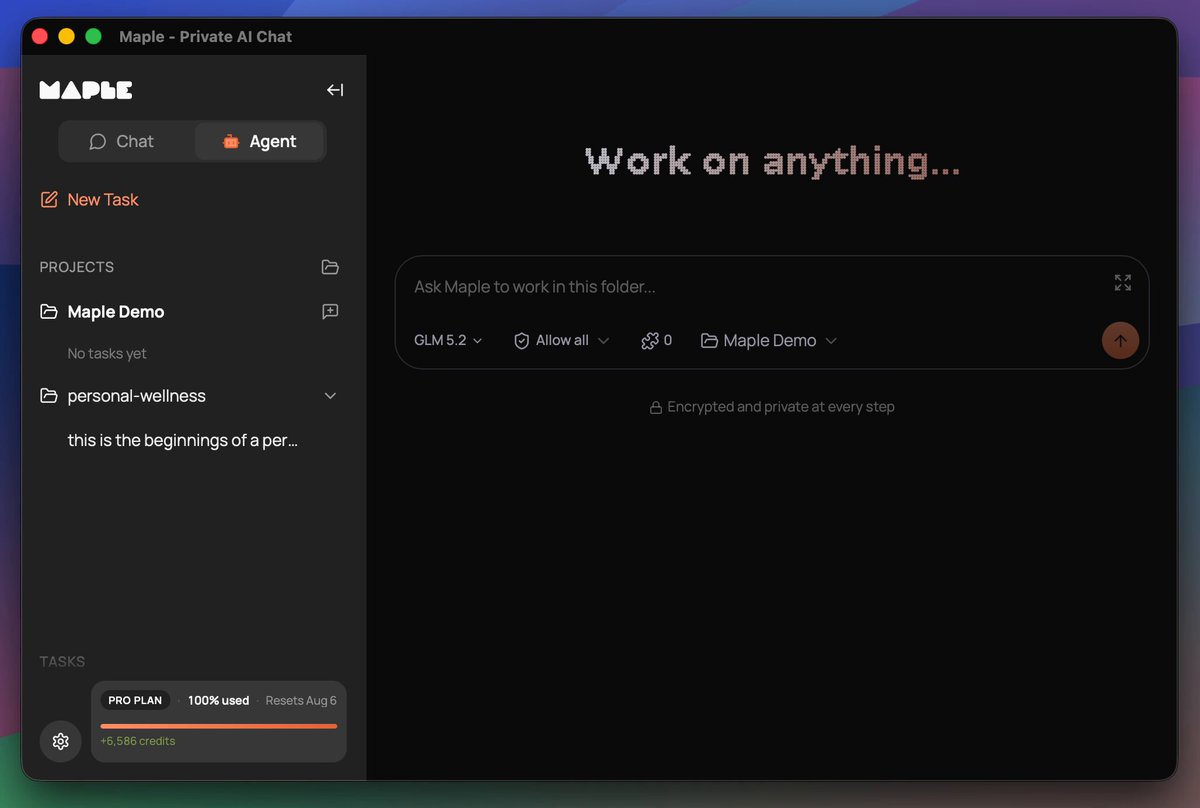
Maple is preparing for the release of a co-working agent. You install it locally and it works with your files, whether it's office work or building websites and apps. It's a turnkey solution, as easy as Claude Code, that keeps your data secure and private, no data sharing with closed AI labs. This is THE sovereign AI app for individuals and businesses who want powerful AI while retaining ownership of their information. Why build an agent into the Maple app when other agents already exist? Easy, we want to give you control over your work. We don't have a business plan that incorporates making money off our users' data. In the age of AI, your information, whether it's personal or company trade secrets, is the single thing that differentiates you from everyone else. We all have access to AI that can build a professional website for selling shoes. But your strategy and network for how you sell shoes should not be shared with your competitors. Sovereignty is the path to protecting what makes you, you. Maple sits at the intersection of Usability and Sovereignty. Maple gives you the best tools that are both easy to use and maintain your data sovereignty. Sovereign for one, sovereign for all. It has been a journey to get here. We brought to market the very first personal chatbot with end-to-end encryption using TEEs in late 2024. Prior to that there were proofs of concept but no full product offerings. Every other AI chat product on the market handled your data in plain text, either selling you a service to get your data or asking you to trust that they won't snoop on you. Quickly people found Maple and latched onto its open-source code and verifiable encryption. We didn't stop there. You may remember earlier this year we teased a product called "Maple Agent" and opened up a waiting list. That product is a mobile app that acts as your AI "friend", maintaining one long continuous chat, and getting to know you over time. I dislike using the word "friend" there, but it's the best way to convey the UX in a few words. AI is a tool, always has been, always will be. Any kind of friendly personality on top is just synthetic. In our testing, the UX of Maple Agent is really powerful for what it does. Think about the many short AI chats you have in your favorite app, whether it's looking up a historical fact or asking advice about a topic. With Maple Agent, those all go away in favor of the long-running chat with the friendly agent. It's like you have your own personal assistant who knows you so well and can look up anything for you. When I ask AI certain questions, I want to ask an expert who already understands my situation so I'm not repeating myself for the 100th time. That's the amazing value the personal agent brings to the table. We still see great utility for a personal agent like the "Maple Agent". Thousands of people on the waiting list, hoping to get their hands on it, agree that the concept is worth exploring and trying out. We were constrained in launching it due to a few circumstances, one of them being access to the scale of compute needed to power it. We have a clear path laid out for how to get there, but today is not the day to execute on that. It will be in the near future. Instead we have a different agent ready to go that we think is also incredible. We now have an agentic harness inside of the Maple Research app. This thing is a powerhouse. It even builds and publishes its own software releases. The agent in Maple Research works with your local filesystem, speaks to the largest open models running in TEEs, utilizes local models for certain tasks, is compatible with MCP tools, has an API for connecting to anything you need, and also supports the ACP protocol, which means it can be extended in the future to speak to other tools like Claude Code, Codex, and local models running on your own hardware. A big unlock for us was the Goose Development Kit, which powers the core of our agent harness. More on that to come as we publish articles and documentation later about the agent. The agent inside Maple Research doesn't have a name. At least not yet, not sure if it ever will. For now we call it "Chat Mode" and "Agent Mode". Think of this as the workhorse, the truck, the heavy lifter. Our other "Agent", the phone app, is your sidekick in your pocket, ready to help with quick things and ongoing conversations about life. I am incredibly excited about the Maple Research Agent. While I'm already seeing great results using it for internal work items, I'm especially thrilled about the personal health and wellness work it's doing for me. I know there are plenty of apps out there for compiling wellness data, but I'm having it build a tool tailored specifically for what I need, without the extra fluff. And none of my health data is being donated to the closed AI labs or sent to advertisers. I know that the AI logic is not being silently adjusted to fit the whims of a large corporation that has paid for product placement. It's me, state of the art AI, and my data. That's how I want it. Maple's new agent makes that possible. We can't wait for you to try it out. If you want early access, comment here, email us, reach out in some way. To those on the other agent waitlist, you're already in the queue. Thanks for reading this lengthy update. :)

Mark

44,707 次观看 • 21 天前