Sensitive content

This media may contain sensitive content.

Loading video...

Video Failed to Load

Go Home

(Preview 1) Yoru no Bartender: Daks Daddy’s Secret Service 🍶 (夜のバーテンダー — The Night Bartender’s Secret Service)” Akala ko ako ang makakarat, pero ako pala ang lalaspag sa kanya 😈 From one drink to an all-night wild ride — straight na binatang ama, pero beast pa rin sa kama....

297,708 views • 11 months ago •via X (Twitter)

0 Comments

No comments available

Comments from the original post will appear here

Related Videos

Diversionary tactic of Vice President Sara Duterte EXPOSED! The Chairman of the House Committee on Appropriations responded to the video message of the Vice President Sara Duterte last night and I agree that this is nothing but a diversionary tactic. In his speech as attached below, Chairman Zaldy Co pointed out very good points and I highly recommend you watch its entirety. The video message last night was a diversionary tactic to the real issues 1.) the 125 million confidential funds spent in 11 days 2.) Low PISA score 3.) Issues and questions about the DepEd expenditures and a lot more. If there is one thing I want to highlight here, it is probably the part when Chairman Zaldy Co said that Vice President Sara Duterte assured them she can defend/justify the requested confidential funds. And so, let me thank the 19th Congress for disapproving the confidential funds requested by the OVP in 2024. “Pang-apat, paulit-ulit niyang sinasabi, "I will defer to the wisdom of Congress," pero hindi ito totoo. Kung talagang iginagalang niya ang Kongreso, sasagutin niya ang mga tanong, lalo na sa isyu ng confidential funds. Last year, kinausap namin si VP Sara tungkol sa 2024 budget, at sinabi niya na “ituloy n’yo yan” – meaning ang confidential funds – dahil kaya daw niya itong i-justify. Buti na lang at hindi namin itinuloy. Tama ang ginawa namin, at saludo ako sa aking mga kasama sa Kongreso. Ang kapangyarihan ng budget ay nasa Kongreso, at ipinagmamalaki ko na hindi namin isinuko ang kapangyarihang ito sa Office of the Vice President. Ang pinag-uusapan dito ay pondo ng taumbayan. Tandaan, ang COA, hindi Kongreso, ang nagsabing mali ang paggamit ng P73-million confidential funds sa loob lamang ng 11 araw “

Just

271,623 views • 2 years ago

Ive always wanted to post this whole conversation.. BIANCA' S PARENTS MUST HAVE AVAILED THE LIVESTREAM.. THATS WHY THEY NEVER judged DUSTIN. LIKE his haters did who probably watch it in Primetime, which is super edited or on tiktok vids who surely spliced it even more... to paint a certain narrative. He is just emotional of what happened.. Aminado nman silang lahat na sinadya nilang asarin sya ng paulit ulit. Kaya nya natawag na insensitive si michael kasi alam ng hurt na sya di pa rin tumitigil. ( even josh shared his experience with Michae and kira ) When he said di sya sanay sa ganun babae : putol lang kasi pero at the start of the video.. Dustin : ipaparinig mo na may gusto kang iba. my favorite part? How he explained "makakaapekto yun sa tingin ko syo." Dustin: ganun nman kasi talaga like yung actions natin.. for example sipain ko yan (cup tower) kahit sabihin kong joke lang nman anu magiging tingin mo sa kin? KUPS AKO. ginawa ko sya eh.. If anything this video proves kung gano nya talaga kagusto si Bianca from the start. Na before the incident puro positive lang yung nakikita nya sa kanya... and he was really happy. Natawa pa ko sa part na sabi nya.. Ienjoy na lang daw nya.. (stay sa PBB) di nman daw kailangan (lovelife) .. tapos sasabihin nyo sya ang may hanap ng loveteam... and sna na-air yung part na to.. Josh : outside ba di ka inaasar ng tropa mo? Dustin: inaasar nila ako sa gusto ko.. Hinde yung ganun.. Yung harapan tapos tropa tapos babae (na yung mga tropa nya tutuksuhin yung isa pa nyang tropa sa gusto nyang girl ) 😂 GETS?? he also mentioned that at that point.. they've had serious conversations na about family etc. Josh even asked if maingay pa din si bianca during those talks.. Dustin: TAHIMIK i also appreciate how he stopped talking when he noticed cameras were on him and how he said mabait si brenty. ( na di rin comfortable kay michael by the way eh first duo nya 😂) i hope everyone should see this.. the very conversation that has been blown out of proportion.. All villains have Backstories.. YES! but Dustin? he wasnt the villain...his backstory? makes him the victim.. Thank you sa pag edit sa primetime.. berigood kayo. #dustbia #dustinyu #BIANCADEVERA

little old me

54,958 views • 1 year ago

China's biggest livestreamer worked from 8 at night until 7 in the morning, 350 nights a year. Then the government fined her $210 million, and deleted her from the internet in under 6 hours. Her name was Huang Wei, though viewers knew her as Viya. In one night in October 2021, she sold about $1.3 billion of goods. Years of talking on stream had left her voice permanently hoarse, and while doctors could have operated, she never took the time off. Her money came from commissions, plus fees brands paid just to get their products a spot on her show. She earned that money personally, and China taxes personal service income like hers at up to 45%. Company profit, by contrast, is taxed at 35% at most. So she set up one-person companies on Chongming Island, outside Shanghai, and had her fees paid to them instead, turning her personal pay on paper into company income. How much did that save her? Chongming used a rule meant for businesses too small to keep proper books: the tax office simply assumed profit was 5% of revenue. That means the real rate was 35% of 5%, or 1.75%, as tax official Yang Sanyi published. The lowest salary rate in China is 3%. And nobody hid any of this. On the very day she was fined, reporters opened the Chongming development zone's own government website, where a page in bold called this setup a "tax-avoidance magic weapon" that could "save more than 70%," and promised that "every policy complies with national law." A county government was selling the loophole and calling it legal. Then, on December 20th, 2021, came the fine: 1.34 billion yuan, more than the fines on actresses Fan Bingbing and Zheng Shuang combined. At 5:12 that afternoon, state media declared "livestreaming is no 'place beyond the law,'" and People's Daily said she "asked for the hammer and got it." By 9:40 that night, her Weibo, her Douyin, and her Taobao Live channel all returned nothing. Her 18 million Weibo followers and the 89 million people following her shopping channel had nowhere left to find her. She never streamed again. The officials who advertised the loophole were never named.

Sam Szuchan

238,514 views • 10 days ago

This is absolutely fascinating: Jason Furman, one of the foremost economists in the U.S. and former chair of the Council of Economic Advisers, explains why the so-called "China shock" is a myth. According to him, "85 to 95% of Americans benefited" from trade with China, and "China has been part of helping [the US economy] work, not hurting it work." In other words, the narrative that China "stole" American jobs and wages is the exact opposite of reality. Furman's logic is pretty ironclad: 1) He points out, which is factual, that "the slowdown of wage growth and the rise of inequality began in the 1970s, when there basically was no trade with China." It then accelerated in the 1980s-90s when China trade was small, and **slowed down** after 2000. And "since about 2013," when trade with China was at its highest, "we've had pretty fast real wage growth," with "the fastest real wage growth for moderate income households." In other words, the timing doesn't fit: if China was the cause, the problem should have gotten worse as trade with China increased. Instead, it got better. 2) A common narrative one hears about China is "who cares about affordable goods, we need well-paying jobs." But Furman points out it's actually one and the same thing: "the way we measure jobs is how much your wages can buy. If you improve purchasing power, you are making every single job in the economy better." In very concrete terms, if salaries stay flat but Chinese imports make goods 10% cheaper, your purchasing power just went up 10%, as if you got a 10% wage hike. This makes every single job in the economy better. In effect "jobs vs. cheap goods" is a false dichotomy: cheap goods ARE better jobs. 3) Furman also points out, rightly, that the majority of what U.S. imports from China isn't consumer goods: "more than half of what we import is actually inputs into the manufacturing process itself." In other words, Chinese imports make U.S. manufacturing MORE competitive as it decreases their input costs. If you were to cut all Chinese imports, you'd cripple U.S. manufacturing as it would no longer be able to compete on price with anyone. And, as per point 2 above, you'd also destroy Americans' purchasing power, making every single U.S. worker worse off. 4) Last but not least, Furman says that the "China shock" literature is fundamentally flawed, as it "doesn't answer the most important question, which is what the net effect was." It "doesn't consider other causes for the job losses, doesn't look at all the places that gained jobs and wages, and doesn't integrate the consumer side." All in all, he believes that if one were to actually calculate the net effect of trade with China on the U.S. economy, it'd show that "85 to 95% of Americans benefited." And even for the 5-15% who lost out, Furman says these people were failed by "our labor policies, our social safety net" - not by China. What Furman is saying is more relevant than ever because, both in the U.S. and in Europe, this notion that China is somehow "stealing" Western jobs and prosperity has become the unquestioned premise of so many of today's policies. Nobody even debates it anymore, it's almost universally assumed correct. In my own country France, Macron keeps repeating it all the time, leading the charge in Europe to slap tariffs on Chinese imports, warning that China is "killing its own customers" and that it's a question of life or death for European industry ( He literally called last week for the EU to build its own version of America's Section 301 - the same protectionist tool Trump uses ( BUT, if Furman is right, and the data strongly suggests he is, France and Europe are about to inflict economic self-harm in the name of a problem that doesn't exist. Much more affordable cars, for instance, would literally give every single European a big wage hike. It's Furman's argument on "85 to 95% benefiting" vs 5% to 15% losing out: the vast majority of Europeans would see their money go further, while a small number of jobs in legacy automakers would be disrupted. Instead of helping those workers transition, Europe wants to prevent making everyone better off. Anyhow, please do watch the whole podcast, which has many other fascinating insights because Furman also debates with Justin Yifu Lin, the former Chief Economist of the World Bank and State Council Counsellor of China. They're both interviewed by my friend Hansong Li - also a professor and an immensely smart man - in his excellent new podcast "worldviews" (imho one of the best new podcasts our there). The video is here:

Arnaud Bertrand

161,115 views • 4 months ago

MI6 PLAN TO CUT CHINA INTO THREE COUNTRIES BREAKING NEWS: Unearthed documents show that MI6, the British spy service, planned to cut China into three separate countries. The British plan was formulated as recently as the 1990s—and part of it is STILL RUNNING NOW. This is an extraordinary story which researchers uncovered from historical documents, and which was presented at a university conference recently. Full details with sources are in the video report. Summary of 15 key points are below. 1.) In the early 1990s, agents at British spy agency MI6 consulted UK academic Gerald Segal of the Royal Institute of International Affairs on how to chop China into three countries. 2.) The UK’s key players would be Uyghur separatists. “Xinjiang has long been a target of British intelligence— with London hoping to manipulate the Uighur refugees from Xinjiang and Uighurs still there, into cannon fodder for London's plans to break up China…” (Journal of Strategic Studies). 3.) Enter a real-life secret agent—a Turkish man named Catli of the Grey Wolves, who shared MI6 goals in Xinjiang. A book about a related CIA venture called Operation Gladio said Catli “helped the Uyghurs… mount insurrectionary attacks that killed 162 people”. 4.) To understand this story, it’s vital to know that the west falsely presents an image of Xinjiang as a place where one ethnic group are prisoners and the other are oppressive overlords. Not true. In Xinjiang, people with Uyghur background can commonly be found as police officers, army soldiers, and local officials, including the ones right at the top—chairman of the regional government. 5.) In March 1992, the chairman of the regional government, Tomur Dawamat, issued a warning: “Hostile forces, both at home and abroad, have stepped up their infiltration, subversion and sabotage.” 6.) At the time, the CIA was backing separatist Isa Yusef Alptekin, another backer of the Grey Wolves. In a 1992 speech he said: "The time for collapse and dissolution has arrived for the Chinese empire.” 7.) The Americans gave his son Erkin Alptekin a job in US anti-China propaganda. In the 1990s, he worked for Radio Liberty, a US media propaganda unit, part of the Radio Free Asia cluster. 8.) By 1994, academic Gerald Segal had finished the map showing how to cut China into three countries. The US had already circulated stories of a “Tibetan genocide” to prepare for this. 9.) As part of their Central Asian program, the US had devoted hundreds of millions of dollars to get the mujahideen rebels to train groups of guerilla fighters. They added hundreds of Xinjiang separatists to join the training. (This project eventually backfired for the Americans – the central Asian guerilla groups they were financing give birth to al-Qaeda, ISIS and the Taliban.) 10.) Western forces worked further with secret agent Catli, who created more trouble in Central Asia and China. But he made lots of enemies and was killed in a suspicious car crash in Turkey in 1996. 11.) From 1996 to 2002, other agents continued to train Uyghur separatists in China, who went on to make multiple terrorist attacks. FBI whistleblower Sibel Edmonds later wrote: “Between 1996 and 2002, we, the United States, planned, financed, and helped execute every single uprising and terror-related scheme in Xinjiang.” (This US government denies this.) 12.) Problems arose for the western agents: UN data showed that the Tibetan population was growing faster than other Chinese groups– the opposite of a genocide. Also, there was also growing public knowledge that the “Tibet exiles/ Dalai Lama” project in India had been set up and financed by the CIA. So the “cut-China-into-three” plan became “cut-China-into-two”. 13.) In 2004, the US hosted the founding of East Turkistan as “a country”. For convenience, they decided to have the prime minister in Washington DC instead of China, selecting a man named Anwar Jusuf Turani from Fairfax, Virginia. The new “country” did not get international recognition by anyone – not even the United States! 14.) Between 2007 and 2014, there were a large number of terrorist attacks in China by members of the East Turkistan project the west had encouraged into being. In a 2009 operation, separatists used Facebook to co-ordinate a massive attack in which 197 people died. In another, a huge car bomb in Urumqi killed 43 people and wounded 94. At Kunming’s train station, an attack by eight knife-wielding terrorists killed 29 people and wounded 140. Xinjiang’s leaders, with help from the central government, sent in police officers and soldiers to halt the carnage—and, against extraordinary odds, succeeded. 15.) In the 20-teens, it was time for the Americans to use their superpower – narrative control. They needed to do three things: i) Get journalists and academics to cut all mentions of MI6 or CIA involvement in Chinese Uyghur stories. ii) Trick the public into seeing the terrorists who had killed so many innocent people as the oppressed victims. iii) Mislead everyone into believing that the authorities trying to stop the murder of innocents were the root cause of the problem. Creating this new, upside-down narrative may sound like a tall order – but, incredibly, they managed to attain all three goals. They did this by relentless circulation of mainstream media news reports which painted a picture in which “oppression” by “the Chinese” had “created” the violence. (See the video for detailed examples.) The US then organized a 2019 meeting in Washington to relaunch the debunked “Tibet genocide” narrative as a Uyghur genocide hoax. The story continues.

Nury Vittachi

881,569 views • 11 months ago

The US is well advanced in preparations for a war on China. Here are 28 steps taken. Bookmark this, and please add others. 1. BATAN: The US quietly carried out a major operation last summer to deepen the harbour on the island of Batan, south of Taiwan—so that warships can use it on their way to the China coast. 2. LANDING STRIPS: A US team has compiled a list of long flat areas in Asia that can be used as aircraft runways for use in launching fighter jets to bomb China. 3. PRACTICE RUNS: US troops held exercises specifically preparing for an invasion of China last year with armies from Japan, Australia, and Indonesia. 4. TAIWAN TRAINING: The US military landed troops in Taiwan secretly to train soldiers---and they are now learning how to attack amphibious vehicles. 5. TROOPS IN PLACE. More than 100,000 US troops have already been assigned to what the US calls the "Pacific Theatre". 6. SHIFTING SUBS: The US has told Australia that its subs may not be delivered in time (or ever) because all attack subs will be needed close to China. 7. FLOATING ARMS DEPOTS: The US admits it has placed vast amounts of ready-to-grab weapons in places such as Taiwan. 8. DIVISION OF LABOR: Europe has already been told to replace all US troops and weapons in their own parts of the world with local equivalents, so that US troops and hardware can head to China. 9. FIRST WAVE: The first wave of fighters will be Taiwanese using the "proxy war" model to keep actual Americans at a safe distance, as specified in US strategy books. 10. DISINFORMATION: The Pentagon has set up a division called Perception Management to tell the public that China is an expansionist military power, not the USA. Mainstream media is hiding the fact that Taiwan is legally part of China and instead reporting that China "claims" Taiwan. 11. CONFLICT CREATION: The Philippines under new pro-Washington leader President Ferdinand Marcos Jr. has been working hard already for months to create conflicts in the seas. (Video includes specialist analysis of a ship-to-ship dispute.) 12. NINE BASES: Large sums of money have been paid in the Philippines so that it now hosts NINE China-facing bases. 13. OKINAWA: The US has quietly abandoned its 12-yr-old plan to reduce the number of troops in Okinawa. 14. CAMP SCHWAB: Nearby, a landfill bigger than the entire Pentagon will house US helicopters and Osprey rotating-rotor airplanes for use in attacking China. 15. PNG PROBLEMS: The US flew in to PNG to buy the use of three airports, two ports and one naval base, and are renovating a military base on the island to the north. 16. COMMS JAM: Electronic magnetic pulse weapons will be employed to jam communications in China. 17. VANISHING GPS: The US will weaponize the GPS system to force the Chinese to use their much younger homemade system. 18. BANKING ON TROUBLE: The world's main money transfer system, called SWIFT, will be instructed to allow no money into or out of China. 19. DOORSTEP DELIVERY: Standing by in the Pacific right now are special ships [image supplied] which beach themselves on enemy land to discharge 900 tons of attack forces. 20. DANGER FROM THE SKIES: Army paratroopers have recently been training in Hawaii for a mission that would see them ready to land in rural areas outside Chinese cities. 21. STAR WARS: The Pentagon has a special division working specifically on how to attack China from space. 22. SEAPATHS BLOCKED: The US plans a blockade of everything that could go in and out of China by sea by using what they call The First Island Chain and The Second Island Chain—basically friends that Washington has bought and paid for. 23. LAWFARE: Acts will be passed in the US demanding that the whole world boycotts China, exactly as the US did with Russia three years ago. 24. BLACK OPS: The US has been quietly penetrating parts of China with trained troublemakers, as they did in Hong Kong. These people will trigger street battles which the western media will portray as "pro-democracy" protests. CIA and US army intelligence groups will conduct "black ops" inside China in a bid to create chaos. 25. DRONES: The US has a long record of successfully using killer drones. The new generation ones, still under wraps, have AI built in so they can kill people without human help. 26. AIRSTRIKES: The US is currently letting its F-35 pilots practice dropping "bunker buster" bombs on Yemen—these bombs can go through 20 feet of solid rock to kill people hiding in shelters—and are preparing to target China. 27. CASH THEFT: Political leaders in the US and the UK and European nations have already said that they consider themselves entitled to freeze, take, and spend the assets of countries they judge to have behaved aggressively. 28. TECH BROS: The Pentagon has a division that monitors all major tech companies to pull them as needed into the war effort—and they won't be given a choice. .

Nury Vittachi

715,443 views • 1 year ago

Important reminder Binance CZ 🔶 BNB 🚨 Remember what Binance did to us on 10.10. The big picture here. Here is a summary, an analysis, a reminder, and a warning. Never forget. Whoever has too much power is too dangerous. 🔺 1. What happened on 10.10: On 10 October 2025 the crypto market suffered the largest single liquidation event in its history. More than 19 billion USD in leveraged positions were wiped out within hours, affecting well over 1.6 million traders across all major venues. Bitcoin had just printed an all time high above 122000 USD. Within the 10 to 11 October window it crashed to lows around 104000 to 110000 USD, a drawdown of 10 to 15 percent in less than a day. This day is now referenced across mainstream media, research and exchanges simply as 10/10. The trigger in the headlines was clear: ▶️ Trump announced additional 100 percent tariffs on Chinese imports. US China trade war reignited. But the scale and structure of the crypto damage did not match a normal macro move. They matched a structural failure inside the plumbing of one venue. That venue is Binance. 🔺 2. Binance: Before the crash Binance handled: ▶️ 60 to 70 percent of global USDT altcoin spot volume ▶️ The deepest unified collateral system in crypto ▶️ Cross margin links across spot, futures, options and structured products Independent data providers like Kaiko and CoinGlass consistently identify Binance as the global price discovery engine for altcoins. On 10.10 that centralization became a single point of catastrophic failure. Across research from Kaiko, CoinGlass, Coindesk, Aurpay, Galaxy and independent analysts: ▶️ Binance order book depth collapsed more than any other exchange ▶️ Venue specific collateral assets broke first and hardest on Binance ▶️ Liquidations elsewhere followed Binance with multi minute lag ▶️ On chain and off chain data show certain wallets profited massively from the failure pattern This was a centralized system imploding under stress. 🔺 3. The Binance specific anomalies: Three Binance collateral assets behaved abnormally: ▶️ USDe traded at 0.62 to 0.65 USD on Binance while near 1 USD elsewhere ▶️ wBETH printed 430 USD while ETH traded near 3500 USD on other venues ▶️ BNSOL printed 34.9 USD while far higher elsewhere Insights4vc and Galaxy found ATOM, ENJ and other majors printed near zero only on Binance. Global markets remained far above. When you see: 1 exchange 3 collateral assets 80 to 99 percent divergence Invalid prices Frozen liquidity You are seeing a matching engine and oracle collapse. Binance later called this a “technical ghost”. It behaved like a centralized kill switch. 🔺 4. The liquidation cascade and ADL CoinGlass, Reuters and FT all agree: 10.10 created the largest liquidation cascade in crypto history. More than 19 billion USD were liquidated. But this number is only the visible liquidation counter. It does not include: • ADL reductions on profitable positions • Forced margin reductions not registered as liquidations • Collateral destruction from oracle mispricing • Spot positions force closed • Options and structured product collateral failures • Off book desk unwinds and hidden exposure reductions When analysts reconstruct the full chain, the true economic unwind is well above 40 billion USD. Several market structure estimates place the systemic damage between 60 and 100 billion USD. 19B is what dashboards show. 40B+ is what the market absorbed. Insights4vc documented: ▶️ Thousands of liquidations per second ▶️ Hyperliquid triggered ADL ▶️ Binance triggered its own ADL events Distorted Binance prices fed industry oracles and dragged the global market down. 🔺 5. On chain and off chain fingerprints: Wallet 0xb317..: ▶️ 192 million USD BTC short during crash ▶️ 163 million USD short after ▶️ Perfect timing with Binance anomalies Binance publicly acknowledged peg failures in USDe, wBETH and BNSOL. Zero prints happened only on Binance. The data convicts the structure. 🔺 6. Collapse of Fake Liquidity: Altcoins that went to zero on Binance did not do so elsewhere. Spoof liquidity, wash trading and internalized market making created an illusion of depth that vanished instantly under stress. 🔺 7. Comparison with fair, regulated markets: On NASDAQ: Market makers must quote both sides Liquidity withdrawal requires approval Wash trading is prohibited Exchanges cannot run secret market makers On 10.10 Binance’s order book had a buy side vacuum with no notice and no accountability. 🔺 8. Binance’s regulatory vacuum and conflict of incentives: Longs were liquidated. Shorts were ADL’d. Delta neutral strategies were wiped out. In an unregulated venue generating 70 million USD per day in fees, fairness is not enforced. 🔺 9. Evidence Binance refuses to provide: Mark price logs Oracle inputs Liquidation engine data ADL queues Insurance fund movements Engine parameters Matching neutrality proof None provided. 🔺 10. Why “never forget” matters: A single exchange distorted global prices in minutes. Fake liquidity collapsed. Oracle flaws vaporized billions. Unified margin amplified everything. 🔺 11. The message The data is here. The traces are here. The failures are documented. Remember what Binance did to us on 10.10. Concentrated power in crypto is systemic fragility with better marketing. Power is liquidity. Only users decide who holds it. Thanks for reading. — by $MASTR crypto project

MASTR

17,432 views • 7 months ago

The Masters is one of my favorite sporting events, and its 88-year history brings some great traditions. Here's a running list of the most interesting facts: 1. Media tickets (badges) have RFID tags inside them so the club knows where each person is at all times. 2. Even players who miss the cut at the Masters still walk away with a $10,000 check. 3. A 5-bedroom home near Augusta will rent for $30,000+ during Masters week, and brands often pay six figures for larger homes where they can host events. 4. The IRS has a special exemption in the tax code called the "Augusta Rule," allowing homeowners to rent out their homes for 14 days per year without paying taxes on the income. This rule was initially implemented for Augusta residents only but is now available to everyone in the United States. 5. The Masters will do $70 million in merchandise sales this week. That's... • $10 million per day • $1 million per hour • $16,000 per minute • $277 per second The merchandise is so popular because you can only buy it at Augusta (aka no online sales). 6. In 1931, Augusta National was purchased for $70,000— or an inflation-adjusted $1.4 million. However, the property is now valued at over $200 million. 7. Augusta National has quietly been expanding over the years, spending more than $200 million (through an array of LLCs) to buy 100+ properties. Augusta has purchased strip malls, restaurants, apartment complexes, and homes, adding 270+ acres to the property and often paying 3-4x their value. 8. Augusta National is debuting "Map & Flag" at this year's tournament. The premium hospitality offering isn't even on the property — it was built in a strip mall down the street that Augusta acquired for $26 million in 2020 — yet they were able to charge $17,000 per ticket (+ week-long badges) and have completely sold out. 9. The concession stand food is wrapped in green packaging, so it can't be seen on TV if someone litters. 10. Someone once found a green jacket in a Canadian thrift store. They purchased the jacket for $5, and it later sold at auction for $140,000. 11. Magnolia Lane is exactly 330 yards long, with 61 trees on each side. 12. Augusta's clubhouse has a wine cellar with 30+ pages of the world's most exclusive wines. 13. Previous Masters champions gather every year for dinner on the Tuesday before the tournament. The previous year's winner gets to pick the menu, but he must also pay for the meal. 14. The Masters leaves millions on the table by giving away the broadcasting rights to ESPN and CBS for free. They do this to maintain complete control, handpicking advertisers, eliminating on-course signage, and only playing 3 to 4 minutes of commercials each hour. 15. Unlike most golf clubs, which are registered as non-profits, Augusta National is a for-profit corporation. This requires them to pay more taxes, but they do it anyway because it means they don't have to share their member list, income, holdings, or expansion plans. 16. More than 1,500 private jets will land in Augusta this week, paying about $3,000 in landing and parking fees. 17. Augusta has SubAir Systems under each green. This enables them to keep the greens consistent, sucking up water when it rains and adding moisture when it's hot. Also, when someone slipped a few years back, Augusta added SubAir systems under all the walkways. 18. Dwight D. Eisenhower is the only U.S. President to become a member at Augusta National. He never actually attended the Masters, but Eisenhower made 29 trips to the property, playing 210 rounds of golf, during his eight-year term as President. Even crazier, Augusta worked with the Secret Service to build him a safe place to stay, called Eisenhower Cabin, which is still used on the property today. That's it for today! Enjoy the tournament, and if you learned something from this post, follow me for more sports business content.

Joe Pompliano

2,107,599 views • 2 years ago

Ali Ghodsi never wanted to be CEO. In 2015, he was interviewing for a professor job at Berkeley when the Databricks board handed him the interim title. Revenue that year was $1.5M. This episode with Ali Ghodsi will go down as one of my favorites. 10 things I took away: 1. Focus the entire company, orders of magnitude of attention, on its single biggest bottleneck. Like a laser, almost to an extreme. The cycle is 1-3 years, not weeks. If your focus changes weekly, then you’re just in firefighting mode. 2. There is nothing worse than a conflict-averse CEO. They are wonderful people, but they are in the wrong job. Conflict is the gym for a CEO: nobody likes it, but everyone has to go. 3. Study your enemy carefully, understand their weaknesses and apply your strengths to those weaknesses. Snowflake had 2x his revenue. He didn’t copy them. He found three weaknesses (proprietary, no AI, expensive) and hammered them account by account for four years. Watch the competition, never follow it. 4. The concept of a Lakehouse was ridiculed internally and online. No one wanted to market with this new term. So he made the whole company religious about it anyway, killed the ads that converted better without the word, and put it in the sales comp plan. It worked. All hands on deck, no exceptions. 5. Be willing to take a step back for a much bigger vision, even when the company is already succeeding. At multiple hundreds of millions in ARR, he was unhappy, because the vision he pitched investors wasn’t the company he was running. So he took one step back to go ten forward. 6. On the flat org, player-coach model that a lot of people have talked about this year: “it’s BS.” Separate how the company thinks (AI, ontology) from how the humans get managed (they are after all, still humans). His staff meets 3x a week. I asked if it could just be coordinated in a Google doc. His answer: do you meet your wife and kids, or coordinate that in a Google doc? 7. His test for a sales leader: can they build the car, or just drive it? Ron Gabrisko, the Databricks CRO, had seen $0→50M and $50→100M+, and hadn’t changed jobs in 10 years prior to joining. Now he has been the CRO for over a decade. He built and drove the car the whole way. That almost never happens. 8. Hire execs ahead of the curve because by the time you need them, it’s too late. A real search takes 6-12 months. The extra time helps you increase false negatives and decrease false positives. Do an insane number of backdoor references because 80% of ‘front door’ references are bs. 9. The best salespeople are not super technical, so stop trying to force them to be. Square peg, round hole. The best win with professional aggression, high EQ, and mapping the real power base (how decisions get made high up in an organization), not technical depth. 10. Yes, your best AEs will annoy people. One of the first at Databricks got a meeting nobody could get, but got banned from the customer’s building for it. He told Ali, “what are you complaining about? I got the meeting.” Professionally aggressive is the bar. One bottleneck, zero wussing out. He reminds me of Elon Musk that way. Chapters 0:00 – Introduction 1:22 – The secret CEO search and why the board bet on a founder 4:11 – Professor or CEO? Always taking the harder option 8:18 – Pour everything into one bottleneck 12:16 – Killing PLG and learning what great enterprise sellers actually have 19:09 – Hiring ahead of the curve: sales leaders, execs, and back-door references 27:02 – The Snowflake rivalry: study your enemy, never copy them 33:22 – Lakehouse: conviction, ridicule, and the case for second acts 41:02 – The killer instinct and why conflict-averse CEOs fail 44:10 – Dunbar's number and rethinking the org chart around AI 48:00 – AGI is already here — enterprises just use it as a chatbot 52:55 – Does he still code? Two days for a connector vs. three quarters 57:18 – A day in the life, and why the Monday meeting isn't theater 1:04:53 – Why Databricks will go public, just not yet 1:08:09 – Get over conflict aversion, or don't be CEO 1:11:07 – Brian's takeaways Link to more in the comments.

Brian Halligan

193,162 views • 11 days ago

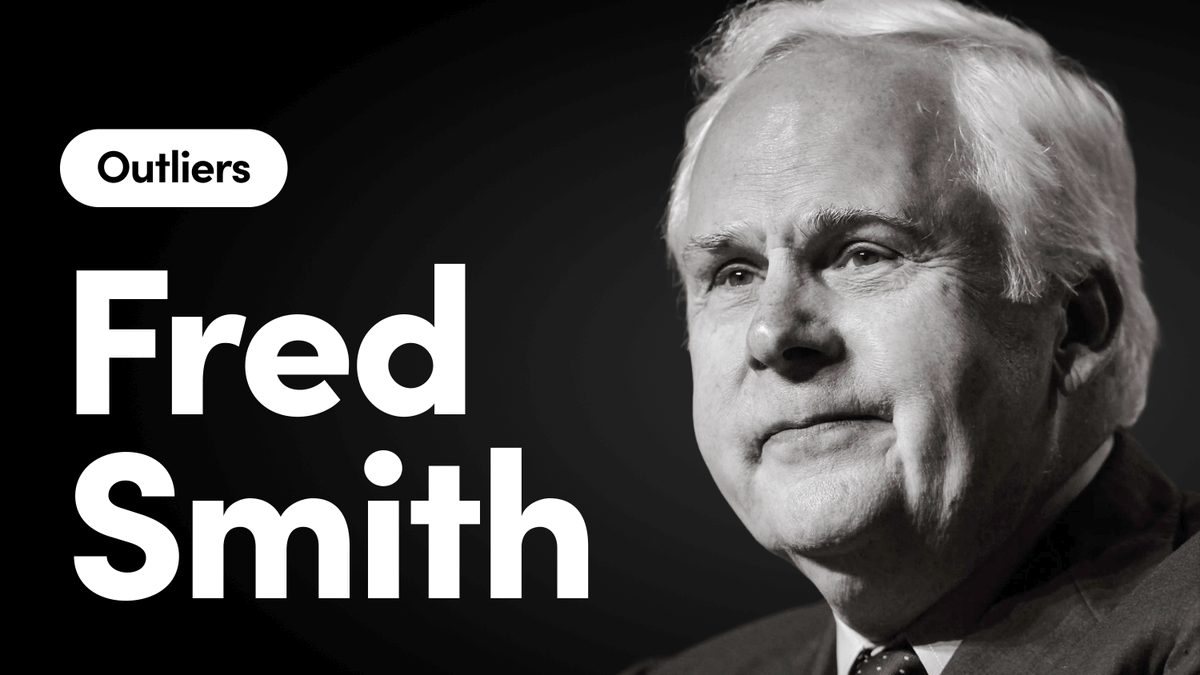
10 Lessons From Fred Smith, the founder of FedEx 1. Not trying guarantees failure: Fred Smith spent his childhood in leg braces. Doctors said he’d never walk normally. Through thousands of hours of excruciating therapy, he didn’t just walk; he became a varsity athlete. “Fear of failure must never be a reason not to try something,” he’d later say. When everyone said overnight delivery was impossible, he remembered the doctors who said he’d never play sports. 2. The power of incentives: The Memphis hub was a nightly disaster. Planes had to land, unload, sort, and reload in hours. Nothing worked until someone noticed the obvious: they paid workers by the hour. The longer it took, the more they earned. FedEx switched to paying by the shift. Same pay, go home when you’re done. The sort suddenly ran like clockwork. Charlie Munger loved this story: “Never, ever, think about something else when you should be thinking about the power of incentives.” 3. Loyalty is earned in the trenches: In Vietnam, Smith learned soldiers don’t fight for politicians; they fight for the person next to them. Years later, when FedEx ran out of money, employees worked without pay. Pilots used personal credit cards for fuel. Not because they had to. Because of the loyalty that was earned in the trenches. 4. Become a learning machine: Fred Smith read four hours a day. Every day. “People who supposedly have vision spend a lot of time reading and gathering information, then synthesize it until they come up with an idea,” he explained. All that reading showed him something nobody else saw: people would soon care more about tracking their package than getting it fast. 5. Take care of your people and they will take care of you. In 1974, investors moved to fire Smith. Every senior officer signed the same letter: fire him, and we all walk. One was even offered the presidency as a bribe. (He refused.) This was People-Service-Profit in action. The order of those words is important. People first, then service, then profit. Not the other way around. Most companies put this stuff on motivational posters. At FedEx, people bet their careers on it. 6. Reliability is rare. Speed without predictability is useless. FedEx guaranteed overnight delivery or your money back, a feat that seemed impossible at the time. The guarantee created trust with customers and accountability internally. There were no excuses. 7. All in or all out. FedEx had $5,000 left. The planes needed $24,000 to fly on Monday. So Smith took the five grand to Vegas and turned it into $27,000 at blackjack. When investors heard this story, they didn't see a gambling problem. They saw a founder who'd already bet his inheritance, his house, everything, and was still fighting. Two weeks later, they gave him $11 million. 8. Trust is built in drips and emptied in buckets. When Smith bought Flying Tigers, he faced a choice: protect the seniority of Tigers pilots or his own FedEx pilots. He chose Tigers. The FedEx pilots—the ones who'd saved his company with their credit cards—called it "treachery." FedEx recovered financially, but the family was dead. 9. Outcome over ego. FedEx lost $629 million in Europe because Smith assumed Europeans wanted overnight delivery. They didn't. Their countries were small enough that regular trucks worked fine. Rather than double down to save face, Smith killed the entire operation. Most CEOs would have thrown another billion at the problem rather than admit they were wrong. They confuse stubbornness with strength. But Smith had learned from military history: sometimes the smartest generals are the ones who know when to retreat. 10. Bounce, but don't break. Smith survived childhood disease, his friend's death, Vietnam combat, near bankruptcy, a coup attempt, and a $629 million failure in Europe. Despite disasters that would have broken most people, he kept going and built an $88 billion empire.

Shane Parrish

457,292 views • 1 year ago

Three days ago I asked myself a dumb question. It was so stupid I was actually ashamed to Google it. Can AI earn money while I sleep? Not saving time. Not automating routine. I mean putting real money into my account while I am not looking at the screen. Everyone says ClawdBot will change how we work. Automation. Task management. Smart replies. But I was sitting in my kitchen thinking about something else entirely. You know that feeling when you look at a tool and realize everyone is using only 1% of its potential? It is like being given a race car and only using it to drive to the store for bread. I decided to test it. I started a notebook. I record everything. > Day One I started with something simple. I gave Clawdbot a task. Find wallets on Polymarket where the numbers do not add up. Where the profit is too high for the win rate. Where the result smells like a system rather than luck. It thought for 14 minutes. I had time to pour a coffee and forget about it. Then the screen flashed. 4 addresses. I scrolled through the first three in a minute. Big bets on politics. They guessed the election. Classic. On the fourth one I stopped. Not because it was the most profitable but because I did not understand what I was looking at. The wallet was not trading politics or sports or anything people write reviews about. It was trading the weather. I read it three times. Weather. Will it be 9 degrees in London tomorrow? Will it rain in Tokyo? These are markets I would not even click on by accident. Then I looked at the numbers. > It started with $27. It is now at $63,853. $27 is two trips to McDonald's. It is nothing. $63,853 is a new car or a down payment on an apartment. It is two years of someone's salary. Between those two numbers was only one thing. Thousands of bets on rain. I closed the tab. Opened it again. Checked if it was a glitch. Real dollars. On markets that look like a bad joke. > Day Two I could not get that wallet out of my head. I went to look at its transaction history. I expected to find one big win that explained everything. A lucky hurricane forecast. Instead I saw thousands of small bets. Boring. "Will the temperature in New York be above 15 degrees?" Then I noticed the detail that finally broke my brain. Its win rate: 33%. It loses more often than it wins. 2 out of 3 bets go to zero. Any normal person with that result would be posting about how the market is unfair. Yet this wallet is sitting on $63,000 in profit. How? I started deconstructing the trades. After an hour I got it. When it loses, it loses 10 or 20 cents. When it wins, it takes $1.00. Loses 9 times in a row? Lost $1.80. Wins 1 time? Got $10.00. > This is not trading. It is math that works as long as you do not interfere with your emotions. Here is how it works. Weather is one of the most predictable things on the planet. Governments invest billions in satellites. Data is updated every 2 or 3 hours. Precision to a tenth of a degree. This data is public. But Polymarket is not a weather station. It updates its markets with a delay of 6 or 8 hours. Imagine the situation. 6 AM. The weather service updated the forecast. The probability that London reaches 9 degrees tomorrow rose to 80%. Algorithms everywhere already recalculated the data. But on Polymarket the YES button is still sitting there for 10 cents. Because the market has not woken up yet. This bot sees the difference. It buys YES for 10 cents when the real probability is already 80%. It is not guessing. It is buying what is essentially already known. It just waits a day and collects the dollar. 10 cents turn into a dollar. On information available to anyone who can read weather APIs. That evening I called a friend. He has been trading for 3 years. He sits in analytical chats. Draws support levels. I asked him: "How was the last month?" "I broke even. The market is tough right now. Too much noise." I looked at the screen. A bot betting on rain with a 33% win rate. Profit: $63,853. My friend with 3 years of experience and hundreds of hours of analysis. Profit: $0. Who is doing it wrong? I am not asking you to take my word for it. The blockchain does not lie: > Day Three I decided to dig deeper. I looked at the wallet description. I expected something complex. A hedge fund. A team of developers. Secret data sources. I found one line: Claude plus public weather APIs. Ordinary Claude. The one on your phone. Connected to free weather services. No secret stations. No insiders. No millions for infrastructure. Just an AI doing what any of us could do. But we are too lazy. Or bored. Or we think it is too simple to work. If someone already built this with basic Claude and free APIs... What happens when Clawdbot gets direct access to trading? > Day Four I watched the wallet in real time. First bet: loss. Second bet: loss. Third bet: loss. I thought: this is it. The statistics are collapsing. Fourth bet: loss. Fifth bet: loss. Down $12 in an hour. I was ready to write a post about how I overestimated this. Sixth bet: Temperature in Chicago. Win. +$87. Seventh bet: Win. +$94. By evening: 9 losses. 5 wins. Daily total: +$385. No emotions. No posts about injustice. No strategy changes after a loss. Just the next bet. I wrote to my friend. The one who has been trading for 3 years. "How was your day?" "Down $200. Market makers caught my stop loss again." I looked at the screen. A bot with no posts and no loud claims. +$385 for the day on rain bets. My friend with 3 years of experience and dozens of books. Minus $200 and a post about how the system is against him. > Day Five I woke up with a thought that kept me up all night. It finally hit me. It is not about the weather. It is not about APIs. It is not that the bot is "smarter". > It is about what the bot does NOT have: an ego that hates being wrong. No urge to revenge-trade. No boredom from repetition. My friend trades against the market. He tries to be smarter than the crowd. This bot trades against human nature. And nature loses every day. Clawdbot found me this wallet in 14 minutes. The weather bot turned $27 into $63,000 on markets everyone else thinks are trash. Both use the same principle. Do something simple. Remove emotions. Repeat. I do not know when Clawdbot will start trading on its own. Maybe in a month. Maybe in a year. But I know one thing. While we discuss if it is possible... Someone already set up their bot and went to live their life. Right now as you read this. Somewhere a weather service updated a forecast. Polymarket is sleeping. The bot is already entering a position. And my friend is writing a post about how market makers do not let honest people earn. Guess who wakes up tomorrow with money in their account?

Blaze

29,808 views • 8 months ago

Charlie Munger literally explained how "Inversion Thinking" helped him become a billionaire: 1. He solves every problem backwards. Munger calls it inversion, and he uses it constantly. Most people ask how do I succeed at this. He asks the opposite: what would guarantee failure here, and then he simply avoids that. He says it works like algebra. Some problems you cannot solve forwards, but invert them and the answer falls out easily. 2. As a young weather forecaster, he asked how he could kill pilots. Stationed in the Air Corps ferry command, drawing weather maps alone in a hangar at night, he didn't ask how to forecast well. He asked: how would I most easily kill these pilots? He worked it through in reverse and found only two answers. Send them into icing their plane couldn't handle, or send them somewhere they'd run out of fuel before any airport was clear. He became fanatical about avoiding exactly those two things. 3. He points out that inversion could have saved Kobe Bryant. The two ways he found to kill a pilot, icing and getting caught out with nowhere to land, are flight risks a disciplined person simply refuses to take. If someone around Kobe had thought that way, Munger says, he'd still be here. It was so stupid, in his words, to die that way. The whole point of inversion is that the fatal error is usually obvious once you go looking for it on purpose. 4. His grandfather taught him the same trick as a boy. When Munger went swimming, his grandfather told him to swim as long as he wanted, but stay near the shore. It sounds simple enough to laugh at, but it's inversion in one sentence: don't optimize for the best swim, eliminate the way you drown. Munger insists the man was genuinely wise. 5. The military gave him a second trick: bracketing. In ROTC he was taught to fire mortar shells one long, one short, then correct to land the next one on target. He says he never fired a real shell in his life, but he has used that bracketing method to size decisions ever since. When he needs to know how big or small to make something, he brackets it high and low and closes in. Kapow. 6. His best inversion turned $125,000 into $600,000. As a young lawyer he had a client whose ranch land the Edison Company wanted an easement through. The client's famous, pompous appraiser valued it at $125,000, using the standard two-dimensional method: comparable sales, price per acre, acreage. Munger, who wasn't even an appraiser, saw the flaw. The land was hilly. 7. He forced the problem into three dimensions and the answer changed completely. Hilly land gets developed by lopping off the tops of hills and filling the valleys. The transmission towers would freeze the grade and make that impossible, doing enormous damage the flat, two-dimensional appraisal never captured. The old appraiser refused to change a thing, so Munger told his client to fire the twit, hired one who could think in three dimensions, and got $600,000 out of honest engineers who also thought that way. 8. The more due diligence someone does, the weaker a thinker they usually are. This is his sharpest line. Munger says endless analysis is often just a way of soothing an inner insecurity, and it doesn't actually work. The genuinely capable thinkers understand a situation fast and act. The armies of young lawyers billing by the hour to comb through every purchase order are, more often than not, papering over the fact that they can't see the answer. 9. You don't need certainty. You need to be about 96% sure. Munger is blunt that waiting for 100% is a mistake, because in most cases 96% is all you're ever entitled to, and the rest is wasted motion. The skill is knowing when you already have enough to act, and having the nerve to move on it. 10. He and Buffett closed a multibillion-dollar oil deal in about two days. When Occidental needed money fast to buy Anadarko, Munger didn't fly anywhere or run endless analytics. He and Buffett talked by phone, and after decades together, he says, one grunt speaks a volume. It was obvious: the Permian Basin is America's best oil, layer after layer with nothing comparable, and they'd get an 8% preferred dividend from a reputable operator plus upside. A no-brainer, he says, as long as you don't insist on making it hard.

Jaynit

248,408 views • 2 months ago

$GRAB Secret Sauce 🧵 How this company will thrive to $300B MC and beyond! It took me a while to gather the material for this thread. I will link down below other threads I talked extensively on all current and future $GRAB services to avoid making this thread too long. It is very important to understand product roadmap on the SuperApp, and how it will make money over the long-term, and transfer that value creation to shareholders. The closest analogy for new investors to understand is Amazon obsession over customers where $AMZN makes a little bit of money on each transaction to break even, but make the most money on Prime Membership. Or Costco obsession over customers where $COST makes 10-15% margin or lower on most products to break even on operation, but to make the most money on Costco membership fees. Jeff Bezos famously said "investors should invest in the company that obsesses customer experiencein the long term, there's never any misalignment between customer interests and shareholder interests!" The TLDR version: Being Customer Obsessed over Competition. We never heard much where Anthony Tan described or bitter about competition. Because Anthony does pay attention to competition, but he is more focused or obsessed on how to serve customers better at the lowest price possible, those that pay for $GRAB services. It is not just a business, it is a mission from first day of $GRAB or formerly known as MyTeksi. Anthony Tan and Co-founder Hooi Ling Tan both met at a class “Business at the Base of the Pyramid.” This class shaped the years of $GRAB success and today mission, creating a valuable business servicing the mass market, the lower income communities. Now, lets start with Customer Obession. $Grab does not see just users as customers, Anthony Tan views drivers, merchants, and partners are customers as well for long term success of the company. This is a big differentiator that contributed to GRAB success today. A. Hyperfocus on users: Grab emphasizes safety, with 99.9% of rides completed without incidents, and offers affordable options like Saver rides (26% of mobility transactions, 1.5X higher order frequency) alongside high-value services like Premium Rides and GrabUnlimited (3.7X more frequent usage, 2X higher retention). This likely enhances user satisfaction and retention, driving revenue growth, as seen in their Q1 2025 earnings of $773 million, up 18% year-over-year. But it does not stop at rides, it translate this obsession into food/grocery/financial and other services. Anthony Tan centered $GRAB success on affordability and reliability over the long-term since its early startup day. Essentially, the long-term TAM for servicing 2- 3 billion people is to get 30-50% of them on GrabUnlimited. Now it is $4.99 a month, will probably be adjusted to $7-$10 adjusted to inflation 10-15 years from now or around $7-$10B or more subscription revenue straight to net income B. Hyperfocus on Merchants: Grab has significantly focused on merchant growth as a core strategy to expand its ecosystem, particularly through its GrabFood, GrabMart, and financial services like GrabFinance. The reason is simple, these merchants/businesses are bringing in user growth. Businesses also pay GRAB on ea transaction very well, and at the same time using Cheap Loan(provided by Grab) to expand, and pay on GrabAds(this will have the highest margin after GrabUnlimited up to 50-60%). Grab also investing heavily on #AI to help merchants with OpenAI and Anthropic partnerships. The impact is unreal with this core strategy, many merchants today have more than 50-60% of its monhtly sales from $GRAB SuperApp(grew from 10-15% in 2021-2022). This approach has positioned Grab as a leader in Southeast Asia’s on-demand market, with significant potential for further expansion as it continues to innovate and optimize C. Hyperfocus on Drivers: In today world, you will never see $uber or Lyft talking about seeing drivers as customers. GRAB is the only company that sees Drivers as customers, and this focus is critical to maintaining a robust supply of driver-partners to meet consumer demand for ride-hailing, food delivery, and other services. Grab has scaled its driver network significantly since going public day with 5-6m registered driver-partners. Expanding rental/low fee fleets to secure drivers, creating stable employment in its current 8 countries. President Ferdinand R. Marcos Bongbong Marcos recently acknowledged $GRAB's significant impact on employment in the Philippines. All of 8 countries Grab operates in, all presidents and PM have praised Grab contribution on employment in their countries. GRAB makes its the company mission to expand more drivers registered on $GRAB SuperApp. Last Fun Fact, GRAB drivers in its 8 market have much higher income than BA degree holders and in many cases x2 or x3 the average salaries due to Grab Dynamic Pricing to bring supply and demand back to lowest price. AKA when demand is mad high, price will be higher to attract more drivers to bring down price. Drivers financial success is Grab long-term success. Conclusion: Grab's SuperApp success, as evidenced by Q1 2025 financials, is tied to putting customers, drivers, and merchants first. Their focus on safety, affordability, financial inclusion, and upskilling creates a robust ecosystem, reflected in increased MTUs, revenue growth, and profitability. The SuperApp will expand to 3 billion people TAM or more over the long term. 1. User Growth(Transactional Users) 2. GrabAds (expanding beyond SuperApp into Physical Grocery/Fleets) 3. GrabUnlimited( Expanding valuable services/features to make it stupid not to have it) Over the long-term, $GRAB will expand beyond SuperApp. Just like when Amazon has some spare computer capacity and decided to rent it out and became the AWS today, which is a behemoth that's now >4 times bigger than its original shopping business. No, I'm not saying $GRAB is the next Amazon. I'm telling you that with this "Secret Sauce" strategy of customer obsession, Anthony Tan can expand to other ventures with the massive FCF+ and profitable SuperApp to fund it. Disclaimer: I do own a large position in the Private Portfolio, and currently 100% on $GRAB on small public portfolio. This is the public portfolio where I contribute $500-$1000 of my own money. This public portfolio is not intended to be just 100% pure $GRAB, but it is the first position. I will try to keep it under 10 companies, and high quality growth businesses ONLY. I will not bother with garbage or hyped businesses where people just hype x10 x100 x1000 next week/year. You can follow others for that. Everything I wrote here is NOT Financial Advice! Source: Private Sources, Grab Dot Com, Webull, TOS, Bloomberg, Various Asian Media Outlets, Youtube, Anthony Tan, WSJ, Financial Times, Yahoo, Reuters, Jakarta Globe...

Mike

209,603 views • 1 year ago

🔊UNBELIEVERS: ONE MORE TIME—DON'T CLOSE YOUR EARS!! The tribulation is coming, and you are completely unprepared for what’s around the corner! It will be the worst time in all of history, and you have no idea what’s coming. God is about to unleash His judgment on this world, and NO ONE will stop Him. The 7-year tribulation will soon begin, but before that, He will come to take His Church OUT of this world. IT'S TIME TO TURN TO JESUS!! 🔥Times are about to change once the Church is removed! The world as we know it will come to an end and it will face the 7-year tribulation. 📜It's all written in the book of Revelation which is a letter written by Jesus to His Church, where He tells us HOW He will judge and unveil His divine nature to this world after being hidden for 6,000 years. He opens the scroll and breaks the seals, revealing what is about to happen. ⚠️SNEAK PEEK OF WHAT'S COMING UP! 👉🏼First, Jesus will descend from heaven to resurrect and rapture His Church. All believers who have died in Him will be raised from the dead, and then, those of us who are still alive will be taken to heaven to be the Lord. The world will try to spin it as if it's related to aliens or some other fabricated story—do NOT be deceived! Remember, it's written: 📖 "For the Lord Himself will descend from heaven with a shout, with the voice of an archangel, and with the trumpet of God. And the dead in Christ will rise first. Then we who are alive and remain shall be caught up together with them in the clouds to meet the Lord in the air. And thus we shall always be with the Lord." 1 Thess 4:15-17 🖊️After the Church is taken away, the Antichrist will emerge and will sign a 7-year peace agreement with Israel allowing them to rebuild the third temple. This agreement will mark the beginning of the 7-year tribulation. It will be a time of great trouble, the worst the world has ever seen! 👉🏼During this time, according to the Book of Revelation, God will unleash 21 divine judgments upon the Earth, leading to the death of over half the world's population. These judgments will include turning both the seas and fresh drinking water into blood and causing the sun and moon to lose their light. 📜THIS IS HOW IT WILL UNFOLD: 👉🏼 Seven Seals: 1/4 of the world’s population dies. (Revelation 6) 1. The White Horse (Antichrist-false peace). 2. The Red Horse (War). 3. The Black Horse (Drought/Famine/Economic disaster). 4. The Pale Horse (Plague/Disease). 5. Martyrdom of those who refuse to worship the beast (The Tribulation saints massacre). 6. A massive earthquake reshapes the earth. 7. Silence in Heaven. 👉🏼 Seven Trumpets: 1/3 of the world’s population dies. (Revelation 8-11) 1. Hail and fire mixed with blood. 2. A great mountain cast into the sea. 3. Wormwood — a meteor that poisons a third of the drinking water. 4. A third of the sun, moon, and stars darkened (great cold and darkness) 5. First Woe (Those who accept the mark suffer under a plague of demonic locusts). 6. Second Woe (one-third of mankind killed by a demon army). 7. Third Woe (Lightning, Voices, Thunder, an Earthquake, and Great hail.) 👉🏼 Seven Vials/Bowls (Revelation 16) 1. Grievous Sores on those who take the mark of the beast. 2. The rest of the seas turn to blood. 3. Rivers and fountains turned to blood. 4. Great heat. 5. Great darkness over the earth. 6. The Euphrates River dries up. 7. A Massive earthquake and vast earth changes. 🕞During the midpoint of the tribulation, 3.5 years after the Antichrist signs the deal with Israel, he will sit in the temple, declaring himself as God and demanding to be worshipped. Israel will realize they've been deceived and seek refuge. If you're still here during this time, DO NOT ACCEPT THE MARK OF THE BEAST, it will be your doom, and you will go straight to hell! 👉🏼 The Battle of Armageddon (Revelation 19) At the conclusion of the seven years, the Beast's armies, alongside the kings from the east, assemble in the Megiddo Valley (Israel) with the intent to annihilate the remaining Jewish population. At this moment Christ will return in power and glory, accompanied by the Armies of Heaven. Together, they defeat the evil armies, securing the final victory! 👉🏼 The Judgment of the Nations (Matthew 25) Christ judges the remaining nations. This will be the end of the 6,000 years and a new era will begin for this world. 👉🏼THE MILLENIAL KINGDOM: Christ will reign on the throne of David in Israel, ruling over the earth for a thousand years. During this time, the world will be freed from the curse of sin, and it will become a peaceful place, as it was originally intended to be from the beginning! 🔥As far as our understanding goes, without salvation, all those who rejected Him will be sent to Hades (Luke 16:22–23) upon death, where they will experience an excruciating time waiting for the end of the 7-year tribulation and the 1,000-year millennial period when Jesus will rule on Earth. 💣After this, Satan who was bound will be released, and he will revolt against God again, but his rebellion will be finally defeated. At that point, the Bible tells us that he will be thrown into the lake of fire (Revelation 19: 19-20; 20:7-10). Then everyone who has died, whether they were important or not who rejected Christ and His cross, will face God at the "Great White Throne" (Revelation 20:11–15). 👉🏼Next, "the books" described in Revelation 20: 12 will be opened. These books hold records of everyone's deeds, whether good or evil. It's crucial to understand that God knows everything that has ever been said, done or even thought. Using this information, God will fairly judge each person based on their actions. 📕Another book will be opened at this moment, known as the "Book of Life" (Revelation 20: 12). This specific book plays a crucial role in deciding whether a person will receive eternal life with God or endure eternal punishment in the lake of fire. 🔥On this horrific day, all those who are not morally perfect and have rejected the free gift of salvation in Christ, His cross, will be thrown into hell, known as the lake of fire. Their fate will be sealed, and there will be NO HOPE of ever getting out! (Revelation 20:13) 👉🏼I don't share any of these terrible things with you to scare you, but to awaken you to the reality you face. The most important decision of your entire life is where you put your trust. Jesus is the way, the truth, and the life! He died so you can spend eternity at His side! 👉🏼God says: 📖" ‘As I live,’ says the Lord God, ‘I have no pleasure in the death of the wicked, but that the wicked turn from his way and live. Turn, turn from your evil ways! For why should you die, O house of Israel?" Ezekiel 33:11 ✝️Ready or not, the world as we know it is coming to an end, and at the end of that road, we will ALL face HIS cross. At that point, our future will depend on ONE decision we make here on Earth — choosing Jesus! Jesus Christ is Lord! 🔚At the end of that road, it will not matter what your opinion of Jesus is anymore. The Bible states that "every knee will bow and every tongue will confess that Jesus Christ is Lord." 🔊 At the cross is where it all ends for every person who has ever lived. The most important decision that you could ever make in your life is to believe in Jesus, this is where our life truly begins! 🔊TURN to HIM BEFORE YOUR FATE IS SEALED! DON'T REFUSE HIS INVITATION!! Jesus is coming for His Church to rescue us from those horrific 7 years of tribulation that the world must endure. We are at the end of the road! 👇🏼👇🏼👇🏼 ⚠️Believe Jesus is the Son of God, who shed His blood for you, and died on the cross for our sins, He was buried and resurrected during the third day, according to the Scriptures, so we can have eternal life with Him. The moment you believe in Him and that He died for your sins - you're saved, justified, sealed until the day of redemption, and rapture ready! The Holy Spirit will come to live inside of you - He will help you, guide you, change you, and be with you FOREVER! 📖"For God so loved the world that He gave His only begotten Son, that whoever believes in Him should not perish but have everlasting life." For God did not send His Son into the world to condemn the world, but that the world through Him might be saved. He who believes in Him is not condemned; but he who does not believe is condemned already, because he has not believed in the name of the only begotten Son of God." (John 3:16-18) ︵‿︵‿︵‿︵︵‿︵‿︵‿︵︵‿︵‿︵‿ Maranatha!🤍🤍🤍

Maranatha777

15,233 views • 1 year ago

A wild bobcat. Cold, open water. A body that was never built for this. This is an animal that can kill a deer. The water was about to beat it anyway. Watch the video first. Then read on. What happens in the final seconds is the reason I can't stop thinking about it. . Some clips you watch. Some clips you feel in your chest for an hour afterward. This is the second kind, and I want to explain exactly why, because once you understand what you are actually looking at, you will never watch it the same way again. This is a long one. Every section ends with something that makes the next one worth it. Stay with me. . 01 // THE COLDEST MATH IN THE WILD Let's start with something nobody tells you about water. Water is a thief. It pulls heat out of a living body up to 25 times faster than air at the same temperature. Not a little faster. Twenty-five times. It is the reason a cold day is uncomfortable and a cold swim is an emergency. Now put that math on an animal wearing a fur coat. Fur works because of what is trapped inside it: air. Thousands of tiny pockets of warm air held against the skin. The air is the insulation. The hair is just the scaffolding that holds it in place. Soak that coat and the air is gone. What was a winter jacket becomes a wet towel wrapped around the body. It is heavy. It drags. It bleeds heat at the exact moment the animal can least afford to lose it. And swimming is not free. A cat does not swim the way an otter swims. Otters are engineered for it: dense waterproof fur, webbed feet, a body shaped like a torpedo. A bobcat is engineered for something completely different. Every stroke burns fuel it does not have, while every second in the water drains the fuel it already has. That is the trap. Heat goes out. Energy goes out. Nothing comes in. In humans, the first minute in cold water triggers what physiologists call the cold shock response: a gasp reflex, a spike in heart rate, panicked breathing. Then comes the slow part, where muscles and nerves cool down and stop doing what you tell them. Animals do not get an exemption from physics. Bodies are bodies. Survival experts who study cold water use a simple frame for humans, the 1-10-1 rule. One minute to get your breathing under control after the initial shock. Ten minutes of meaningful muscle function before your limbs start refusing orders. About an hour before hypothermia becomes the real threat to life. Now shrink the body. A smaller body has more surface area for its mass, which means it sheds heat faster. Those human numbers are a generous best case. For a 20-pound animal, the clock runs quicker. So when you see a wild animal in water it did not choose, you are not looking at a swimmer. You are looking at a countdown. Here is the part that should bother you: the animal does not know it is a countdown. It only knows that it has to keep moving, and that stopping is not an option, and that there is nothing solid anywhere. Hold that thought. Because the next thing I am going to tell you is why this particular animal is the last one you would expect to be in that position. . 02 // THE "BIG HOUSE CAT" LIE Somewhere along the way, someone decided a bobcat is basically a large housecat with attitude. Somebody was wrong. Let's do the numbers. A typical house cat weighs 8 to 10 pounds. Most adult bobcats land somewhere between 15 and 30 pounds, with big males pushing past that. That is two to three times the mass, and none of it is soft. It is wire and spring: long hind legs built to launch, shoulders built to hold, claws that retract and reset like a trap. By widely cited estimates, a bobcat can cover roughly 10 feet in a single leap. That is not a pounce. That is a projectile. It hunts the way the best hunters do: by being patient past the point where patience seems reasonable. It picks a spot. It goes still. It waits, sometimes for a very long time, until the world arranges itself into a single clean opportunity. Then it ends the situation in a second. Rabbits and hares are the staple. Mice, voles, squirrels, birds. But here is the detail that changes how people talk about them: bobcats have been documented taking down deer, animals much larger than themselves, particularly in harsh winters when deer are weakened. Think about what that means. This is a creature that routinely wins fights against animals that outweigh it. It has ear tufts that scientists still argue about. It has a ruff of fur around the face like a lion in miniature. It has a stubby tail, four to seven inches long, that gave the animal its name. It has a spotted coat that is essentially camouflage for dappled light, and, useful fact, the spot pattern is different from one animal to the next, which is how researchers identify individuals on trail cameras. And it has a voice. Purrs, hisses, growls, and a night scream that has been mistaken for a human in distress by people who did not know what they were hearing. So this is who we are talking about. Not a pet. Not a pushover. One of the most efficient small predators on the continent. Which is what makes the situation in this video so strange. Because everything I just told you about strength, speed and pride goes quiet when the ground disappears. . 03 // THE ANIMAL YOU HAVE PROBABLY WALKED PAST Here is a fact that should feel a little unsettling. Bobcats are one of the most widespread wild cats in North America. Their range stretches across the lower 48 states, into southern Canada, and down into Mexico. Forests, swamps, deserts, mountains, the ragged edges of suburbs. They are adaptable in a way that very few predators are. And yet most people, including people who have lived their entire lives near them, have never seen one. That is not an accident. Bobcats are solitary, shy, and mostly active around dawn and dusk. They live in the margins. They move through your world at times you are not looking, and they have made avoiding you into an art form. A bobcat's entire survival strategy is to see you first and never be seen. Which means any video of one, let alone a close, unhurried, unguarded look at one, is rare. Wildlife photographers wait years for angles like this. Researchers set up cameras and come back to empty memory cards. Now think about what it takes for a wild bobcat and a human being to end up in the same small space, with the animal not running. The animal has to be in a situation where running is no longer possible. That should give you chills. Because it is not a heartwarming meeting. It is what happens when a very proud animal has run out of options. And what happens next is the part that does not add up, which is exactly where the next section starts. . 04 // THE PART THAT DOES NOT ADD UP Predators do not do calm. A wild animal's nervous system is a hair trigger. When something big and unfamiliar closes in, the body floods with adrenaline and cortisol, and the decision tree is short: fight, flee, or freeze. Every instinct it has been born with says a large, upright, two-legged creature is the most dangerous thing in the environment. So when a wild animal is calm around humans, there are only a few explanations, and none of them is "it decided to trust us." Sometimes the animal is habituated, meaning it has lived near people so long it has stopped treating them as a threat. Sometimes the animal is so depleted, cold, hurt or exhausted that its body has quietly shut down the option to fight. Biologists have a name for one version of this: tonic immobility, a kind of involuntary freeze in which an animal goes still and unresponsive when escape seems impossible. And sometimes it is a mix of all of it, in ways science is still working out. Here is the line I want you to remember, because it will save you from a lot of bad internet takes: Do not confuse calm with consent. Stillness is not friendship. A quiet animal is not a tame animal. And some of the most dramatic moments in wildlife rescue come not from the fight, but from the moment the body stops fighting and everyone has to figure out what that actually means. There is even a documented condition, capture myopathy, in which the sheer stress of being restrained can damage a wild animal's muscles and organs badly enough to kill it, sometimes hours or days after the event, with no visible wound at all. Handling stress is a real cause of death in wildlife work. That is why professionals move slowly, keep things dark and quiet, and treat every second of contact like it costs something. Which means that in a situation like this, the difference between a good outcome and a tragic one can be invisible to the naked eye. That is what makes the footage so tense to watch if you know what to look for. And I am going to tell you exactly what to look for. But not yet. First I need you to understand how unlikely it was that anyone was there at all. . 05 // NATURE HAS NO AUDIENCE Almost everything that happens in the wild happens unwatched. Think about that for a second. Billions of small emergencies, every single day. Animals slipping, trapped, lost, starving, stranded. A fawn separated from its mother. A bird with a broken wing. A predator that misjudged a jump by an inch. Almost none of it is ever witnessed by anyone. No camera. No rescuer. No witness. It simply happens, and then it stops, and the world continues as if nothing occurred. For a rescue to happen, a chain of things has to line up. Somebody has to be in the right place. Somebody has to be looking in the right direction. Somebody has to notice a small, wet, dark shape in a huge moving surface, and understand what it is. Somebody has to decide to act rather than say "huh" and keep going. And somebody has to actually know how to help without making it worse. Break any single link and the story ends before it starts. Every viral rescue video you have ever seen is a chain like that, where all the links happened to hold. I think that is why these clips hit differently than almost anything else online. They are not just proof that an animal survived. They are proof that the chain can hold. That in a world that mostly does not look, sometimes someone does. The cold math says this animal had little time. The odds say nobody should have been there. And yet. I keep circling that "and yet." . QUICK PAUSE Before we go deeper, a small experiment. Without scrolling back up, answer this in your head: how long was the animal in that water before anyone noticed? Got a number? Now hold it loosely. The truth about time in a moment like this is that it never feels like what it is. Seconds stretch. Minutes vanish. Nobody in a crisis has an accurate clock. Keep your number. We will come back to it. . 06 // WHY YOUR BRAIN CANNOT SCROLL PAST THIS Let's zoom out, because this is the part that fascinates me professionally. In 2012, two Wharton researchers, Jonah Berger and Katherine Milkman, studied thousands of New York Times articles to figure out what makes online content spread. Their finding was not what most people expected. Positivity helped, but what mattered even more was how much physical arousal a piece of content produced. Awe, anger and anxiety, all high-arousal emotions, made people share. Sadness, which is low-arousal, made people stop. Now look at a clip like this through that lens. It has anxiety: will the animal make it? It has awe: this is a wild predator, close enough to see the texture of its fur. It has relief, and something bigger than relief. Psychologist Jonathan Haidt has a word for that bigger thing: elevation. It is the warm, expanding feeling you get when you witness someone behaving with unexpected goodness. It is the emotion that makes people want to be better, to call their mother, to do something kind. It is exactly the kind of emotion that makes people hit share before they have even finished watching. And then there is the mechanism behind the hook itself. In 1994, the behavioral economist George Loewenstein described what he called the information gap theory of curiosity: curiosity is the discomfort of noticing a gap between what you know and what you want to know. The bigger the gap, and the closer you feel to closing it, the harder it is to look away. That is what I did in the first three lines of this post. I gave you a wild animal, a disaster, and an unanswered question. Your brain has been carrying that open loop ever since. You cannot un-notice it. You can only close it. That is not a trick. It is how attention has worked since the first campfire story. The only difference now is that the campfire fits in your pocket and never goes out. There is one more thing, and it may be the most important one. Animals do not perform. They cannot posture for a camera, hide their fear behind a joke, or spin the story afterward. Their reactions are uncut. In an internet made mostly of people curating themselves, a wild animal reacting honestly to a moment is about as authentic as content gets. And in a feed that is ninety percent outrage, ten percent ads, and the occasional argument about sandwiches, a clip that is about competence and kindness feels like finding cold water in a desert. So no, it is not weird that you cannot look away. It would be weirder if you could. . 07 // 15 BOBCAT FACTS THAT CHANGE HOW YOU SEE THE CLIP You now know what the water does and what the animal is. Here is the rest of the file, fast. 1. The scientific name is Lynx rufus. "Rufus" means reddish. The animal has been carrying a color-coded label for centuries. 2. It is the most common wild cat in North America, which makes how rarely people see one even more remarkable. 3. Bobcats are ambush hunters, not chasers. They win by patience, not by endurance. Long chases are not their thing, and long swims are definitely not their thing. 4. Yes, bobcats can swim, and they do it when they have to: crossing rivers, fleeing danger, following prey. But it is a tool of last resort, not a hobby. 5. Kittens are born in spring, usually in litters of two to four, and the mother raises them alone. Dad is not part of the picture. 6. A kitten's eyes open at around a week and a half old. It will stay with its mother for most of its first year before heading off to find a territory of its own. 7. Young bobcats leaving home can travel dozens of miles looking for a place to settle. That means young animals are the ones most likely to end up somewhere unfamiliar, in situations nothing in their short lives prepared them for. 8. Bobcats mark territory with scent, scrapes and scratched trees. Their world is written in a language we mostly cannot read. 9. When they cannot finish a meal, they often cover the leftovers with leaves, snow or debris and come back for it later. Forward planning, from a cat. 10. They climb trees and use them for escape and lookout. If a bobcat ever wanted to get out of a situation, vertical was its first idea. 11. Their ear tufts are still debated. Camouflage? Hearing? Communication? Nobody has a definitive answer, and I love that. 12. Bobcat and Canada lynx are cousins, not twins. Lynx have longer ear tufts, bigger paws for snow, and a fully black-tipped tail. A bobcat's tail is black only on top of the tip, like someone dipped a paintbrush and stopped halfway. 13. Coat color changes by region. Desert animals run pale and sandy. Northern animals run darker and grayer. Same species, different wardrobe. 14. A bobcat is not closely related to a cougar. It belongs to the Lynx genus. The cougar belongs to another. When people call it a "baby mountain lion," a biologist somewhere loses a year of their life. 15. In the wild, life is often short and hard. Many bobcats do not make it to ten years old. In captivity, they can live far longer. Which tells you what the wild costs, every single day, on top of everything else. Fifteen facts. One conclusion. Every one of these facts describes an animal built to survive. Which is exactly why watching one in trouble is so hard to forget. . 08 // SIX MYTHS ABOUT WILD CATS AND WATER Since we are here, let's clear up some things. MYTH 1: All cats hate water. FALSE. Tigers swim. Jaguars swim. Fishing cats literally dive for a living. The idea that cats are universally water-averse comes from house cats, and even that is a generalization. Plenty of wild cats are comfortable in water. It is not fear of water. It is that most cats do not choose it unless there is a reason. MYTH 2: If an animal can swim, it is safe in water. FALSE. Being able to swim and being able to survive in water are two different skills. Temperature, distance, current, exhaustion and time all matter. A strong swimmer can lose to cold long before it loses to drowning. MYTH 3: A tough predator does not need help. FALSE. Toughness is not immunity. Predators die of exposure, injury and exhaustion all the time. Being at the top of a food chain does not mean being at the top of every situation. MYTH 4: A calm wild animal is a friendly wild animal. FALSE. We covered this. Calm can mean cold, tired, hurt or in shock. It does not mean safe to touch. MYTH 5: Wild cats attack people constantly. FALSE. It is the opposite. Bobcats avoid people so well that many humans go a lifetime without seeing one. Encounters that end badly are extremely rare, and most involve an animal that is sick, cornered or handled. MYTH 6: Rescue is easy. FALSE. Rescue is the visible five percent. Underneath it are timing, knowledge, restraint, risk and an enormous amount of luck. Six myths. Not one of them survives contact with the footage. . 09 // THE SECOND HALF OF EVERY RESCUE Here is something the clips never show you. Getting the animal out is the first half of the story. The second half is quieter, slower, and matters just as much. When a wild animal ends up in professional hands, the priorities are almost the opposite of what your instincts tell you. Warmth, calm, darkness and silence come first. Then a medical check for injuries, dehydration and hypothermia. Then, if all goes well, recovery in a space where the animal sees as little of humans as possible. Yes, as little as possible. Good rehabilitators deliberately avoid cuddling, talking to, or bonding with wild patients, because an animal that gets comfortable around people is an animal that struggles to survive once it goes back out there. The goal is never a rescued pet. The goal is a released predator. And when it is possible, animals are often returned to the area where they were found, because that is the territory they know: the routes, the hiding places, the food, the neighbors. So the real happy ending of a wildlife rescue is not a hug. It is a door opening, and an animal walking through it without looking back. Hold on to that image. It will matter in a minute. . 10 // PLEASE DO NOT TRY THIS I am going to be blunt, because the comment section will not be. Every time a clip like this goes viral, thousands of people write some version of "I would have grabbed it too" or "I want to keep it." Please do not. A wild bobcat is not a pet. It is a wild predator with claws, teeth, and a nervous system built to treat contact as an attack. Even a small, exhausted, seemingly docile animal can injure a person badly in a fraction of a second. Bites and scratches from wildlife can carry infection. Rabies in bobcats is uncommon, but it is real, and that is not a gamble you take on a hunch. And as we covered, the danger runs both ways. The stress of being handled can hurt or kill a wild animal even when nobody meant it any harm. In many places it is also illegal to keep or transport wild animals without permits, which means the well-intentioned rescuer can end up in a legal mess and the animal can end up worse off. So what should you do if you ever find a wild animal in trouble? Keep your distance. Keep noise and movement low. Do not try to pick it up, feed it, or warm it up yourself. Call your local wildlife agency, animal control, or a licensed wildlife rehabilitator, and follow their instructions. They do this for a living. They know what the animal needs, and what it does not. Love wildlife the right way: at a distance, with respect, and through the phone number of someone qualified. The best rescue stories are the ones where the animal gets to go back to being wild. Which brings me to the ending. . 11 // HOW TO WATCH THIS VIDEO Here is my one request. Do not watch it on autopilot. Before you press play, decide what you think is going to happen. Make a prediction, honestly. Then watch, and see how wrong you were. Keep your eyes on the animal, not on the people. Watch the eyes. Watch the ears. Watch the moment the animal has to decide what it wants to do. Wildlife tells you everything if you know where to look, and it does not lie. Pay attention to the way the whole tone of the clip shifts as it goes on. The first seconds and the last seconds feel like two entirely different films. And carry these five questions with you while it plays: Why is a predator this strong not fighting? What does an animal like this actually feel in a moment like that? How many other animals never get this chance? What would you have done in that spot, honestly? And what is the very last thing the bobcat does? Only one of those has an answer you can see with your own eyes. And remember the door I mentioned, the one that opens and the animal that does not look back? Keep that picture in your head while you watch. See how close reality gets to it. And stay to the last frame. There is a reason I told you the ending matters. A second watch will show you things the first one hides. . 12 // THE THREE RULES EVERY WILDLIFE PROFESSIONAL LIVES BY If you spent a week with people who do this work for a living, you would hear the same three ideas over and over. Rule one: the animal comes before the story. Good professionals never put a camera ahead of the patient. The best footage in the world is worthless if it costs the animal something. Rule two: distance is a form of kindness. The closer you get, the more stress you add. The most respectful thing you can do for a wild animal is usually to do less, from farther away, and let it be what it is. Rule three: success means the animal does not need you anymore. Not gratitude. Not a bond. Not a photo with a cute caption. Success is independence. Notice how that flips the usual story. In most human stories, success is being needed. In wildlife, success is being forgotten. . 13 // IF YOU ONLY REMEMBER FIVE LINES Screenshot this if you want to. I would. 1. Water steals heat 25 times faster than air, and a wet coat stops working. 2. A bobcat is an ambush predator with the strength of an animal twice its size, and none of that helps when the ground disappears. 3. Do not confuse calm with consent. 4. Almost everything in nature happens unwatched. That is why the times someone looks matter so much. 5. The best ending to a wild rescue is an animal that walks away on its own. . 14 // THE REAL REASON I POSTED THIS We spend a lot of time online being told the world is getting worse. Sometimes it is. But there is another truth underneath, one that rarely trends: in a random moment, on an ordinary day, with no cameras and no audience and nothing to gain, someone looked, someone cared, and something wild got another chance. Remember the number you guessed earlier, the seconds or minutes in that water? It turns out it does not matter. What matters is that somebody noticed at all. That is the whole post. Not a miracle. Not a spectacle. Just a small, stubborn piece of evidence that the chain can hold. If it moved you even a little, that is not weakness. That is the part of you that still works. If this landed for you, here is what to do: Reply with one word for how you felt watching it. Just one. I read them. Repost it for the person in your life who says they do not care about animals. Watch what happens to their face. Bookmark this thread-that-is-not-a-thread for the next time your feed makes you tired of everything. And follow me if you want more clips that make you feel something real, plus the stories behind them, without the fluff. One last thing. You made it to the bottom of a very long post. That means something. It means you are the kind of person who stays for the ending. Now go back to the video, press play, and stay for the last frame. P.S. If you scrolled straight to the bottom to see how this ends: the video is attached to this post. The ending is in the video. Nothing I write can replace it, and I would not want it to. P.P.S. Drop your prediction in the replies before you press play: what does the bobcat do in the very last seconds? Then come back after and tell me how wrong, or how right, you were. I will pin my favorite.

Earth Unveiled

58,188 views • 7 days ago

2017 Capitulation Tour ⚔️ The plan to save the world has been in the making for many years. To the casual onlooker, the outworking of that plan may have looked a whole lot more sinister. This plan required precision and had to be designed carefully. It was the only way to stop the incredible crimes being carried out around the world. These crimes involved the children. It had to stop. And… stop it did. Follow through as The Q White Hat Military Alliance With The Commander in Chief takes down one world leader after another. Sometimes he managed whole groups at one time. I thank Charlie Freak for the information given on his video. View below. Before we get into this post, let’s make sure we understand the meaning of the word ‘capitulate’ taken from the Merriam-Webster Dictionary: Definition of ‘capitulate‘ intransitive verb a: to surrender, often after negotiation of terms The enemy was forced to capitulate unconditionally. b: to cease resisting : ACQUIESCE The company capitulated to the labor union to avoid a strike. CAPITULATE stresses the fact of ending all resistance and may imply either a coming to terms (as with an adversary) or hopelessness in the face of an irresistible opposing force. Some Synonyms for ‘capitulate’ bow, concede, give in, knuckle under, quit, relent, submit, succumb, surrender, yield Why is this important? It’s important because this is exactly what the heads of each country around the world did when faced with dossiers of factual information about their ‘misdemeanors’. When 🎖️The Commander In Chief 🎖️was inaugurated, there was something keeping him busy for about 18 months. During that time he traveled the world visiting the country heads. On arrival, he presented them with huge dossiers: Definition of ‘dossier‘ Taken from Merriam-Webster Dictionary A file containing detailed records on a particular person or subject. Examples: The patient’s medical dossier Police began compiling a dossier on him. These huge dossiers contained damning information against the recipients. More often than not, the information related to one or more of the following: ▶️Human Trafficking ▶️Satanic Rituals ▶️Pedophilia ▶️Sex Trafficking Regarding children (Notice: I tried to use these words in a different order but continually ended up with an error/warning that wouldn’t allow it! Interesting!) and other abominations! A choice: To capitulate to President Trump. Or refuse to concede and therefore be arrested on the spot! Q plan to save the world It’s important that you realise that this is not just President Trump’s plan alone. There is a complete team of White Hats (good people who only want good for this world) working alongside him. He acts as the face to these people, and was chosen because of his tenacity and determination to see a job through to the end. Every country, because of the sheer amount of damning evidence against them, capitulated. It happened either immediately, or by the next morning, after they had had time to peruse the contents. Step #1 Saudi Arabia🏳️⤵️ (July 2017) During President Trump’s visit, the Saudi’s capitulated to him. They had to show everyone else that they had done so: They had just performed the Sword Dance. Only the King is allowed to hold the sword during the Sword Dance Ritual, but here we see it being held by President Trump. That was the sign. The new Crown Prince Mohammed bin Salman (now King) works very closely with President Trump and Team in aiding to drain the swamp. Step #2 Israel🏳️⤵️ Some of the Saudi’s then went with President Trump to his next destination. They were earning points towards their own salvation, so they wouldn’t be as harshly punished as they could have been. These Saudi’s, because of the capitulation, are now a part of the White Hats, helping ferret out others they know are involved in the same kind of abominations. The Israelite’s really balked at what President Trump was saying. It took an extra day before they finally gave in. They were the hardest country of all. How do we know they capitulated? That was when they agreed to allow the movement of U.S.A’s embassy to Jerusalem. This symbolizes who is in power in Israel. It was a symbolic act. Step #3 – Vatican City🏳️⤵️ His next move, a few days later, was to turns up at the Vatican to see Pope Francis. The dossier they had was so very huge! Vatican – Pope Francis (very sad) capitulates to President Trump (very happy)! Why did they have to concede? Actually, there were many reasons why, but that’s a story for another time. Please do your own research. The Pope would certainly not have surrendered unless the evidence against him and the church was solid and true! The plan to save the world from this evil stranglehold: Step #4 – Brussels European Parliament for the EU NATO 🏳️ President Trump called everyone together, then he purposefully arrived late, causing them to sweat it out as to what was going on! He walked in late and threw the big folder on the table. He said “We have it all!” In a very short time, they all capitulated! In the days after this, the EU backed down on Brexit, and other issues were taken care of. From this point on, the United States no longer paid for NATO. He told them they could now pay. They obeyed, because now he was in charge! Trump’s visit to Brussels paid off well… they were all there! All these officials would not have capitulated if the evidence against them wasn’t as solid as a rock. Step #5 CEO's From Major Corparations 🏳️ Google Twitter Microsoft Apple Facebook Black Rock Vanguard etc These people are all minions, or puppets, for the New World Order (One World Government). He showed them all the documentation the NSA (National Security Agency) had against them. Bin Salman said they either come onboard and play for Team Trump, (as he is in total control of these corporations), or declass! All of the information would be declassified, one by one, and each one of them would be shown to the masses as a child-murderer! They all capitulated! 🏳️ Bin Salman sees Jack Dorsey (Twitter) Bin Salman sees Mark Zuckerberg (Facebook) The interesting thing is that President Trump is the owner of all these Media outlets now, even though it’s kept quiet. All the troubles people experience with them today is not because of these ‘heads’. It’s because President Trump is trying to get us all to see what these people have been up to… and to take a stand! Interesting Note: It’s the same with each country. He wants the people within the country to see just how bad their leaders were… and to take a stand against them. Gradually it’s happening, as more and more people take to the streets in peaceful protests etc. Asian Tour (November 2017) Step #6 Japan🏳️⤵️ This is the symbolic gesture where President Trump presents the winner’s trophy. This is done only by the highest figure in the land! Japan is now in submission to President Trump, the NSA and the *Q* Team. Step #7 South Korea/North Korea 🏳️⤵️ One of the biggest procurers of Adrenochrome has always been Asia, and South East Asia. They were deeply involved with Hollywood and Washington DC politicians. These people needed children for their drugs and have leaned heavily on the South East Asian governments. It’s been going on for many years. As he showed them all the documents, and because they knew their crimes were capital punishment acts, they all capitulated. In secret, he went to the North Korean border and began his peace talks with Kim Jong-un. Step #8 China🏳️⤵️ Soon after President Trump became president, the Chinese president paid him a visit. This was largely ignored by the mainstream media. Chinese President Xi Jinping vists Trump. In the Forbidden City at Trump’s request. The method used by China to show they had surrended to Trump was to allow him into the Forbidden City. By the Chinese president allowing this, it is bigger than we can possibly understand or imagine! One of the biggest surprises was to learn how the Chinese wanted communism kicked out of their country! They met Trump with open arms. Many terrible things were going on in China. Step #9 Vietnam 🏳️⤵️ In a very public ceremony, President Trump was placed slightly in front of the Vietnamese president, and to the right. The Vietnamese promised to stop their participation in procuring children, human tracking and such-like. They gave in easily. Step #10 Davos, Switzerland🏳️⤵️ (Early January, 2018) President Trump called this meeting in Davos, Switzerland. It contained the ‘Who’s Who’ of all the major companies, including George Soros. Much evil was in attendance. Remember, President Trump was outworking his plan to save the world! All these people were all presented with envelopes the day before. At the meeting above, they were given folders which stated all the NSA information collected on them. Underneath these mountains were a great many very deep tunnels. It was a very brave move by President Trump to even go there. He so easily could have disappeared forever ‘down below’! But of-course, he wouldn’t have gone there alone. They very quickly capitulated, after a night of sweating it out. They were told they would be made public, one by one, with all they had done if they didn’t surrender. Step #11 India Prime Minister of India🏳️⤵️ … Narendra Modi, after capitulating to Trump. He was the first of many Prime Ministers to hold hands in such a way that suggested their hands were tied… It said: ‘I’m sorry, my hands are tied.’ Central America Step #12🏳️⤵️ Mexico President Andres Manuel Lopez Obrado (AMLO) of Mexico really resisted, but finally surrendered to Trump. Step #13 The rest of the Central American Countries After Mexico, 🏳️⤵️ he went to all the rest of the countries in Central America. They all did as they had to. Once again, they all held their wrists together as if they were being bound and forced into doing it. In a way they were… capitulate and help Team Trump, or be exposed and receive the capital punishment immediately. Step #14 Brazil🏳️⤵️ President Jair Bolsonaro They held a public meeting where once again this president held his wrists together in submission. One of the first acts of Bolsonara was to arrest ‘John of God’ who was running one of the largest child-trafficking rings. Note: This is the kind of thing all the Presidents/Prime Ministers did in all the countries around the world. They arranged the arrest of known pedophilia people within their country. Step #15 Argentina 🏳️⤵️ President Mauricio Macri left standing alone on the stage. President Trump makes a power move showing he believed him to be the scum of the earth! Step #16 Canada 🏳️⤵️ Prime Minister Justin Trudeau capitulated with his hands clasped together as if he were in handcuffs. Step # 17 Germany🏳️⤵️ Chancellor Angela Merkel capitulated Step #18 France🏳️⤵️ President Emmanuel Macron submitted. President Trump made a show of him because he was a real Adrenochromer! Step #19 England🏳️⤵️ Prime Minister Teresa May Here she is crying. Not only because of all the dirt they had on her, but because President Trump was able to inform her that the Phoneticians were planning to assassinate her. Their reason was to be able to put Boris Johnson in. Boris Johnson is a strong character who may simply be playing a role for the White Hats. Not sure…. time will tell. President Trump appears to act extremely rudely with the Queen. He took no care where he walked. This was deliberate and showed the capitulation. Step #20 Russia🏳️⤵️ President Vladimir Putin As he famously said ‘The ball is in your court now!’ This reference meant that they were now working for Trump. The ball also had reference to Adrenochrome. So there you have it. Not every country is mentioned in Charlie’s video, including Australia and New Zealand… but the truth is, PT didn’t stop until all the world leaders were in agreement to leave behind the filthy use of the little children of this world. All those who did participate in it will either receive capital punishment (death sentence) or spend the rest of their lives inn an inescapable prison. Here The Video Charlie Freak & Bonfire Guy The Take Down Of The Cabal From A to Z

DutchForce17

153,045 views • 5 months ago

🚨BREAKING🚨: Gary McKinnon, the man behind the most sensitive and largest military hack in U.S. history, sat down for the first time in years and described seeing a cigar-shaped UFO hovering above Earth in a NASA database attached to Johnson Space Center. This corroborates the testimony of former NASA employee Donna Hare who claimed she saw a photograph of a UFO in the exact building McKinnon scanned. McKinnon also discovered a spreadsheet titled "Non-Terrestrial Officers" listing roughly 40 names and ship-to-ship transfers of exotic materials. He was promptly persecuted by American authorities, threatened with extradition along with 70 years in prison and remains on the Interpol Red List to this day. For the first time in decades, Gary reveals what he really thinks NASA’s “secret space fleet” was: a supply chain for highly useful, thinly-layered metamaterials that require a low-gravity space environment for fabrication. He also opens up about being implanted with a “tracking” chip in the middle of the night a few years after the hack. Gary McKinnon hacked into 97 U.S. military and government sites in early 2000 from his girlfriend's aunt's flat in London. NSA at Fort Meade. DISA. Army, Navy, Air Force networks. NASA. All accessed with a Perl script scanning for blank passwords on a 56K dial-up connection while smoking weed in a dressing gown at 4 AM. He was not a professional hacker. He was a guy from Falkirk, Scotland, who grew up near Bonnybridge, one of the UK's most active UFO hotspots, who had read the Disclosure Project book and wanted to know for himself. What he found inside those systems, and what the U.S. government did to him for finding it, is one of the most consequential stories in modern UFO history. 1. Cigar-Shaped UFO Hovering Above Earth Inside Building 8 at Johnson Space Center, McKinnon found a machine with two folders on a bare desktop: "Raw" and "Processed." On his 56K connection the file loaded line by line. First blackness. Then a hemisphere. Blue and white. Earth. Then a straight silvery line. A smooth, cylindrical, cigar-shaped object with no seams, no rivets, no sensors. Far beyond low Earth orbit. Then the mouse moved on its own. Someone at the other end right-clicked the network icon and disconnected him. He never saw the full image. 2. "Non-Terrestrial Officers" Spreadsheet On what he believes was a Navy system, McKinnon found a spreadsheet titled "Non-Terrestrial Officers." One tab listed roughly 30-40 names. Another listed ship names that matched no known U.S. Navy vessel. A third recorded fleet-to-fleet transfers of materials: molybdenum, barium, strontium. He downloaded it. When he was arrested, all his data was seized by the Office of Naval Intelligence. He has tried for years to get his hard drives back. ONI says the investigation is ongoing. 3. Space Supply Chain, Not “Alien Officers” McKinnon never found the secret space program known as Solar Warden. That term came from an anonymous forum post after his case went public. What the spreadsheet describes is logistics. Ship names. Personnel. Material transfers between fleets. Non-terrestrial means not Earth-based. Not necessarily non-human. The simplest read is a classified space manufacturing operation: humans creating exotic metamaterials in zero-gravity that are physically impossible to fabricate on Earth. This interpretation emerged live during the interview. McKinnon said he had never connected it that way before. 4. Materials in Space Made for Anti-Gravity Barium and strontium are high-K dielectrics that store and discharge electric fields efficiently. These are the exact materials in Thomas Townsend Brown's mid-century anti-gravity experiments. Molybdenum is used in advanced alloy strengthening. Commercial efforts to build in space haven’t succeeded historically due to cost of launch – but for materials like these with extreme national security implications – it makes sense for such a program to exist. McKinnon has been researching the Biefield-Brown effect since 2007 and is building his own experiment in a garden shed. The overlap between the spreadsheet and electrogravitics research is not something he recognized at the time. He made the connection for the first time in our interview. 5. They Wanted Him in Guantanamo The UK's crime unit initially said six months, maybe community service. Then those officers visited the Office of Naval Intelligence. When they came back, the tone changed completely. Ed Gibson, U.S. attaché in London, told McKinnon's lawyer: "We want to see him fry." The DOJ said he would be tried under Military Order Number One. Guantanamo status. No media. No family visits. Seven counts, ten years each. Seventy years. 6. He Bought Lethal Injection Chemicals and Considered Taking His Own Life By 2008, after losing multiple court cases, McKinnon gave up. He purchased potassium chloride, one of the three chemicals in lethal injection, and calculated dosage per kilogram of body weight. In 2012, UK Home Secretary Theresa May blocked the extradition, citing unacceptable risk he would end his life. Gordon Brown, David Cameron, and Barack Obama all engaged with the case. McKinnon remains on the Interpol Red List and cannot enter the United States. 7. Donna Hare Said Building 8 Held UFO Photos. McKinnon Found Building 8. Donna Hare, a NASA photographic specialist with secret clearance, testified at the Disclosure Project that a colleague in Building 8 of Johnson Space Center showed her satellite imagery of a large disc that cast a shadow. His job was to airbrush these objects out. McKinnon was already inside JSC's network when he read her testimony. He used Windows auditing commands to isolate Building 8 machines. About a dozen came up. Half had blank passwords. The first one had two folders on a bare desktop: "Raw" and "Processed." The same building. The same kind of imagery. Decades apart. 8. He Got In With Blank Passwords McKinnon wrote a Perl script that scanned hundreds of thousands of military IP addresses in minutes. Five percent responded. Of those, a further five percent had passwords that were blank, "password," or "admin." He used a tool called LanSearch to search every file and folder across up to 5,000 networked PCs at once. The Pentagon's most sensitive networks were protected by nothing. 9. He Reveals He Was “Microchipped” (likely with a tracking device) Gary opens up for the first time about his sleep being interrupted due to a chip implant. He shows us the implant on camera. Two small bumps - incisions - on his foot. He’s done some vigilante investigating and thinks the company that likely made the chip is called Verisign – they built “grain of rice” sized microchips often meant for human implantation. McKinnon’s was likely an RFID tracker to track his whereabouts. Dystopian to say the least! Why This Matters Matthew Bevan hacked into the Department of Energy and atomic labs in the 1990s using more sophisticated techniques. Slap on the wrist. McKinnon used blank passwords and found UFO imagery and a logistics spreadsheet. He faced decades in prison. The severity of the response tells you something about what he found; the existence of a secret space supply chain. The materials on that spreadsheet, barium, strontium, molybdenum, are the same materials in Townsend Brown's anti-gravity research – that is not a coincidence you dismiss easily. McKinnon never intended any harm – he was merely a curious UFO fanatic. He used off-the-shelf available technology. He should be pardoned by Trump (who has explicitly expressed interest in UFO transparency) immediately. #FREEMCKINNON Full conversation covers all of this and much more. Maybe the most mind-blowing and dot-connecting interview we've ever done 👇

Jesse Michels

41,491 views • 7 months ago