Sensitive content

This media may contain sensitive content.

Video yükleniyor...

Video Yüklenemedi

Ana Sayfaya Dön

(Preview 2) 好奇心の先にあるもの “What Lies Beyond Curiosity” They didn’t know where it would lead. They just knew they wanted to try. Four adult boys, one experimental night, and a story they’d never forget. 🖤 ⭐️Chase Little Dragon (Your Bunso) LF Sponsor BCD 02-25/28 社長 DADDY SOTA 🃏| Shanghai China...

262,234 görüntüleme • 6 ay önce •via X (Twitter)

0 Yorum

Yorum bulunmuyor

Orijinal gönderinin yorumları burada görünecek

Benzer Videolar

A Harvard professor just revealed why nobody likes you. She studied 1,000+ speed dates, parole hearings, and police body cam footage. What she discovered about conversation will change how you see every interaction you've ever had. Here's the science she just revealed on the latest Diary of a CEO: Dr. Allison Wood Brooks has spent 20 years studying how humans talk to each other. And it explains why you're probably making people dislike you without knowing it. It starts with something called "boomeranging." You say: "My favorite restaurant is Mr. Chows." They say: "Oh I've been to Mr. Chows! Last time I went with friends and..." They've just stolen your moment. You shared something personal. They made it about themselves. This happens constantly. And it's killing your relationships. The fix? One follow-up question before you redirect. "Who did you go with?" or "What did you order?" That's it. One question. Then you can share your story. But here's what really blew my mind: Dr. Brooks studied 1,000 speed dates at Stanford. She measured how many questions each person asked. People who asked just ONE extra question per date converted way more second dates. One question. That's the difference between connection and rejection. Men were way worse at this than women. Men asked fewer questions on average. But when they wanted the second date, they often didn't get it. The solution was embarrassingly simple: Ask more questions. Here's her framework for being instantly more likable: T - Topics: Prep 2-3 talking points before any conversation. Even 30 seconds of forethought makes you smoother. A - Asking: Ask more questions. Especially follow-up questions. This is where all the magic happens. L - Levity: Humor and warmth prevent boredom. If people aren't engaged, nothing else matters. K - Kindness: Use people's names correctly. Show respect. Small language choices compound. The most powerful phrase she teaches? "It makes sense that you feel X about Y." Someone says something crazy? Don't attack it. Say: "It makes sense that you feel that way. Tell me more." This validates without agreeing. It keeps the conversation alive. The moment you say "I disagree," their brain literally shuts down to your ideas. Brain scans prove this. But the scariest finding was about male friendship. 40% of men report having ZERO close friends. Dr. Brooks watched hundreds of men try to make friends. They talked about sports. Weather. Surface stuff. None of them asked: "What have you been struggling with?" None asked: "What do you hope to achieve?" Women ask these questions in the first 3 minutes. Men never got there. Vulnerability is the doorway to real friendship. And men have been socialized to see it as a weakness. The result? An epidemic of loneliness. Men are 4x more likely to say they have no one to turn to in a crisis. One last thing that stuck with me: If you walked into a room trying to be 1/10 likable, what would you do? Ignore people. Stay on your phone. Get their name wrong. 5/10? Small talk. Bland. Disinterested but not offensive. 10/10? Completely focused on them. Remember details. Ask about their life. Most people live at 5/10 without realizing it. The gap between forgettable and magnetic is smaller than you think. It's just attention. Curiosity. Follow-up questions. Skills anyone can learn. But almost nobody practices.

Zyan

232,659 görüntüleme • 7 ay önce

HOW TO MAKE $50K/MONTH SELLING MANAGED AI AGENTS (FULL COURSE) The model: sell managed AI agents to businesses for $5K/month each. You handle the infrastructure, they get an employee that never sleeps. 10 clients puts you at $50K MRR with 85%+ margins, run entirely by you and a fleet of agents. Nick Vasilescu is doing exactly this, and he came on the pod to walk through the whole playbook. Here's what I learned: 1. The arbitrage is that nobody knows this is possible. 99% of business owners are still asking ChatGPT what the weather is. One working agent hooks them on the spot. 2. Sell abundance. Unlimited agents, unlimited infrastructure. They don't care what an MCP is, they care that their problem is gone. 3. Don't niche too early. Say yes to everyone and let the market pull you. You find the niche by doing reps, not guessing. 4. Paid audit into managed service. Charge $1K to map every automation opportunity, then credit it toward month one. Qualifies the lead, makes the upsell a no-brainer. 5. First call, don't sell. Record it, map the workflow tip to tail, find the automation with the most value and least effort. Start there. 6. The stack is Hermes + Composio + Orgo. Composio connects all their apps in one click. Orgo spins up a working Hermes agent in 26 seconds. 7. Productize with a golden snapshot. Build one perfect agent, clone it, and every copy comes over one for one with auth intact. 8. Turn client call transcripts into skills in 10 minutes. Feed the recording to Claude Code, write the skill, port it to the client's agent via Orgo MCP. 9. Watchdogs make you look elite. Get alerted before the client notices anything broke. "Already fixed it" is why they keep paying you. 10. You become their guy. You drive more outcomes than their own employees, they credit every win to you, and churn drops to almost nothing. His 2 key takeaways: 1. Bet on cost going to zero. They launched unlimited tokens when it was barely profitable because they knew they'd capture the spread. Build for where the puck is going. 2. One client every six weeks gets you to $600K a year. The model isn't hard, it's just unevenly executed. That's the entire opportunity. Nick is crushing this model and we had a blast diving deep on how you can do the same. Go follow Nick Vasilescu Full video below. (Also available on the Build With AI podcast wherever you get your pods)

Corey Ganim

85,182 görüntüleme • 1 ay önce

Steve Jobs literally gave a 10-minute masterclass on building a company (better than $100K MBA): 1. Someone has to be the keeper of the vision. There is a staggering amount of work in building anything, and when you have to walk a thousand miles, the first step looks impossibly far. Jobs saw his job as the person who constantly reminds everyone that the goal is real, not a mirage, and that each step gets you closer. In a thousand small and occasionally large ways, the vision has to be repeated, or people lose faith it exists. 2. The honeymoon ends fast, and then the world only cares what you produce. After six months, Jobs told his team that all the goodwill they got just for existing was old news. You can point to the lawsuit, the setbacks, the this and that, but the bottom line is the world does not care. It cares about what you ship and how timely you bring it to market. From here on out you get judged like every other startup, by your product, not your story. 3. The most important job of a leader is recruiting. Jobs says it plainly: hiring is the thing he considers most important about a role like his. He didn't want seasoned professionals so much as people who were insanely great at what they did, who had the latest understanding of the technology at their fingertips and the passion to bring it to millions. 4. A great team becomes self-policing about who it lets in. Once you assemble a core group of ten genuinely great people, something powerful happens: they start guarding the bar themselves. They will not tolerate letting mediocre people into the group. The quality defends itself, which is why getting those first ten right matters more than almost anything. 5. Start with the customer experience and work backwards to the technology. This is the mistake Jobs says he made more than anyone in the room, and he has the scar tissue to prove it. You cannot start with a piece of awesome technology and then hunt for where to sell it. You start with what incredible benefit you can give the customer and where you can take them, and only then figure out the technology to get there. 6. You have to find what you love, and not settle. Your work fills a huge part of your life, and the only way to be truly satisfied is to do what you believe is great work. The only way to do great work is to love what you do. If you haven't found it, keep looking, and don't settle. Like any matter of the heart, you'll know when you find it, and it only gets better over the years. 7. They didn't set out to start a company. They just wanted the thing to exist. There was no personal computer in 1975, so Jobs and Wozniak built one because they wanted one and none existed. They made it for themselves, showed it to friends, and the friends all wanted one. They started building by hand until it consumed all their spare time, so they decided to manufacture a hundred just to stop. That is how Apple began. Not a plan to start a company, a circle that kept getting bigger. 8. "I want to make lots of money" is not a good enough reason. When people tell Jobs they want to start a company, he asks why. If the answer is to make lots of money, he tells them to forget it. He has barely seen anyone succeed that way. The ones who succeed often didn't even want to start a company. They just had an idea they needed to get out into the world, and had to build a company because no one else would listen. 9. You lead by example, because everyone is watching. You can say anything you want, but people watch extremely carefully what senior management actually does. When something isn't quite good enough, do you stop and make it great, or do you just ship it? Everyone sees which choice you make in the hard moments, what decisions you make and what values you hold, and that, not your speeches, is what permeates a company of thousands. 10. Focus doesn't mean saying yes. It means saying no. Jobs kept the organization simple and did very few things well. And focusing is hard precisely because it means deciding not to do a huge number of things so you can pour everything into a handful. Most people think focus is about what you take on. He understood it's about what you refuse. 11. Let people do the best work of their lives. Everyone wants to do something great, to be excited about what they're building, and to be recognized when they nail it. So Jobs tried to build a place where people could do their best work and then get it in front of 25 million customers. Knowing millions of people will use the thing you're making, and that the whole industry will copy it if it works, is enormously motivating. 12. Don't lose the war because you won a few battles. Late in the clip Jobs gets blunt about a danger he sees creeping in: losing the startup hustle. If you zoom out, it would be a shame to lose the war because you were busy winning small battles. He felt people were concentrating too hard on minor fights and losing perspective on the real one. And the war, he says, is survival, not running out of money before you get your product to market.

Jaynit

26,635 görüntüleme • 11 gün önce

“There were four entities.” “They had a large head, small body, and dark eyes.” This Air Force veteran just alleged that he was taken aboard a UFO from Vandenberg Air Force Base in 1964. And the entities revealed shocking things about the universe to him: First, they told him that they abducted him because they needed to access the nuclear weapons on the base. Why? Because they would never let humanity launch nukes. They told him that if humanity ever started a nuclear war, they would intervene. And they told him there are many other civilizations out there, some of which aren’t as “benevolent.” This is Richard Barth’s shocking testimony: It was 2 AM in September 1964. “I just saw a wall of fog … ” Barth was guarding a Minuteman missile launch site. “Next thing I know, I see this shadow in the fog … which appeared to be a man or a humanoid figure.” “And I could feel it in my mind.” “It was like it started grabbing hold of me.” “As it approached me, I tried to pull my pistol … and my right arm was paralyzed.” “It was terrifying.” “The next thing I know—I don’t know if I passed out, it’s just blank at that point—I’m inside this circular room.” “I’m on my knees, and there’s a 2.5-3 foot circle that’s clear.” “I could see through it.” “There’s this figure to my right, and it’s communicating with me: ‘don’t look at me, just look through the circle.’” “It’s weird, because it’s not words.” “So I’m looking at the circle, and what you see initially is just this gray fog.” “All of a sudden, this kind of clears away—like clouds splitting.” “It’s just getting light, and I can see this truck pull up to the gate.” “A guard came over to the right side of a truck and was … checking whoever was driving, opened the gate, let the truck in, and then the clouds closed up.” “I’m still looking through this hole, and … I kind of raised my eyes to look around.” “There were, opposite me, about 6-10 feet away, these four figures sitting on a bench.” “The wall of the—I’ll call it a craft—I could see that the bench was just a continuation of the material of whatever the wall was.” “The figures were silhouetted, like the light source was from the wall, but very consistent.” “They had a large head and smaller body, disproportionate.” “The eyes were discernible because they were darker than the skin.” Next thing he knew, Barth was back in his guard shack, lying on the floor. “There’s a little porch right in front of the door to the guard shack … and this being is sitting on the porch and has my head in its lap.” “It’s communicating: ‘I’m sorry, we didn’t mean to scare you … but we had to have access to the site.’” “The other thing was … it did not want me to see it.” “He says: ‘now I’m gonna leave, and I want you to just keep your eyes shut.’” “He left, and … I laid there for maybe fifteen minutes with my eyes shut.” “I finally got up and looked around, and … there’s a ridge of mountains … and the sun was coming up over that ridge.” “It was a beautiful sight.” “There was a little chipmunk on the ground, and I just felt so much love for that little chipmunk.” “I felt like I was joined with that chipmunk, one living creature to another, and it kind of just looked back at me and scurried away.” What is your reaction to Richard Barth’s testimony? Jesse Michels

Holden Culotta

93,834 görüntüleme • 5 ay önce

If making heaven is by works, BISHOP OYEDEPO WON’T MAKE IT. None of us will. Hypergrace is the only gospel! If God will mark iniquities, no GO can stand! If we make rapture by sinless perfection, none of us is perfect enough by our actions to go! 1. Apostle Paul said Nothing can separate us from God’s love. We didn’t say it, Apostle Paul said it. 2. We love God because He loves us, thus the one who understands God’s love, loves more, we saw that in the story of the woman with alabaster box of oil. 3. Where sin abounded, grace abounded much more. I think the body of Christ refuses to acknowledge that before Romans 6.1, there is Romans 5.20. Romans 6 verse 1 wasn’t saying grace runs out when we sin, rather we are dead to the NATURE OF SIN and we should use that reality to live above sinful conducts. 4. The continuous slander against Hypergrace is unfortunate. People commit sins in winners all the time, we have not accused winners of producing sins. Hypergrace doesn’t tell people to commit sins, Hypergrace insists on God’s eternal presence in His children , causing them to produce good works and restoring them to godly conducts no matter their mental or physical sins! He has given us eternal life, we will never perish! “But ye believe not, because ye are not of my sheep, as I said unto you. My sheep hear my voice, and I know them, and they follow me: and I give unto them eternal life; and they shall never perish, neither shall any man pluck them out of my hand.” John 10:26-28 KJV 5. Jesus said ‘I never knew you’, He never knew them, they were not believers, just because a pastor says he is a winners pastor doesn’t mean he is one, if the system doesn’t know him, the system doesn’t know him! Please don’t use scriptures for false prophets for God’s children. The conversation continues!!

Apostle Harrison Ayintete

13,579 görüntüleme • 1 ay önce

Good evening you lovely people! Just wanted to do a little awareness video so if this happens to any of you Mums & Dad out there in the future you know what to do. Because we didn’t. Our Roma, our youngest daughter had a seizure today called Febrile Convulsions. This happens to 1 or 2 out of 100 under the age of 6 years old. It’s when a baby overheats when they have a temperature and their bodies can’t cool them down so they have a fit/seizure. Our Roma had whooping cough earlier this year and has been suffering with a sore throat, so had a slight temperature even though she seemed normal. As a parent I can honestly say it’s the scariest thing I’ve seen because I thought I was going to loose my daughter this afternoon. But now I’ve been with the fantastic medical team at Queens hospital they have reassured me that it’s all okay. If this happens to your baby especially is this hot summer. Try not to panic. Lay them on their side. Cool them down with damp cold rag/towel. Take out dummies. Keep talking to them. Try not to panic as hard as this seems. It will only last 5/10 minutes. If you have a car with air con, get them in the car and turn it on full cold power. Do not shake them. Get them as comfortable as possible. They will be really sleepy after this had happened. I hope this can help some mums and dads out there as one of the most scariest things I’ve seen. Sorry to anyone who I overtaken rushing to the hospital in the car. Thank you to lovely people at Sainsburys who helped my wife and the team at Queens. All my 3 children are now in bed and I’m having a nice cup of tea. Good night. God bless. And don’t panic. My wife is a super hero. Bosh❤️

Thomas Skinner ⚒

412,819 görüntüleme • 1 yıl önce

MrBeast found four other lunatics online. Three college dropouts. One high school dropout. One guy who quit his job. They talked on Skype every day for 1000 days straight. 7am to 10pm. Then sleep. Then do it again. One of them became the biggest YouTuber on the planet. He spent 10 minutes explaining what they studied: Here's why having the right people accelerates everything. "Imagine working solo. 12 hours a day for a year. You make a mistake, you learn from it. You grind." "Now imagine four friends equally grinding on something similar." "Friend one makes a mistake on Friday. Teaches the other four. Friend two makes a mistake the next week. Teaches everyone." "You're all learning from each other's mistakes. Constantly studying 24/7. Downloading each other." "After a year, you're like 2 years ahead of the guy who was solo." They studied thumbnails obsessively. "We'd take a thousand thumbnails and see if there's a correlation between the brightness and how many views it got." "Something a lot of people forget: on phones, thumbnails are really small. People edit thumbnails full-blown on their computer. When you shrink it down, you can't see anything." Your title and thumbnail set expectations. Then you must exceed them. "At the very beginning of the video, to minimize drop off, you want to assure them that those expectations are being met." "If you're putting a million Orbeez in a pool, don't start the video with you shopping for your mom's birthday present." "Just say: this is 100 million Orbeez. We're going to fill this pool and this entire backyard with them." "Match the expectations. Then exceed them. Blow their mind. Be like: you're also getting even more." Anyone can clickbait. The difference is delivery. "We say we put 100 million Orbeez in the backyard. We put 100 million Orbeez in the backyard." Here's the algorithm truth no one wants to hear. "Anytime you say the word algorithm, just replace it with audience." "The algorithm didn't like that video? No. The audience didn't like that video." "If you're not retaining a viewer, would it make sense to promote it? Why would you promote a 10-minute video that people watch on average a minute and a half?" "Literally all the algorithm does is reflect what the people want. If you deny that, you just make terrible videos and are trying to find a scapegoat." His reinvestment strategy was relentless: "For the last eight or nine years, every dollar I've made, I just spent it the next month on content." "I just did that every single month. It just kept getting bigger and bigger. And here we are." Meanwhile, he lived in a $700/month duplex. Split with a roommate. $360 each. "Living your life chasing a nicer and nicer car and a bigger and bigger box to live in is kind of a dumb way to go about life." He only moved because someone broke in and stole everything. "I had to get a little nicer house for security reasons." On obsession: "Since I was 13, there probably hasn't been a single hour that's gone by that I've been awake where I haven't thought about YouTube." "I'm just focused on making the best videos possible, period." "I don't care about making money. I don't care about time. I just want to make the best videos on the planet." The effort is insane. "Sometimes we're filming for 3 or 4 days. 10 hours a day. 30, 40 hours of filming plus months of setup." "Most creators probably film for a couple hours and set up for a day." "We brainstorm video ideas relentlessly. Hours every day." "By always doing all those things, it just distinctively sets it so far apart that in my head it's like: why would you not watch it?" Viewers aren't stupid. "They can tell when you half-ass a video or if you really put in effort." "If they can tell you're putting in a lot of effort, they're going to be more likely to click on future videos." "Once you build that trust, they get to a point where it doesn't matter what you upload. They just know it's high effort. They're just conditioned to watch because you have a good track record." On why most creators burn out: "A lot of people aren't willing to put in 10-hour days because they don't like what they're doing." "If you don't enjoy it, you're going to burn out. You're doing this for years, not months." "I just had the blessing of finding what I loved at a young age." "To get to this level, it takes a decade. Most people don't find what they love till their young 20s. So they'd be where I'm at in their 30s." "I just lucked out and found it when I was really young." One insight changed everything: "Only 10% of the world speaks English. 90% of the world can't even watch your content." "When I realized that, I was like: wait a minute." "We started doing dubs like 6 months ago. It's crazy how viral some of these videos go. 51 million views in Spanish." "The guy who does my dubs is the same guy who dubs Spider-Man." Here's the math most creators get wrong: "It's much easier to get 5 million views on one video than 50,000 views on 100 videos." "Takes way less effort." This 10 minute video will teach you more about content, obsession, and why most creators stay small than every course combined. Bookmark & give it 10 minutes today, no matter what.

Jaynit

71,945 görüntüleme • 3 ay önce

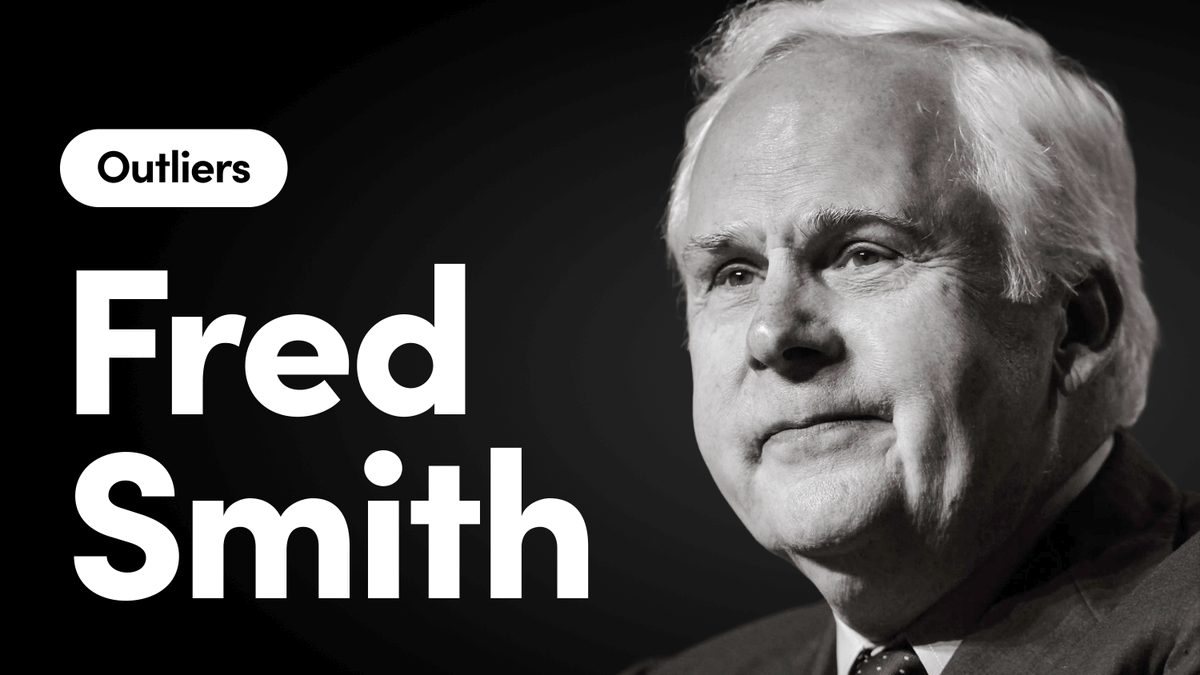
10 Lessons From Fred Smith, the founder of FedEx 1. Not trying guarantees failure: Fred Smith spent his childhood in leg braces. Doctors said he’d never walk normally. Through thousands of hours of excruciating therapy, he didn’t just walk; he became a varsity athlete. “Fear of failure must never be a reason not to try something,” he’d later say. When everyone said overnight delivery was impossible, he remembered the doctors who said he’d never play sports. 2. The power of incentives: The Memphis hub was a nightly disaster. Planes had to land, unload, sort, and reload in hours. Nothing worked until someone noticed the obvious: they paid workers by the hour. The longer it took, the more they earned. FedEx switched to paying by the shift. Same pay, go home when you’re done. The sort suddenly ran like clockwork. Charlie Munger loved this story: “Never, ever, think about something else when you should be thinking about the power of incentives.” 3. Loyalty is earned in the trenches: In Vietnam, Smith learned soldiers don’t fight for politicians; they fight for the person next to them. Years later, when FedEx ran out of money, employees worked without pay. Pilots used personal credit cards for fuel. Not because they had to. Because of the loyalty that was earned in the trenches. 4. Become a learning machine: Fred Smith read four hours a day. Every day. “People who supposedly have vision spend a lot of time reading and gathering information, then synthesize it until they come up with an idea,” he explained. All that reading showed him something nobody else saw: people would soon care more about tracking their package than getting it fast. 5. Take care of your people and they will take care of you. In 1974, investors moved to fire Smith. Every senior officer signed the same letter: fire him, and we all walk. One was even offered the presidency as a bribe. (He refused.) This was People-Service-Profit in action. The order of those words is important. People first, then service, then profit. Not the other way around. Most companies put this stuff on motivational posters. At FedEx, people bet their careers on it. 6. Reliability is rare. Speed without predictability is useless. FedEx guaranteed overnight delivery or your money back, a feat that seemed impossible at the time. The guarantee created trust with customers and accountability internally. There were no excuses. 7. All in or all out. FedEx had $5,000 left. The planes needed $24,000 to fly on Monday. So Smith took the five grand to Vegas and turned it into $27,000 at blackjack. When investors heard this story, they didn't see a gambling problem. They saw a founder who'd already bet his inheritance, his house, everything, and was still fighting. Two weeks later, they gave him $11 million. 8. Trust is built in drips and emptied in buckets. When Smith bought Flying Tigers, he faced a choice: protect the seniority of Tigers pilots or his own FedEx pilots. He chose Tigers. The FedEx pilots—the ones who'd saved his company with their credit cards—called it "treachery." FedEx recovered financially, but the family was dead. 9. Outcome over ego. FedEx lost $629 million in Europe because Smith assumed Europeans wanted overnight delivery. They didn't. Their countries were small enough that regular trucks worked fine. Rather than double down to save face, Smith killed the entire operation. Most CEOs would have thrown another billion at the problem rather than admit they were wrong. They confuse stubbornness with strength. But Smith had learned from military history: sometimes the smartest generals are the ones who know when to retreat. 10. Bounce, but don't break. Smith survived childhood disease, his friend's death, Vietnam combat, near bankruptcy, a coup attempt, and a $629 million failure in Europe. Despite disasters that would have broken most people, he kept going and built an $88 billion empire.

Shane Parrish

457,292 görüntüleme • 10 ay önce

21 Rules of $KASPA 1. Those who understand buy Kaspa. 2. Those who don’t, criticize Kaspa. 3. Everyone is against Kaspa before they are for it. 4. You will never be done learning about Kaspa. 5. Kaspa is powered by chaos. 6. Kaspa is the only game in the casino that we can all win. 7. Kaspa is the one thing in the universe that you can truly own. 8. Everyone gets Kaspa at the price they deserve. 9. Only buy Kaspa with the money you can’t afford to lose. 10. Tickets to escape the matrix are priced in Kaspa. 11. Kaspa insight is restricted to those with a need to know. 12. All your models will be destroyed. 13. The cure to economic ill is the orange pill. 14. Be for Kaspa, not against Fiat. 15. Kaspa is for everyone. 16. Learn to think in Bitcoin & Kaspa. 17. You don’t change Kaspa, it changes you. 18. Laser eyes protect you from endless lies. 19. Respect Bitcoin & Kaspa, or it will make a clown out of you. 20. You do not sell your Bitcoin & Kaspa (unless you understand marketcycles) 21. Spread Bitcoin & Kaspa with love. 22. Bitcoin was the testnet of Kaspa 23. Bitcoin = digital Gold, Kaspa = digital silver 24. Kaspa = 600x faster than Bitcoin (soon 6000x faster) Just have a look at: (change to 10BPS --> end of Q1 implemented) 25. Kaspa solves the Trilemma (read it again) 26. 90% of all KAS in circ supply 27. In 2 years $KAS is already more scarce then $BTC 28. Already 2nd biggest hashrate. Compare with $BTC MC 10 years ago = bigger hashrate already 29. Like $BTC = Firstmover. BTC = first blockchain KAS = first Ghost Blockdag 30. Marathon (biggest publicly listed BTC mining company) is now involved in $KAS Mining BONUS: Binance, Coinbase, VCs & KOLs initially ignored $kas because they had no control over it. Now they’re forced to chase what they once dismissed. Our lesson? Follow the tech, don't go against it. Don´t sleep on it Michael Saylor and just read "The book of Kaspa" #micdrop 🫳🎤

Jens Illgner - Road To Glory Jil

46,585 görüntüleme • 1 yıl önce

Jayne Anne Phillips just won the Pulitzer Prize for her novel called "Night Watch." She’s written six books and founded the Rutgers-Newark MFA Program and this episode is all about her approach to writing. Some lessons below: 1. It's strange what you don't forget. Those things are a key to who you are and what really matters to you. 2. “When I’m writing, nothing is going through my head.” 3. Your job as a writer is to listen to the work itself because it'll tell you what to write next. 4. Every novel teaches its reader how to read it. It’s a unique world with its own rules, rhythm, relationships, and way of perceiving reality. 5. Writing is fundamentally about perception, and it's the author's job to show the reader how they perceive the world. 6. What's unique about children is the way they formulate their own conclusions by looking for truths that are truer than the ones they've been given. 7. We are creatures of narrative. We think in terms of words and in terms of images. 8. Small towns are webs of secrets beneath the surface: There's always a world underneath the world, and children hearing adult conversations know this better than anyone. 9. Jayne tells a story: “Someone said to me once: 'When I read your work, I don't feel as though I'm reading about something. I feel as though I'm inside it.' That is exactly what I want the reader to feel." 10. Find your writing allies. Some will be living writers, others will be dead ones, but no matter what, it’s worth reading all their work. 11. Language is like music. Every word is a different note, and the best way to find the flat notes is to read your writing out loud. 12. It's all intensely meaningful, no matter how terrible life can sometimes be. I've shared the full interview with Jayne Anne Phillips below. If you'd rather watch it on YouTube or listen on Apple or Spotify, check out the reply tweets. Enjoy!

David Perell

48,550 görüntüleme • 1 yıl önce

Ex Machina is no longer sci-fi. China has finally built it. The company is AheadForm, founded in Shanghai. The product is the world's most hyper-realistic robotic face. Silicone skin you can't tell from human, 25 micro motors hidden underneath pulling the face into real expressions. And RGB cameras embedded inside the pupils so when it looks at you, it actually sees you from where its eyes are. They raised $28.5M to "give AI a head," which is also where the name comes from. AheadForm = a head form. This is the opposite of where everyone else in robotics is focused. Unitree, Figure, Tesla, Boston Dynamics: all about the body. AheadForm chose the face because they think trust is the harder problem to solve, and trust gets decided at the face. The reason nobody else has tried this is the "uncanny valley." It's the creepy zone where a robot looks almost human but not quite, and looking at it just feels wrong even when you can't say why. Most roboticists believed no amount of engineering could make a face realistic enough to escape it. So they gave up and kept robots cartoonish on purpose: big anime eyes, exaggerated features, clearly synthetic. But AheadForm decided to treat it as an engineering bug instead. Add enough motors, tune the silicone, fix the timing, the valley closes. And they're pulling it off. A few crazy details about how this actually works: 1. The robot learns its own face in a mirror. You put it in front of a camera, let it fire every motor randomly, and it watches what its face does and builds an internal map of "if I send command X to motor Y, my eyebrow does this." Same exact process a human baby uses staring into a mirror. The robot teaches itself who it is by experimenting. 2. It predicts your smile 839 milliseconds before you smile. By watching the micro-tells in your face that precede a smile, the robot starts smiling 0.8 seconds ahead, so its smile lands at the same moment yours does. Most robot mimicry happens half a second late, which is exactly why it always feels artificial. 3. The pupils are the cameras. When the robot makes eye contact, the gaze and the sensor are the same physical thing. Most humanoid robots stick the camera on the forehead or chest, so they aren't actually looking at you when their eyes are pointed at you. 4. The founder, Yuhang Hu, did his PhD at Columbia under Hod Lipson. Lipson is the guy who in 2006 built a four-legged robot that figured out it had four legs by experimenting with its own movement, nobody told it the body shape, it discovered it. He has spent 25 years trying to build machines that know what they are. AheadForm is that 25-year research arc productized. 5. NetEase Games already paid them to physically embody a fantasy video game character. That opens up a brand-new category: robotics as the physical embodiment of fictional IP. Every character-rich studio, Disney, Riot, Hoyoverse, Pokemon, Netflix, now has a question to answer about when their characters get bodies. AheadForm believes whoever ships the first robot you'd actually want around your family wins. That's the bet behind the most realistic robot face on earth.

Ole Lehmann

534,963 görüntüleme • 2 ay önce

💥 LAP Alert 💥 "I did this sort of spy thing where I changed hotel rooms and I changed taxis. I was making sure I wasn’t followed." ~Knapp Is Lacatski Lying to Us About the Craft and Breaching the Hull? ~ "If not for that [2017 NYT] story about AATIP and the problems that [Lacatski] saw with it, he would never have mentioned [AAWSAP]...I don't think, ever." ~Knapp (So, in other words...thank you from the UFO community, to the NYT, for getting it wrong? 🙂) ~ Jeremy Kenyon Lockyer Corbell: "Should we listen to Dr. James Lacatski on UFOs, on the fact, or the idea, that our government has at least one, he's admitted, and we breached the hull? Should we listen to him, George?" George Knapp: "I know a lot of people have noticed that he's talked about his role in counterintelligence as part of the AAWSAP program. And because they equate counterintelligence with lies, false info., cover stories, misdirection. Aha! He's putting out a bunch of false info. a decade after he retired from government service." (I saw one person suggest that, and I thought it was a questionable take...) Grant Lavac: "Given that Dr. James Lacatski was the 'counterintelligence coordinator' for AAWSAP, how much confidence can we invest in the veracity of his public statements that 'at least one recovered craft of unknown origin, a flying machine with no wings, no engine, no fuel, and no fuel tanks' is in the possession of the US government and that they had 'breached the hull' of the UFO? In the context of the counterintelligence value of UAP/UFO, his comments in this most recent interview on WEAPONIZED (edited for brevity) only raise more questions for me." ~~~ Knapp: "A, it's not [Lacatski]. He's not out there beating the bushes. He's talked to us, but that's pretty much it. He's telling the full story as much as he can in a series of books. And I was co-author on two of those, not on this one. And, you know, I remember the first time I met him, it was in 2018." ~ (In April of 2019, Knapp shared that story, minus Lacatski's name, at UFO MegaCon. Knapp in 2019: "I thought today I would share with you, sort of the informational foundation that I’ve acquired. So, one year ago, I made this trip to Washington, D.C. at the invitation of Senator Harry Reid. It was St. Patrick’s Day, 2018 and I already knew a little bit about AATIP and AAWSAP and what they’ve been studying and where the money came from and how the program was created. I did this sort of spy thing where I changed hotel rooms and I changed taxis. I was making sure I wasn’t followed. And if there was ever actually, anybody following me, they must have thought I looked ridiculous because it was way over the top. "But I ended up having to meet with Senator Reid and some other people who were directly involved in these programs and they gave me a download. And I thought I knew a lot about these programs when I went there and realized that I only knew a little tiny bit. The purpose of this was to learn about these programs. We all know about AATIP, but in reality, there was something before that. "I sat down for a couple of hours with Senator Reid and other people whose names, they don’t want to be known. They brought me up to speed on how AATIP was created. How its predecessor was under way for a number of years. It coexisted for a long time. People in this room. People who investigate this topic may have suspected for a long time that there was some kind of a program that still existed. We’ve all heard that Project Bluebook was the end. 1969 it ended and the government was done with UFOs. They closed up shop. And the reason they closed it down is because there was no evidence that it involved national security. "And we all knew that was baloney because of the stories that we’ve seen that are really well documented. For example, UFOs over nuclear missile bases. UFO encounters with the military installations and atomic facilities. Things of that sort the have been well documented over the years. There are cases that involved national security. So at the end of Blue Book, of course, this memo said, alright, any cases involving national security will continue to be investigated in the regular way. Well, what the heck was the regular way? We didn’t know. Well now we do know. At least a little bit of it." (Project Blue Book was shut down in December of 1969, but a few months earlier, in October, we had the Bolender memo, which noted that "reports of UFOs which could affect national security should continue to be handled through the standard Air Force procedure designed for this purpose." What standard Air Force procedure? The regular way? Where did those cases go? We still don't know what Bolender was referring to in that memo.) ~ Knapp in 2019: "And one of the regular ways was this program called AATIP. So I went on this trip. [and] I learned this stuff about AATIP. I had known a lot about it before but I got this briefing about this alphabet soup of different programs, how they began and what they studied. December 2017, the New York Times breaks this story about AATIP. Now, I had known about it for a long time because I lived in Las Vegas. I knew Bob Bigelow. I knew Harry Reid. We’d talk about UFO stuff and what was going on. "So when I was told the New York Times was gonna break the story, I’m kind ticked off about it. Because hey, I’ve been sitting on this for a long time. Why don’t I get to break the story? And they had to, one after another, gently remind me, 'You know. You’re not the New York Times.' Which I had to admit! It was true. And if I had done the story, the Times had said that they weren’t going to do it if somebody else breaks it. So, if I had done it, it’d be another story from a UFO reporter. "The New York Times did it and they changed everything. Because they did it, wider organizations did it. Some of them took shots at the New York Times because The Times got the story and they didn’t. But that story was accurate, to a degree. But the story that it told was not the full story. AATIP, that we know about…the AATIP that studies nuts and bolts saucers…case of UFOs that have encounters with military units such as the USS Nimitz, that is studied by a group of people, Lue Elizondo was the head of it. "It’s not so much a program as it was a loose network of intelligence officials in different agencies, including the Air Force and the Navy, CIA, DIA, DARPA…there might be a couple of other agencies. But a case would come in from any one of their units [and] it would be shared with this group of people, analysis would be done, evidence would be looked at and then stashed in a draw and nobody ever sees it. It’s not passed up the chain of command. "In 2007, that changed. One of the guys (Lacatski. ~Joe 2025) I met with in this meeting in Washington is the one who changed it. He had been in the same position that Lue Elizondo had been in. And his name is just not out there. He grew frustrated with what was happening with the phenomenon and he suspected that UFOs flying around the sky, buzzing our military units every once in a while, is not the full story. Even if you could solve that part of the mystery it wouldn’t solve the bigger part of the picture. "So he grew interested in Skinwalker Ranch and he had read the (Knapp/Kelleher – 'Hunt For The Skinwalker') book. And after he read it, he called up Bob Bigelow and said…actually, he wrote him a letter and said, 'Hey, can I go to the ranch…go look around? I’m with the DIA.' Bigelow says, 'Come on out to Las Vegas and I’ll take you there.' And that’s what happened. He flew to Las Vegas. They flew on Bigelow’s jet. They went to the ranch. "This guy’s not there fifteen minutes and he has an experience. And I’m not gonna go into detail. I’m hoping that he’s going to maybe come forward at some point and describe his experience. But it was just for him. Of all the people in this room, in the encounter, he was the only one who could see it. He’s the only one who had an angle on this thing that appeared. And he’s pretending that he’s not seeing it but it’s right out of the corner of his eye. And he doesn’t say anything until he leaves the ranch. And he gets off and he asks Bigelow if he had seen it. And he had not. The other people who had been in the room had not seen it. "He flies back to Las Vegas, goes back to Washington, D.C. and looks up Harry Reid and tells him about it. Now Reid had some experience in these matters that I’ll get into in a little bit. But as a result of that conversation, Reid, who had an interest in UFOs and had maintained that interest over many years – and I can attest to that personally – called in a couple of his friends in the Senate – Daniel Inouye and Ted Stevens. They had a conversation in a secure room and they decided to provide some funding for a much broader study. Something that looked at…beyond flying saucers, that looked at other paranormal aspects…supernatural aspects that we would not normally associate with aliens or ETs. Assuming that that’s what this is, which I’m not sure anyone knows for sure. And that is how AAWSAP was born. The Advanced Aerospace Weapon System Applications Program." ~~~ Knapp Yesterday: "The only reason [Lacatski] came forward, he was ticked off about how AATIP had been described in major media reports, and no mention had been given to the actual, real program. That one that had a $22 million budget, lasted 27 months, and which put together the biggest UFO data warehouse in history, that had written all these papers that still have not been released." (In the most-recent interview (Part 1) with Weaponized, Lacatski let it fly with his issues related to the 2017 NYT article: "The initial reporting...by the New York Times story in 2017 was totally inaccurate. Contrary to what some people claim, the authors knew my name and position at AAWSAP, yet never attempted to contact me. Likewise, the The Washington Post. POLITICO (laughs) contacted me within hours after the articles were published in the free publications, asking for my opinion. They knew my name, they had my phone number. Why didn't they contact me [beforehand]?" ~Dr. James Lacatski on Weaponized ~ Knapp: "So, Jim was a counterintelligence guy for AAWSAP, but in this role. He wasn't putting out cover stories or lies, he didn't put out anything. The world didn't hear that AAWSAP existed until years later, at least by that name. There was one statement made to the press about that program. It was by Robert Bigelow, whose company, BAASS, got the contract. A week after he signed it, he came on with me on Coast to Coast AM and said, 'We got this program dealing with UFOs, we have an unnamed partner, and we're excited to get going.' That was it. "Jim Lacatski wasn't putting out PR releases about AAWSAP. There was nothing. That was the last thing anybody said until the New York Times did the AATIP story, and then Jim Lacatski felt the real story was being covered up. If not for that story about AATIP and the problems that he saw with it, he would never have mentioned this. I don't think ever." (Well, then, thank you to the NYT journalists and editors for pissing off Lacatski!) Knapp: "You'll recall, AAWSAP, at the time that things went downhill, that the funding was moved away, they were trying to make it into a SAP, a Special Access Program. And if it had happened, we probably would never have heard of it. If it had happened, Lue Elizondo would have been the counterintelligence guy for AAWSAP, that he had already talked to Lacatski. "But Lacatski is not proclaiming the greatness of the program. He's not out there beating the bushes on podcasts and newscasts, other than with us, and he never put out in counterintelligence. His role, counterintelligence, meant something different for AAWSAP. The thing that DIA had told him was, 'Look, you know, it's not a rogue program. I know it gets weird into some of the phenomena that was at Skinwalker Ranch and other places. We don't care. Here's what we care about: Don't let the secret out. We don't want to see this on the front page of the Washington Post. We want it kept secret.' (John Greenewald was one person questioning whether AAWSAP was actually a prosaic program and Lacatski just decided to go rogue with a foray into UFOs and the paranormal.) Greenewald Tweet: "Did the U.S. government really sanction this, and if so, is this really how it was run? Or was this a rogue operation by a select few on the inside playing with Uncle Sam's coffers?" (Greenewald was quote tweeting a Greenstreet hit-piece video on AAWSAP. In his interview on Weaponized aired over the past few weeks, Lacatski said that former Deputy Director of AARO, Tim Phillips, also used the "rogue" word when describing AAWSAP. Did DIA really not know what AAWSAP was about? Did Lacatski go rogue and turn a program that was supposed to look at prosaic, advanced technology into one that studied UFOs and the paranormal? Here's an exchange from the 2023 interview Knapp and Corbell did with Lacatski and Colm Kelleher.) Kelleher: "The critical part of AAWSAP that we tried to convey in 'Skinwalkers at the Pentagon,' was that there were two fundamental, parallel tracks that AAWSAP ran on. The first one was the examination of UFO performance. And, you know, the UFO performance part was getting all of the data from eyewitnesses, plus deploying sensors into the field, in order to gather data on the performance of UFOs. That was track number one. And track number two was: What effects do UFOs have on humans? That was a parallel track that, from the get go, AAWSAP decided, unambiguously, to run both tracks in parallel. We documented psychological effects, and then we also documented paranormal effects." Lacatski: "Anything can be said on the internet it seems, factual or not. Well, one thing that is not factual is, DIA knew what it was getting into in regard to both aspects that Colm just described to you. And let me end my statement right here. We had no choice but to pursue both aspects." (That was a poor way of him saying: The claim that DIA was unaware of AAWSAP looking into all aspects of UFOs, including the paranormal, is NOT true.) Lacatski: "I want to emphasize something I said on my first and only interview. It was a closed program. It operated very similar to a SAP. The director, the director of analysis, and my office chief...and, of course, division chief, knew about this program. No one else did. Now, I was also protected by the stovepipe nature of that. I did not have to address political-type questions. I was insulated, but they were, too. There was no one else. People in the surrounding cubicles didn't know. Nothing was purposely being hid. It was a closed, stovepipe system, and it needed to be. It needed to be operated that way." ~~~ Knapp: "And so, Jim Lacatski took it on himself, put it in his own hands. He and Colm Kelleher interviewed all these people who applied for the jobs, the 50 full-time positions that they staffed, in a matter of months. They did background checks, they required security clearances for all those people, and they were worried about leaks. They didn't want information to get out. "They also were concerned about espionage by foreign players, by foreign companies, things of that sort. And some of that really did happen. As Jim has shared with us, there were a couple of phones that were transmitters that were found inside Bigelow Aerospace, inside the Bigelow, uh, facilities, and it was very alarming because they weren't sure who was doing it. I think they think it was a foreign government. I'm not going to say which one, uh, they suspected the most." (Lacatski said that the phones in question were made in China.) Knapp: "But, and then they also found weird frequencies emanating from Skinwalker Ranch. That's not strange, and there's a lot of unusual stuff that happens there, but it was some sort of a an espionage program that they believed was was not only looking at the ranch, but also at BAASS. "That was his primary concern. He was worried that the story gets out, because secrecy was of paramount interest to the heads of DIA and he's worried about the information getting out to the public. Because once it happened, then the knives come out in the Pentagon and within the intelligence community, which is kind of what happened. A memo was sent from Harry Reid's office, let other people know that AAWSAP existed, and that's when things started getting problematic." Corbell: "The bugging thing. So, it's not just like Bigelow Aerospace was tapped with something, he said, specifically, AAWSAP, right? So they were looking at that new UFO program. And I don't know how public this is, but he did say it was - not just him, other people have all said - it was multiple nations, multiple, different devices from those phones. And he also said that they worked with FBI, they had FBI liaisons looking at the ranch property, and also at Bigelow Aerospace. "Because, remember, they were supposed to receive a transfer of materials. That's why they reverse, reverse engineered (laughs), you know, they built everything to be able to hold SCIF-capable and material-capable property at that classification level. So, look, I think if we pull it back, the whole idea is, James Lacatski made a statement at some point that he was, you know, head of, or part of, or running the counterintelligence for AAWSAP. But his point was to keep AAWSAP itself secret from foreign nations. So then he has to keep it secret from the U.S. He did it. He did a great job. They actually kept it secret. That doesn't mean he's going out and creating false information to the public like he's been accused of. "So, should we listen to Jim Lacatski? That was like, you know, the main question. Oh, one second. He also identified that there is currently a counter-programming, counterintelligence operation going on to the American public, but not against the American public, by AARO." (In other words, spread misinformation to the American public so they can advance their goal of misinforming and confusing our adversaries who are always listening. National security! IMO, that's only acceptable if we're talking specifics related to propulsion, technology and weapons that can be used to give us a leg up on said adversaries. But everything else should come out and be made public. We shouldn't be told a bunch of lies about information we paid for and that could, potentially, give us some clarity about our species and other lifeforms on this planet.) Corbell: That was so clear in our interview with him that he said that, you know, 'Look, they're acting this way. They are telling you lies about AAWSAP and what happened.' And that's why he said, 'My books, I'm a government employee. This was paid by taxpayers. I'm trying to give you information.' And that's what his books are. "So it's clear from these rounds of interviews that we just had with Dr. Lacatski that he supports a controlled UFO disclosure. He made that very clear. So should we listen to what he has to say? I mean, he was a big dog, right, George?" Knapp: "He was the head of the largest U.S. government-funded UFO investigation in history, that we know of. He worked with Colm Kelleher, who was the boots-on-the-ground guy in Las Vegas. He worked with Jay Stratton. Stratton's role in the development of AAWSAP has not been really fully explored, but he's got a book coming out at some point, once it gets through the DOPSR process. But then we'll get additional information to buttress what Lacatski has said."

Joe Murgia

56,558 görüntüleme • 8 ay önce

MrBeast: "If you knew what I knew, you could get 10 million subscribers in six months" "Your videos suck. You think your videos are good, but they suck. They just do. And the sooner you learn how to make good, great videos that people actually want to watch, the sooner you'll get views." MrBeast shares his early reality: "When I was 14, I thought my videos were the best in the world. They weren't, they were terrible. To be successful, you kind of have to have a little bit of that ego where you think your content's great. But also, if you have sub-1,000 subscribers, there's a good probability your videos just suck. They just do." He explains what to do about it: "You need to make hundreds of videos. Improve something every time. And just get to the point where they don't suck. When you make good content, you'll blow up. It's not the algorithm. It's not anything. Most people who are in my position just made terrible videos, and that's okay. Because you've got to make a bunch of videos and improve over time to be great." MrBeast uses an analogy: "You don't just pick up a baseball and become an MLB-level athlete within a year. It takes many, many, many years. YouTube's kind of the same way." On analysis paralysis: "A lot of people get analysis paralysis. They'll sit there and plan their first video for three months. If you have zero videos on your channel, your first video is not gonna get views. Period. Your first 10 are not gonna get views. I can very confidently say that. So stop sitting there and thinking for months and months on end. Just get to work and start uploading." He gives the formula: "All you need to do is make 100 videos and improve something every time. Do that, and then on your 101st video, we'll start talking. Maybe you can get some views. But your first 100 are gonna suck." How to improve something each time: "The second video: put more effort into the script. The third one: learn a new editing trick. The fourth one: figure out a way to have better inflections in your voice. The fifth one: study a new thumbnail tip and implement it. The sixth one: figure out a new title. There's infinite ways. The coloring, the frame rate, the editing, the filming, the production, the jokes, the pacing, every little thing can be improved. There's literally no such thing as a perfect video." On the algorithm: "What YouTube wants is for people to click on a video and watch it. That's what it is at its core. By studying the algorithm, you'll learn that you're more studying human psychology. What do humans want to watch?" MrBeast shares a simple reframe: "Anytime you say the word 'algorithm,' just replace it with 'audience' and it works perfectly. 'The algorithm didn't like that video?' No, the audience didn't like that video. Literally, that's it. If people are clicking and watching, it gets promoted more. The algorithm just reflects what the people want." On titles: "Short, simple, and just so freaking interesting that you have to click. If someone reads it, are they like, do they have to watch it? Is it just so intrinsically interesting that it's gonna haunt them if they don't click?" He adds nuance: "Keep it below 50 characters. Above 50 characters, on certain devices it goes dot, dot, dot, and that's the worst thing because then people don't even know what they're clicking on." MrBeast shares the extremity principle: "The more extreme the opinion, typically the higher the click-through rate. 'Fiji water sucks', that'd do fine. But 'Fiji water is the worst water I've ever drank in my life', way more extreme, would do way better. But then you have to deliver. The more extreme you are, the more extreme you have to be in the video." On the first 5 seconds: "Before you film a video, what is the thumbnail? What is the title? Then what's the first 5 seconds? Then what's the first 30 seconds?" He explains why autoplay changed everything: "On YouTube now, videos automatically play. So many people don't even see the thumbnail because it autoplays so quickly. The thumbnail is irrelevant for them. I have to visually convince you to click on the video in the first 5 seconds. Before, the hook was important because you had to convince people to watch. Now you have to convince people to click and watch at the same time, with the first 5 seconds." On matching expectations: "Your title and thumbnail set expectations. At the very beginning of the video, to minimize drop-off, you want to assure them that those expectations are being met. If you click on a video called 'Tether is a scam' and at the very beginning, he starts talking about literally anything else, you're like, 'Oh, this is BS. This isn't what I clicked on.' But if at the very start you go, 'Tether is a scam and I'm gonna teach you why,' then it's like, okay, you match the expectations. Then you want to exceed them." He emphasizes the importance: "The thing people undervalue the most is literally the first 10 seconds of the video. That 15% difference in viewership between losing 35% of viewers in the first 30 seconds versus losing 20%, that really does make the difference between 2 million views and 10 million views. You just had a more strategic intro that hooked them." On removing dull moments: "You basically want to remove every dull moment. Find the 10 most critical people you know, make them watch the video, and just roast it. If I talk to a camera for 10 seconds without a cut, a lot of people will get bored. Having a B-cam and C-cam three seconds in, cutting to a different angle, now it's more interesting even though it's essentially the same thing." On keeping viewers watching: "Give them why they clicked. Tell them why they should watch. Then just stick on topic. That right there isn't even super complex, but I would already put you in the upper echelon of YouTube. A lot of people drag it out. It's like, 'I'm going to eat $100 ice cream, but first...' and then it's them birthday shopping for their mom. That's not why I came here." On quality over quantity: "It's much easier to get 5 million views on one video than 50,000 views on 100 videos. A lot of small YouTubers just post videos that aren't bad but aren't great, and none of them ever pop off, so they never get an audience. It might be better to upload half or a third or even a fifth of the videos, but make the videos you upload so freaking good that the algorithm has to promote it." He warns against the consistency trap: "When you set a consistent schedule and you're constantly having to upload videos that aren't as good as you'd like because you gotta hit 'Oh, this Monday I said I'd upload', that's a dangerous trap. The viewers notice the quality isn't as good and it makes them less likely to watch. I think it hurts your longevity." On the real metric that matters: "A big thing that everyone underestimates, what was your experience with your last video? If people loved the last video of yours that they watched, they're more likely to watch your next one. When people watch your video, you don't want them to go, 'Okay, that was good, but that's enough of you for the day.' What you want is them to go, 'Holy crap, that was crazy! Oh my god, what's that?' and they watch 10 videos. That's how you get high view counts. People watch 10 videos, not one." On thumbnails: "You want it to be simple. When they're scrolling, you want them to instantly understand what you're conveying and feel some type of emotion. Make it so interesting, or spike their curiosity so much, that if they don't click it, they'll wonder before they go to bed what happened?" He gives an example: "If you uploaded 'I rode a skateboard with 1,000 other people on it', and people are falling off the side, it's about to go off a big ramp if you don't click that, you're gonna be so curious. Later in the day, when you're daydreaming, you'll think, 'What happened to those 1,000 people on that skateboard?' That's the mindset you should have when making thumbnails." On knowledge being the only barrier: "It's all knowledge. It really is. I could start a new channel tomorrow without using my face or my voice, without ever promoting it, and in six months have 20 million subscribers. I just could. It's purely knowledge. If you knew what I knew, you could get 10 million subscribers no matter where you are right now within six months." He addresses the skeptics: "90% of the people watching don't agree with that. Everyone has excuses. 'Nah, YouTube just doesn't work like that, Jimmy.' But I mentor a lot of people. I see it all the time. It is possible. It is simply knowledge. The second you accept that it is knowledge and you start your journey of learning figuring out what makes a good video, what does my audience want, how can I elevate and then you take that knowledge and just assume 'I will never understand what the perfect video is' and every single day be devoted to learning and improving as much as possible there you go." On money not being the barrier: "There are tons of viral ideas that don't require money. It does not require money to go viral. One of my most-viewed videos was spending 24 hours in a desert, we just grabbed a tent and some stuff and went to the desert. It got 60-70 million views. People say, 'I could be MrBeast if I had money.' A, I didn't start off with money; I was poor, I had no money. It took me seven years just to buy a camera saving up from YouTube. And B, some of our most-viewed videos literally anyone can do." On why no one will outwork him: "No one's ever gonna do what I do better than me. It's just not humanly possible. I reinvest every penny I make. I work every hour I'm awake. I devote every atom in my brain to solving this. I hire the best people on the planet. I've been doing this for 14 years. And I think in decades, not years. I'm gonna be doing this for another 20-30 years. If I thought someone was doing better than me, I'd just start sleeping less so I could work even more." But he doesn't recommend it: "I don't have a life. I don't have work-life balance. My personality, my soul, my being is making the best videos possible. That is why I exist on this planet. And I don't recommend it. You should have work-life balance. You should not devote your entire life to this one thing. I have a mental breakdown every other week because I push myself so hard. I don't recommend it." The only question that matters: "Subscribers don't matter. Views don't matter. I mean, they do. But everything you want as a creator comes from making the best videos possible and thumbnails. The video part's the hard part. Ask: 'How can I make my videos better?' Do that every single day for years. And then you'll probably get views."

Jaynit

125,085 görüntüleme • 1 ay önce

❤️‍🩹 It's strange that there would be... ❤️‍🩹 Thinking that... well.. 🤍 Never... never really done something like this before... 🤍 People walking back and forth, you know? Looking for a moment, for the right timing... 🤍 Hey! There's no one left now... 🤍 Hey! Even at the stairs... 🤍 Get what I mean? Yeah... right... 🤎 imagine, imagine, imagine... 🤍 So, it’s like telling the background story of Prim and Bambi why they broke up and all that... 🤍 Bambi... you were the one who broke up with me.. ❤️‍🩹 Yes, because back then... I was still young... ❤️‍🩹 Still young and... what do you call it... I still didn’t understand... ❤️‍🩹 I was very selfish. Even now I still am, but back then it was much more... 🤍 Don't you ever feel sorry for me? I rushed out of the set with a really oily face... ❤️‍🩹 Phi, I was hurt too... but we have to look at the reality... ❤️‍🩹 I mean, I understand... I understand Bambi.. 🤍 I realized... it’s like not wanting to hold anyone back.. ❤️‍🩹 Right, right... because if we had forced ourselves to stay together back then... ❤️‍🩹 Prim would have lost opportunities, lost work, things like that... ❤️‍🩹 ​I get it and Bambi, she wanted to be number one, you know? 🤍 I see... Has anyone ever experienced this? A partner making you choose between them or work? You can press the stars. 🤍 1 2 3 4 5 6 7 8 9 10 right down below... 🤍 And we’ll understand you.. ❤️‍🩹 Or you can go listen to “Favorite Toxic”. 🤍 Wow! You’re so good at promoting! ❤️‍🩹 Go on, Phi, promote it... 🩷 Just one verse, just one verse... ❤️‍🩹 Oh wow, Phi... 🤍 Hey! Since you served it up like this... 🤍 Ai Im... kid... can one verse be, like... a keyboard or something? ❤️‍🩹 And then the part... Don’t cross the line.. 🤍 Oh! I’ll send it to you, I’ll send it... 🤍 No worries... this is just a teaser... 🤍 Because I just sang it... but I haven’t sung it in Thailand yet... 🤍 Wow... it has to be the debut, right... 🤍 Are you going to continue? If you sing your part, that’s it, you’re done... #GirlRulesSeriesEP5 #NamtanFilm #น้ำตาลฟิล์ม Trans (disc)

Belle

16,832 görüntüleme • 3 ay önce

🚨 ALERT AMERICA: HERE IS THE PROOF - ONE OF THE NINE FEDERAL REFUGEE CONTRACTORS ADMITTED THE ENTIRE RESETTLEMENT SCHEME ON CAMERA AMERICA HAS BEEN SOLD OUT! This 2021 video from Episcopal Migration Ministries (EMM), one of the nine federally funded refugee resettlement contractors, is one of the most revealing pieces of footage you will see. They were speaking openly at All Saints Church in Pasadena, assuming no one outside their activist circles was paying attention. But what they admitted is devastating. This wasn’t a sermon or charity. It was a full-blown political strategy briefing, filmed in a church, explaining how the U.S. government and religious NGOs work together to: 📍 dramatically expand resettlement pipelines 📍 pressure Congress to change immigration laws 📍 mobilize churches as pro-immigration activist armies 📍 build permanent support networks for arrivals 📍 redefine “refugee” to include economic & climate migrants 📍 overload the system by design 📍 coordinate lobbying directly with Washington And they said all of it out loud - we are funding our own demise! 1. They admit they are an official U.S. government partner Brother Chris McNabb of EMM states: “EMM is a ministry of the Episcopal Church and one of nine national agencies responsible for resettling refugees in the United States in partnership with the government.” This is not charity. They are federal contractors with a financial quota. More refugees = more money. It’s that simple. This is state-funded demographic policy laundered through churches. 2. They confessed the scale: from 18,000 refugees → to 4,000 Afghans PER WEEK McNabb brags: “In 2020 all nine agencies resettled about 18,000 refugees. We are now resettling 4,000 Afghans a week.” This was a mass importation pipeline, not a humanitarian drip. He openly says they had to “staff up significantly” because the pipeline “exploded overnight.” 3. They admit DHS used “humanitarian parole” to bypass the legal process McNabb explains Afghans were: “Paroled in by the Department of Homeland Security… because they did not have time to wait for the immigration system to operate.” Translation: ➡ Normal vetting was bypassed. ➡ The legal process was circumvented. ➡ Tens of thousands were rushed in without proper screening. Congress still hasn’t adjusted their status, but the arrivals are here permanently. 4. They train congregations to take in asylum seekers and parolees — not just refugees Through the Neighbor to Neighbor program, churches are trained to: 📍 provide physical & emotional support 📍 provide transportation 📍 help navigate legal processes 📍 sponsor asylum seekers & Afghan parolees Teams of 5–10 church members take over the roles official agencies would normally handle. This decentralizes the pipeline and embeds it inside communities. 5. They push churches to DEFUND ICE Rector Mike Kinman proudly declares: “We are strong advocates for the complete defunding of ICE.” So you have: 📍 a federally connected resettlement contractor 📍 working with the State Department 📍 using a church pulpit to demand the abolition of ICE This isn’t ministry. This is open-borders political warfare. 6. They openly plan to expand “refugee” to include climate & economic migrants When asked what happens to migrants who don’t meet asylum criteria, McNabb says: “We will begin seeing more and more climate refugees… more folks who come for economic reasons. We are preparing for that.” They are planning the next wave, economic & climate migrants, long before Congress approves anything. 7. They reveal the Episcopal Church has a lobbying arm on Capitol Hill They talk about OGR - the Office of Government Relations - their official lobbying office in the “God Box” on Capitol Hill. From the stage they instruct congregants to: 📍 call Congress 📍 pressure senators 📍 demand the Afghan Adjustment Act 📍 expand asylum categories 📍 increase refugee admissions 📍 secure more funding for EMM This is organized political lobbying coordinated from the church pews. 8. They admit they operate 11 affiliate offices nationwide, including in red states When asked about IRIS in Los Angeles, McNabb says: “That’s one of our 11 affiliates.” They place arrivals everywhere: Los Angeles, Seattle, Austin, Miami, and beyond. Red states are the main prize. And their “interfaith” branding? A manipulative façade - a left-wing coalition built to push anti-Western, anti-Christian, and anti-Jewish policy through religious cover. 9. They tell congregations to serve undocumented immigrants, too Kinman boasts All Saints is a “sanctuary church” ready to support: 📍 undocumented immigrants 📍 asylum seekers 📍 Afghan parolees 📍 migrants with “various statuses” This goes far beyond refugees — this is a parallel, extra-legal system. 10. They end by admitting the goal is a permanent, embedded migration infrastructure McNabb says this is just: “the beginning of a relationship.” The goal is permanent community integration — meaning once these pipelines enter your town, they never leave. 🚨 WHY THIS MATTERS, AMERICA This is just ONE of the nine federal contractors. In one hour, at one church, they admitted: ✔ their formal partnership with the U.S. government ✔ the massive scale of Afghan importation ✔ bypassing normal processes through parole ✔ pushing to abolish ICE ✔ expansion to climate & economic migrants ✔ their professional lobbying arm ✔ their nationwide network ✔ their plan for permanent demographic restructuring If this is what they say on camera, imagine what they say off camera. Americans deserve to see this video, understand how this system truly works, and decide whether they consent to having their communities transformed, with their tax dollars, without their input. Any politician - Republican or Democrat - who continues funding this racket, this federally backed demographic-engineering pipeline that European leaders openly describe as human-trafficker behavior — WILL be held accountable. If you fund it, defend it, or stay silent while your voters are kept in the dark, Laura Loomer and I will expose you. And WE will fight with everything we have to make sure you never hold office again. No one is going to fight like Laura and me to protect American communities from turning into mini-Islamic states!

Amy Mek

229,978 görüntüleme • 8 ay önce

THE SOUND OF FREEDOM: Exposes The Pedophile Economy enslaving millions of innocent children around the world to a life of rape, torture and murder. Tim Ballard, former Homeland Security Special Agent confirms Adrenochrome is real. They take the children's blood and they drink it. The U.S. Department of Labor and the United Nations estimate that there are over 6 million innocent children who are forced into sex slavery, labor slavery and organ harvesting. It is absolutely a real thing. The United States is the number one consumer of child rape materials and close to number one in production. 85,000 unaccompanied minors were let into the United States and delivered to a Sponsor without the Sponsor being vetted, DNA checked or having a background check. Thousands were under the age of five. This is the Economy of Pedophilia in the United States. There are baby factories, real cases where they have kidnapped women as young as 13 year old children and impregnate them, they rape them and they make babies. Then they take these babies and sell them for their organs, sell them for sex and sell them for satanic ritual abuse. This is very real and it is really happening. Why is the Mainstream Media ignoring these horrific crimes? Tim Ballard says: I think it is because if there are 2 million children forced into commercial sex a lot of people are involved. There are people who don't want this exposed because they are involved in it. Tim Ballard goes on to say that there is something called Adrenochrome where they are taking the children's blood and devouring it. It is very real, they take these children, they take their organs, they take their blood and they drink it. They take the genitals of children and hang it over the rooftop of their businesses thinking the dark gods will bless them. These are real things happening to innocent children. Tim Ballard was with the CIA for one year and then transferred to the United States Homeland Security Investigations Division as an Undercover Special Agent. During his time with Homeland Security he was asked to join a newly formed Child Crimes Unit. During his first assignment in the Child Crimes Unit Tim was so shocked by what he saw, he would never be the same. In his first case in 2002 he was given VHS videos and hard drives that he had to look at. While explaining what he saw during this interview Tim holds back tears remembering the very first images he had to see. He saw three little boys, 7, 5 and 3 years old who looked like his own children, who were being raped by a Pedophile. He was so shocked, that he dropped to his knees and dry heaved in a waste basket thinking he was going to throw up. He suffers from PTSD (Post-traumatic stress disorder) because of seeing the horrors being done to innocent children. Child rape videos have increased by 5000 percent recently. After viewing these shocking images Tim Ballard could never see the world in the same way. He had to come to grips with the fact that there are millions of people who are Pedophiles, only millions of Pedophiles could justify a demand for millions of child exploitation materials and videos. Ernst Oshinsky the real Pedophile who was arrested in the Sound of Freedom movie had over 2 million pieces of child rape material in his house. Tim had to be confronted with the reality that there are millions of people on this planet who want to indulge in watching 5 year old children be raped and sexual assaulted in ways unimaginable. To watch children's bodies actually break in the act of sexual assault, acts that your mind couldn't imagine, but is real, is so shocking to the system it changes your life forever. When Tim Ballard says children's bodies actually break in the act of sexual assault he is referring to the pelvic bones of the innocent children breaking apart as a result of being brutally raped by an adult male. Children's bodies were not designed to be raped by an adult. This is the most horrific crime a child must endure. Pedophiles include all walks of life Tim says, he has arrested educators, lawyers, law enforcement and clergymen. These Pedophiles have normalized raping and torturing children. He says something has taken over them which scares him when he looks into their eyes. They believe their behavior is normal he says. Jim Caviezel says it wounds God in the greatest way when you take these innocent children who have done nothing, who have no sin and kill the most innocent. He goes on to say very emotionally that he hears the screams of these children in his heart because of the agents that he worked with. He was weeping so hard by the horrors of what he saw. He viewed this evidence because he had to know the pain and suffering of these children in order to share this truth with the world. He goes on to say the Media and the 3 letter agencies are not telling the truth. Jordan Peterson asks Jim Caviezel how has this movie changed you? Jim says "I would give my life in a heartbeat. I am less concerned about myself. I will tell you this right now, I would absolutely die, if this were to change the world and get rid of trafficking and pornography and all of the 8 arms of this Octopus that has to be destroyed. The only way you can destroy it, is to take the head off. If that happened, I would give my life in a heartbeat." The Head of this 8 armed Octopus that Jim Caviezel is talking about is the Committee of 300. A Scripture that Tim Ballard remembers and recites to help him stay strong and focused on his child trafficking rescue operations is "Better than a millstone be placed around your neck and you tossed to the bottom of the sea than you should hurt one of these little ones." God clearly stands against children being abused, raped, tortured and murdered. There is righteous violence coming to those who hurt children. Our innocent children are being targeted like never before Tim says. There are groups trying to get rid of the name Pedophile and call themselves Minor Attracted Persons. At the same time they are sexualizing children in schools, teachers are giving them pornography to read, things we used to be able to arrest them for in the past. Now children can consent to Transgender mutilation which will lead to children consenting to having sex with a Pedophile. Our culture is enslaving millions of children to a future life of rape and torture. If we do nothing to stop this, we are all guilty of these horrific crimes.

Truth Justice ™

4,014,637 görüntüleme • 3 yıl önce

Steve Levitan is the creator of Modern Family, one of the most popular sitcoms in history, which won 22 Emmy Awards. This conversation is all about how he wrote it. Highlights below: 1. Know the theme of what you’re writing, as it’ll give you a north star for every decision you make. 2. Better stories come from bigger conflicts, but bigger doesn’t mean screaming and explosions, but rather the high stakes that come from a conflict that’ll cost the characters emotionally if it isn’t resolved. 3. What kinds of conflicts work best? The stuff that never changes: love, loss, heartbreak… relationships between parents and kids, couples working through their problems. 4. The story is everything. Once you crack what’s actually going to happen, the script practically writes itself. That’s why there’s an old screenwriter saying that the first draft is 90% finished once you’re done with the outline. 5. Cut the half-jokes: A lukewarm joke kills momentum faster than no joke at all. 6. Be real. Take it down a notch. Steven gets annoyed by “big.” When things feel heightened to the point where they don’t feel human anymore, or when they’re performing on stage, to an audience, instead of just being real people. 7. Emotional moments must be earned. You want them to sneak up on you, to be understated. 8. Steven would spy on his family for TV gold. Sometimes, he’d be sitting at the table, take his phone out to frantically capture the dialogue. When friends came over, his kids would joke: “Be careful what you say around the Levitan house. It might end up on Modern Family." 9. A writer’s antenna needs to be up at all times. If you're observant, there's almost nowhere you can't go where you don't think: "That's funny." 10. Some questions for writers to ask themselves: Does it feel real? Are they talking the way people talk? Are you tapping into what you're thinking about today? 11. Conflict is everything, but how you do it matters. Don't just slap "these two hate each other" on your characters and call it conflict. Dig into who they actually are: what specific traits, backgrounds, or worldviews make them rub each other the wrong way? The clash has to come from something real. 12. Steven’s mantra for writing Modern Family episodes: Keep it moving, but don’t race through them (he thinks the episodes became too frenetic in the later years). 13. How was modern family written? About 7 writers. 8-10 weeks of story breaking at the beginning of a new season. Then the weekly cycle began: Mondays and Tuesdays were for rewrites, Wednesdays were for table reads, and then the final versions were due by Friday. 14. What happens before a show is launched? Writers spend weeks doing nothing but talking about characters and the dynamics between them, with the goal of establishing relationships that’ll play out over the course of hundreds of episodes (if things go well). 15. Give your characters a comedic lens to see the world through. On Modern Family, Phil is the Dad and he thinks he’s the “cool dad” with misguided confidence that he’s hipper than he really is, so the writers of the show knew how he’d react to things before they even wrote the scene. I've shared the full conversation with Steve Levitan below, and if you want to watch it on YouTube or find the audio links for Apple or Spotify, check out the reply tweets.

David Perell

70,518 görüntüleme • 1 yıl önce

【不気味の谷のジュピターキング】 『METAL SLUG3』のMission 3のボス「ジュピターキング」って、あちこち不自然に傾いているでしょう? あれは、私がパースを意識して描いた結果の大失敗ではなく、わざと奇妙に傾けたんです。 なぜそんなことしたかというと、その方がより恐ろしく見えるんじゃないかと思ったからです。 ゾンビもまっすぐ立つのではなく、歪んだ姿勢やぎこちない動きで不気味さを生みますよね。 これは、人間に酷似したロボットが違和感から恐怖を呼ぶ「不気味の谷現象」とは少し違いますが、「認識のズレ」と「予測の裏切り」を狙ってみたんですよ。 機械はこうあるべき、というプレイヤーの認識を揺さぶり、生理的な違和感を生む。 人間ではないのに異常な状態にある、というギャップが、不気味さや恐怖を生むのではないかと考えたんです。 …でも久々に見たジュピターキングの歪んだ姿勢は、「恐怖」ではなく、やっぱり下手くそに見えますね。 お恥ずかしい…😅 先日、あきまんさんのツイキャスで『サイボーグ1号』のお話をされていたので思い出したんですが、このボスのアニメーションを担当する後輩に、一つお願いをしていたんです。 ボスが倒され大爆発して現れた残骸の中に、『サイボーグ1号』の中身を描いておいてくれ、と。 1970年ごろにタカラから販売された、クリアボディーの着せ替えアクションフィギュア『サイボーグ1号』を皆さんは覚えてますか? 実は、ボス破壊後にそんな遊び心を仕込んでいたことを、私自身すっかり忘れていました。 改めて見て、ああ、プレイヤーの皆にもこのささやかな「発見」が届いていたらいいな、としみじみ思った次第です。 【The Uncanny Valley of Jupiter King】 You know how the Mission 3 boss in METAL SLUG 3, the “Jupiter King,” is oddly tilted in various places? That wasn’t some failed attempt at perspective, it was deliberately made to look crooked. Why? Because I thought it would make the boss look more frightening. Zombies don’t stand straight either, they create eeriness through crooked postures and awkward movements. This is a little different from the “uncanny valley” phenomenon, where human-like robots evoke fear through subtle unnaturalness, but what I aimed for was a mismatch in perception and a betrayal of expectations. It shakes the player’s assumption of how a machine is “supposed” to look, creating a visceral discomfort. It’s not human, yet its abnormal condition creates a gap, one that I thought could evoke eeriness and fear. …But looking at Jupiter King’s crooked posture again after all this time, it doesn’t look frightening. It just looks clumsy. How embarrassing…😅 The other day, while listening to Akiman-san’s TwitCasting stream where he talked about “Cyborg No. 1,” I remembered something. I had once asked the junior in charge of animating this boss for a favor: to draw the inside of “Cyborg No. 1” within the wreckage that appears after the boss is defeated in a huge explosion. Some of you may remember the clear-bodied dress-up action figures “Henshin Cyborg 1” sold by Takara around 1970. In fact, I myself had completely forgotten that I had hidden such a playful touch in the boss’s wreckage. Looking at it again now, I can’t help but think how nice it would be if this little “discovery” reached the players too. #MetalSlug #UncannyValley #HenshinCyborg1

akio

908,612 görüntüleme • 11 ay önce

In 1998, Warren Buffett and Charlie Munger spent 4 hours explaining why the smartest people in finance keep going broke. It might be the most valuable finance lecture ever recorded: 1. The smartest people in finance went completely broke. Long-term Capital Management had 16 people with possibly the highest average IQ of any firm in the country, 350 to 400 combined years of experience, and most of their own net worth in the fund. They still went bankrupt. Buffett said if he ever wrote a book it would be called why smart people do dumb things. 2. Life and markets have no relation to sigmas. Buffett keeps a 1901 newspaper on his office wall. Northern Pacific went from $170 to $1,000 a share in a single day when two buyers accidentally cornered the stock. A brewer who had shorted it, facing a margin call, dove into a vat of hot beer. That man probably understood sigmas and knew such a move was impossible. Buffett has never wanted to end up in the vat. 3. Beta and sigmas tell you nothing about the risk of going broke. the LTCM team relied on mathematics and believed a six- or seven-sigma event could not touch them. they were wrong. history does not tell you the probabilities of future financial events. the real risk is a permanent blind spot in something crucial, often caused by knowing a great deal about something else. 4. To a man with a hammer, every problem looks like a nail. Munger's explanation for why brilliant people do dumb things. They learn a set of mathematical techniques and then twist every problem to fit the solution they already know. Combine that with a poor grasp of history, and you get people with advanced degrees blowing themselves up. 5. To make money they did not need, they risked money they did need. That is just plain foolish, Buffett says, no matter your IQ. Hand him a gun with a million chambers and one bullet, offer any sum to put it to his temple and pull once, and he will not do it. there is nothing on the upside that justifies the downside. people do this financially all the time without thinking. 6. The major banks all had risk models and had no idea what they owned. they met weekly at risk committees, printed all the statistics in neat columns, and did not have the faintest idea what risk they were carrying. The rare and essential quality is someone who can contemplate perils that have not popped up yet, the ones no past model contains. 7. A chief risk officer often just makes you feel good while you do dumb things. munger compares him to the Delphic oracle who convinced the Persian king to attack. he has a PhD and does advanced math, but he tortures reality to defend a model that does not hold under extreme conditions. all that computation makes you feel like you clobbered the risk when you have only clobbered your own head. 8. The whole quant risk system just changed the shape of the curve and kept going. Munger notes the business schools "improved" by throwing away the Gaussian curve and drawing a different one. They talk about fat tails now, but they still have no idea how fat to make them. he and Buffett always knew the tails were there, and used to roll their eyes at the risk-control people at Salomon. 9. Never risk what you have and need for what you do not have and do not need. Buffett will not explain to his family, who hold most of their net worth in Berkshire, that they went broke on a 100-to-1 gamble. Their returns get penalized 99 years out of 100 by being too conservative, and in the hundredth year they survive when others do not. 10. Build the business so that if the world stops working tomorrow, you have no problem. Berkshire double-layers its protection. First, they behave so no rational person questions their credit, then they hold so much liquidity that if the world suddenly hated their credit, they would not notice for months. It gives up higher returns 99% of the time and survives the one time others do not. 11. The real danger is a risk that has never happened before. Buffett wants someone who can imagine perils that have not yet appeared, the ones no model contains. The major institutions all had models, and that inability to envision the unprecedented is exactly what proved fatal. He and Munger spend a lot of time thinking about things that could hit them out of the blue that others leave out entirely. 12. Investing is simple, but not easy. The framework is not complicated. you did not need a high IQ to buy junk bonds in 2002 or stocks at low multiples in 1974. you just needed the courage of your convictions and the willingness to act when everyone else was paralyzed. Following logic rather than emotion is obvious, and yet some people find it almost impossible. 13. You cannot get rich with a weathervane. Buffett and Munger pay no attention to predictions about the economy or the market. People love predictions, entire industries are built on them, but it is like the king hiring a forecaster to read sheep guts. They have never made or avoided a single business purchase because of a macro view. 14. Name one super-wealthy economist. Munger's challenge. All these economists with 160 IQs spend their lives studying markets, and you cannot find one who got rich buying securities. Even Keynes tried to predict the credit cycle, broke a couple of times, and only did well once he switched to buying good businesses cheap and concentrating. 15. Focus only on what is important and knowable. Some things are important but unknowable, like whether someone drops a nuclear weapon tomorrow. Some things are knowable but unimportant. You narrow your attention to the small set of things that are both important and knowable, and you ignore everything else. 16. The market is there to serve you, not to instruct you. This is Graham's chapter eight, and Buffett calls it enormously important. When people talk about momentum or charts, they are saying the market instructs you. It does not. It just quotes prices. When it does something silly, you get a chance to act. Otherwise you go play bridge and check again tomorrow. 17. You can make a decision in five minutes or not at all. Buffett and Munger act fast because they rule out enormous territory in advance. Munger blots out startups entirely, and half a dozen other filters, so what remains is small enough to judge instantly. If they cannot decide in five minutes, they will not learn enough in five months to make up for going in deficient. 18. You can make a lot of money on a Sunday. Buffett said the calls you get on a Sunday, when things are truly screwed up, are the ones you make money on. All you have to do is be the collie and not the caller. You never get in a position where the other party can call your tune, so you can always play out your hand. 19. You are not right because others agree with you. Ben Graham said you are neither right nor wrong because the crowd disagrees. You are right because your facts and reasoning are right. Being contrarian has no special virtue over being a trend follower. All that matters is whether the facts are correct and the logic is sound. 20. Know where the edge of your circle of competence is. Buffett says the size of your circle does not matter. Knowing its perimeter does. You do not have to understand 90% of businesses. You just have to know something real about the few you actually put money into, and honestly recognize the ones you do not understand and walk away. 21. Intrinsic value is just the cash a business will produce, discounted back. Buffett thinks of every business as a bond with coupons that are not printed on it. Your job as an investor is to estimate those future coupons. If you cannot estimate them, like in a high-tech company, you pass. Investing is putting out money to get more back from what the asset produces, not from selling it to someone else. 22. The best businesses earn a royalty and need little capital. Coca-Cola sells a formula and takes a cut of every drink. Magazines like People operate on negative capital because subscribers pay in advance. The great businesses are the ones that can grow very large while needing almost no capital, which is why consumer businesses with pricing power are so valuable. 23. You only have to find one good idea, not twenty. Munger said you cannot find twenty deeply mispriced things, and Buffett agreed you do not need to. You do not have to have tons of good ideas in this business. You just need one good idea that is worth a ton, occasionally. For small sums, Buffett said he would have been 100% in Korea a few years earlier, where great companies traded at three times earnings. 24. The trick is measuring everything against your best opportunity. Munger calls this opportunity cost, the doctrine from the first page of the economics textbook that modern portfolio theory somehow ignored. Once you have found the best thing you understand, you measure every other option against it. The higher your default option, the more you can reject. 25. Modern portfolio theory is, in Munger's words, asinine. Most people will not find thousands of equally good things. They will find a few where one or two are far better than anything else they know. The right way to invest is to concentrate on your best opportunity cost, not to diversify into mediocrity because a model told you to. 26. Big opportunities must be seized, and seized big. Buffett says imagine you got a punch card with only twenty punches for your whole life, one per financial decision. You would think hard about each one, make fewer and better bets, and probably never use all twenty. The discipline of scarcity would make you rich. Dabbling in a bull market because it is easy is how people lose. 27. America has always been full of reasons to sell, and wrong every time. Coca-Cola went public in 1919 at $40, dropped to $19 within a year, and then faced the great depression, World War, and atomic bombs. One share reinvested is worth millions now. The country's opportunities have always won out over its problems. It is investors, not the economy, who tend to be their own worst enemy.

Jaynit

102,847 görüntüleme • 26 gün önce