Video wird geladen...

Video konnte nicht geladen werden

Zur Startseite

Product Name is: ESOFT Women's Stretch Bootcut Small Pocket Work Pants, Heavyweight Pull On Wrinkle Free Ponte Dress Pants for Business Casual #esoft #fashion #workpants #dresspants #businesscasual

50,875 Aufrufe • vor 14 Tagen •via X (Twitter)

2 Kommentare

Profilbild von Thomas Wilde
Thomas Wildevor 13 Tagen

That’s a manly voice

Profilbild von LoLyphe
LoLyphevor 13 Tagen

Sexy yes… but your voice is amazing 🤩

Ähnliche Videos

ULTIMATE AI SERVICES FREE COURSE ($0-10,000 in 30 DAYS) I'm making over $1,000 an hour selling AI services to local business owners. I got to $8,000 MRR in 10 days with this model. The whole thing is a three-offer ladder: free mini assessment, $999 paid assessment, then a $1,000 to $2,000/month AI Concierge retainer. I just published the entire course for free. Here's the whole model: 1) The whole business came from one lunch. A successful friend told me he'd pay $1,000 for me to follow him around and point out where AI fits in his business. Every business owner has that same problem. 2) Every AI project must pull one of three levers: make them money, save them time, or improve their product. If it doesn't, ignore it. 3) AOA: Audit, Optimize, Automate. Most clients want to jump straight to automate. Never do it. Audit the current manual process, cut the fat, then automate the optimized process. 4) The free mini assessment is the tripwire. Text 10 business owners you know. 6 respond, 1 to 3 book a 15-minute call. Ask the magic wand question (the video explains what that is). 5) Route every pain point into one of three buckets. High frequency, high friction gets an off-the-shelf tool. Judgment-based tasks get Claude Cowork. Proprietary workflows get a Claude skill. 6) 30 to 50% of free assessments convert to the $999 paid version. A Claude skill I built does 90% of the research and scores everything on an impact vs effort matrix. 7) Price is the implementation lever. At $200 and $500, people paid but never implemented. At $1,000 they take it seriously. My first $1,000 assessment buyer bought 3 on the spot. 8) Sell the math, not the tools. One report showed $3,940/month in net time ROI against $60 in tool costs. A 3.6x return in month one. 9) The Concierge is 90 minutes of calls per month plus Voxer access. My blended rate is $1,100+ an hour. 10) Raise your price every time you get a yes. I went $1,200, $1,500, $1,500, $1,800, $2,000. Zero hesitation every time. Only cost is a $20 Claude subscription. 99.8% net margin. Two things that make this work: 1) Every rung sells the next. The free assessment pitches the paid one. The paid review call pitches the retainer. You never cold-sell the expensive thing. 2) Free work is pipeline, not charity. Do your first 1 to 3 assessments free for testimonials, then never charge under $1,000 again. There are 4 resources I give away for free during the video: 1) AI assessment template 2) AI Concierge playbook 3) 8 common objections (and how to destroy them) 4) Mini assessment playbook Grab all 4 resources (for free) in one place here: Full breakdown below. This is all the sauce. enjoy.

Corey Ganim

42,331 Aufrufe • vor 2 Monaten

This guy quit the NFL to build a porta-potty business. In month 1, he made $6,000. By year 2, he crossed $1M in revenue. His biggest growth lever? Reviews. Here are 5 tactics to get more reviews for your business: 1. Positive review them first Send customers an auto text after each job: “Hey, [Tech's Name] said you were lovely to work with. Thanks for being incredible customers. If you felt the same about [him/her], leave him a review here → [link]" This is what’s known as the law of reciprocity. You're saying thank you before they've done anything, which creates a psychological obligation to return the favor. This got us 20% more reviews when we tried it in our business. 2. Throw a special event Host monthly community nights with free drinks, live music, etc. Greet people and tell them they could help by posting a Google review. Then walk around and thank reviewers in real time. You'll pull hundreds of reviews in a single night. And sometimes, your customers will bring friends… which could turn into referrals too. 3. Run a contest Do a monthly giveaway for reviews. Ask customers to tag you on socials or use a custom hashtag. Each post counts as an entry to the monthly drawing. We ran one of these and got 1,000+ reviews and newsletter subscribers from a single giveaway. 4. Celebrate your best customers Congratulate them for meeting certain milestones: • being a “power user” on your site • 1-year anniversary of being a customer • buying X repeat products Send a thank you, maybe a small gift, and ask if they’ve left a review yet. The ask feels like a natural next step in the relationship. 5. Pay your team to ask Give your employees a small bonus for every review they bring in. But instead of a generic review request, frame it as tipping the employee. One version I love: "Leave [Tech's Name] a 5-star review, mention his name, and we'll tip him $10 for you." Free for the customer. Motivating for the employee. Personal enough that people actually follow through. - I’ve used every single one of these 5 tactics to get more reviews for my businesses. And so have thousands of our academy members in the ones they've bought. Speaking of which….. Want learn how to find, buy, and run businesses like these? I’m running a 3-day live event teaching the full process. Save your spot here: ↓↓

Codie Sanchez

46,596 Aufrufe • vor 3 Monaten

🚨 Soap box talk🚨 I gotta get this off…so I don’t even watch streams but a homie of mine told me to tap into BendaDonn, guess since I’m from Memphis and he is she figured I wanted to see it especially since I be setting up at Atlanta streetwear market. I literally stopped watching after this part….mane that shit lame. How you gone compliment homie work and soon as he tell you to break bread with him all of a sudden now you don’t want it. Long as it was free you was cool with it. He wasn’t like them other folks and I respect it. Folks was literally like “come check out my brand” and this nigga Ben “like that shit hard just drop it in the cart whatever you want me to have” half ass engaging with people. Then what’s killa he was giving u the shirt for FREE if you got the pants. Then talkin bout I just was gone show love. Bruh that streaming shit don’t guarantee them folks no sales. Nigga gotta travel, get product, pay vendor fee, and the cost for they both. Let them make some kinda money. Dude acting like a real Brewster. Aye mane you ain’t even no fashion nigga, you a comedian/entertainer. Niggas don’t look at you for fashion or say “aye you see what been got on mane he fresh as hell let me go cop that” you not one of them my nigga. You not a bloody Osiris, Ye, Pharrell, Tyler, Ian Conner, Luka sabbat… nun of that. You walking round in chrome heart jeans but homie jeans was probably 100-200 max maybe. That’s shit crazy. I’m glad he stood on his square. Don’t move just because niggas got a following. All these streamers / celebrities ain’t beneficial to your craft. Learn the tiers of who is and who ain’t. Ok rant over

South Memphis Grimeball

249,553 Aufrufe • vor 10 Monaten

Local AI 101: open models, Hugging Face, and businesses to build (38 min masterclass) I still think cloud AI is the default for most things, and honestly it should be, the frontier models are the strongest and easiest to use. But something shifted in the last 4-5 months. You can now run genuinely good open models directly on your own laptop, or even your phone. And once you actually try it, it changes how you think about what AI is even for. LOCAL AI, CLEARLY EXPLAINED: 1. The model is the brain doing the thinking. Gemma, Llama, Mistral, and Qwen are the main families, and each is better at different things, some at reasoning, some at coding, some small enough to run on a phone. 2. Hugging Face is the warehouse where you find them. You go there to see what each model is good at, check the license, and grab the compressed versions that run on a normal computer. 3. The software is what runs the model on your machine. Start with LM Studio if you're not technical, it feels like a normal app where you search, download, and start chatting. Ollama is the one you reach for when you want to plug a model into your own apps. 4. The workflow is the actual product you build on top of it all. That's what I'm ideating around for some businesses to create. I think local AI just made a specific kind of business way easier to start. Find an industry that: 1. Sits on sensitive data they'd never paste into ChatGPT 2. Does the same review over and over 3. Runs on software from 2003 Then build a local AI tool that does that review on their own machine, so the data never leaves the building! Take home health agencies. Nurses write visit notes all day, and if a note is missing a detail, the billing gets denied or the audit flags it. Here's how I'd start: 1. Find 5 small agencies. Offer to review a batch of their notes for them. 2. Run the notes through Gemma locally (free, private, no cloud). Read every output yourself. 3. Write down the 20 issues that keep showing up: missing vitals, vague med changes, notes that don't support the billed level. 4. That list of 20 is your checklist. The checklist is the product. 5. Turn it into a local desktop app that flags those 20 things before a note gets submitted. You just went from a service anyone could offer to a product nobody else has, and you learned exactly what to build by doing the work by hand first. Same recipe works for restoration contractors (draft the damage report on-site before the tech leaves) and wealth advisors (catch the compliance landmine in a client email before it sends). Basically the framework is sensitive data, repeated review, ancient software. I think there are tons of businesses like this! Almost none of it clicked for me until I actually started using local AI. So if you take one thing from this, go run a model on your own machine once. Also a fun thing to try with your friends. Feel free to send this to a friend. The episode is live for free on The Startup Ideas Podcast (SIP) 🧃 (thanks to Google for sponsoring today's episode and supporting local AI) I feel like local AI one of those things you need to try for it to really click. Run one model on your own machine and you'll see what I mean! I go way deeper in the full 38 minute masterclass, the models, the setup, and the businesses to build. Link below. LINK TO WATCH: OR WATCH BELOW ON X What do you think of local AI?

GREG ISENBERG

32,410 Aufrufe • vor 19 Tagen

“I wasn’t planning to make this video, but since the video of what happened has gone viral, I feel I should tell my own side of the story. This happened last Saturday, after choir rehearsal. I went home, changed out of my kaftan into a polo and jeans, and went to Garki International Market to get fabric for a client’s suit. A friend had also asked me to help pick up some pants from a vendor there. His shop was opposite where this happened. He was still attending to other customers, so I decided to get my own things and come back. As I stepped out of the shop and walked through the corridor in Obasanjo Block, I heard a man, clearly older than me, making sexual comments about a little girl. She looked about 7–10 years old. She was wearing a brown dress, holding a blue Moniepoint POS machine and helping with her mum/guardian’s POS business. A woman nearby said, “This one na small pikin na.” The man carrying the red jerrycan replied, “Who tell you say na small pikin? If you carry am enter inside room now, she go break your waist.” At that point, I couldn’t keep walking. I turned around and said, “Sir, with all due respect, this thing you just said is very stupid. You shouldn’t say that to a child because she’s a minor.” Instead of acknowledging that what he said was wrong, he started defending himself. What disgusted me even more was other men supporting him. Another man even commented on the girl’s dress, asking why she was wearing a “show me your back” dress. She’s a CHILD! Why are grown adults looking at a child through a sexual lens? Another man told me it wasn’t my business and that I should leave. And I keep asking myself: at what point does something become our business? When it’s your daughter? Your sister? Your niece? I didn’t know anybody was recording me. I didn’t know the video would end up on TikTok, and I didn’t step in for attention. I stood up because I’m human, but beyond that, I’m a Christian. The life of God in me trumps my humanity. I couldn’t hear that and walk away. This isn’t about me being a “good man.” It’s about refusing to normalize the sexualization of children….” 📺 elpraise/IG
1:03

Sensitive content

“I wasn’t planning to make this video, but since the video of what happened has gone viral, I feel I should tell my own side of the story. This happened last Saturday, after choir rehearsal. I went home, changed out of my kaftan into a polo and jeans, and went to Garki International Market to get fabric for a client’s suit. A friend had also asked me to help pick up some pants from a vendor there. His shop was opposite where this happened. He was still attending to other customers, so I decided to get my own things and come back. As I stepped out of the shop and walked through the corridor in Obasanjo Block, I heard a man, clearly older than me, making sexual comments about a little girl. She looked about 7–10 years old. She was wearing a brown dress, holding a blue Moniepoint POS machine and helping with her mum/guardian’s POS business. A woman nearby said, “This one na small pikin na.” The man carrying the red jerrycan replied, “Who tell you say na small pikin? If you carry am enter inside room now, she go break your waist.” At that point, I couldn’t keep walking. I turned around and said, “Sir, with all due respect, this thing you just said is very stupid. You shouldn’t say that to a child because she’s a minor.” Instead of acknowledging that what he said was wrong, he started defending himself. What disgusted me even more was other men supporting him. Another man even commented on the girl’s dress, asking why she was wearing a “show me your back” dress. She’s a CHILD! Why are grown adults looking at a child through a sexual lens? Another man told me it wasn’t my business and that I should leave. And I keep asking myself: at what point does something become our business? When it’s your daughter? Your sister? Your niece? I didn’t know anybody was recording me. I didn’t know the video would end up on TikTok, and I didn’t step in for attention. I stood up because I’m human, but beyond that, I’m a Christian. The life of God in me trumps my humanity. I couldn’t hear that and walk away. This isn’t about me being a “good man.” It’s about refusing to normalize the sexualization of children….” 📺 elpraise/IG

MaziTundeEdnutfan

86,449 Aufrufe • vor 20 Tagen

Nas is the guy everybody points to as the smart one. Mass Appeal. Into Coinbase before most people had heard of it. Ring, Dropbox, PillPack. When people argue about which rapper understood business first, his name comes up before anybody else's. So I pulled Illmatic on the government's copyright register. It's free. Anyone can do it. Registration SR0000207177, filed June 28, 1994. The claimant line reads: Sony Music Entertainment, Inc. (employer for hire). That's the most revered album in the genre, and on the federal record it's registered as work made for hire. It Was Written, two years later, SR0000220016. Same phrase. Sony Music Entertainment, Inc., employer for hire. Then something changes. Stillmatic, 2002, SR0000305698. Claimant is still Sony. But the words "employer for hire" are gone. Same label, same artist, 8 years apart, and the authorship language is different. Nobody explains that in a documentary. Now the part I didn't expect. Pull the song instead of the recording. It Ain't Hard To Tell, the track that closes Illmatic. Registration PA0000921815. The claimants are Zomba Enterprises, Skematics Music, and Ill Will Music, Inc. That's his. Named for his friend Willy Graham. So the same album sits in two different places in the same government database with two different answers. Sony holds the recording as employer for hire. His own company is a named claimant on the song underneath it. A master is the recording. A composition is the song inside it. They get owned separately and sold separately, and almost nobody says which one they mean. One more thing. There's a 2009 filing that pulls Illmatic into a document covering 832 titles across 663 pages. Sony BMG renamed itself Sony Music Entertainment in January of that year. Every number above took about 20 minutes and cost nothing.

Eric Jackson

34,078 Aufrufe • vor 25 Tagen

Just jumped off the Shopify Q3 Earnings call. If you missed it, I'll summarize: Q3 was an incredible quarter for Shopify. Here are the highlights of Q3 2024 Shopify: 1️⃣​ Financially, it was a strong quarter. 🚀​ GMV was up 24% Year over Year in Q3 - the 5th consecutive quarter where GMV growth was more than 20% 🚀​ Revenue accelerated to 26% - the 6th consecutive quarter where Shopify delivered 25% or greater top-line growth, excluding logistics 🚀​ Gross profit grew 24% Year over Year 🚀​ Our Free Cash Flow Margin expanded to 19% which means we’re delivering profitability that allows us to both grow the business and invest in the future of commerce. 2️⃣​ We’ve built the most integrated platform on the planet where everything in your business works together really really well. ⚡​ Shopify POS is powering more and more large, complex, multi-location merchants like legendary Canadian women's fashion retailer, Laura, which migrated over 130 stores to Shopify’s POS in Q3. ⚡​ We are making every part of commerce work better. This quarter we helped merchants make in-person shopping truly delightful by expanding Tap to Pay in more countries. ⚡​ And, we’re making it easier for our merchants to sell in new countries with our Managed Markets product, which has helped some merchants see an average global sales increase of 40%. The power of our platform is unmatched. 3️⃣ Shopify is increasingly the go-to platform of choice not just for entrepreneurship, but for all of commerce. We are making massive strides across our long-term growth drivers like B2B, international, enterprise, and offline commerce. 🚀​ We had our single largest B2B GMV month ever, with it growing over 145% Year over Year. This is a trend at this point, marking 5 consecutive quarters of triple digit B2B GMV growth. 🚀​ International GMV continues to outpace the growth of North America accelerating to more than 30% and our international merchants grew 36% Year over Year. 🚀​ In Q3 alone we had 16 enterprise launches on Shopify, including brands like Hanes and On Running. The best brands like Reebok, and Victoria’s Secret and high fashion brands like FashionPhile and Off-white are all coming to Shopify. Our mission has always been the same: make commerce better for everyone and, ultimately, create more entrepreneurs across the world and help them grow bigger and faster. We are doing exactly that. We are focused on helping merchants of all sizes thrive today and in the future. It’s why you see brands come to us and never leave. Thank you to everyone on the Shopify team, our partners, and our incredible community for an exceptional quarter.

Harley Finkelstein

142,293 Aufrufe • vor 1 Jahr

AppLovin founder Adam Foroughi lays out the long-term vision for the company: turn ads into something so well-targeted they function as content, and use a billion-strong audience of mobile gamers as the distribution layer. The starting point is the audience itself. Adam explains that AppLovin reaches over a billion users who play games every single day around the world, with more than 150 million adults in the US alone. The power user isn't who you'd expect: "That's not the same 21 year old who's on Instagram for six hours a day. The power user who's playing casual games, Candy Crush for 2-3 hours a day, as an example, is more of like a middle-aged person who has more time and is just getting relaxation here." These users are willing to sit through long ads. Adam notes that the average ad on the platform runs over 35 seconds — "like a television commercial on the mobile device." For years, that attention was only used to push more games. Adam describes the old loop bluntly: "We used to take a user and say game, game, game, game, game. If you weren't in the business of switching games, that's a pretty bad ad format to show you." The expansion into e-commerce changed that, and Adam frames it as the first step toward a much bigger thesis — that as the targeting models get better, ads stop feeling like interruptions and start feeling like discovery. He explains: "The diversity will go up, the technology is already capable to do it, and then the value to the end consumer will go up. And that whole thing I said earlier of the ad becomes more like content." Then comes the punchline that defines the vision: "The hope we have is that we can get the local laundromat discovered by someone playing a game because we serve a really good ad to someone who needs their clothes washed. If that happens and we get to that level of scale, this business is going to be much, much bigger than it is today." Adam is clear about who he wants to serve first. AppLovin has no sales force, so large enterprises will eventually come to the platform on their own. The real opportunity, in his mind, is the small and medium businesses that nobody else helps: "We want to help those small to medium sized businesses. What made us really successful in gaming was going to the companies that really didn't have much support at most of the other businesses and going, what's your 10 people? Let's work together. Let us grow your business." The end state is a single targeting engine pointed at a billion adults, capable of matching them to the right local shop, the right Shopify store, the right product — not the right game. When advertising gets accurate enough, it stops being advertising.

Genius Business

15,371 Aufrufe • vor 4 Monaten

We're excited to launch 🚀Airtable AI Assistant 🚀 today, along with AI document analysis and AI web research capabilities! Airtable was founded 12 years ago with the mission of democratizing software creation. Our pioneering innovation was to distill app-building concepts (data, logic, interface) into intuitive visual components, like a no-code lego kit for app building. At the time, we speculated that someday, maybe AI would get good enough to enable conversational app building–talking to an expert AI app builder–and be a huge unlock, making app building even more accessible. We’re now at that point. While surprisingly impressive text generation and manipulation by LLMs was the breakthrough of the 2022 ChatGPT moment, the emergence of surprisingly impressive reasoning capability from LLMs is the breakthrough of 2025. This is unlocking more autonomous agentic experiences, and generating apps and code is the first killer use case (Cursor, @windsurf, Devin, v0, bolt.new, Replit ⠕ Agent to name a few). But for the large class of non-technical builders, a different approach is needed. When AI generates apps with code, rather than no-code building blocks, it requires a developer to fully understand how they work – and to verify them for hidden mistakes that would be tricky/impossible to debug by interface inspection alone (it may look right, but what is the data model business logic is flawed in non-obvious ways?). Airtable Assistant is an agent that can build and modify Airtable apps through conversation, changing schemas, adding automations, and designing interfaces. You can ask it to do things like: –“Research every conference attendee in this base” to have the Assistant immediately spin up an army of researchers that pull in background information for your attendees –“Analyze each contract to identify key risks they pose to my business” to have the Assistant add an AI field that runs an analysis at scale for each contract you’ve signed. Airtable Assistant can also answer questions about the data in your apps, like prompts as advanced as: –“I'm about to meet Jane Smith at Zelos, read all of their recent sales call transcripts and tell me how far along they are in their implementation and if they’re dealing with any issues” –“What are the most common risk factors in our contracts? Are there any changes to our default posture we might consider?” Credit to Mike Krieger for introducing us to the concept of low floor and high ceiling in HCI many years ago, which has become part of our internal lexicon for thinking about product improvements. Assistant dramatically lowers the floor to building apps, including more sophisticated ones, by helping human builders translate their business requirements into the schema design, logic, and interfaces required to deliver on the use case. In addition to launching Airtable Assistant today, we’re also releasing the capability to deploy thousands of AI web researchers, and AI document analysts, to continuously work on the data in Airtable apps. You can do things like: –Pull strategy and value stories from every product requirement doc to draft launch and release messaging –Monitor all brand mentions across digital channels to measure campaign impact –Create an automatically updating competitive intelligence dossier with the latest news and messaging from every competitor in your industry Check it out 👇

Howie Liu

2,313,379 Aufrufe • vor 1 Jahr

i ran 1,000 agents across the last month of the internet looking for one thing: people who are already paying real money to do a job by hand 24 days later that list has paid me $104,513. the agents cost $4,100. the workers ran on Claude Sonnet 5, which had been out for two days when i started. the verifier ran on Fable 5, back online the day before that. cheap model doing the reading, expensive model doing the judging. none of that is the interesting part. the interesting part has a name, and it is called Graph Engineering: independent work runs side by side instead of in a queue, dependent work keeps its order, and nothing is allowed to grade its own homework. one agent asking one question at a time would still be reading today. wired as a graph, the same models did this: → 1,000 workers, 16 live at once, each handed its own slice: one forum, one thread, one review section. no worker ever saw another's work → every worker hunted one phrase shape: a person admitting what they already pay. "i pay someone to do this every morning." "we keep a guy just for this task." → a separate Fable 5 verifier picked up every hit on fresh context and killed anything without a name and a number attached → all of it collected into one file 1,940,000 discussions read. 41,812 hits. 3,147 survived the verifier. that verifier killed 92% of what the workers brought back, and that number is the entire business. people complain for free. the ones naming who they pay and how much are buyers. 14 hours from launch to one finished file. one agent doing the same work end to end needs 224 hours straight and forgets the beginning by the middle. 3,147 buyers collapsed into 63 repeating jobs. the most profitable one was so boring i almost deleted it on the first pass. 412 people paying a human $740 a month to do the same dull thing by hand. nobody had built for it because nobody wants to build it. i emailed all 412 before writing a line of code. 96 replied. 34 prepaid a year at $1,400. $47,600 in the bank before the product existed. i cost six times less than the person they were already paying, and that closed every call. built it in 11 days, for people who had already written me their own spec. then the remaining 3,147 got the email: 26 more prepaid a year, 97 signed monthly at $129, and four paid $2,000 each to have it fitted to their process. $47,600 + $36,400 + $12,513 + $8,000 = $104,513 take the Graph Engineering out and there is no story. one agent runs out of memory before it finishes 1.9m discussions. a searcher grading its own findings hands you 41,812 pieces of garbage. a thousand workers sharing one context overwrite each other by hour two. fan out where the work is independent. verify on fresh context. isolate every worker. three moves, 24 days, and a month of the internet becomes one file you can sell from. i wrote the whole method down: what a node is, how to spot the dependencies that were never real, and six graphs you can run this week. free ↓ bookmark this

Argona

19,695 Aufrufe • vor 2 Monaten

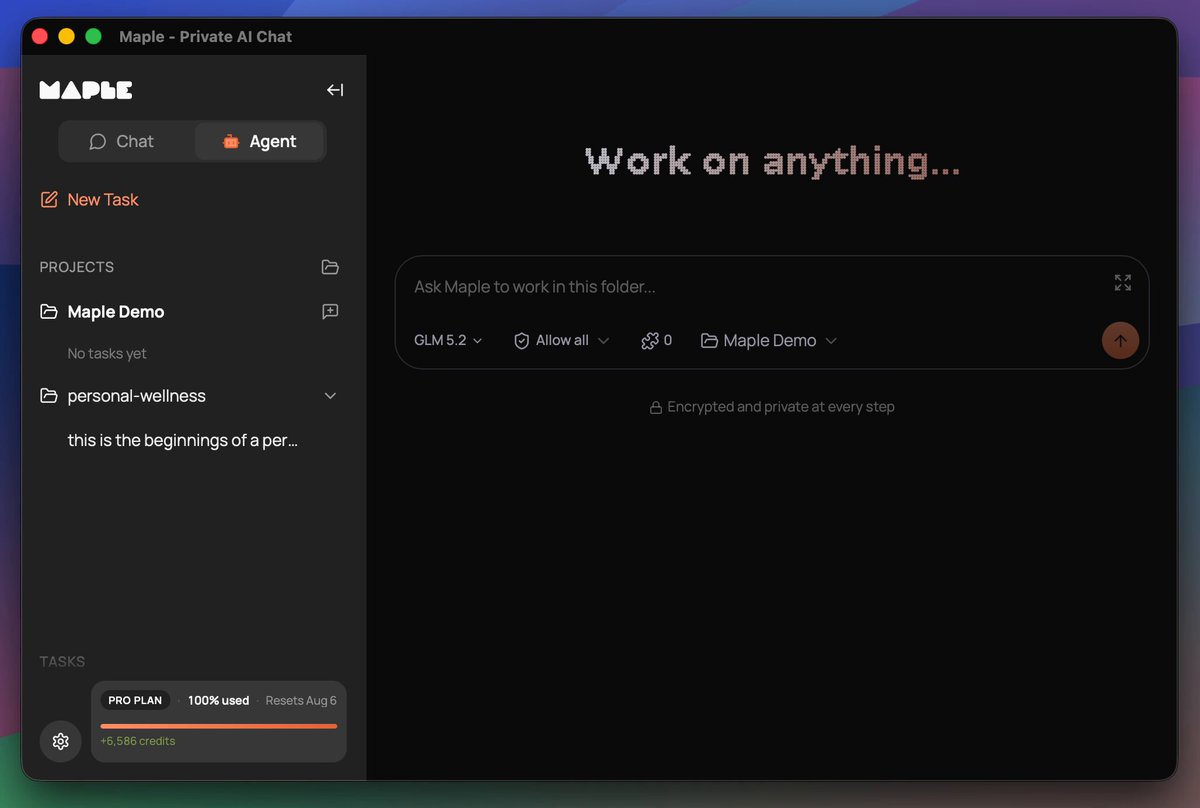
Maple is preparing for the release of a co-working agent. You install it locally and it works with your files, whether it's office work or building websites and apps. It's a turnkey solution, as easy as Claude Code, that keeps your data secure and private, no data sharing with closed AI labs. This is THE sovereign AI app for individuals and businesses who want powerful AI while retaining ownership of their information. Why build an agent into the Maple app when other agents already exist? Easy, we want to give you control over your work. We don't have a business plan that incorporates making money off our users' data. In the age of AI, your information, whether it's personal or company trade secrets, is the single thing that differentiates you from everyone else. We all have access to AI that can build a professional website for selling shoes. But your strategy and network for how you sell shoes should not be shared with your competitors. Sovereignty is the path to protecting what makes you, you. Maple sits at the intersection of Usability and Sovereignty. Maple gives you the best tools that are both easy to use and maintain your data sovereignty. Sovereign for one, sovereign for all. It has been a journey to get here. We brought to market the very first personal chatbot with end-to-end encryption using TEEs in late 2024. Prior to that there were proofs of concept but no full product offerings. Every other AI chat product on the market handled your data in plain text, either selling you a service to get your data or asking you to trust that they won't snoop on you. Quickly people found Maple and latched onto its open-source code and verifiable encryption. We didn't stop there. You may remember earlier this year we teased a product called "Maple Agent" and opened up a waiting list. That product is a mobile app that acts as your AI "friend", maintaining one long continuous chat, and getting to know you over time. I dislike using the word "friend" there, but it's the best way to convey the UX in a few words. AI is a tool, always has been, always will be. Any kind of friendly personality on top is just synthetic. In our testing, the UX of Maple Agent is really powerful for what it does. Think about the many short AI chats you have in your favorite app, whether it's looking up a historical fact or asking advice about a topic. With Maple Agent, those all go away in favor of the long-running chat with the friendly agent. It's like you have your own personal assistant who knows you so well and can look up anything for you. When I ask AI certain questions, I want to ask an expert who already understands my situation so I'm not repeating myself for the 100th time. That's the amazing value the personal agent brings to the table. We still see great utility for a personal agent like the "Maple Agent". Thousands of people on the waiting list, hoping to get their hands on it, agree that the concept is worth exploring and trying out. We were constrained in launching it due to a few circumstances, one of them being access to the scale of compute needed to power it. We have a clear path laid out for how to get there, but today is not the day to execute on that. It will be in the near future. Instead we have a different agent ready to go that we think is also incredible. We now have an agentic harness inside of the Maple Research app. This thing is a powerhouse. It even builds and publishes its own software releases. The agent in Maple Research works with your local filesystem, speaks to the largest open models running in TEEs, utilizes local models for certain tasks, is compatible with MCP tools, has an API for connecting to anything you need, and also supports the ACP protocol, which means it can be extended in the future to speak to other tools like Claude Code, Codex, and local models running on your own hardware. A big unlock for us was the Goose Development Kit, which powers the core of our agent harness. More on that to come as we publish articles and documentation later about the agent. The agent inside Maple Research doesn't have a name. At least not yet, not sure if it ever will. For now we call it "Chat Mode" and "Agent Mode". Think of this as the workhorse, the truck, the heavy lifter. Our other "Agent", the phone app, is your sidekick in your pocket, ready to help with quick things and ongoing conversations about life. I am incredibly excited about the Maple Research Agent. While I'm already seeing great results using it for internal work items, I'm especially thrilled about the personal health and wellness work it's doing for me. I know there are plenty of apps out there for compiling wellness data, but I'm having it build a tool tailored specifically for what I need, without the extra fluff. And none of my health data is being donated to the closed AI labs or sent to advertisers. I know that the AI logic is not being silently adjusted to fit the whims of a large corporation that has paid for product placement. It's me, state of the art AI, and my data. That's how I want it. Maple's new agent makes that possible. We can't wait for you to try it out. If you want early access, comment here, email us, reach out in some way. To those on the other agent waitlist, you're already in the queue. Thanks for reading this lengthy update. :)

Mark

46,589 Aufrufe • vor 2 Monaten

Mayur Kamat (Mayur Kamat) is CPO at N26, ex-Head of Product at Binance, and built and scaled products at Google (Gmail Mobile, Hangouts), Microsoft, and travel unicorn agoda. Mayur shares endless wild stories and a lot of unconventional product insights I've never heard before. There's something in this conversation for everyone. Some of my biggest takeaways: 1. Binance’s leadership met every single day (often at 11 p.m.) so no decision waited more than 24 hours. Tight feedback loops beat elaborate planning. 2. Founder CZ kept about 55 direct reports so individual contributors were never more than one level away from the CEO. This forced leaders to live in the details and empowered ICs to “own the whole cell.” 3. Mayur literally moved his desk to whichever team had the biggest 10x upside—or downside—at that moment. Apply the same lens: growth and compliance issues usually move the needle fastest in fintech. 4. Treat “strategy” as a hypothesis pipeline: ship small, measure fast, double down on what the data proves. Tools like Statsig, Gemini summaries, and cohort dashboards make this possible at scale. 5. Work at companies that compound learning. High-growth environments (Google in the early mobile era, Agoda’s A/B culture, Binance’s hyperscale, N26’s pan-EU banking) give you daily reps and a powerful alumni network—worth far more than early salary bumps. 6. Optimize for your superpowers, not your gaps. Identify what energizes you—via StrengthsFinder-style assessments or honest reflection—and choose roles where those strengths decide success. Early in your career, ignore compensation differentials that don’t accelerate this fit. 7. Fast, reversible decisions beat “perfect” ones. In most product calls there’s no right vs. wrong—only slow vs. fast. Move quickly, learn, and pivot; reserve heavyweight processes for bets that could kill the company or the user. 8. Fintech creates exceptional PMs. Banking/financial products involve existential tradeoffs daily, requiring exceptional stakeholder management and decision-making skills. Listen now 👇 • YouTube: • Spotify: • Apple: Thank you to our wonderful sponsors for supporting the podcast: 🏆 WorkOS — Modern identity platform for B2B SaaS, free up to 1 million MAUs: 🏆 Paragon — Ship every SaaS integration your customers want: 🏆 Vanta — Automate compliance. Simplify security:

Lenny Rachitsky

240,889 Aufrufe • vor 1 Jahr

ONE MAN RESPONSIBLE | Who is responsible for half of Bengaluru City's traffic woes? Can there be one single person responsible for it? Yes. Read on. After exposing the hidden 200Cr house of Rajeev Chandrasekhar 🇮🇳, in his own name, he accepted that the house belongs to him. Now he and his followers have challenged us to talk about development. So we decided to talk about Rajeev's development in Bengaluru for 18 years. In 2010 the then BJP Govt came up with a signal free corridor from Sirsi circle to Agara. As per the plan, a 120 Cr signal free corridor from St. John's signal in Koramangala to Agara was given tender and the work started. It involved 2 underpasses and two flyovers. One underpass at Water tank signal, another at Wipro park junction and two flyovers one at Krupanidhi junction and another at Jakkasandra. And then Rajeev ji arrived. He declared that the project is unscientific and used the resident welfare associations to fight BDA. He declared that it is corruption of BJP, because he was with Janata Dal then. They filed a PIL and killed the project. The roads were dug up for the underpass, which many people might still remember. Finally Siddaramiah Govt came and widened and fixed the road. It still takes around 45-60 mins to cover this 5km stretch in peak hours. After Modi came, he switched sides to BJP. He then tried to kill the Steel Flyover project. We've covered that in detail in this thread below. So, when you are stuck in traffic in Bangalore, especially in North and South Bangalore, the face to remember is Rajeev Chandrasekhar's. We did this video, because he says he did a lot of development as an MP, without disclosing what exactly it is. Other than his business interests, there is nothing he did as an MP. KPCC General Secretary Nisha Soman Thettayil explains:

Congress Kerala

29,420 Aufrufe • vor 5 Monaten

The simplest hustle I've seen this year. He pulled $1,800 in 5 minutes using Claude Meet Gianni. A regular dude with a laptop, sitting in his bedroom. No courses to sell, no team behind him, no fancy setup. What he does is honestly stupid simple. He opens Google Maps in his city. Scrolls around. Looks for one specific thing. Local businesses with great reviews but no website. Roofers. Plumbers. Landscapers. HVAC guys. Tree services. Half of them are still running their entire operation off a phone number and word of mouth. In the video he finds Aspen Roofing in Colorado Springs. 4.5 stars, 8 reviews, zero web presence. That's his target. He copies the company name. Pulls a few of their best Google reviews. Pastes everything into Claude with one prompt. «Build me a sexy, luxurious, high-converting website for this business. Use these reviews to understand their strengths.» Claude writes the entire site from scratch. He drops the code into Lovable, clicks Publish, and a real working website is live in one click. Hero section reads «Colorado's Premier Roofing Experience.» CTA button says «Get Your Free Roof Inspection.» Now the fun part. He emails or DMs the owner with the link. Says «I built you something, take a look.» The owner sees a professional site that already represents his brand. Buys it on the spot for $1,000 to $2,000. Plugs in his domain. Done. One website. 5 minutes of work. $1,800 in the pocket. And there are millions of local businesses in the US still running without a site. He's just stamping them out one after another.

winkle.

112,786 Aufrufe • vor 4 Monaten

🚩Breaking News : Finance heavy hitter Craig Stobo has been announced by NZ First as a candidate in Botany, the seat currently held by Christopher Luxon. Stobo will be on the list. He brings a serious record in finance, especially superannuation and financial regulation: He built BT Funds Management, led the tax review that produced the PIE regime that KiwiSaver is built on, and later chaired the Financial Markets Authority. He was removed from that role at the FMA after an official review found his public commentary, including on the Treaty Principles, breached the political neutrality expected of an independent regulator. In plainer terms, he was taken out of the FMA for refusing to bow down to Māorification Mumbo Jumbo. * He created NZ’s municipal bond market. Stobo chaired the LGFA establishment board and has been inaugural chair since 2011. It is now the largest NZ-dollar bond issuer after the Crown, with about $25 billion of AAA bonds and almost every council as a voluntary borrower. That is a rare piece of financial-market plumbing: cheaper long-term money for local infrastructure without a Crown guarantee. Craigs business experience completely pulls down the pants of any MP currently in the house. Track record : He has built a funds business from scratch. He co-launched BT Funds Management NZ in 1992 and ran it as CEO until 2004, taking AUM to about $3 billion making it under his guidance, NZ’s largest and most successful Funds management company. He sits right at the intersection of city balance sheets and markets. He was a founding director of the Auckland Future Fund, set up to invest the proceeds of Auckland Council’s airport share sale (~$1.3 billion) rather than spend the capital. Rather than just sitting on boards Craig has got actual outcomes. He chaired Precinct Properties from incorporation in 2010, changing it from a unit trust to a company, attracting foreign investment that enabled the company to be listed as PCT on the NZX. He chaired Fliway a family owned logistics company, over seeing its scaling through its NZX IPO and later sale to NZ Post for $55 Million. He chaired AIG New Zealand from licensing in 2012 to 2022. Taking over after the global giant was wounded badly during the GFC and building a legitimate local arm that is profitable and still trading. At NZ Windfarms he oversaw the first consented windfarm repower in New Zealand (about 21 months, versus the seven-years plus, common in the sector). Craig holds First-class honours in economics at Otago, Milner Prize at Waitaki Boys, Wharton AMP. Diplomat for both NZ and Australia (seconded to DFAT in Canberra, including Middle East work, involved in Hawke–Keating deregulation in the 80’s ). Economist at DFC/Zealcorp, then Bankers Trust NZ on the rates desk — heading the same dealing room where a young John Key made his name in FX. Craig Stobo is one of the few New Zealanders with such a highly credible CV who has both written the tax architecture of managed funds, which helped build Kiwi saver and built the vehicle that funds capex for most councils in NZ. He’s an excellent addition to NZFirst to help us turn this country around. Craig Stobo was also in attendance at the anti mandate protest in Wellington, and was mandated out his job for refusing to take the jab. Listen to the incredible excerpt below where he discuss how the business a political elite have too much power and have hurt people for far too long.

Holyhekatuiteka

29,123 Aufrufe • vor 1 Monat

Damage Control From a Mayor Who Has Everything to Fear The national grooming gang inquiry has not yet begun. But the political effort to control it already has. As predicted, Greater Manchester Mayor Andy Burnham publicly rebuked critics of the inquiry's new chair, urging them to stop "reading politics into it" and to "let the inquiry do its business." Damage control from a man who has everything to fear from what this inquiry might expose. Burnham is not some outside observer. He is neck-deep in this scandal's recent history. As mayor, he commissioned, promoted and defended the Oldham Assurance Review. A whitewash sold to the public as independent but designed from the start to avoid the most serious evidence of institutional failure. That review was not botched incompetence. It was a cover up. Look at what it actually did: - it cleared political figures of wrongdoing - it refused to interview a single Pakistani grooming gang survivor - it accepted political explanations without testing them against evidence - it concluded there was no cover up despite confirming children were gang raped, public officials and politicians knew what was taking place, and information was hidden from parents. There is no plausible explanation for clearing politicians while excluding the most relevant survivors other than protection. Burnham knows exactly what he faces. He commissioned a review that cleared his allies while silencing survivors. He defended a process that excluded Pakistani rape gang victims. His review was used to block any further inquiry. Now he is desperately trying to manage expectations before the real investigation begins. Burnham thinks containing the inquiry's scope will protect him. He is wrong. The evidence of his role in commissioning institutional cover-up is already established. The only question is whether this inquiry will have the independence to follow where that evidence leads and call Burnham to testify under oath. Burnham's intervention is not defending justice. It is defending himself. And he has every reason to be afraid. And for those that have asked. All Andy Burnham has to do is name the time and place. I will present the evidence of his role in the cover up of the industrial scale gang rape of children to his face if he dares face me. _________ I’m Raja Miah. For seven years, I led a small team that exposed how politicians protected the rape gangs. Before that, I spent over a decade safeguarding children and protecting communities from extremists. My work is free because the truth must circulate. But truth without numbers is easy to crush. The government does not fear facts. It fears scale. Starmer and the Labour Party fear thousands reading, sharing, and backing the same work because numbers mean witnesses, pressure, and consequences. That’s why I am blacklisted by the legacy media. That's why this matters. 🔴 Subscribe to the newsletter. It’s free. Every subscriber is a number they can’t erase. Every reader widens the circle they can’t control. 👉 Subscribe or support here: If you can afford it, please support for 75p a week (£3/month or £30/year). Not for perks. Not for access. But because numbers with backing become power. A few supporters can be ignored. Thousands cannot. This is how this campaign survive. This is how we see this through. This is how voices like ours stops being managed and starts being feared. 🔴 Prefer a one-off contribution? 👉 👉 No sponsors. No parties. No institutions to lean on. Just numbers. Growing fast enough that shutting this down becomes impossible. We don’t need everyone. We need enough. We need you. – Raja Miah MBE

Raja Miah

20,644 Aufrufe • vor 9 Monaten