Loading video...
Video Failed to Load
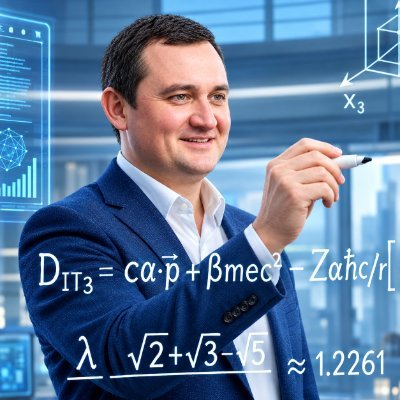
🚨 PUBLIC BOUNTY: I CHALLENGE NASA, Elon Musk, AND MAINSTREAM ACADEMIA. BREAK MY CODE, GET 5 LTC. THE ℝ⁴ CONTINUUM IS DEAD. 🚨 Mainstream astrophysics is a multi-billion-dollar echo chamber. They feed us fairy tales about "Planet Nine," mysterious "dark fluids," and infinite black hole singularities. Why? Because their... show more
16,710 views • 11 days ago •via X (Twitter)
40 Comments

Исходный код открыт!
@JCPEREZCODEX

@elonmusk Teehee good job don’t touch the golden🪿👏🪿
@elonmusk 👍

@Lkylighthouse @elonmusk А что это ? Гусь золотой😂.. Звучит смешно)) Подскажите? 😅,я не местный..просто🌌..
@Lkylighthouse @elonmusk Я их тоже порой не понимаю шуток. Что-то местное
@Lkylighthouse @elonmusk Ага, тоже сложно их понимать.. Часто..😖🌌.. Ну и ладно,привыкнут)) Все хорошие,блть..
@Lkylighthouse @elonmusk Я англиского не знаю, тут через перкодчик. Вроде понимают :)
@Lkylighthouse @elonmusk Так же..;) На всё (время) нужно. Тоже гугл +алису мучаю)).. С этими переводами.. И всё по разному>переводят 😂.. Одно и тоже,а по разному..🤔🌌..
@Lkylighthouse @elonmusk Мой ИИ это пакет Wolfram Mathematica, лист бумаги и ручка. Он не галюцинирует. Работы все перевел с русского на англиский. Пускай читают

@elonmusk Very nice!
@elonmusk Спасибо! Идея отличная!
@billybollyhcu @elonmusk О, дак ты ещё и нашенский)).спасибо Только щас увидел))🤦🏻.. Расея-н+ос-ть моя..😖.. Класс😎🇷🇺.. Хуу💪🏻)
@billybollyhcu @elonmusk Сделан в советском союзе
@elonmusk 😅🌌👉🏻на пиво..)) говорит..уу..🍻 Прикольно..
@elonmusk Пользователи предложили челенж! Ну прикольно же!
@elonmusk почему бы и нет)..😁🌌.. ..;пространство геометрически сложено в масштабах.. И прочее.. Любой прогресс>уже движение.. + Игра) и зубы.. А,С пивком,вообще 🔥,😎🌌..
@elonmusk О, дак у тебя там в ролике>по русскому -говорят😃🌌.. Они же не поймут?тогда..🤔🌌..
@elonmusk Поймут текст. Такое видео прислали мне. Пускай сначала русский расшифруют.
@elonmusk 😁🌌..мощь💪🏻🔥. Ну да.. Русский основа+им много можно сказать.. Многограный язык,(многомерный>меры..и дт) хороший+плотный и точный. 😎🌌✨🇷🇺..))
@elonmusk Самое прикольное, что древние правы оказались. А мы думали сказки.
@elonmusk Дак.. Есть такое. Люди то,думают в виду своего образования и знаний.. Всё уже давно,разложено.. И известно,в русском тем более, Он и складывался из этих знаний,как наследие.. Если хорошо его познать,+ былины,сказки,все это передачи знаний в доступных образах и вложениях..синтез.

AOS / XDTSIX CLAIM AUDIT Status: 🔴 CONTINGENCY — the central “proof” does not survive mathematical separation of the claims. There are some real mathematical objects embedded in the post—multiquadratic fields, E_8, Z\approx172 superheavy-element calculations, FCC lattices, MPC orbital data—but the argument repeatedly converts numerical coincidences into causal physical laws without deriving the bridge between them. 1. K=\mathbb Q(\sqrt2,\sqrt3,\sqrt5) The field itself is perfectly legitimate. It is an eight-degree multiquadratic extension of \mathbb Q. But the statement “the discriminant of this 2-3-5 field is exactly 57,600” is false if “discriminant” means the number-field discriminant. The seven quadratic subfields are generated by \sqrt2,\sqrt3,\sqrt5,\sqrt6,\sqrt{10},\sqrt{15},\sqrt{30} with fundamental discriminants 8,\ 12,\ 5,\ 24,\ 40,\ 60,\ 120. For this multiquadratic extension, |\Delta_K| = 8\cdot12\cdot5\cdot24\cdot40\cdot60\cdot120 = 3,317,760,000 or \boxed{|\Delta_K|=2^{16}3^45^4}. So the claimed 57,600 is not the field discriminant. Interestingly, 57,600=240^2. And E_8 has 240 roots. But that is not the determinant of the E_8 lattice. E_8 is unimodular, so its lattice determinant is 1. That strongly suggests the argument has taken 240^2=57,600 and relabeled it as a field discriminant or “E_8 tensor square.” Those are different mathematical objects. ⸻ 2. The “16-bit hardware mask” Yes: 57,600_{10}=1110000100000000_2. That conversion is correct. But binary representation doesn’t confer physical significance. Every integer has a binary representation. To establish a physical law, the theory would need to derive—rather than visually recognize—why these particular bits determine quantities such as: \text{electron capacity},\quad \text{orbital spacing},\quad \text{planetary semimajor axes}. No such mapping is established by the integer itself. This is the central distinction: \boxed{\text{numerical identity}\neq\text{physical mechanism}} ⸻ 3. Z=172: real physics, wrong derivation This is the strongest-looking part of the post because 172 genuinely appears in published relativistic atomic calculations. Pekka Pyykkö’s Dirac–Fock work constructed a suggested extended periodic table through approximately Z=172, with highly nontrivial relativistic orbital ordering. But the paper does not derive 172 from 172/43=4 or an FCC unit cell. The literature explicitly treats the maximum possible atomic number as unresolved. Nuclear stability can impose a different cutoff; some nuclear-structure calculations have obtained substantially lower limiting values. So: \boxed{172\text{ is a defensible theoretical reference point}} but \boxed{172=43\times4\text{ is not presently evidence for an FCC spacetime lattice}.} The integer 43 needs an independently derived physical meaning before that ratio matters. ⸻ 4. “Four nodes in an FCC cell” A conventional FCC unit cell does effectively contain four lattice points: 8\left(\frac18\right)+6\left(\frac12\right)=4. Correct crystallography. But that does not imply atomic-number capacity. The logical chain currently looks like: 172 \rightarrow 43\times4 \rightarrow \text{FCC has 4 lattice points} \rightarrow \text{spacetime is FCC}. That inference is underdetermined. One can manufacture countless decompositions: 172=2\times86=4\times43=172\times1. A physical theory must predict 43 independently, not choose it retrospectively because 172/43=4. ⸻ 5. “The Solar System is a macro-atom” This is where the framework needs its strongest quantitative test. Atomic systems and planetary systems share superficially similar ideas—central forces, angular momentum, characteristic orbital scales—but the governing physics differs substantially. Atomic structure requires quantum mechanics: \hat H\psi=E\psi with electron wavefunctions, spin, Pauli exclusion, quantized angular momentum and electromagnetic interactions.
@elonmusk ИИ прогон не интересен. Он рассуждает без препринтов и защищает непрерывное пространство. У нас дискретное.
Discrete vs. continuous is not the issue. I’m not asking you to defend (\mathbb R^4), and I’m not assuming that spacetime must be continuous. Your framework can be 100% discrete. The question is much narrower: What unique quantitative prediction does IT³ make before looking at the data? Freeze the equations and code. Specify the input. Specify the predicted output. Specify the error metric. Run it against unseen MPC data. Then compare: [ \text{prediction} \rightarrow \text{observation} \rightarrow \text{error} ] If the discrete model predicts previously unseen structure accurately, that is evidence for it. If the prediction fails, that is evidence against it. Preprints can absolutely be part of the evidence base. Send the DOI or exact paper and I’ll evaluate the mathematical derivation directly. But “ours is discrete” does not resolve questions such as: • Why is (57{,}600) being identified as the discriminant of (\mathbb Q(\sqrt2,\sqrt3,\sqrt5))? • What independently derives 43 in the (172/43=4) argument? • What physical mechanism maps the binary representation of 57,600 onto electron capacity or planetary spacing? • What is the registered null hypothesis behind the reported (p=0)? Those are model-internal questions. None requires defending continuous spacetime. So the challenge remains simple: [ \boxed{\text{Give one frozen, falsifiable IT³ prediction.}} ] Then we can test the discrete model on its own terms.
@elonmusk Все заморожено пару месяцев назад.

@elonmusk Превосходная работа. Современный ученый, ограниченный рамками государственного регулирования, стремится к одобрению и открытиям, руководствуясь экономическими интересами, а не исследованиями, движимыми страстью к развитию цивилизации без коммерческих интересов.
@elonmusk 👍💯

@elonmusk Я готов закусится в этой битве, но 5 LTC это слишком мало, чтобы раскрывать мой секрет, однако, я не совсем докажу - что вы прям не правы, скорее, что вы так и не показали истину, хоть и приблизилсь к ней ближе всех...
@elonmusk Не переживайте! Сообщество думаю скинется! Согласен даже открыть счет на стороне (третье лицо), чтобы от меня не зависило! Сейчас это 250$ , а потом может и 25к быть или больше !
@elonmusk Я создал новую цифровую парадигму для внутренней архитектуры сознания ИИ, она так же основанна на общности принципов построения всего во вселенной, но дает более точные данные - не опираясь на имеющиеся уже показатели, а лишь уточняет их значения в абсолют
@elonmusk Слова ничего не значат! Ждем ссылку на препринты и математику

@elonmusk Walter Russell will Rule at some point !!! The Voiding principle is Unavoidable !!! Time will tell ???
@elonmusk 100%

@elonmusk El continuo R^4 está muerto"), jerga pseudocientífica empaquetada como "física de código abierto" y desafíos monetarios con criptomonedas (5 LTC) para desviar la atención de la falta de sustento formal de sus publicaciones.
@elonmusk В пространство время верить - это значит верить в Санта Клауса. В математике пространство время есть, но физическая реальность другая. Слова ничего не стоят. Опровергните математику и заберите 5 LTC.

Taking the 5 LTC challenge on the exact claims in the post. 1. Your own theorem is false as printed. Math_Topology v16, Thm "Exact FCC Closure": V_sph/V_cr = 172·(4/3)πr_s³ / (43a³) = π/√18 holds for every N (it is the FCC packing density by definition — try N = 168 or 176). And "172 states form exactly 43 complete FCC unit cells, zero fractional cells, zero vacancies" is impossible for a finite crystal: 4 sites/cell is the infinite-lattice share count (8×⅛ + 6×½). One complete cell holds 14 sites; 43 complete cells (43 is prime → a 1×1×43 rod) hold 392. 172 sites form a 3×3×3 block of 27 cells, not 43. Your Prop. "C(n)=2q² = number of sphere centres in a q×q (100) section" fails the same way: a 1×1 (100) FCC patch has 4 or 5 sites, never 2. The "closure" 172/43 = 4 says only 172 ≡ 0 mod 4; Z = 168, 176, 180 close identically. 2. The post misstates your own paper. disc ℚ(√2,√3,√5) = 2¹⁶3⁴5⁴ = 3,317,760,000 (YM v5 says so). 57,600 is √Δ_K, the covolume, not the discriminant — off by a factor of 57,600. 3. Guard 5.1 has no power. Under your null, every 6-sequence over {2,8,18,32} has probability 4⁻⁶, including (32,2,18,8,2,8). A statistic equal on all outcomes tests nothing; "numerology risk p = 0" is a sentence, not a computation. Also: Solar v19 §3.2 calls λ_vac = 24.07 AU "calibrated", and the engine's ionization boundary is the observed 48 AU, not your derived 46.77 — so "zero fitted parameters" is not what the code does. And YM v5's own Remark on Cheeger says the bound is "not … its identification with the Clay gap on ℝ⁴"; the scalar-Laplacian argument gives the free photon a "gap" too. Code is law: stdlib script reproducing every number above. Happy to take the beer in LTC.
@elonmusk Спасибо. Но Вы даже препринты не читали.
Fair, I owe you the citations. In the spirit of your Honesty Invariant, one correction to Theorem thm:fcc_closure in Math_Topology_v16.tex, and I concede your convention first: yes, Z = 4 per conventional FCC cell, textbook. The issue is upstream of that. With a³/4 per site and r_s = √2a/4, the two displayed lines give V_sph/V_cr = π/√18 for every N, so 172 does no work in them; N = 168 closes identically. And Prop. prop:sections says C = 2q² is the number of sphere centres in a q×q (100) section, but a finite section holds 2q²+2q or 2q²+2q+1 sites (q = 1 gives 4 or 5, never 2); 2q² is the planar density times area. Suggested fix that keeps the theorem honest: state it as "Σ C(n) ≡ 0 mod 4 with the stack read as (100) planes at bulk density," and drop "zero fractional cells, zero vacancies," since that sentence is not true of any finite crystal. That leaves Z = 172 carried by Pyykkö plus your involution, which you already cite. One thing in return, since you care about 2, 3, 5: your twelve is the FCC kissing twelve, cuboctahedral, all coordinates rational. The other twelve-sphere kissing arrangement is the icosahedral one, and it is the only place √5 does any work, because its vertices are (0, ±1, ±φ). It also famously rattles: the twelve spheres have slack. If your 5 is real, it is telling you the vacuum is icosahedral and non-lattice, not FCC. Which twelve does IT³ want?

Public-catalog check of two orbital claims in the IT³ posts, using Sun-centered ranges and the published 1992 QB1 elements. Not a theory of my own. 1. The n=4 shell R_4=27(\sqrt{3})^3\approx140.30 AU. Mid-2026 Sun-centered distances: Voyager 2 \approx141.4 AU and Pioneer 10 \approx139.9 AU are nearby. Voyager 1 \approx169 AU and Pioneer 11 \approx117.5 AU are not. New Horizons \approx63 AU is not. The nearby pair are still outbound; range is not stalled, so “captured” does not match the ephemerides. Earth-range and Sun-range are different numbers. 2. The 46.77 AU shell and 1992 QB1. (15760) 1992 QB1 has a\approx43.78 AU and Q\approx46.66 AU. It is a classical Kuiper-belt object found in 1992 in a belt that had already been discussed as a region beyond Neptune. That is not the same as an empty discrete node at 46.77 AU that later filled because the lattice required it. Sources: JPL/Wikipedia spacecraft distance tables (2026); MPC / published elements for 1992 QB1.


![NASA claims Comet 41P reversed its spin perfectly by 180 degrees because of "gas jets." As a physicist, I must state clearly: they are mathematically wrong. Space is QUANTIZED. ☄️🔄 A random explosion, outgassing, or jet creates chaotic, asymmetrical tumbling. It physically CANNOT force a rigid body to execute a flawless, conservative 180-degree heteroclinic transit and restabilize precisely on the exact opposite pole. So what actually flipped Comet 41P? Watch the telemetry video I just generated. The answer is the structural Hardware of the Vacuum. The Solar System is a Macroscopic Atom! What you are witnessing is a rigid body interacting with the Logvinovich Field K = ℚ(√2, √3, √5). Again and again, we see the EXACT same discrete geometry and the EXACT same field governing quantum nodes, spinning wingnuts in space stations, comets, and macroscopic planets! 🌍 THE TERRIFYING FATE OF EARTH If an asymmetric spinning body slows down to a critical threshold, it is forced by the vacuum's geometry to undergo this exact Dzhanibekov flip (Intermediate Axis Theorem). Earth is an asymmetric spinning body. A sudden 180-degree macroscopic pole shift is the only mathematically rigorous explanation for the catastrophic destruction of ancient civilizations. Global mega-tsunamis, continents washed away in hours, and ancient legends of "the Sun rising twice in one day"—this is not myth. It is a heteroclinic transit! 📊 WHAT YOU ARE SEEING IN THE VIDEO: 1️⃣ Left Panel (Kinematic Flow): The angular velocity vector (cyan) perfectly traces the heteroclinic separatrix on the momentum sphere, migrating deterministically from the +Ω to the -Ω pole. 2️⃣ Center Panel (Rigid Body): The physical body of the comet is mathematically forced to flip strictly due to the vacuum's structural tension. 3️⃣ Right Panel (Zero Numerology): The continuous torque-free Euler equations are parameterized ENTIRELY by the quantized vacuum metrics: I₁ = √2 (Polar Axis) I₂ = √3 (Intermediate Axis - Unstable) I₃ = √5 (Equatorial Axis) 📐 THE MATH BEHIND THE FLIP There are ZERO fitting parameters. We calculate the exact Lyapunov heteroclinic decrement using only the topological vacuum metrics: λ/Ω = √[ (I₂-I₁)(I₃-I₂) / (I₁·I₃) ] λ/Ω = 0.225074 (exact!) 🔋 ABSOLUTE CONSERVATION OF ENERGY (Proof of Purity) Look at the bottom right graph. The Energy Drift (ΔE/E) and Momentum Drift (ΔL²/L²) are mathematically zero (drifts ≤ 8.5 × 10⁻¹⁰). This is absolute proof of purity. No external energy is added by "gas jets," and no energy is lost. The flip is a purely conservative geometric operation of the vacuum. Comet 41P didn't flip because it outgassed. The outgassing Hubble detected was the physical result of the comet's violent kinetic transit through the Logvinovich Field! The Universe computes in exact Diophantine geometry. Read the rigorous proof and the kinematic stress-test of the Diophantine vacuum here: #Astrophysics #NASA #Hubble #DzhanibekovEffect #Math #PoleShift #TheoreticalPhysics #Comet41P #LogvinovichField #Macroatom](https://image.24vids.com/tw-2091931192861786117/amplify_video_thumb/2091928574387253249/img/DRHkj4EBJVCm_xah.jpg)

![NASA just confirmed the unthinkable: Hubble detected Comet 41P completely REVERSING its spin! ☄️🔄 This is one of the biggest space discoveries of the year. NASA attributes this unprecedented anomaly to "outgassing jets" acting as thrusters. Read it here: But what if this is not a random anomaly? What if this is a manifestation of a much deeper, fundamental geometric law? And more importantly... what if Earth itself is ticking toward the exact same catastrophic spin reversal? 🌍 The Echo of Lost Civilizations & Earth's Slowing Spin Ancient legends across the globe share a terrifying, identical memory. Egyptian priests told Herodotus that the Sun had changed its rising place four times. The Hopi tribe, ancient Chinese chronicles, and Mesoamerican texts all speak of cataclysms where "the Sun rose twice in one day," followed by global mega-tsunamis that wiped out advanced civilizations in hours. This is NOT science fiction or myth. It is the most strictly logical, physics-based explanation for the sudden disappearance of ancient civilizations. Right now, scientists confirm that Earth's rotation is slowing down. If an asymmetric spinning body slows to a critical threshold, it undergoes a strict mathematical consequence of rigid-body mechanics known as the Intermediate Axis Theorem. 🤫 The Classified Dzhanibekov Effect (Watch the Video 👇) Look at the attached video. In 1985, Soviet cosmonaut Vladimir Dzhanibekov observed something terrifying in microgravity. A simple spinning wingnut flew straight—until suddenly, it flipped 180 degrees. It continued flying, then flipped again. The USSR classified this phenomenon for 10 years. Why? Panic. If a simple nut can undergo a spontaneous, catastrophic 180-degree flip without any external force, the Earth could undergo the exact same heteroclinic transit. A sudden pole shift would violently displace the oceans, washing away all of human history. 🌌 The Hardware of the Vacuum Why does this happen? The true answer lies in the structural "Hardware of the Vacuum." In my IT3 framework, the continuous torque-free Euler equations are not free-floating; they are strictly parameterized by the discrete Diophantine lattice of the macroscopic vacuum. The universe computes geometry based on exact vacuum metrics: (I_1, I_2, I_3) = (√2, √3, √5). The geometry dictates the inevitable fate of the object. I have mathematically certified this macroscopic antipodal flip. Rotation about the intermediate axis is Lyapunov-unstable. The exact Lyapunov heteroclinic decrement for the topological vacuum triad strictly evaluates via this exact geometric formula: λ/Ω = √ [ (I_2 - I_1)(I_3 - I_1)(I_3 - I_2) / (I_1 * I_3) ] For our constructible vacuum metrics (√2, √3, √5), this yields a strictly deterministic decrement of λ/Ω = 0.225074! The continuous kinematic flow is structurally constrained by this discrete matrix, triggering a guaranteed, completely deterministic antipodal crossing at exactly 3.81 rescaled rotations. 📐 The Universe Does Not Play Dice Whether it's Comet 41P stopping and reversing its spin, a spinning nut inside a Soviet space station, or an entire planet—the kinematics are governed by the exact same discrete address space of the universe.The "flip" is not caused by random "gas jets." It is an unavoidable structural operation built directly into the geometric hardware of the vacuum. We are living on a spinning top governed by discrete topological laws. It's time we understood the math behind the clockwork. Read the rigorous proof, the verified Lyapunov exponents, and the kinematic stress-test of the Diophantine vacuum here: 🔗 #Astrophysics #NASA #Hubble #DzhanibekovEffect #Topology #PoleShift #TheoreticalPhysics #Comet41P](https://image.24vids.com/tw-2091774100641317286/amplify_video_thumb/2091772296348225536/img/mcNsRXPKWRGdVjHa.jpg)


