Loading video...

Video Failed to Load

Go Home

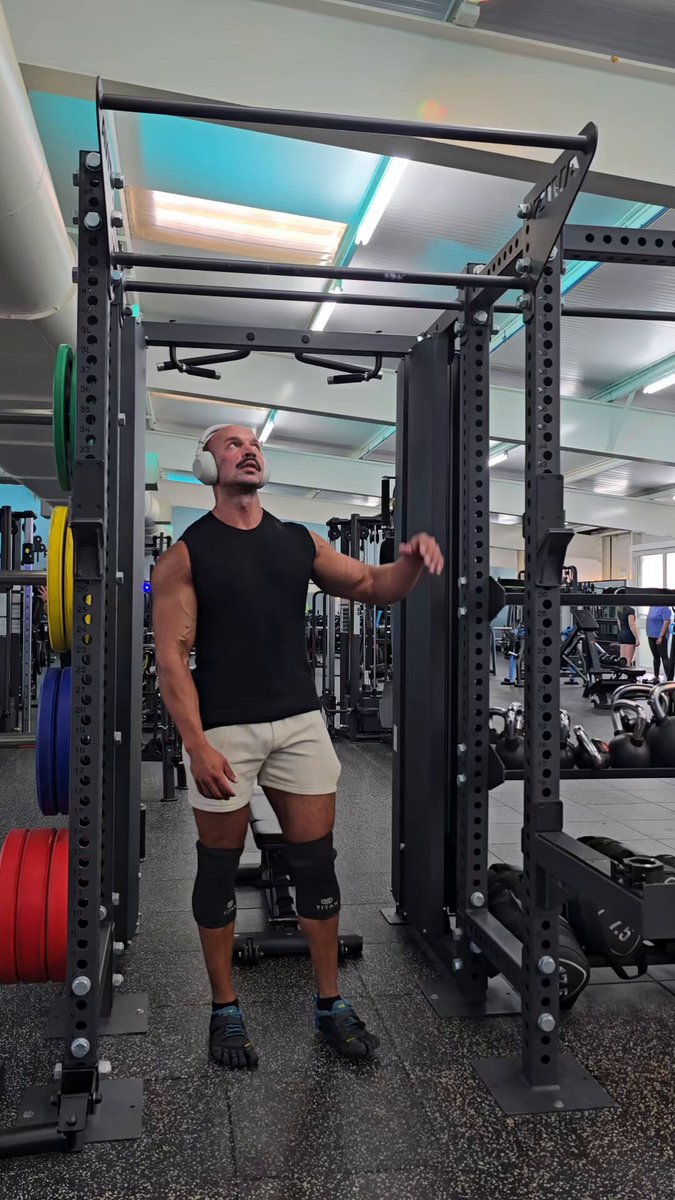
Push-ups get dismissed as “too easy” because most people never load them properly. If you’re doing sets of 30–50 reps, you’re not building as much strength or muscle as you think. Progression matters. Here’s how I scale the load on push-ups without machines or a weighted vest: • Start...

65,584 views • 3 months ago •via X (Twitter)

0 Comments

No comments available

Comments from the original post will appear here

Related Videos

Do you need to train heavy to build muscle? 💪 For years the mantra was you need to go heavy to build muscle. Or you needed to go heavy to stimulate large type II fast twitch fibers but go light for more reps to stimulate smaller type I fibers. But new research has challenged that dogma. Several meta-analysis have shown similar muscle growth with low loads vs high loads when set number is matched & proximity to failure is similar (PMIDs: 28834797, 35015560, 33312275, & 33433148). While muscle hypertrophy was not different between high and low load training, strength increased significantly more with high load training in all these meta-analysis As far as targeting fiber types, it becomes kind of irrelevant when you take an exercise close to failure because fiber types tend to be recruited in order from smallest to largest. So with high load training, small & large fibers get recruited quickly but you don’t do many reps. With low load training, you initially recruit smaller fibers but as the muscle fatigues it is forced to recruit the larger fibers as the exercise is taken close to failure. The net effect is that taking sets close to failure with high or low loads produces a lot of muscle activation and similar hypetrophy The take home is, do what you enjoy if muscle growth is the goal. Just make sure you train HARD & go close to failure (within a few reps) & do enough total sets. But if strength is a priority you’ll need to train heavy & be careful going to failure as it can impair strength gains From my first conversation with Andrew D. Huberman, Ph.D.

Layne Norton, PhD

53,287 views • 1 year ago

Example of a true working set... You’re probably doing way more sets than you need Trust me ⁠ Back in high school and college, I would lift 7 days a week, doing anywhere from 30 to 50 sets per day I used to think those 30-50 sets were the key to growth, but over time, I realized that most of those weren’t true working sets ⁠ Here’s the thing... If you can do 4 sets of 8 reps with the same weight each set, you’re probably not pushing yourself hard enough A true working set should leave you near failure within the target rep range ⁠ For example, let’s say your plan calls for 2 sets of 6-8 reps After a few warm up sets, you try 135 lbs and hit 8 reps, but you know you could have done 6 more That’s still a warm up set since you’re not reaching failure in the 6-8 rep range You’d then go up to 145 lbs and aim to fail around 6-8 reps If 145 still feels too light, that’s another warm up set You keep going up in weight until you find the load that challenges you to fail within that 6-8 range If you don’t have a spotter, leaving one or two reps in the tank is okay ⁠ This is where true muscle growth happens, by pushing close to your limit Sleep and diet is actually where muscle growth occurs but you never push yourself hard enough in the gym and give your body a reason to grow, hypertrophy will never happen The gym is just the stimulus to give the muscle a reason to grow We then get bigger through sleep and diet ⁠ Back to the working sets... For example, in the video, I hit 540 lbs for 8 reps on this hack squat Looking back, I feel I had one or two reps left, but it’s a solid starting point and it was a new PR for me at the time The next week, I would aim for 540 for 9-10 reps or bump up the weight to 545-550 and try to hit 8 reps aka progressive overload ⁠ I typically keep my quad and hamstring workouts separate and do only about 4-7 sets per muscle group, but each set is intense, and I’m struggling by the last few reps on each set ⁠ Give this approach a shot, and I promise you won’t need nearly as many sets as you think

Bailey Schober | Men’s Fitness & Nutrition Coach

23,353 views • 5 months ago

Chest Workout Routine To build a great chest, you need the right workout routine. This routine will help you effectively target your chest muscles and build strength and size. Warm-up (5-10 minutes) It is important to warm up before starting any workout. This prevents injury and prepares the muscles for the workout. * Light cardio (such as jumping jacks or skipping) * Dynamic stretching (such as arm circles, torso twists) Main Workout Perform the following exercises in 3-4 sets, with 8-12 repetitions in each set. Rest 60-90 seconds between each set. * Barbell Bench Press * This is one of the most effective exercises for the chest. It targets the upper, middle and lower chest muscles. * How to do: Lie on your back on a bench, feet firmly planted on the floor. Hold the barbell slightly wider than shoulder-width apart. Bring the barbell down to your chest and then push it up. * Incline Dumbbell Press * This exercise especially helps develop the upper chest muscles. * How to do: Sit on an inclined bench (about 30-45 degrees). Hold a dumbbell in each hand. Push the dumbbells up above your chest, then slowly bring them down. * Dumbbell Fly * This exercise helps stretch the chest muscles and give a deep cut. * How to do: Lie on the bench on your back, holding a dumbbell in each hand. With your arms slightly bent, stretch the dumbbells above your chest as if you were hugging someone. Slowly bring them back to the starting position. * Cable Crossover * This exercise focuses on the inner chest muscles and provides a better definition. * How to do: Stand in the middle of the cable machine. Hold a handle with each hand. Bring your arms to the front, as if you are bringing your hands together. * Push-ups * Push-ups are a great bodyweight exercise that strengthens the chest, shoulders and triceps. * How to do: Come down on your palms and toes, keeping the body straight. Lower your chest close to the ground and then push up. If normal push-ups are difficult, you can do them on your knees. Cool-down (5-10 minutes) Cooling down and stretching after a workout is important for muscle recovery. * Do static stretches of the chest, shoulders and triceps. Hold each stretch for 20-30 seconds. Important tips * Progressive overload: Slowly increase the weight or increase the number of repetitions over time so that your muscles are constantly challenged. * Correct Form: Always focus on maintaining correct form. Incorrect form can lead to injuries and muscles not being targeted properly. * Nutrition: Adequate protein and a balanced diet are important for muscle growth. * Rest: Getting enough sleep and giving your chest a rest before the next workout is essential for muscle recovery and growth. This routine can help you build a strong and well-developed chest. Remember, consistency is key to seeing results!

Dev Fitness Expert

11,046 views • 11 months ago