Video wird geladen...

Video konnte nicht geladen werden

Zur Startseite

🐆 Rapid-MLX v0.12 is here. We’ve officially evolved from a simple chat app into a full-fledged, on-device AI studio for Apple Silicon! 🖥️✨ We didn't just push the MLX inference engine to its limits and expand support for a massive lineup of local open-source models—we are alpha-launching the highly...

34,148 Aufrufe • vor 1 Monat •via X (Twitter)

0 Kommentare

Keine Kommentare verfügbar

Kommentare vom Original-Post werden hier angezeigt

Ähnliche Videos

Introducing Workshop: cloud + on-device agentic AI. And to celebrate, we're giving away $250k in Google Gemini AI credits. (details below). The future of AI work is neither cloud-based nor local. It's both. In Workshop Cloud, you can use agents powered by frontier models like Claude and/or open source models like Z.ai's GLM-5 to build internal tools, dashboards, and AI web apps. Or, breeze through tasks like managing your Google and Meta Ads. In Workshop Desktop, you can do all the same right on your computer, plus make desktop apps, mobile apps, and 3D creations. Our favorite part? You can power the full agent experience with local models like Qwen 3.5 family on your computer. Fully offline. 2026 is the year in which local models for agentic tasks will become viable for mainstream use. But the setup for tools like OpenClaw is like setting up Linux from scratch on your computer. Workshop Desktop is one-click to install on Windows, Mac, and Linux. It recommends which open source model you should use for your hardware and lets you download and run it right in the app. And its agent harness allows you to chat, create websites, build personal utilities, and analyze data. 100% offline. Or multitask with AI models in the cloud while running other agent threads locally. Start in Workshop Cloud when you want flexibility and speed. Download your project and continue in Workshop Desktop when you want local files, privacy, and/or better performance on large code bases. Publish from either. The agent tooling space is maturing and discerning users have come to expect a lot from their tools. We've packed Workshop with features to help you 10x your productivity. - Native support for skills - Autocompaction for seamless context management - Built-in AI for your apps - Dozens of connectors, like Google Drive, Big Query, and Supabase - dbt integration to ground your dashboards in your semantic layer - Native Github integration - Private app deployment - ... and more (+ we're shipping super fast) To access the free credit offer, RT this post and reply with "Workshop". Make sure you are following us so we can DM you the instructions to redeem. - First 100 to RT + comment get $500 in credits. - Everyone else gets up to $250 And thanks to our partners Modal, Google Gemini, and Z.ai!

Workshop AI

29,379 Aufrufe • vor 6 Monaten

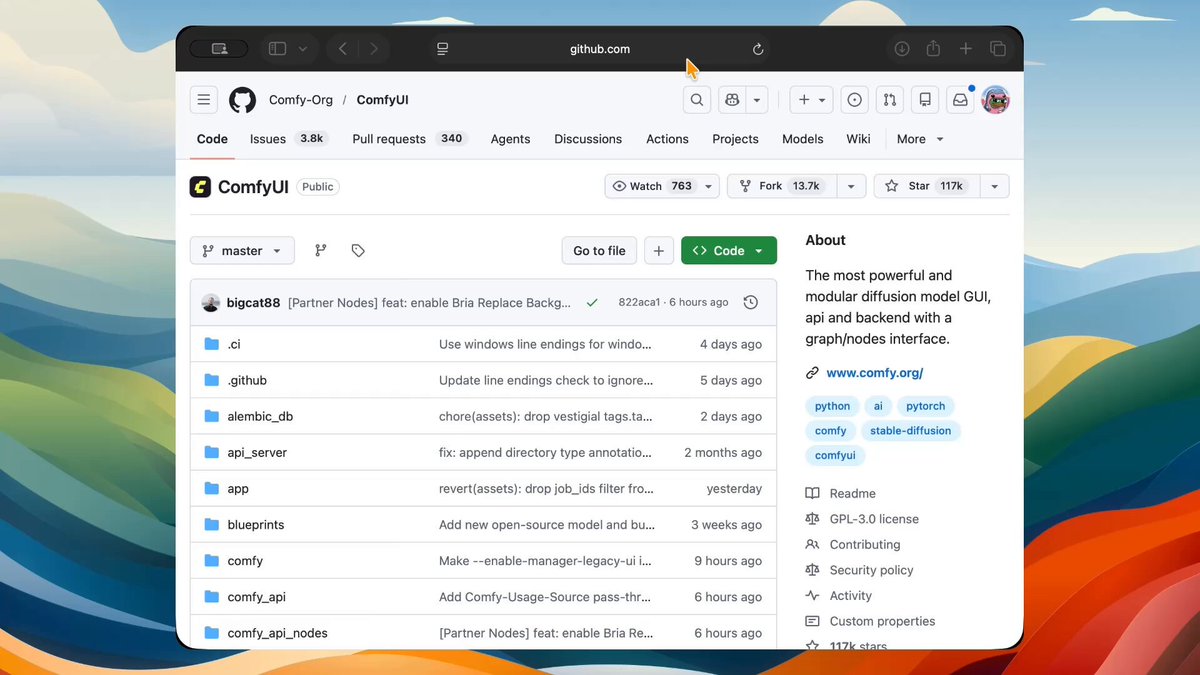
no money for grok or midjourney? this tool is for you. there's a FREE tool created by an anon dev. open-source. runs locally. 117k stars on github. it generates: > images & video > 3d models > audio > 20+ models here's how to set it up in under 5 minutes: 1️⃣download ComfyUI Desktop go to and grab the desktop app for your system. windows 10+, mac (apple silicon), or linux. it installs like any normal app, it sets up python and every dependency for you in the background. no terminal, no config files. 2️⃣open it first launch, it spins up its own environment automatically. you just wait a few seconds and you're in. you'll land on a node canvas, that's the whole interface. 3️⃣load a starter workflow top menu → Workflow → Browse Templates → Image Generation. click it. this drops a ready-made setup onto your canvas so you don't build anything from scratch. 4️⃣grab a model comfyui ships empty on purpose, the model is the brain, and you pick it. in the template, the "Load Checkpoint" node has a Download button when no model is installed. click it. it pulls one in for you (a few GB, this is the only real wait). 5️⃣install ComfyUI Manager this is the one add-on you don't skip. it lets you install models, custom nodes, and updates with a click instead of the command line. grab it from github (link in comments). it's the difference between fighting comfyui and flying in it. one honest note: an NVIDIA gpu makes this fast, apple silicon works great too, and a weak machine still runs it just slower. that's the whole setup. you now own an image, video, and 3D studio that costs you nothing per month. save this. and the next time grok or midjourney asks for your card. you won't need it. disclaimer: comfyui itself is 100% free. so are the local models (sdxl, flux, wan 2.2, ltx-2). some premium models like seedance are pay-per-use api models, only if you want top-tier quality. the free local ones cover most of what you need. (github link in the comments) follow and turn on post notification for daily AI contents.

m0h

14,542 Aufrufe • vor 3 Monaten

For science, AI sovereignty and physics-grounded reasoning are non-negotiable. But how can we teach a small LLM like Gemma-4-E4B physics? One way is to use Agent Skills, but this has so far been limited to closed frontier models. mistral․rs now implements Agent Skills natively: the first self-hosted inference engine that does this as part of the local inference substrate, where we can use small models to solve complex scientific and other tasks in a flexible and scalable way. We are in a period of uncertainty about frontier models - access, pricing, deprecation, abrupt restriction. The good news is that when the entire stack runs locally we can build AI that is entirely your own: You own the weights, the skills, the execution loop, the data - all of it runs on your hardware and is reproducible and durable. While virtually all local inference engines expose a model behind an OpenAI-compatible endpoint, everything agentic is then assembled around it by an external orchestrator that injects context, manages tools, mounts files, and brokers execution. mistral․rs is natively agentic and moves that machinery into the server itself, allowing us to build complex agentic workflows and run them locally, on open-source models. With this new feature you can now upload Agent Skills bundles to /v1/skills, reference them from Responses API requests by identity, and run them inside a native agentic loop with persistent Python sessions, figure capture, sandboxed shell execution, file inputs mounted directly into the working session; plug-and-play and completely compatible with your existing code/workflow. A model with a native skill substrate can act, observe consequences, and can modify what it is able to do. The skill is retained procedural capability of the system. Attached is a short video of all of it: skills, code execution, the full agentic loop carried by Gemma-4-E4B; running entirely on my MacBook Pro. You can install and run a server with this capability in two lines in your terminal, with any quantization you need. Nice work by the Google Gemma team Logan Kilpatrick Demis Hassabis and Eric Buehler with mistral․rs!

Markus J. Buehler

10,229 Aufrufe • vor 3 Monaten

Local AI 101: open models, Hugging Face, and businesses to build (38 min masterclass) I still think cloud AI is the default for most things, and honestly it should be, the frontier models are the strongest and easiest to use. But something shifted in the last 4-5 months. You can now run genuinely good open models directly on your own laptop, or even your phone. And once you actually try it, it changes how you think about what AI is even for. LOCAL AI, CLEARLY EXPLAINED: 1. The model is the brain doing the thinking. Gemma, Llama, Mistral, and Qwen are the main families, and each is better at different things, some at reasoning, some at coding, some small enough to run on a phone. 2. Hugging Face is the warehouse where you find them. You go there to see what each model is good at, check the license, and grab the compressed versions that run on a normal computer. 3. The software is what runs the model on your machine. Start with LM Studio if you're not technical, it feels like a normal app where you search, download, and start chatting. Ollama is the one you reach for when you want to plug a model into your own apps. 4. The workflow is the actual product you build on top of it all. That's what I'm ideating around for some businesses to create. I think local AI just made a specific kind of business way easier to start. Find an industry that: 1. Sits on sensitive data they'd never paste into ChatGPT 2. Does the same review over and over 3. Runs on software from 2003 Then build a local AI tool that does that review on their own machine, so the data never leaves the building! Take home health agencies. Nurses write visit notes all day, and if a note is missing a detail, the billing gets denied or the audit flags it. Here's how I'd start: 1. Find 5 small agencies. Offer to review a batch of their notes for them. 2. Run the notes through Gemma locally (free, private, no cloud). Read every output yourself. 3. Write down the 20 issues that keep showing up: missing vitals, vague med changes, notes that don't support the billed level. 4. That list of 20 is your checklist. The checklist is the product. 5. Turn it into a local desktop app that flags those 20 things before a note gets submitted. You just went from a service anyone could offer to a product nobody else has, and you learned exactly what to build by doing the work by hand first. Same recipe works for restoration contractors (draft the damage report on-site before the tech leaves) and wealth advisors (catch the compliance landmine in a client email before it sends). Basically the framework is sensitive data, repeated review, ancient software. I think there are tons of businesses like this! Almost none of it clicked for me until I actually started using local AI. So if you take one thing from this, go run a model on your own machine once. Also a fun thing to try with your friends. Feel free to send this to a friend. The episode is live for free on The Startup Ideas Podcast (SIP) 🧃 (thanks to Google for sponsoring today's episode and supporting local AI) I feel like local AI one of those things you need to try for it to really click. Run one model on your own machine and you'll see what I mean! I go way deeper in the full 38 minute masterclass, the models, the setup, and the businesses to build. Link below. LINK TO WATCH: OR WATCH BELOW ON X What do you think of local AI?

GREG ISENBERG

32,410 Aufrufe • vor 18 Tagen

New course: MCP: Build Rich-Context AI Apps with Anthropic. Learn to build AI apps that access tools, data, and prompts using the Model Context Protocol in this short course, created in partnership with Anthropic Anthropic and taught by Elie Schoppik Elie Schoppik, its Head of Technical Education. Connecting AI applications to external systems that bring rich context to LLM-based applications has often meant writing custom integrations for each use case. MCP is an open protocol that standardizes how LLMs access tools, data, and prompts from external sources, and simplifies how you provide context to your LLM-based applications. For example, you can provide context via third-party tools that let your LLM make API calls to search the web, access data from local docs, retrieve code from a GitHub repo, and so on. MCP, developed by Anthropic, is based on a client-server architecture that defines the communication details between an MCP client, hosted inside the AI application, and an MCP server that exposes tools, resources, and prompt templates. The server can be a subprocess launched by the client that runs locally or an independent process running remotely. In this hands-on course, you'll learn the core architecture behind MCP. You’ll create an MCP-compatible chatbot, build and deploy an MCP server, and connect the chatbot to your MCP server and other open-source servers. Here’s what you’ll do: - Understand why MCP makes AI development less fragmented and standardizes connections between AI applications and external data sources - Learn the core components of the client-server architecture of MCP and the underlying communication mechanism - Build a chatbot with custom tools for searching academic papers, and transform it into an MCP-compatible application - Build a local MCP server that exposes tools, resources, and prompt templates using FastMCP, and test it using MCP Inspector - Create an MCP client inside your chatbot to dynamically connect to your server - Connect your chatbot to reference servers built by Anthropic’s MCP team, such as filesystem, which implements filesystem operations, and fetch, which extracts contents from the web as markdown - Configure Claude Desktop to connect to your server and others, and explore how it abstracts away the low-level logic of MCP clients - Deploy your MCP server remotely and test it with the Inspector or other MCP-compatible applications - Learn about the roadmap for future MCP development, such as multi-agent architecture, MCP registry API, server discovery, authorization, and authentication MCP is an exciting and important technology that lets you build rich-context AI applications that connect to a growing ecosystem of MCP servers, with minimal integration work. Please sign up here!

Andrew Ng

142,256 Aufrufe • vor 1 Jahr