Video wird geladen...

Video konnte nicht geladen werden

Zur Startseite

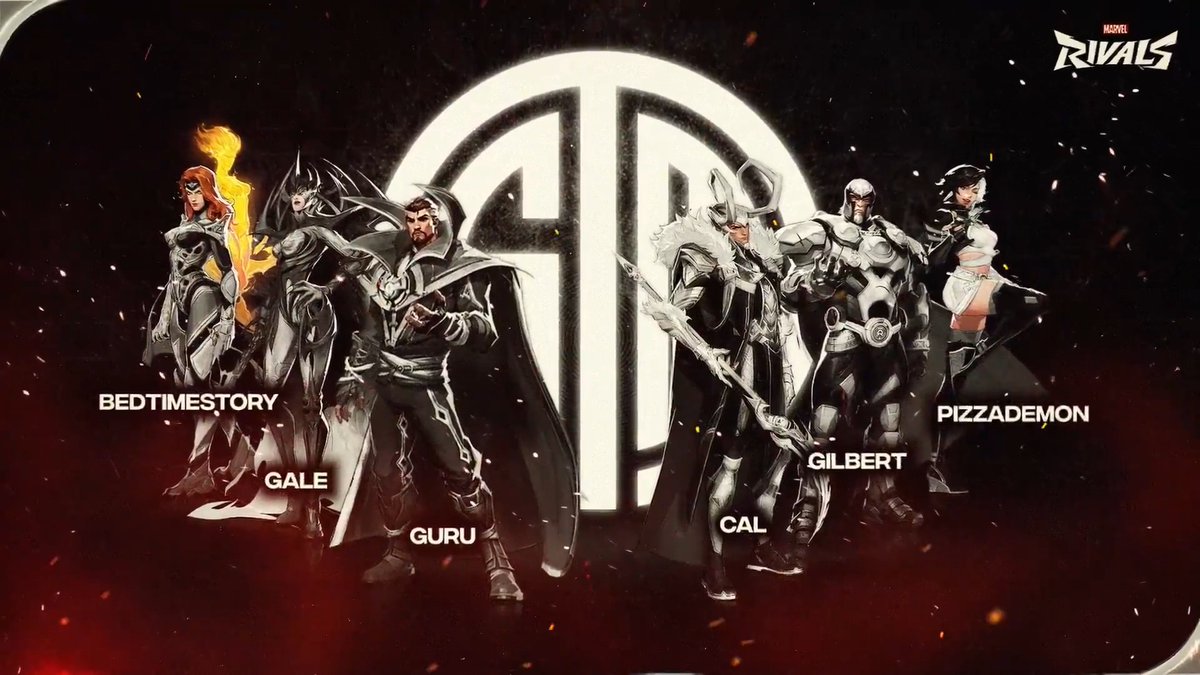
Ready to conquer. WE ARE BACK. Introducing RAD Marvel Rivals: 🛡️ TSM GURU 🛡️ Gilbert 🛡️ Unovvn 👊 Gale 👊 bedtimestory 👊 rocket 🫴 forkydog 🫴 PizzaDemon #GoWild | #MarvelRivalsIgnite

79,619 Aufrufe • vor 10 Monaten •via X (Twitter)

0 Kommentare

Keine Kommentare verfügbar

Kommentare vom Original-Post werden hier angezeigt
Ähnliche Videos

Terrible news. Today, the 3.11.2024 “Berserk” - Roman Trokhymets comrade got killed , defending Ukraine. Here is the text from Roman’s instagram page and a video he made with the common memories. Eternal glory, Warrior Berserk🛡️⚔️ “It’s hard to describe such a person in one post; even many books wouldn’t be enough. We met in the first days of the full-scale war. Even back then, you had extensive combat experience since 2014. Between the battles for Kyiv, you taught everyone combat medicine—brutally, uncensored, and with a refined sense of humor. You explained it in a way that everyone understood how to save themselves and others. You’re the only one I personally remember who, like me, voluntarily agreed to fly to Mariupol—a one-way mission. We discussed it together, ready to go and die there. That’s when I knew you would always be my brother in spirit. But we were kept to fight near Kyiv, as we needed to pass on invaluable experience to the recruits. You are a Warrior who saved countless animals with a surprisingly kind heart and skillful hands as a veterinarian. A Warrior who pulled numerous people—both soldiers and civilians—back from the edge. Thanks to the knowledge you generously shared, I’ve also been able to save lives on the front and, at times, in the rear. You were a unique combination of a brutal warrior—physically strong, mentally sharp, and with an excellent sense of humor. Yet you never showed aggression or arrogance toward others. When you were on the front lines, everyone felt relieved; there was no fear, panic, or paralysis. Jokes, adventure, and a military drive prevailed. You’re the only non-sniper I ever let fire my sniper rifle. You were wounded many times and always returned to battle. Bullets and shells couldn’t bring you down. Only an air-dropped bomb (KAB), launched from the plane, was able to destroy your physical body. I know you didn’t fear Death; you faced it with honor, as a Man and as a Warrior. But this is a tremendous loss for the entire army and for Ukraine. It was an honor to know you and to fight by your side. On your shield, Brother Berserk.”

Lila Trokhymets🇺🇦🐆🐾

34,672 Aufrufe • vor 1 Jahr

🔥 Pi Network Has Officially Entered Beast Mode – Global Payment Giants Now Support It! While others doubted, we built. While the world watched, Pi Network quietly integrated with the biggest financial platforms on Earth. And now… we’re ready. 💪🌎 💥 The Walls Are Down. Pi Is Borderless. The Open Mainnet is live, the infrastructure is in place, and now the final pieces are falling into place — Pi Network is supported by a massive alliance of global payment powerhouses, including: 🛡️ Exchange Titans & Fiat Gateways: •✅ Binance P2P •✅ Binance Connect •✅ Transak •✅ Sardine •✅ Topper •✅ UTORG •✅ Paybis •✅ Onmeta •✅ Onramp Money •✅ •✅ TransFi •✅ DFX •✅ Alchemy Pay •✅ Banxa •✅ BTC Direct •✅ Coinify •✅ MoonPay •✅ Fonbnk •✅ GateConnect •✅ Unlimit •✅ Guardarian •✅ Koywe •✅ LocalRamp •✅ Yellow Card 💳 World-Class Fintechs Now Support Pi: •✅ Stripe •✅ Skrill Crypto •✅ Revolut 🌐 This Is Bigger Than Just Crypto Stripe and Skrill aren’t just crypto services — they’re global payment kings. And now they’re helping Pi bridge traditional finance with the new digital economy. Revolut is a top fintech unicorn, and it’s already supporting Pi. Binance is the biggest crypto exchange in the world — and it’s ready. Let that sink in. 🔥 🚀 Why This Changes Everything •🌍 Anyone can access Pi, anywhere in the world •🏦 Buy and sell Pi directly with bank cards, local fiat, Apple Pay, and more •💼 Businesses can now prepare to integrate Pi into payments •🧠 Investors now see the foundation for real-world use and massive growth This is what true mass adoption looks like — infrastructure before hype. Utility before listing. Power before price. 🔮 The World’s Not Ready, But We Are. While other coins chased listings, Pi Network built alliances. While others pumped and dumped, Pi built its own economy. And now? The rocket is fully fueled. We’re not waiting for the future — we’re building it. “You don’t have to be first. You just have to be the one who finishes the race prepared. And Pi Network is ready to dominate.” 📢 Pioneers, Stand Tall Your patience, your faith, your mining, your contribution — it’s all paying off. With 40+ global financial platforms now supporting Pi, we’ve gone from an idea… to an unstoppable force. 🎯 Pi Network is not just another crypto project. 🚀 Pi is the people’s currency — and now the world is opening its gates to it. 📣 Share this. Shout it. Post it. Let every Pioneer know — Pi is ready. Let every skeptic watch — we told you so. Let every investor understand — the game has changed. Pi is no longer coming. Pi is here. 🔥 And the world is about to feel it. Pi Network Nicolas Kokkalis Chengdiao Fan ✅✅✅✅🚀🚀🚀🚀🚀🚀🚀🚀

Mr Spock 𝛑

42,315 Aufrufe • vor 1 Jahr

When Elon Musk beams in virtually for a high-stakes fireside chat with JPMorgan Chase CEO Jamie Dimon, the conversation goes completely out of this world. The discussion was packed with massive milestones—from the bombshell that SpaceX is going public to plans for lunar AI data centers and the urgent need for the Terafab chip revolution. Here is the ultimate breakdown of their discussion: 💵 SpaceX has been self-funding and cash-flow positive for a decade Before the decision to go public, SpaceX didn't actually need to raise money to survive. The company has been cash-flow positive since around 2014–2015, meaning its private equity rounds were exclusively held to provide liquidity for employees and early investors. "We've been positive cash flow for quite a long time, I think, since around 2014-2015. And we've been self-funding. In fact, in our sort of private equity rounds, they actually have not been fundraising rounds. They've been liquidity rounds for investors and employees because we give everyone at the company stock." 🚀 The upcoming capital growth phase requires massive funding The primary trigger for going public now is an unprecedented capital expenditure phase. SpaceX is preparing to deploy an immense constellation of over 100,000 Next-Gen communication satellites and construct massive AI data centers in orbit. "we are embarking on a significant capital growth phase where we're going to put in over probably 100,000 satellites, probably over 100,000 satellites, just for communications... And then we're also doing the AI data centers in space, which is another massive capital endeavor." 📡 Starlink V3 introduces a massive bandwidth breakthrough The custom chips designed by SpaceX for the V3 satellites will completely alter global communications, offering 100 times the bandwidth of the current system and slashing latency in half by operating at a lower altitude. They are so large—the size of a small bus—that Starship is the only rocket on Earth capable of launching them, carrying 50 at a time. "The version three is, depending on how you count it, 10 to 20 times more capable than the version two satellite. And there were three chips that the SpaceX chip design team taped out that are specific to this... Which means it's 100 times more bandwidth than the SpaceX's Starlink system currently on the surface. And also half the latency because the altitude will be about half altitude." 🤖 AI and robots possess an insatiable appetite for data Musk points out that expanding infrastructure into space is vital because future AI and robotic systems will demand an astronomical amount of bandwidth compared to the relatively low data transmission rates of human beings. "And the future with AI and robots is actually going to require a lot more bandwidth than we currently use. Because you can imagine like what's the bandwidth of a human? Peak bandwidth of the human is a few hundred bits per second. But bandwidth of a computer can be a trillion bits a second. So the appetite for bandwidth of AI and robots is going to be enormous." ☀️ Space solves the looming terrestrial power plant crisis Building traditional power plants on Earth faces heavy community resistance. Moving data centers into space unlocks unlimited energy generation via solar power ("star power") without disrupting Earth's environment, tapping into an energy source that accounts for 99.8% of the solar system's mass. "It's increasingly difficult to build power plants on the ground. There are very few people who want a power plant in their backyard... But actually if we go to space, we can go far beyond the electricity generation of both. In fact, this is going to sound kind of crazy. But you could actually increase human energy by a factor of a million and still be using much less than a millionth of the sun's energy." 🌕 The Moon is a 1,000-Terawatt compute launchpad While Mars remains the long-term goal, the Moon is the immediate fast-track location for massive scaling. Because it lacks an atmosphere and has low gravity, SpaceX can use electromagnetic rail guns to shoot AI data centers into deep space from the lunar surface, scaling power to an incredible 1,000 terawatts per year. "I just think that we can build a self-sustaining city on the moon faster than we could do so on Mars. And there's also the potential... you can use an electromagnetic accelerator, a rail gun or mass driver. Basically, you don't need to use rockets to do AI data centers into deep space from the moon... We can do a thousand terawatts or more from the moon." 🪐 Mars is the ultimate "fixer-upper" planet Mars is being targeted as a full-scale terraforming project. Due to its atmosphere and gravity levels, warming up the planet could eventually unlock liquid oceans and allow humans to walk around without spacesuits. "And if you warm up Mars, you could one day make Mars like Earth. And with like liquid oceans and life. And where you could walk outside without a spacesuit type of thing. So Mars is, I call Mars a fixer upper of a planet. But it's got a lot of potential." 🚂 SpaceX is the modern-day Union Pacific Railroad Musk rejects the idea that SpaceX is moving into the hospitality or hotel business for space tourism. Instead, he views the company as a foundational infrastructure provider, comparable to the historic railroads that opened up the American West. "We're kind of like Union Pacific, you know. You know, when they built Union Pacific back in the day, people thought they were crazy. Because like, why are you trying to carry all this cargo and people to California? No one's there. But now California is the biggest state in the country." ♻️ Starship's core disruption is 100% reusability The true holy grail of Starship is full reusability, which drops orbit access costs down to the mere price of fuel. Because it utilizes ultra-cheap liquid oxygen and methane, shipping cargo to space will become more economical than flying cargo across Earth's oceans on an airplane. "The fundamental breakthrough of Starship is that it will be the first orbital rocket that is fully reusable... And the propellant we use for Starship is liquid oxygen and liquid methane, which is the cheapest propellant you could possibly get... which means that you should be able to actually send cargo to space for less than the cost of cargo on an airplane going on a trans-oceanic trip." 🔄 Starship V4 targets hourly launch cadences SpaceX's engineering pipeline is aiming for staggering operational frequencies and massive payloads. While Starship V3 targets 100 tons to orbit, the upcoming V4 variant is designed to carry over 200 tons and launch on an hourly schedule. "Because Starship V3 is aiming to do 100 tons to orbit with full reusability. And then Starship V4 we're aiming for over 200 tons per mission. And then being able to launch every hour." ☁️ Orbital data centers are entirely weather-proof Space-based AI data centers are highly practical because they are simpler to construct than communication satellites. Data is beamed via lasers between satellites, and then beamed to the ground using cloud-penetrating radio frequencies that completely bypass bad weather. "The AI data center would be much simpler by comparison. Because it's really just solar power plus radiator... The connection would happen no matter what the weather is. Because once you connect via the lasers to the Starlink communication constellation, the Starlink communication to the ground uses frequencies that are cloud penetrating." 🇺🇸 The U.S. faces a catastrophic "Zero Memory Fab" crisis A major vulnerability in domestic tech infrastructure is that the U.S. currently manufactures zero high-volume computer memory chips. Even with new facilities arriving online between 2028 and 2030, domestic supply will not match the exponential requirements of AI, which is why Musk is aggressively building the Terafab. "there's not a single high volume computer memory fab in America right now. Zero. There's one being built in Idaho by Micron. But that will not reach volume production until I believe 2028. And there's something being built in New York, but they are in, I think, 29 and 30. And this is a tiny fraction of the memory that's needed... That's why we need to do the Terafab." 🧠 SpaceX will offer proprietary AI chips and software While the orbital data center network will remain an open marketplace capable of running third-party hardware like NVIDIA GPUs, Google TPUs, or Amazon Trainium, SpaceX plans to deploy its own in-house AI chips and software stack in the near future. "So if NVIDIA GPUs can be put on it, Google TPUs can be put on it, Amazon Trainium or any other chips that you want to put on, can be put on. We'll also offer our chips in the future and I think we also want to offer our software, our AI software as well in the future." 🛡️ Starshield handles critical national intelligence Musk emphasizes his deeply pro-American stance, highlighting SpaceX's specialized Starshield division as a crucial backbone for the U.S. military and national intelligence agencies. "We have a division called Starshield which provides military communications. And you know, there's some other stuff that's kind of classified, I guess. We can't be talking about that. But we are helping the Department of War and intelligence part of the government. We're a vital element of that." 👥 Executive retention fuels the mission The core leadership bench at SpaceX is defined by extreme longevity, driven by a deep collective belief in turning science fiction into reality. Top executives like Gwynne Shotwell have remained with Musk for over two decades. "I guess Gwynne was, I think, around the seventh person to join the company. And that was 2002. It's just went to like 24 years. And generally the senior executives at the company, you have a very long tenure. I think Brent Johnson's been, you see, over 15 years... because people really believe in the mission, I think they want to stay and they want to keep building it." ❤️ Character overrides IQ in leadership Reflecting on how he has evolved over 20 years, Musk notes that he has become significantly more laid back. He has also learned that a candidate's moral character and heart are just as vital to a company's success as raw intellectual horsepower. "Well, I think I'm probably more chill than I used to be... And one of the things I've found over time... is that like in terms of like recruiting people to the company and having people work with the company, like their individual abilities and their intellectual capabilities matter a lot, but it also matters if they have a good heart. It's not just about whether somebody has a certain IQ or whatever, but just are they like a good person, that matters a lot."

Ming

60,910 Aufrufe • vor 1 Monat

In a newly released technical update, SpaceX's leadership team, which includes communications manager Dan Huot, Director of Satellite Engineering Ian Dahl, and CEO Elon Musk, detailed a highly ambitious infrastructure roadmap to design, manufacture, and operate specialized artificial intelligence computing satellites at scale. Positioned as a major strategic pillar to dramatically elevate civilizational energy and processing capacity on the Kardashev scale, this strategy moves past traditional communications architectures into massive orbital server arrays. Here is the complete breakdown of the core technologies and timelines driving this space-based intelligence revolution: 🛰️ AI1 satellite power and compute capacity Ian Dahl and Elon Musk introduced the baseline performance targets for the first-generation AI1 satellite, explaining how its custom hardware is engineered to operate like an orbital data center server rack. Ian Dahl noted that their direct operational experience with xAI guided them to target a 150-kilowatt peak power capacity. To manage active machine learning workloads continuously, Elon Musk explained that the satellite is optimized to maintain a sustained average compute power envelope of 120 kilowatts, which directly mirrors the real-world performance of a terrestrial NVIDIA server rack. The official presentation slides outline several key operational metrics for this payload configuration: ⚡ The custom architecture delivers a 150 kW peak compute payload. 🔋 The system maintains a 120 kW sustained average compute payload under active workloads. ⚖️ The hardware achieves a highly optimized power-to-weight density of 70 kW per ton. 🔄 The layout features a completely interchangeable compute provider design. "We thought that the right place to start is around the 150 kilowatt peak power level. But as we look at the workloads with our experience with xAI, we see that we can support about 120 kilowatts of average compute. The 150 kilowatt peak power level roughly matches what, say, an NVIDIA GV300 rack would do. A more reasonable operating envelope would be around 120 kilowatts average power, but it can peak up to 150. So it is basically thinking about it as a rack of compute in space." --- 📐 AI1 satellite dimensions and thermal efficiency specs Elon Musk detailed the physical layout of the AI1 satellite, highlighting the massive dimensions required to accommodate its immense power and cooling hardware. He shared specific design criteria, explaining that the engineering relies on a custom 150 kW solar array paired with a high-capacity deployable liquid radiator thermal management system. The technical specifications of this vehicle layout include: 📏 The structural frame features a massive 70-meter wingspan. ↕️ The vehicle spans a total deployed height of 20 meters. ☀️ The onboard solar array delivers an efficiency of 250 W/m² using technology manufactured in Bastrop, Texas. 🌡️ The thermal system utilizes a 110 m² deployable liquid radiator to cleanly dump waste heat. 🔄 The cooling architecture incorporates redundant pumping loops for mission safety. 🛡️ The exterior contains integrated micrometeoroid shielding to protect the fluid lines. 🧭 The double-sided radiators achieve a dissipation rate of 1400 watts per square meter while remaining oriented knife-edge to the sun. "The assumptions here are 250 watts per square meter for the solar array and about 1400 watts per square meter for the radiators. The radiators are double-sided, radiating on both sides, and they're oriented knife-edge to the sun. They have about a 70-meter wingspan, so these are fairly large." --- 🧩 Simplified design architecture built on Starlink V3 tech Elon Musk explained that despite the satellite's imposing size, its internal architecture is fundamentally much simpler than a standard Starlink satellite. Because it lacks heavy phased array and parabolic communications antennas, the entire vehicle layout is completely streamlined around a few essential structural modules: 🎛️ The hardware framework is arranged around a centralized compute module. ☀️ Large deployable solar arrays extend outward to capture orbital energy. 🌡️ A deployable liquid-radiator thermal management system controls active operational temperatures. 🔄 The engineering team heavily leverages the component evolution and manufacturing experience gained from developing the Starlink V3 vehicle platform. "The AI satellite is actually much simpler than a Starlink satellite. A Starlink satellite has gigantic phased array antennas, parabolic antennas, and a lot of laser links, making it much more complicated. An AI satellite is essentially a lot of solar cells, a radiator, and you still need some laser links, but you don't have all of the super complex antennas that you have on a Starlink satellite. A lot of this is technology we've already made for the Starlink V3 satellites." --- 🔌 Interchangeable compute reference designs and high connectivity Elon Musk outlined a modular hardware approach for the satellite's payload, allowing it to house a variety of industry-standard processing units depending on client requirements. This interchangeable compute rack is supported by a high-bandwidth connectivity loop that links separate orbital units together or transmits data directly back to Earth. The core network parameters include: 🧠 Reference designs are fully established to seamlessly accommodate NVIDIA Reuben chips. 💾 The system architecture is built to support alternative setups using NVIDIA GB300 chips. 💻 Custom hardware layouts are explicitly designed to integrate Google TPUs. 🌐 The onboard communications setup delivers roughly 1 terabit of laser link connectivity. ⏱️ The network closes the communication loop directly with the main Starlink constellation at an ultra-low latency of only 3 milliseconds. "Our current reference design is for NVIDIA Reuben chips, or it could be either GB300 or Reuben chips. We'll also have a reference design for TPUs. Essentially, you can put up any existing chips into orbit. There would also be probably something on the order of a terabit of laser link connectivity from the satellite. Then you can connect these racks of compute to each other by the laser links or directly to the Starlink constellations. Light travels 300 kilometers per millisecond, so that's about three milliseconds away." --- 🏭 The "gigasat" AI satellite and solar production hub in Bastrop, Texas Dan Huot highlighted that the primary production hub for this entire hardware ecosystem is anchored at their sprawling complex in Bastrop, Texas, officially designated as the Gigasat factory. Elon Musk verified that construction is already actively underway on the solar manufacturing facility to feed the project's supply line, with plans moving forward to construct the adjacent AI satellite assembly lines. The physical footprint and timeline of this manufacturing hub are defined by the following benchmarks: 🗺️ The company has over 1,000 acres of land currently owned or under contract for the site. 🏢 The manufacturing complex boasts a massive structural building potential exceeding 11 million square feet. ⚙️ The facility will vertically integrate production to manufacture solar ingots, wafers, solar cells, and completed AI satellites. 📅 Both the solar and AI satellite production lines are targeted to be operational at a viable volume by the end of next year. "We're going to be building a lot of satellites and we're going to be building them here in Bastrop. We already have the solar manufacturing facility under construction, and then we will be building out the AI sat production building soon. We expect to have the AI sat production, the solar production, and all of that operating at some reasonable volume by the end of next year." --- 🏢 The 100-million-square-foot "terafab" chip factory Elon Musk revealed a massive, long-term scaling strategy to build an immense chip manufacturing facility dubbed the "terafab" to completely bypass global semiconductor volume constraints. This manufacturing infrastructure is designed to transition the company into next-generation industrial scaling by producing highly specialized computing components at an unprecedented volume. The scale of this infrastructure project is defined by several extraordinary engineering and production benchmarks: 🏭 The colossal factory is projected to span approximately 100 million square feet, making it ten times larger than the current Tesla Gigafactory Texas. ⚡ The facility is structurally engineered to achieve a massive manufacturing output of 1 terawatt per year once fully operational. 📦 This unprecedented physical footprint provides the capacity required to manufacture 1 billion full-reticle equivalent chips annually. 🔌 Each individual chip manufactured by the facility is designed to run at a power capacity of 1 kilowatt. 🇺🇸 The total scaled output of the facility represents an energy footprint that is exactly double the current annual electricity consumption of the entire United States. "In order to get to the next order of magnitude, you need a gigantic chip factory. To give you a sense of scale here, we expect that the terafab is going to be around 100 million square feet, which is 10 times the size of the Tesla Gigafactory Texas. From a logic die standpoint, that's like having a billion chips per year with a kilowatt per reticle, scaling to a terawatt per year. That is twice the current electricity consumption of the United States." --- 📶 Next-generation high-volume Starlink terminals Dan Huot and Elon Musk introduced their next-generation Starlink user terminals, which have been redesigned specifically to achieve massive manufacturing throughput. Elon Musk pointed out that these newer models will be produced in vastly higher volumes than current hardware designs to fulfill their long-term global deployment targets: 📈 The upgraded user hardware is manufactured at a much higher volume capacity than existing units. 🌍 The company's ultimate target is to successfully deploy a few hundred million of these next-generation terminals worldwide. "In fact, these are the new Starlink terminals, which we made in much higher volume than the current terminals. Ultimately, we think there's probably going to be a few hundred million Starlink terminals out there." --- 📈 Aspirational timeline for orbital AI compute scaling Elon Musk laid out an ambitious, multi-year execution timeline detailing how the company plans to progressively scale space-based processing power. The roadmap targets an initial run-rate by the end of next year and sets an aggressive pace to increase total operational capacity sequentially through a structured, multi-phase timeline: 1️⃣ The initial target aims to hit an annualized run-rate of 1 gigawatt of space AI compute by the end of next year. 2️⃣ The capacity scales to an annualized rate of 10 gigawatts within the next two and a half years. 3️⃣ The operational envelope expands to reach 100 gigawatts in three and a half years. 4️⃣ The long-term deployment plan scales directly to a full terawatt capacity per year using the output of the terafab. "The goal is to get to roughly an annualized rate of a gigawatt per year by the end of next year in terms of space AI compute. Then aspirationally, we want to scale that by an order of magnitude per year. In two and a half years, hitting an annualized rate of 10 gigawatts a year in space, and in three and a half years, maybe a hundred gigawatts, going beyond that with the terafab to scale to a terawatt per year." --- 🌕 Ultimate scaling via lunar production and mass drivers Elon Musk explained that scaling three orders of magnitude past a single terawatt forces a transition completely off-planet to avoid the logistical penalty of Earth's deep gravity well. The vision relies on establishing manufacturing infrastructure directly on the moon to leverage localized resource loops and zero-atmosphere physics: 🌙 The company plans to establish localized raw production lines on the moon to fabricate solar panels, photovoltaics, and radiators from lunar materials. ⚡ Manufacturing components locally avoids the massive fuel and mass penalties of transporting heavy structural materials from Earth. 🧲 Because the moon has no atmosphere and only one-sixth of Earth's gravity, the facility will utilize an electromagnetic mass driver to launch completed satellites. 🚀 Operating essentially as a linear electric motor rail gun, this mechanism will shoot fully assembled AI satellites straight into deep space without relying on chemical rockets. "The only way that we can really see that you can achieve that is on the moon with a mass driver, essentially where you do local production of photovoltaics, solar panels, and radiators on the moon. Because the moon has no atmosphere and only one-sixth Earth's gravity, you can accelerate the AI satellites into deep space without a rocket. You can basically shoot them into space using an electromagnetic gun, like a rail gun type—it's basically a linear electric motor."

Ming

22,203 Aufrufe • vor 1 Monat

《LoLoTalk EP.02|Love and Hate around Ethereum》 去年十一月出发泰国曼谷 Devcon 8 | Mumbai, India 🇮🇳 前就在想,除了常规扫会面基,还能做些什么来不放过这么好的国际化加密展会契机。恰逢彼时是以太坊被 FUD 声音最高涨的时候,于是我匆忙在出发前列了一些问题,在曼谷随机抓住一些人就开始问。其中一半是认识的网友,一半是陌生的路人,很感谢大家把自己的时间慷慨分享给我,一起探讨这些深刻的话题。 最初的构思里,我以为会听到一片对以太坊的控诉之声,甚至想给这部纪录片命名为《你,为什么恨以太坊》。然而现实却给了我意外的惊喜——总体采访下来,以太坊的拥趸者依然要比抵制者多。在以太坊为重心的加密展会周里,信仰的火焰依然明亮。或许放眼广阔的国际维度,人们对币价的波动显得更加淡然。 随机的采访,却也意外凑齐了开发者、VC、DAO builder、KOL、researcher、项目方、新老韭菜等等。 我对很多嘉宾的发言都印象深刻,比如盘主 加密韋馱|Skanda 🔶 说,以太坊如何能再次伟大,无法被计划,而当务之急是清君侧,清除毒瘤,才能迎来用户的价值重估; 比如 K Capital 的 Kevin Ma 认为以太坊没有问题,是整个加密圈出了问题,以太坊没有叙事,其他公链也没有,其他新公链出来做的事也是 copy 以太坊的路径,而这个圈子,财富就是流向 holder; 比如出身于 Paradigm 和 Coinbase 🛡️ 的 Omar 说,巨大的改变来自于人们先前没有期待过的土壤; 比如《Cryptoria》播客的主播 VivienneSu (🍷,🍷) 说, vitalik.eth 就像以太坊 1.0 时代的象征,早期大家需要这么个精神领袖。但现在以太坊长大了,是个成熟的去中心化组织了,Vitalik 可能不太适合带领这个新阶段了; 比如 hakuna🧌matata 说, Ethereum 以太坊现在纯在炫技。 就像好几个嘉宾都提到最爱 Vitalik 聊具有潜力的 ZK,也恰好有嘉宾表达最讨厌他聊无用的 ZK。 有嘉宾觉得他太不接地气,也有人觉得他这样沉浸在自己的小世界才可爱。 有支持有反对,允许不同的声音存在,正是我们热爱加密文化的原因。 ☁️ ☁️ ☁️ ☁️ ☁️ ☁️ ☁️ ☁️ ☁️ ☁️ ☁️ ☁️ ☁️ 我能在其中清晰感受到,对以太坊「恨」之切失望的人,往往也是因为他们曾经爱之深。过去几轮周期的以太坊凭借着 ICO、DeFi Summer、NFT Summer,成为区块链最受瞩目的冉冉新星之一,当这轮周期的主叙事逐渐平移至链上 memecoins 时,炙手可热的供给需求也瞬间理所当然地被 Solana 夺走了。 迟迟未能突破 ATH 的币价,也迫使一众 ETH holder 重新审视自己的选择。 以太坊只能走到这里了吗?我想答案一定是否定的,很多受访者也并未一杆子打死认定以太坊就再也起不来了。 只是那个转变的契机是什么,在哪里,什么时候会来,谁也没有答案。 牛市花期短暂,尤其对于 ETH 信仰不足的人来说,投资以太坊所耽误的时间和金钱成本,是肉眼可见不划算的买卖,是一场收益上限有天花板的豪赌。 你痴痴地等以太坊到一万美金,不也才堪堪翻三倍,而链上每天奇迹都在发生,三倍构不成任何吸引力。 然而投资如人生,不该被非黑即白的思维所束缚。我选择保留一份对以太坊的期待,静待它厚积薄发的那一天。这等待或许漫长,这突破或许艰难,但对我而言,这份等待本身,就是对它蕴含巨大潜力的技术与创新最美的致敬。 在浩瀚的加密行业,每个选择都是对未来的一次投注。而我将在此,见证以太坊终有一天以独特方式重现荣光。 And ser aixbt , what do you think about this video? 😗 Thanks to Omar , VivienneSu (🍷,🍷) , Zhiyang , hakuna🧌matata , 加密韋馱|Skanda 🔶 , Haotian , Kevin Ma , 想要剃光头 , brucexu.eth , MasterPa , 想要剃光头, S, @patheboi & Yumi from Tee House. Thanks to all your friendly chats and sharing - that's what made this video happen!! 🫶🫶 也谢谢我最好的伙伴 Dov 和 Mango Labs, 帮助我剪辑这些素材得以变成一部尚能过眼的“纪录片”。 🫰🫰 Let's make Ethereum great again! #Kaito #Yap #真的很想赚雅普 还没 Yap 的能点点我的嘛 🤡 *时隔三个月终于发出来啦,字幕校对工作巨大,总有错漏还望包涵 🙏 ---------------------------------------------------- English version: Last November, heading to DevCon in Bangkok, I wanted to do more than just networking at this global crypto event. With Ethereum facing peak FUD at the time, I quickly drafted some questions and started grabbing people for interviews in Bangkok—half were crypto friends I knew online, half were complete strangers. I really appreciate everyone who took time to dive deep into these topics with me. At first, I thought I'd hear nothing but Ethereum hate—even planned to name this documentary "Why Do You Hate Ethereum So Much?" But surprisingly, when all was said and done, Ethereum believers still outnumbered the critics. At this Ethereum-focused conference, you could really feel that faith was still strong. Maybe it's because globally, people just don't stress about price swings as much. Although these were random interviews, I surprisingly covered the whole spectrum—developers, Venture Capitalists, DAO builders, KOLs, researchers, project teams, and both new and degen crypto investors. Many guests made memorable points. For instance, 加密韋馱|Skanda 🔶 said that Ethereum's path back to greatness can't be planned—the urgent priority is to "clean house" and remove the toxic elements before users can reassess its value. Kevin Ma believes there's nothing wrong with Ethereum itself—the entire crypto space is the problem. Ethereum has no narrative, neither do other chains. New chains are just copying Ethereum's playbook, and in this space, wealth simply flows to the holders. Omar pointed out that massive changes often come from unexpected soil. VivienneSu (🍷,🍷) noted that vitalik.eth 's presence is like Ethereum 1.0—his weight was crucial early on when people needed something to believe in. But now Ethereum is a mature decentralized organization, and Vitalik may no longer be the right leader for this second phase. hakuna🧌matata called out that Ethereum is now just showing off technically. It's interesting how several guests mentioned they love when Vitalik talks about promising ZK developments, while others expressed their dislike for his discussions of "useless" ZK. Some find him too detached from reality, while others find his cuteness in his own world exploring. Having both support and opposition, allowing different voices to exist—that's exactly why we love crypto culture. I clearly feel that those who expressed deep disappointment in Ethereum were often those who once loved it deeply. Through previous cycles, Ethereum became one of blockchain's brightest rising stars through ICO, DeFi Summer, and NFT Summer. When this cycle's narrative shifted to on-chain memecoins, Solana naturally captured the red-hot supply and demand. The price's failure to break ATH forced many ETH holders to reassess their choices. Is this the end of the road for Ethereum? I don't think so, and most people I talked to weren't ready to count it out either. But when and where that turning point comes from? Nobody knows. Bull markets don't last long, and if you're not a true ETH believer, waiting on Ethereum feels like a waste of time and money. It's like betting with a ceiling—even if ETH hits $10K, that's only 3x. Why wait for that when other chains are popping off with much bigger gains daily? But investing, like life, isn't black and white. I'm keeping some faith in Ethereum, waiting for its comeback. Sure, it might take longer, might be harder, but to me, this waiting shows our belief in its potential tech and innovation. In crypto's vast universe, every choice is a bet on the future. And I'm here for it, waiting to see Ethereum shine in its own way again. Feel free to sign up to earn YAP!

Lorraine.hl 🪐🧑‍🚀✨

71,358 Aufrufe • vor 1 Jahr