Loading video...

Video Failed to Load

Go Home

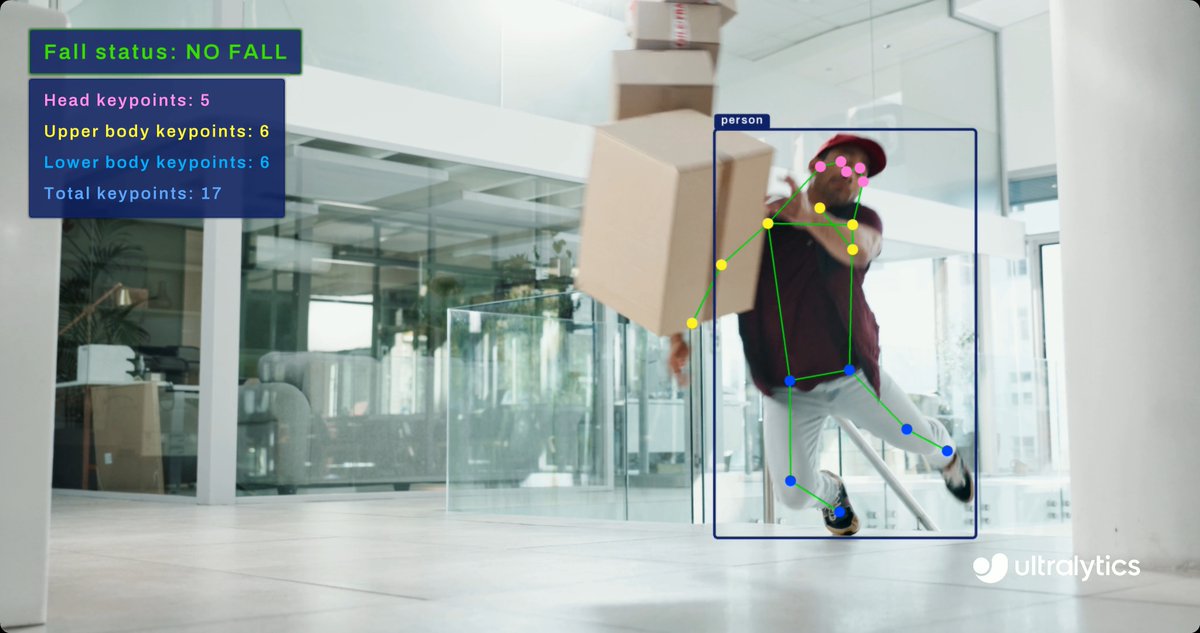
Real-time object detection will never be the same. Traditional YOLO needs NMS to remove duplicate boxes; it's slow and inconsistent. YOLO26 skips it entirely: single-pass predictions, faster inference and up to 300 detections per image. Download model:

374,108 views • 4 months ago •via X (Twitter)

0 Comments

No comments available

Comments from the original post will appear here

Related Videos

I just ran Gemma 4 31B on @CerebrasSystems at 1,800+ tokens/sec and it's multimodal. For context: that's 35x faster than a typical GPU endpoint, and the first token (reasoning included) lands in 1.5 seconds. This isn't a benchmark slide, I recorded the inference live. Prompt I used: "Create a simulation of an iPhone. Include at least one working dummy note taking app, a functional notification pulldown, high quality graphics, single HTML file, any libs via CDN." - Generation time: 3 seconds. - Notes app worked. - Notification panel worked. - Rendered first try. This is what wafer-scale inference unlocks, not just "faster," but a different category of product. When generation is this fast, you stop waiting and start iterating in real time. Why this matters: Gemma 4 31B is Google DeepMind's flagship open weight model, Apache 2.0 licensed, dense (not MoE), and built for efficiency over raw parameter count. It scores close to Claude Haiku 4.5 on the Artificial Analysis Intelligence Index (30 vs 29) but runs ~18x faster on Cerebras. It's also the first multimodal model on Cerebras's platform, meaning you can now feed it screenshots, documents, charts, and UI states at wafer scale speed. # Applications I'm most excited about: - Screenshot → Insight: Drop in a dashboard or document screenshot, get structured findings back instantly. no waiting, no batching. - Live UI generation: Full interactive interfaces (like my iPhone sim) generated and rendered in under 2 seconds. - Screenshot -> Patch: Feed it a broken UI + console error, get a minimal code fix and verification steps back. - Computer use & agentic loops: See -> reason -> act - verify, fast enough to keep a human in the loop instead of waiting on the model. - Long context summarization: Full research reports condensed into decision ready summaries you can read and requery in one sitting. The bigger unlock isn't the speed number itself, it's that agentic and multimodal loops (see -> reason -> output -> tool call -> verify -> retry) finally run in real time instead of feeling sluggish. As Logan Kilpatrick (Logan Kilpatrick) put it: "If every model was doing 2,000 tokens per second, you wouldn't build the same product and just have it be faster, you'd build different products." Gemma 4 31B is live now on Cerebras Inference Cloud in public preview. If you're building multimodal, agentic, or real time apps, this is worth testing today. What would you build with such insane inference throughput?

Alok

12,962 views • 26 days ago

Day 12/90 of Inference Engineering What is chunked prefill within vLLM? In continuation of yesterday's post on the high level architecture of vLLM, I want to dive deeper into vLLM core engine starting with the mechanics of chunked prefill. In this post, I will closely follow the original blog on the anatomy of vLLM. To start, let's define chunked prefill. It's a runtime inference optimization technique that splits a long input request so that it doesn’t monopolize the whole GPU. Keep in mind this is all within the context of vLLM. And since vLLM is an inference engine that's meant to serve a model to multiple concurrent users, having a GPU that’s fully monopolized on a single user's request means other users' requests would be in queue waiting to be processed. It isn’t too good to have the whole GPU occupied on a single request when the GPU is meant to be shared! So the key idea behind chunked prefill is to break the long request into smaller chunks, so that each chunk along with other users' requests gets processed and written into the KV cache together. Suppose we split up the long request into chunks and each chunk has 8 tokens. Now each memory block can hold 4 tokens. Therefore, 8 tokens can fit into 2 blocks of memory. After the first forward pass, 2 blocks are occupied, and after the second forward pass, 4 blocks of memory are occupied and so forth. Each forward pass handles a small chunk of the long request so that there's room in the same pass to keep serving other users' requests. Here's a small animation that I made today to fully visualize the idea behind chunked prefill when learning this topic~

max fu

28,891 views • 8 days ago