Loading video...

Video Failed to Load

Go Home

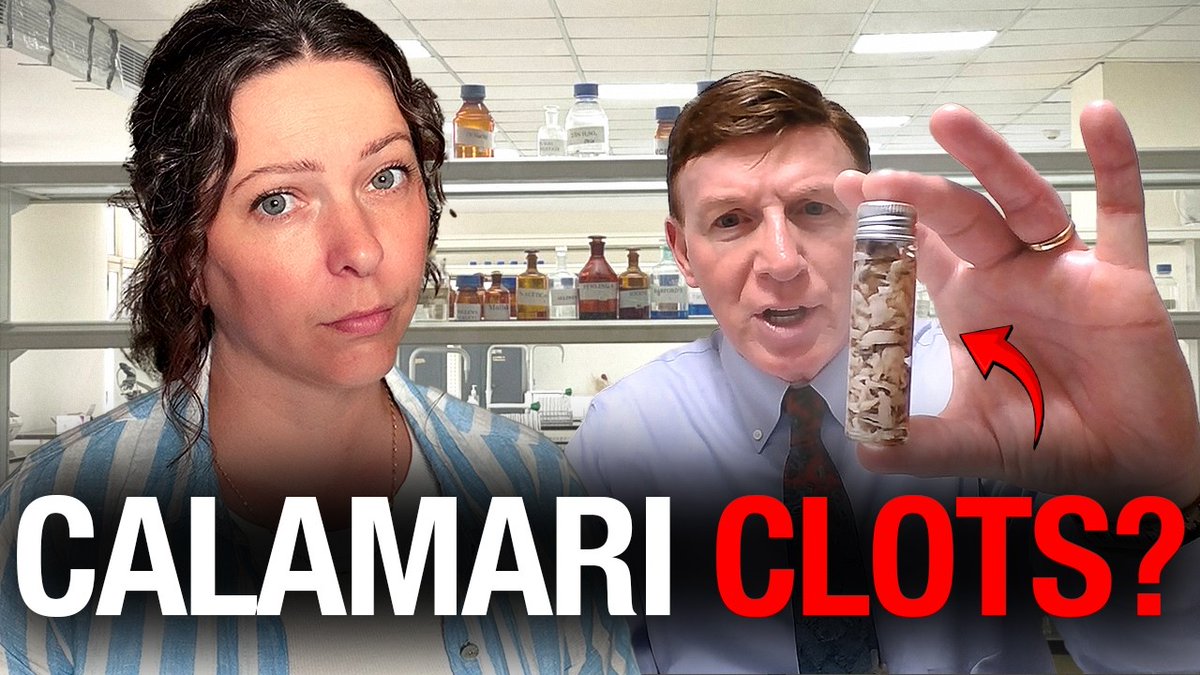
REPORT: A new peer-reviewed study has uncovered a stunning breakthrough: nattokinase, a natural enzyme from fermented soybeans, dissolves 84% of amyloid microclots within just two hours in vitro. For anyone alarmed by the strange white clots turning up in embalmers’ reports and post-vaccine blood tests, the timing of this...

154,517 views • 9 months ago •via X (Twitter)

0 Comments

No comments available

Comments from the original post will appear here

Related Videos

What are these 'calamari-like' clots that embalmers keep finding? New peer-reviewed paper examines the recent phenomena of unusual white fibrous clots found by embalmers. Retired Air Force Major Thomas Haviland’s peer-reviewed research exposes a persistent phenomenon that the mainstream medical establishment continues to ignore. A new peer-reviewed paper published July 1 in the International Journal of Innovative Research and Medical Science breaks down what embalmers across English-speaking countries have discovered in recent years: tough, rubbery, white fibrous clots appearing in a significant percentage of bodies long after the COVID-19 pandemic and vaccine rollout. Thomas Haviland, a retired U.S. Air Force Major, began investigating this phenomenon after watching the 2022 documentary Died Suddenly. He has since conducted annual surveys of embalmers in the United States, Canada, the UK, Australia, and New Zealand. His latest analysis of 808 responses from 2022 through 2025 found that 75% of embalmers reported seeing the unusual clots. “The embalmers are seeing these white fibrous clots in an average of 23% of their corpses,” Haviland stated. A separate, more recent, 2026 survey of Tennessee embalmers showed roughly 70% still observing the clots in 18% of cases, according to Haviland. Notably, these structures differ sharply from clots seen before 2020. “Many of these embalmers have 20 or 30 years of experience, never saw this phenomenon before,” Haviland explained. “Prior to COVID, they would see two types of clots. What’s called grape jelly clots… And they also see what’s called chicken fat clots… Much, much different than these large white fibrous clots, which are really tough and rubbery and hard to break." Haviland also shared the account of an endovascular specialist and cardiologist in Jacksonville, Florida, who contacted him about removing similar clots from living patients at his lab. “He actually refers to the clots as devious clots,” Haviland said. After sharing images and angiograms, the doctor emailed in March 2024 to tell Tom that he had been instructed to terminate communication immediately. “Somebody, his hospital administrator probably got to him, right? Told him to shut up, stop talking about this, or else we’ll go after your medical license,” Haviland observed. “So it’s a shame. That’s what’s happening. People are staying silent about this when they should be speaking out.” Laboratory tests on the clots, including Raman spectroscopy and others, point to the spike protein — whether from the virus, modified RNA injections, or both — sticking to a blood protein called fibrinogen and creating unusual structures. “It makes that fibrinogen all misfolded and twisted… So then it becomes almost impossible to break down the clot. It becomes this rubbery polymer instead,” Haviland said. Despite repeated submissions of survey results to the FDA, CDC, and NIH, and the publication of supporting papers, major health agencies and institutions including the Mayo Clinic, Cleveland Clinic, Johns Hopkins, and Stanford have shown no interest in obtaining samples for further study. Although Haviland’s initial preprint was rejected by one platform as “not novel enough,” four years later, embalmers continue to report the never-before-seen clots into 2026. Haviland and others behind his research are calling for forensic pathologists and independent researchers to examine the structures directly and for congressional hearings to investigate what embalmers have been documenting for years.

Rebel News

22,984 views • 1 month ago

🚨Dr. Kevin McCairn on the Dr. Mary Bowden podcast discussed amyloidogenic fibrin found in the blood of people who received COVID mRNA vaccines and the challenges of treating the resulting damage. He explained that fibrin in the plasma can shift into an amyloid-like configuration, contributing to abnormal clotting that doesn’t break down properly. While his lab has observed seeding reactions, he noted that this occurs within the complex environment of plasma rather than in isolation. He views this as a distinct pathological process from classic prion diseases, though it shares some amyloidogenic features. McCairn said that while removing these misfolded fibrin aggregates and cleaning the blood makes sense as a first step, it is only half the battle. He believes stem cell growth factors and the complex mixture of signaling molecules they contain are equally important for recovery. He highlighted regulatory differences between countries. In the United States, authorities prefer highly purified biologics, which makes it difficult to use the full spectrum of stem cell-derived factors. In contrast, Japan has been more open to using these complex, less refined preparations, which McCairn sees as more natural and potentially more effective. He warned that trying to synthetically isolate single components could reduce the treatment’s overall benefit and gentleness on the body @MaryBowdenMDe Kevin W. McCairn PhD Lyndsey, RN 💜🐭 KenCaptn20114 Charles Rixey, MA MBA (c)

Kenny Carmody

18,602 views • 1 month ago