正在加载视频...

视频加载失败

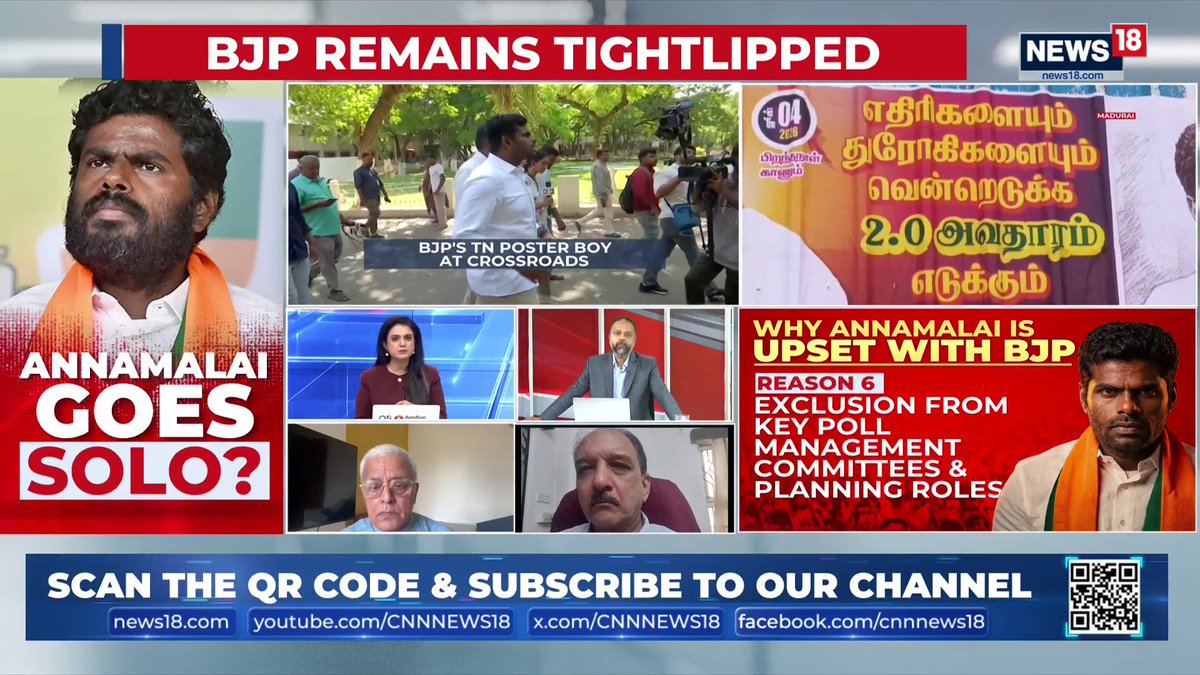
Reports suggest that K. Annamalai may be considering a political path outside the BJP — possibly shaping a new regional formation with a nationalist but secular tone. But what does Tamil Nadu’s political structure actually allow today? In this discussion with political analyst R. Kannan, the conversation moves beyond...

16,654 次观看 • 4 个月前 •via X (Twitter)

0 条评论

暂无评论

原始帖子的评论将显示在这里

相关视频

CM TVK Vijay is simultaneously trying to secure a stable majority for his government while also weakening both the DMK and AIADMK politically during the process. By seeking support from parties within the DMK alliance, Vijay is not only attempting to maintain the government safely above the majority mark, but also trying to strengthen his secular image politically. At the same time, by engaging with #DMK allies and potentially accommodating some of them politically, he indirectly weakens and isolates the DMK’s alliance structure itself. On the other side, his larger political objective appears to be the complete replacement of the #AIADMK space. He has already successfully triggered a visible split within the AIADMK and secured the support of 25 MLAs from the splinter faction. The continuing chaos within the AIADMK is indirectly helping TVK expand and emerge as the principal alternative force in that political space. Now, after the floor test is over and the government appears numerically secure, TVK Vijay may no longer necessarily require the continued political dependence on those 25 AIADMK MLAs, Which also means that he may not be under immediate pressure to reward them with cabinet berths, despite the earlier speculation and expectations. But a sense of uncertainty will always remain for this government and TVK will keep facing pressure from the DMK allies who joined TVK govt. Sooner or later, he may need to reconsider bringing the AIADMK MLAs into the cabinet for the longevity of the Government. My analysis on Thanthi TV TV. #TNpolitics

Sanjeevee sadagopan

17,699 次观看 • 4 个月前

A SWOT of Annamalai’s “We-The-Leaders” Movement – An Amazing and Ambitious Project on Paper, but an Arduous one to Implement! As the very first person to surmise and publicly suggest that Annamalai should launch his own party (despite being a BJP sympathizer myself), I feel both happy and vindicated that he has finally taken the plunge. In fact, when I made that suggestion in April last year, many of his own supporters rebuked me. Today, the very same supporters are jumping in joy. I thought I would offer my honest and impartial views on Annamalai’s new dream and what better way to analyse it than through a SWOT framework? Here we go! Strengths! Annamalai’s speech was positive, confident, and unwavering. For the first time, he explicitly articulated his intention to begin a movement, nurture it into a political party, and eventually contest the next Assembly elections. He appears determined and emotionally invested in his vision. The intent itself appears noble — primarily to break the cult (TVK Vijay) and dynastic/nepotistic (DMK and AIADMK) political culture that dominates Tamil Nadu politics. Today, opportunities are often monopolized either by mass celebrities or by political families where grandfather, son, grandson, and extended relatives continue inheriting political power, while the common man still struggles to find space to contribute meaningfully to society. Annamalai also seems to have understood the importance of grassroots political development. Precisely for this reason, he speaks about creating and nurturing grassroots leaders who can eventually become catalysts for broader societal and political change. Weaknesses! In electoral politics, identifying your principal political opponent is extremely important. Annamalai says he will not attack anyone, but politics rarely functions in that manner. One major reason behind the phenomenal success of Vijay and his rapid rise was that he clearly identified DMK as his primary political enemy, and that strategy worked brilliantly due to severe anti-incumbency. While Annamalai repeatedly spoke about creating grassroots leaders, the overall speech lacked operational specifics regarding how exactly he intends to pull off such an enormous project. Building genuine grassroots leadership cannot realistically be achieved within five years. It requires a generational transformation. By the time any meaningful structural outcome emerges, Annamalai himself may well be in his 60s. Opportunities! A focused, training-based approach to creating grassroots leaders sounds fresh, innovative, and intellectually appealing. No major Tamil Nadu political movement has articulated such an idea in recent times. This approach could resonate strongly with discerning, educated, and politically aware voters seeking long-term systemic change. The proposal for fixed terms for all positions, including councilors, MLAs, ministers, and even Chief Ministers is also a brilliant and refreshing idea. It creates a level playing field and opens opportunities for merit-based political growth driven by performance and competitive spirit. Threats! CMOTamilNadu Joseph Vijay will undoubtedly be the single biggest threat to this movement. This is because Vijay possesses charisma, mass appeal, cinematic aura, and substantial public support already reflected in his 35% vote share. That support base could further expand because Tamil Nadu politics has historically been deeply mass-leader-centric, from Karunanidhi to MGR to Jayalalithaa and now Joseph Vijay. Cinema and politics in Tamil Nadu have always remained deeply intertwined. How exactly Annamalai intends to break this cultural-political pattern remains the million-dollar question. Another concern is that many Annamalai supporters still seem to misunderstand the nature of this initiative. This is supposed to be a long-term grassroots movement, not merely a membership drive. As of now, even if more 7 lakh people have enrolled, that still represents only a tiny fraction of Tamil Nadu’s voter base. Even if the movement eventually attracts 60 lakh people, it would still translate to only around 15% vote share which is insufficient to defeat a strong incumbent government. Many are currently joining because of excitement, novelty, and emotional momentum. But will the movement sustain itself? It is somewhat similar to joining a gym after a New Year’s resolution. Initial enthusiasm is easy. Sustained discipline is rare. If fixed-term political positions is intended merely as an internal party discipline mechanism, then it is perfectly achievable. However, if Annamalai intends to make it a broader political standard for India, then that would require major electoral reforms far beyond the capacity of a regional party. Final words! I do not want to sound pessimistic because there is clearly genuine intent behind this movement from Annamalai. An intent to create seismic long-term societal and political change. But does modern society possess the patience required for such an awakening? Tamil Nadu politics is fundamentally cult-driven. In many ways, cult can only be defeated by another cult. Only a diamond can cut a diamond. Modern voters are often impatient, emotional, short-sighted, and constantly searching for “change” and “excitement” more than governance, administrative experience, or institutional credentials. Neutral and non-political voters also tend to gravitate toward whichever political force appears to possess momentum and inevitability, because people naturally prefer backing someone who they think will win. Will this initial enthusiasm sustain itself? And if yes, what are the long-term plans for sustaining it? There must be constant engagement, frequent interactions, periodic workshops, conversations, and consistent quality control. How will Annamalai alone manage such an enormous undertaking? If he successfully does, he may himself evolve into a political cult figure. In which case, how will be fight cult politics? However, excessive empty rhetoric without visible action could also revive “failed Seeman” comparisons. My humble suggestion to Annamalai would be to first attempt a pilot exercise in the Kongu belt and scientifically test the outcomes. He could train grassroots leaders and allow them to contest local body elections and the 2029 Lok Sabha elections within that region. If successful, those leaders could gradually create model wards, streets, municipalities, and eventually constituencies. That success could then inspire broader replication across Tamil Nadu over the next 10–15 years, while simultaneously earning the trust of Tamil voters. Attempting to achieve all this within just five years appears virtually impossible. Personally, I would say the chances to succeed is only 10%. But it will be an extraordinary political and social experiment if Annamalai genuinely wishes to give back to the society that made him who he is today. Having said all this, I am still willing to give Annamalai the benefit of the doubt because this project is still in the initial phase. Let us wait and watch how things unfold. Even if his party emerges as the principal opposition force by 2031, it would still be a phenomenal achievement. All the very best, brother K.Annamalai

Praveen

30,328 次观看 • 4 个月前