Video wird geladen...

Video konnte nicht geladen werden

Zur Startseite

Resident Evil Requiem has an insanely complex Easter Egg titled "The Final Puzzle", I have spent countless hours attempting to decode it. These are all my findings: MINOR SPOILERS AHEAD - I recommend reading AFTER you finish the "Rhodes Care Home" section of the game as there are some...

2,970,894 Aufrufe • vor 4 Monaten •via X (Twitter)

0 Kommentare

Keine Kommentare verfügbar

Kommentare vom Original-Post werden hier angezeigt

Ähnliche Videos

#ต้าห์อู๋ #Daou #Oueiija 🦖: There was a music festival in Pattaya, and I brought my Mama along. Lately, I have been bringing my Mama to work a lot. And I felt like booking the best hotel for her to sleep in, so I did. That day, she kept looking at the view from the hotel, and I saw her reaction. She said, “Mama has never slept in a hotel like this in my whole life. Mama has been working since the age of 14, performing Chinese opera to provide for the family. I never thought I’d have something like this. Never thought I’d have a beautiful home or get to ride in nice cars.” And it resonated with me, especially since Pa passed away. When Mama says things like that, (it is) true. What I had planned was just one (more) year until Pa and Ma could retire… (but) it was too late. Even if it was just one year or one day, it was too late. Success can wait for tomorrow, (but) if they are not there tomorrow, then it is too late. So, I felt like, “Hey, when can I make her happy?” To be honest, the new house that I built for her, where she can do this and that, is finished. The renovations are all done. The cats have moved in. (She?) has a role as the pillar of the house. So, I feel that the car… I had bought one before, but that time, I had to thank the fans. But this time, it came from (my own) hard work. I want it to be something that makes Mama happy. I know that I bought a car, and she can’t drive it, but I want her to see that I am starting… I want her to see that I have succeeded.

𝐟𝐢𝐥𝐦.

22,766 Aufrufe • vor 1 Jahr

Ethan Klein addresses the iDubbbz apology "I know why they stopped talking about us..I know we have a really good case in Canada..unironically if he had issued this type of apology like months ago I would have thought it was sincere but to do it right after u get the C&D..how am I supposed to think this is sincere..if I did think it was sincere..I'm the first person to let a grudge go, all u have to say is I'm funny..I'm so quick to forgive" "U know all these regular sh*tbags who say the worst possible things..retweeted by Hasan once or twice a month to feed the machine..I haven't seen the messages but I have seen the name and logo for this snark community..they wear it like a badge of honor..that CPS came to my house, that human skulls were sent to my house..these are the groups of ppl u spent the last year aligning with..and u know..it's hard for me to feel bad" "U sacrificed that peace to the alter of clout when u made that Content Cop..encouraged and applauded the CPS visits..justified and spent time w the community that took joy and pride in it..I mean I have to, it's just a matter of principle" "I don't wanna sue u..but at the end of the day I have made a commitment and I am the ultimate hater..I look bad, I'm ok w that bc for me it's personal..I hope that when u guys have children that ur never put in a position that upsets u as much as that upset me, I don't wish that on anyone..I wish it didn't happen to me, but it did..I know the people that participated in it..maybe they didn't make the call..they shouted them out, said they're great ppl and justified it..and I'm just following through on my promises"

yeet

139,792 Aufrufe • vor 1 Monat

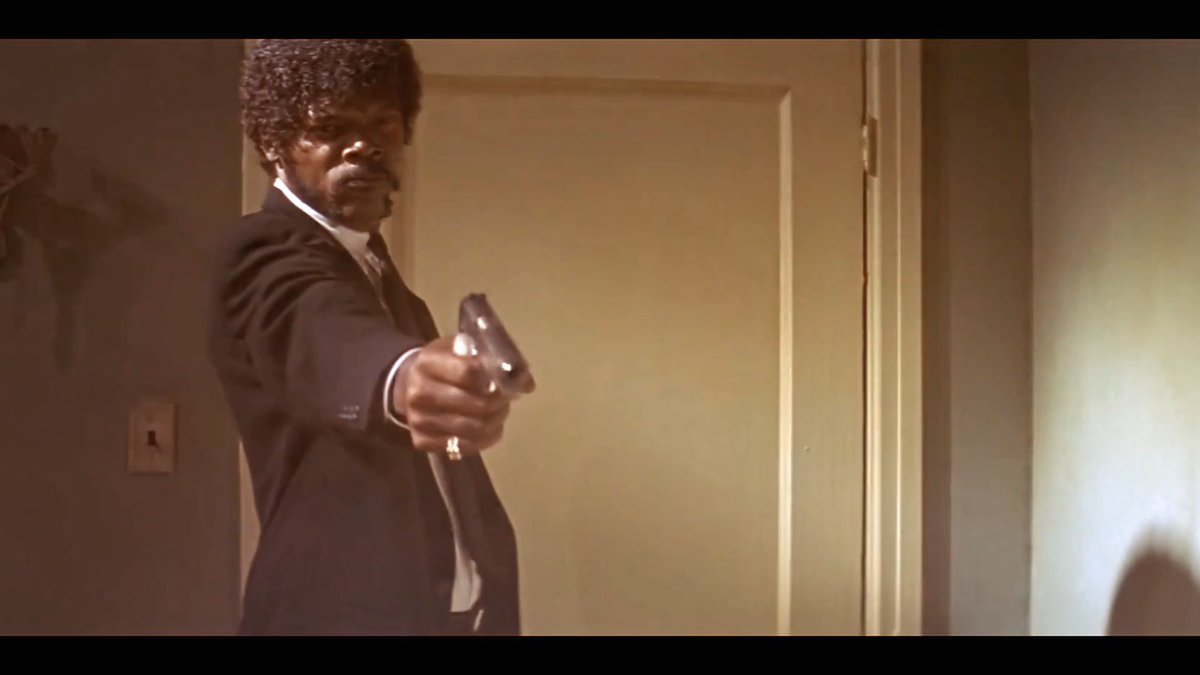
Samuel L. Jackson explains how he landed the role of Jules in Pulp Fiction, and what it was like seeing the film for the first time on the big screen: “Pulp Fiction and I came together in a very strange kind of way. I remember auditioning for Quentin for Reservoir Dogs in New York (for the role of of Detective Jim Holdaway, Mr. Orange’s police contact). And apparently I didn't get that role. But I was at Sundance the year that he screened it for the first time. I was sitting there and I watched that movie - I was awed by it. I mean, there were people running up the aisles when Michael Madsen was cutting the cop's ear off. People were going, "Oh my God, this is horrible!" All these “auteurs” were running out of the theatre. I was like, "This is good. This is happening. This is different." So after the film, I walked up to Quentin and said, "This film's amazing, man. It's great." And he looked at me and said, "Hey! How'd you like the guy who got your part?" And I was amazed that he even remembered who I was - but he remembered me. A year or so later, I got a phone call saying Quentin Tarantino wants to have dinner with you, because he'd seen Jungle Fever and he liked that Gator character. When we had dinner, we were sitting there talking. We started talking about Hong Kong films and cartoons and foreign movies and obscure things that we watched, horror movies. We found out we liked the same kind of stuff. And he told me he was writing this thing, and he was writing this part with me in mind. He was going to send it to me. I went off to do another film. I was in the backwoods of Virginia somewhere doing a film, and the script came. A little plain brown wrapper from Jersey Films. And Jersey's got these gangster images on the logo. And it said, "If you show this script to anybody, two guys named Ernie and Luigi will come and break both of your legs." Whatever. I went, "Yeah, right." So I sat down and read it. Boom. I read this thing. It's like, "Oh my God. This is awesome." And then I said to myself, "Nobody writes a script this good. There's no way that this script is as good as I thought it was." I closed it. I opened it again. I read it immediately. Okay. This is great - If whoever produces this film lets him shoot exactly what I just read, if they stay away from it, they don't try to edit any of this stuff out - this is going to be a great film. It's going to be kind of audience-specific, because I like that kind of stuff. I have friends that I knew would like it. It was a generational kind of film. I never thought it would cross over and do all this stuff. We shot it. We had a great time doing it. And the first time I actually saw the film was at the Cannes Film Festival. That night, it screened, and I was sitting there watching the film. The audience was loving this movie, loving it. About halfway through, I realized there were subtitles at the bottom of it. So I said, "Hey, these people are reading it, and they're getting it. This might be special. This really might be something special." And actually, by the time it was over, there were tears running down my face. I was just so pleased that I was part of that particular film… I never felt that satisfied, and that kind of full about a performance and about being part of something as I was in that particular moment.” Quote comes from an Interview with the American Film Institute 2010

Gangster Cinema Central

83,875 Aufrufe • vor 5 Tagen

Garry Nolan discussing the UAP material he’s analyzed. “I have another material, the so-called Bismuth magnesium material supposedly claimed to be from Roswell.” “we have done all the most advanced analyses you could imagine on them. No idea how anybody would make it.” “That piece is about as close to technology as anything I have. The other pieces are kinda like something that was left over. This is not” Source -Robinson Erhardt 🔗 in comments Transcript 👇🏼 Garry -“I have a material from Ubatuba Brazil, a fisherman who saw an object that dropped something in partway of it dropping. It exploded all over the beach. He collected some of it, chunks of it, and I have pieces of it from two chains of evidence that, and I did something called atomic probe tomography on it, which is basically, you can see literally the positions of the atoms in it. It's 99.99% silicon. 99.999% silicon, 1950, something who makes silicon at that level of purity explodes it over a beach in Brazil. Who makes that level of purity? Silicon Valley makes that level of purity, but only in the last 20 or 30 years. Okay. So, and one of the two chains of evidence had magnesium isotope ratios that are way off Earth normal. I have no idea what it means, but what I do know, what it means is that it's was engineered and made by somebody or something. Right. And it's just a fact. So I don't have an explanation for what it is, but I have the material right and anybody else can use this, that the material is in several people's hands. I have another material, the so-called Bismuth magnesium material from supposedly claimed to be from Roswell. I've had students who shall go unnamed, who will, who are, have been analyzing this stuff. It's engineered at with a level of precision and made of things that we just wouldn't put together. Layered magnesium oxide with Bismuth, interlaces, i, I have in the material, you know, we have done all the most advanced analyses you could imagine on them. No idea how anybody would make it. That piece is about as close to technology as anything I have. The other pieces are kinda like something that was left over. This is not, this is, I mean, we have chunks of this stuff.”

neandrewthal

41,948 Aufrufe • vor 1 Jahr

Hirokazu Koreeda on how he directs Children: "Interviewer: I think 'Shoplifters' (2018) is very remarkable in showing different sides of a city and like you said, people who are pretty much invisible, but I do want to also commend you on another thing, is you often work with young actors, and they always tend to have a significant role in many of your films. How do you go about finding such dynamic young actors, and why do you often put these young people at the center of each one of your stories? Koreeda: First of all, I would say that I tend to make what I would call family dramas, and of course, you have to have children if you’re creating a family, but that’s how it started, but I found that as I did it, I became really interested. It became very interesting and fun to work with these children, and for example, the two children in this film, neither of them had any acting experience at all before this film. I brought them in, and what I find when you bring these children in, and you work with them is that the adult actors change. They become much more lively and natural in the way that they act, and I guess, at some point, I realized this, and I guess, became really attracted to the idea of having children and the impact that it had. Interviewer: Do you find that there is any struggle in terms of working with young actors, or in this case, young children who have not actually acted before? Koreeda: Just to clarify, I have worked with children in many of my films, and all of them have never had experienced before. I always go out and pick non-acting children to work in my films, so just, I wanted to put that out there. In terms of the struggle, it does take time. You have to give extra time to work with these children. When I choose these children, I have an audition, and I pick out who I want to the audition, and then when we get to set, I never give them the script. No child that I’ve worked with has been given a script beforehand, and when I get to the actual part where they’re going to be acting, I give them the lines myself, and work with them and coach them. What I find is that it’s actually really enjoyable, both for them and for myself that way. I also, because I’ve been doing this now for several years, I tend to have a fairly high success rate in choosing children that are able to work with me in that way. Interviewer: That’s fascinating, and it also shows how you are able to create such authentic performances from these child actors over and over again in so many of your films. I think it’s a unique gift that you have, and it’s something that very few directors, I think, here in the United States do. Koreeda: It’s true, I guess by working with these children, I learned. I discovered that the best way to do it was just to communicate verbally their lines, rather than giving them in a written format, and over time, this really worked, and so I just kept doing it. But, interestingly, I loved the movie 'Kramer vs Kramer' (1979), directed by Robert Benton, and one time I bought the movie with all the extra, the making of and everything, and I went over it, and I found through that, that in fact, the child in that movie was also given his lines every day by the assistant director each morning when they came in to set, so I discovered that it wasn’t just me that was doing this." (Koreeda's interview with Scott Menzel, We Live Entertainment, 2018)

DepressedBergman

49,522 Aufrufe • vor 5 Monaten

George Lucas on how he had to reluctantly write the screenplay for 'American Graffiti' (1973) & the confidence he gained from the movie's success: "When I was doing 'American Graffiti' (1973) I was still struggling with my ‘I don’t want to be a writer’ syndrome. I had some good friends of mine that I wanted to write the screenplay, but it took me like two years just to get the money to do a screenplay. And I got a little tiny amount of money and—which I had to go actually to the Cannes Film Festival to get on my own. So finally I got this money. I called back and I said, you know, “I got the money. We can start working on the screenplay.” And they said, “Oh, we don’t want to do that now. We’ve got our own low-budget picture off the ground and we can’t write it.” I said, “Oh no.” I said, “What am I going to do? I am in Europe and I’m not going to be back for like three months and I want to get this thing off the ground.” So they recommended another student from school that I knew pretty well. I had a story treatment that laid out the entire story scene by scene, so I called him over the phone from London and I said, “Do you want to do this?” And he said, “Okay.” The person I was working with at that time as a producer made a deal with him for the whole money because there wasn’t very much. It was so tiny that he could only get him to do it for the whole amount of money. When I came back from England, the screenplay was a completely different screenplay from the story treatment. It was more like 'Hot Rods to Hell' (1967). It was very fantasy-like, with playing chicken and things that kids didn’t really do. I wanted something that was more like the way I grew up. So I took that and I said, “Okay. Now here I am. I’ve got a deal to turn in a screenplay. I’ve got a screenplay that is just not the kind of screenplay I want at all and I have no money.” And, I spent the very last money I had saved up to go to Europe to make the deal, so I had nothing. That was a very dark period for me so I sat down myself and wrote the screenplay. After I did 'American Graffiti', and it was successful, it was a big moment for me because I really did sit down with myself and say, “Okay, now I am a director. Now I know I can get a job. I can work in this industry, and apply my trade, and express my ideas on things and be creative in a way that I enjoy. Even if I end up doing TV commercials or something, or I fall back into what I really love is documentaries. I’ll be able to do it. I know I can get a job somewhere. I know I can raise money somewhere. I know I can do what I want to do.” That was a very good feeling. At that point, I’d made it. There wasn’t anything in my life that was going to stop me from making movies." ('‘American Graffiti’ at 52: A Sentimentally Affectionate Look at America Before the Collective Loss of Innocence', Sven Mikulec, Cinephilia & Beyond)

DepressedBergman

56,916 Aufrufe • vor 6 Monaten

VIDEO Democratic Front (DF) president Mathias Mpuuga on #TheGrindPodcast with Patrick Kamara 933 KFM: 1. "...I am an active politician, I have moved in every inch and space of this country. I know where his [General Yoweri Museveni support is, it is not 71% it is not even 50%, and he knows it too." 2. "I am on record before and after the elections for having spoken out. I went out of my way and wrote to every political party in the opposition, warning and inviting them for a commonality of purpose...Immediately after the elections, I held a press conference spoke about the same issues, I had warned colleagues about that we never cared about and they happened. So, I feel that I am vindicated to the fact that I raised the alarm. Those who didn’t care, there is no much I could do to drag them." 3. "Also I could have raised the challenge about that election in the supreme court, but I was not a presidential candidate and I did not have permission to raise the same on behalf of any candidate. Remember that in one of the amendments that I had intended in the presidential elections act probably out of ignorance or excitement, was to amend the law to the fact that a citizen can challenge the election in a supreme court as long as that citizen is a voter and there is a proof that his challenge is not a waste of court’s time. I had intended that when that happens when presidential candidates are either compromised or timid, a courageous citizen can challenge that election. That didn’t happen, and the opportunity was lost." 4. "What have I done as DF? The DF is is going to challenge particular actions leading to that election and our petition to the Constitutional court is ready, if you want to know how we have moved and that we are not sleeping as the DF." #RealChangeActNow

Democratic Front (DF)

20,784 Aufrufe • vor 2 Monaten