Loading video...

Video Failed to Load

Go Home

Robert Duvall's iconic Oscar-nominated performance as Colonel Kilgore amounts to just eleven minutes of screentime in Apocalypse Now (1979) Francis Ford Coppola lost 100 pounds while filming. He invested $7 million of his own money in the film after it went severely over budget. Coppola eventually had to mortgage...

28,405 views • 7 months ago •via X (Twitter)

0 Comments

No comments available

Comments from the original post will appear here

Related Videos

Francis Ford Coppola’s new film “Megalopolis” cost $120m and he self-financed it (including money from selling his winery). Coppola is a legend of “going all in” and “putting skin in the game”. The GOAT example is “Apocalypse Now”, his classic 1979 war film with arguably the most insane production story ever. Let’s rewind to 1975, the year Copolla turned 36: he is on top of Hollywood after directing “The Godfather” (1972) and “The Godfather II” (1974). What does Coppola choose to do next? Make a film about the Vietnam War. The script was based on Joseph Conrad’s “Heart of Darkness”, the 1889 novel about the horrors of colonialism in the Belgian Congo. The major studios all said “no” to Coppola’s pitch for three major reasons: 1️⃣ He wanted full creative control 2️⃣ He wanted to own all of the film rights 3️⃣ The Fall of Saigon happened in April 1975 and the American audience wasn’t exactly asking for a Vietnam War film (the studios wanted Coppola to make another Mafia flick) Coppola was undeterred and made a huge bet. “The Godfather II” cost $14m and the director estimated that “Apocalypse Now” would be the same budget. He put up $7m (mostly from those sweet Godfather checks) and raised another $7m from United Artists (which bought domestic distribution rights for ~7 years). But the project was a disaster from the start. Filming started in The Philippines in March 1976 and was supposed to last 3-4 months…it would take 16 months: ▫️Harvey Keitel was the initial lead but Coppola fired him after one week. ▫️Martin Sheen (Captain Willard) took the lead role but drank so much on set that he gave himself a stress-induced heart attack and almost died. ▫️Dennis Hopper was doing 3g of coke and 20+ drinks a day while on set (him and Marlon Brandon also hated each other). ▫️A typhoon destroyed 80% of the set and delayed filming for 2-3 months. ▫️Actual dead bodies — stolen from a local grave — were used on set and the Filipino government and its strongman leader Ferdinand Marcos threatened to shut down production after finding out. ▫️Marlon Brando (Col. Kurtz) demanded a huge fee ($3m+ for 3 weeks of work and 10% of the film’s gross). He then showed up late, asked for rewrites, declined to read Conrad’s book and was so overweight that the costumes wouldn’t fit (to obscure his heft, Copolla filmed Brando in the shadows and had him wear oversized dark clothing). The budget ballooned to over $30m. To maintain creative control and maintain all the film rights, Coppola mortgaged his home and borrowed money against his ownership in The Godfather. After the success of “Star Wars” (1977), Coppola even asked his friend and business partner George Lucas — who was originally tapped to direct Apocalypse — for some funds. I repeat: Coppola went ALL THE WAY IN and had SKIN IN THE GAME. His wife Eleanor took recorded video of all the insanity and the footage was turned into a 1991 documentary (“Hearts of Darkness: A Filmmaker's Apocalypse”). The total cost for the film — including marketing spend — reached $45m. Against all odds, Coppola finished the project and the film was released in August 1979. It grossed $105m and Coppola would make a fortune on future DVD, Home Video and other ancillary revenue streams (below is a trailer for a re-mastered cut from 2019). During the Cannes Festival in May 1979, Coppola famously said of the film: “The way we made it was very much like the way the Americans were in Vietnam. We were in the jungle, there were too many of us, we had access to too much money, too much equipment, and little by little, we went insane.”

Trung Phan

1,703,365 views • 2 years ago

There have been many masterpieces that were commercial failures, but nothing quite hurts me like the failure of Jacques Tati's "Playtime" (1968). The production costs of the movie went well over budget that forced Tati to take out large loans and personal overdrafts. Despite all the difficulties, the movie came out nearly as Tati envisioned. So much so that he said, "I’m proud of 'Playtime'; it’s exactly the picture I wanted to make. With all my other films, I could make changes, shoot things differently if I was doing it now. Not with 'Playtime'— I did it and it’s done. I’ve suffered a lot because of it, physically and financially, but it’s really the film I wanted to do." About the movie and Tati's struggles, Francis Ford Coppola said, "Tati took all of his money which he had earned and he wanted to make a film that no one would finance and he made this film and it failed. He had nothing and at the end he died in poverty because the movie he wanted he borrowed the money to make failed. People would let him to live at their house because they loved him but long after he died his movie, 'Playtime', everyone realised was the masterpiece. We all have to say 'Thank you, Jacques Tati' for giving us this because it's a joy and it's wonderful and it wouldn't have been made had he not made that sacrifice." (Quotes taken from Jacques Tati's interview with Jonathan Rosenbaum, Film Comment, 1973 & Francis Ford Coppola, Konbini, 2024)

DepressedBergman

33,386 views • 1 month ago

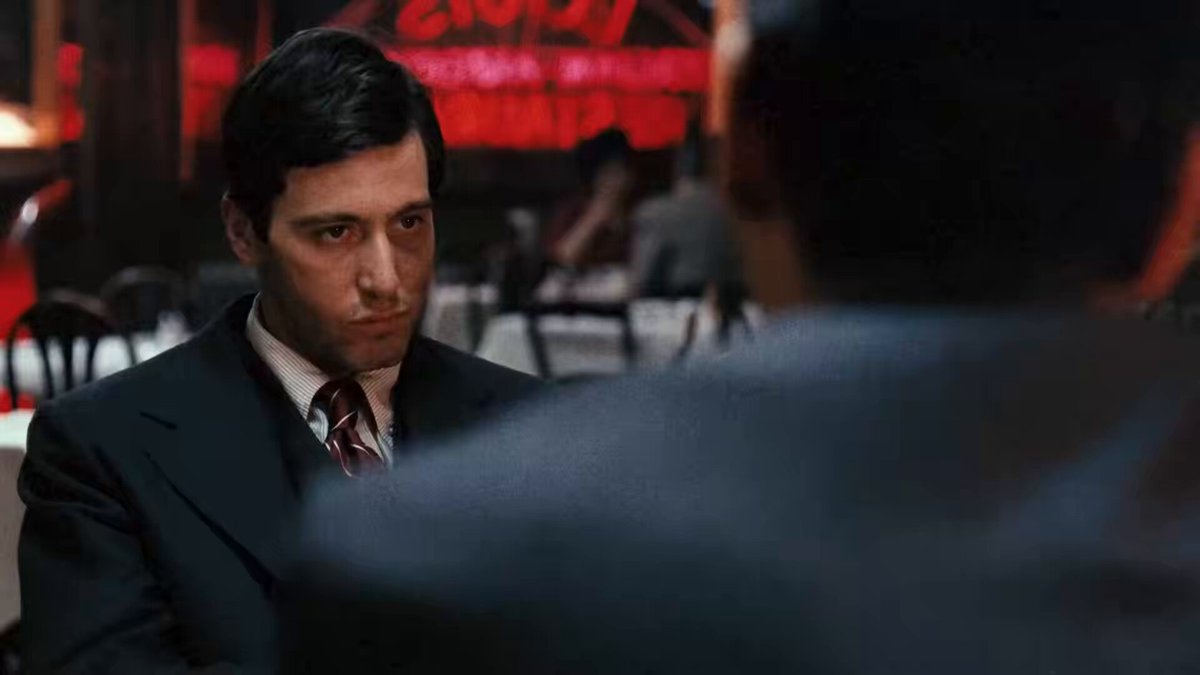
"The Restaurant Assassination" — Francis Ford Coppola doesn't build this scene's climax around the gunshot. He builds it around the silence before it. Most people remember this sequence for the revolver hidden behind the restroom tank. Or for the deafening roar of the passing train just before Michael Corleone rises from the table. But if Coppola's goal had simply been to stage an assassination, he would never have devoted nearly ten minutes to everything that happens before the trigger is pulled. Michael walks into the restroom. He pauses. Retrieves the gun. Straightens his hair. Looks at himself in the mirror. Returns to the table. Then sits in silence. Almost nothing happens that moves the plot forward. And yet, this is exactly where Coppola places the emotional center of the scene. By the time Michael returns to the table, the audience already knows what is going to happen. The question, "Will he pull the trigger?" has already been answered when he calmly tells Sonny: "I'll kill them both." So why does Coppola linger? Because the outcome is no longer what interests him. He wants us to remain with Michael long enough to feel the weight of the choice itself. Earlier in the film, Michael tells Kay: "That's my family, Kay. It's not me." That line is more than character exposition. It becomes the foundation of everything this scene is built upon. Michael does not enter the restaurant as someone born to the Corleone world. He enters fully aware that once the shots are fired, the life he once imagined for himself will be gone forever. That is why his silence is not the hesitation of a man lacking courage. Michael has already faced war. What Coppola is filming is not fear. He is filming a man confronting the irreversible consequences of his own decision. The camera never rushes him. The editing never forces the pace. For a few remarkable minutes, the film simply stays with Michael. As a result, the gunshots are no longer the true climax of the sequence. They are merely the conclusion of an inner journey the audience has already experienced alongside him. That is also what Sollozzo and McCluskey fail to see. They see a young man who has always stayed outside the family's business. A decorated Marine who wanted an ordinary life. A man they assume will never cross that line. Coppola invites us to see something else. The defining question is not whether Michael is capable of killing. The defining question is who he becomes before he does. Perhaps that is why this remains one of the greatest scenes in The Godfather. Francis Ford Coppola does not use silence to heighten suspense. He uses it to observe something cinema rarely pauses long enough to examine: the moment when a man's conscience is still fully alive just before he makes a choice that will alter the course of his life forever. That is why the lasting memory of the scene is not the gunshot itself. It is the feeling that the shot carries such extraordinary weight precisely because Michael never stops understanding what it will cost him. Name movie: The Godfather (1972)

Love Classical Music and Movies 🎺🎻💖🎥🎬

28,523 views • 1 month ago