Loading video...

Video Failed to Load

Go Home

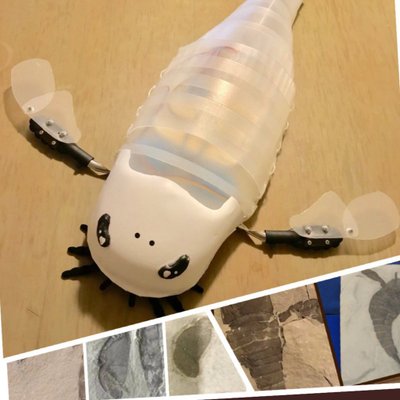
"Robopterus" (inspired by the Palaeozoic predator Pterygotus Test 2. Propulsion method The robot is equipped with three different propulsion methods, which can be compared as shown below. Online support of British sea scorpion researcher Simon Braddy and information from Jun
55,078 views • 2 years ago •via X (Twitter)

0 Comments

No comments available

Comments from the original post will appear here

Related Videos

🚨 ELON MUSK AND NASA’S JARED ISAACMAN JUST SAID THE QUIET PART OUT LOUD: ANTIMATTER PROPULSION COULD BE THE KEY TO INTERSTELLAR TRAVEL. In a recent exchange, Musk predicted that trillions of dollars will eventually be spent developing antimatter propulsion systems to reach other star systems. NASA’s Jared Isaacman publicly backed the vision. When matter and antimatter meet, they annihilate completely, converting 100% of their mass into energy roughly 10 billion times more energy per unit mass than chemical rockets. Why this matters: • Chemical rockets are fundamentally limited by how much energy you can extract from fuel • Antimatter offers orders-of-magnitude higher energy density, which could enable dramatically faster travel and much heavier payloads • It would theoretically make interstellar missions far more feasible than current propulsion concepts The deeper reality: While the physics is sound, turning antimatter into practical propulsion is an enormous engineering challenge. We can produce tiny amounts of antimatter at places like CERN, but scaling it up by the many orders of magnitude needed for a spacecraft is currently beyond our capabilities. Storage is also extremely difficult antimatter annihilates on contact with normal matter. Right now, this remains a long-term theoretical possibility rather than a near-term engineering project. However, the fact that serious figures in both the commercial space sector and NASA are openly discussing it shows how the conversation about deep-space propulsion is evolving. Do you think antimatter propulsion will remain science fiction for the next century, or could we see meaningful progress within our lifetimes? Follow for more frontier space propulsion and interstellar travel concepts.

TheNewPhysics

176,408 views • 1 month ago

🚨Exciting news for archaeology and for human knowledge in general! It has been a long and tedious process, but the Peruvian Ministry of Culture has finally granted permission to export geological samples that will hopefully enable the age of Sacsayhuaman's construction to be determined! Three types of samples have been collected for analysis using different dating methods, and some of them are already on their way to different labs in the US and in Europe. 1 - Soil samples collected from right beneath the blocks that make up the megalithic walls of Sacsayhuaman for Optically Stimulated Luminescence (OSL) dating – this method is used to determine the time elapsed since minerals like quartz and feldspar were last exposed to sunlight by measuring the light energy (luminescence) released from trapped electrons that accumulated in the mineral crystal lattice due to natural radiation since their last bleaching/reset event (i.e., when the ground was covered by the blocks). 2 - Limestone samples from megalithic blocks, quarry sites and carved bedrock, for Cosmogenic Nuclides dating – this method is used to determine the age of geological surfaces by measuring the accumulation of rare isotopes (mainly ³⁶Cl) produced when the limestone is hit by cosmic rays. 3 - Speleothems samples (calcium carbonate deposits such as stalactite or flowstone) collected on carved surfaces for Uranium-Thorium dating – this method is used to calculate the age of carbonate materials by measuring the buildup of thorium-230 from the slow decay of its uranium-234 parent isotope. This won’t give us the age of the carving of these rocks, but this will give us a minimum age, since the rock was obviously cut before these deposits formed. Additionally, if some organic material is found in the soil or speleothems samples, radiocarbon dating will also be performed, which would give us a fourth means of dating the construction of the site. Whether you believe this megalithic site was built by the Incas or by a much older civilization, science will hopefully put an end to this debate once and for all. And, to top it all off, some limestone samples have also been sent to the Geopolymer Institute of Joseph Davidovits for analysis. This is proof, if any were needed, that not all archaeologists are dogmatic and closed to alternative theories. Now, Let's hope that all these methods will yield results. Whatever these results may be, they will be the subject of a scientific publication, and I will share them here on X, so make sure to follow. This could potentially rewrite history!

Weird Old World

113,042 views • 6 months ago

The three-body problem is a classic and notoriously difficult question in physics and mathematics. It asks: How do three objects, such as stars, planets, or moons, move under the influence of each other’s gravity? Unlike the simpler two-body problem, which has precise and predictable analytical solutions (like the Earth orbiting the Sun in an ellipse), the three-body problem quickly becomes chaotic and unpredictable. This complexity arises because each object's motion constantly affects, and is affected by, the other two. These gravitational interactions form a tangled and unstable system. In fact, there's no general formula that can solve all three-body scenarios exactly. This was first demonstrated in the 19th century by Henri Poincaré, whose work laid the foundations for chaos theory. While exact solutions remain elusive, scientists have discovered certain special cases where the motion is stable or periodic. One well-known example is the Lagrange points, where three bodies can maintain a stable triangular configuration. However, such neat solutions are rare. Today, thanks to powerful computers, researchers can simulate three-body systems with remarkable accuracy, helping us study triple-star systems, exoplanets, and asteroid dynamics. Yet even small changes in the starting conditions can lead to dramatically different outcomes, highlighting the sensitive dependence on initial conditions that defines chaotic systems. The three-body problem is actually a specific case of the broader n-body problem, where n can be any number of interacting bodies. As n increases, the complexity and unpredictability rise even further. The three-body problem serves as a vivid example of how simple laws of nature, like Newton’s law of gravity, can produce behavior that is intricate, unexpected, and profoundly difficult to predict.

Erika 

215,120 views • 1 year ago