Loading video...

Video Failed to Load

Go Home

ROCm is gaining serious traction with developers 🔥 At AMD #AdvancingAI, Anush Elangovan broke down how an open ecosystem is accelerating ROCm’s momentum—and why that matters for developers everywhere. From Ryzen laptops to Instinct at scale, AMD is building a pervasive software story to match its pervasive hardware. Catch...

33,051 views • 1 year ago •via X (Twitter)

1 Comments

haagch's profile picture
haagch1 year ago

@AMD @AnushElangovan *Can* students run rocm code on ryzen laptops? I tried running ComfyUI+Flux Dev just now and no, the latest pytorch rocm 6.4 nightly distribution does not support my 780M. With HSA_OVERRIDE_GFX_VERSION=11.0.0 I still get a GPU hang. What's the timeline for it to actually work?

Related Videos

How is an open ecosystem powering the next generation of AI for developers? Recording live from the heart of the action at AMD's Advancing AI 2025, Chain of Thought host Conor Bronsdon welcomes AMD’s Anush Elangovan, VP of AI Software, and Sharon Zhou, VP of AI. Together they unpack AMD's groundbreaking transformation from a hardware giant to a leader in full-stack AI, committed to an open ecosystem. Discover how new MI350 GPUs deliver mind-blowing performance with advanced data types and why ROCm 7 and AMD Developer Cloud offer Day Zero support for frontier models. This relentless pace of hardware and software innovation is reshaping the AI landscape. Then Conor welcomes Sharon Zhou, VP of AI at AMD, to discuss making AMD's powerful software stack truly accessible and how to drive developer curiosity. Sharon explains strategies for creating a "happy path" for community contributions, fostering engagement through teaching, and listening to developers at every stage. She shares her predictions for the future, including the rise of self-improving AI, the critical role of heterogeneous compute, and the potential of "vibes based feedback" to guide models. This vision for democratizing access to high-performance AI, driven by a deep understanding of the developer journey, promises to unlock the next generation of applications. 00:00 Live from AMD's Advancing AI 2025 Event 00:30 Introduction to Anush Elangovan 01:38 The MI350 GPU Series Unveiled 04:57 CDNA4 Architecture Explained 07:00 The Future of AI Infrastructure 08:32 AMD's Developer Cloud and ROCm 7 11:50 Cultural Shift at AMD 14:48 Open Source and Community Contributions 18:35 Software Longevity and Ecosystem Strategy 22:19 AI Agents and Performance Gains 27:36 AI's Role in Solving Power Challenges 28:11 Thanking Anush 28:42 Introduction to Sharon Zhou 29:45 Sharon's Focus at AMD 30:39 Engaging Developers with AMD's AI Tools 31:24 Listening to the AI Community 33:56 Open Source and AI Development 45:04 Future of AI and Self-Improving Models 48:04 Final Thoughts and Farewell

Galileo

37,186 views • 1 year ago

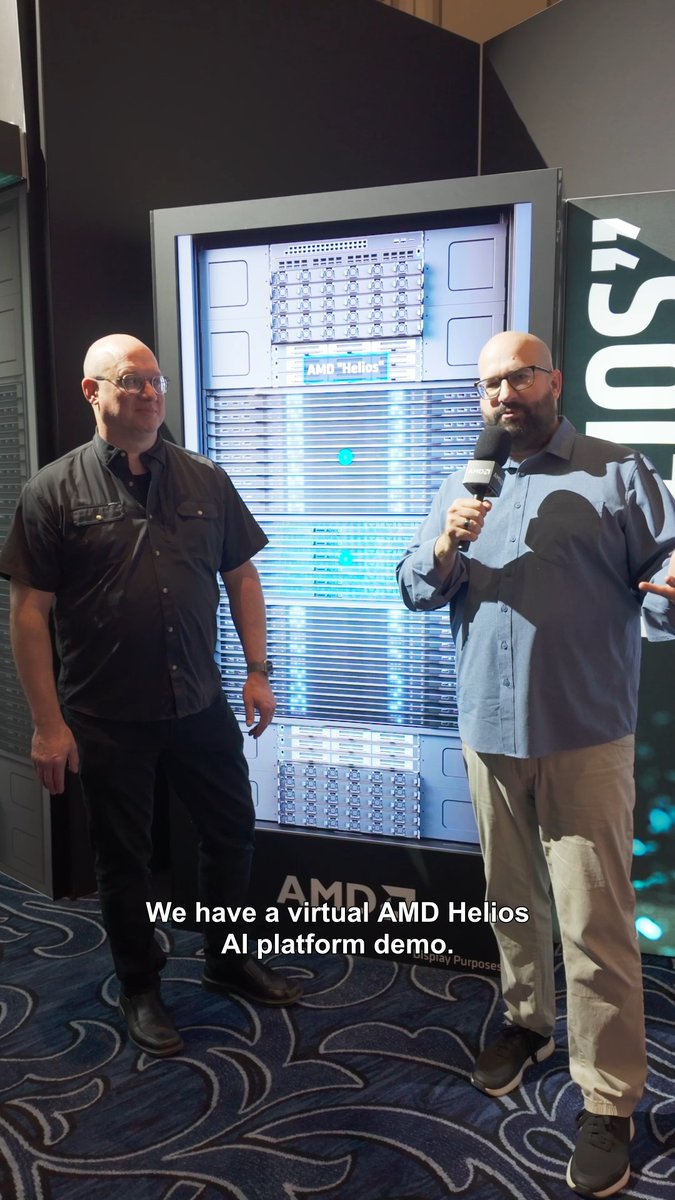
No single vendor will win the AI race, but open ecosystems might. Real velocity in AI comes from interoperability, not lock-in. And AMD just made all of its software open source. At last week’s Advancing AI 2025, we sat down with AMD’s VP of AI Software Anush Elangovan and Sharon Zhou VP of AI at AMD, to discuss their case for why an open, multi-partner ecosystem will accelerate AI innovation faster than any proprietary alternative. AMD’s announcements last week double down on this OSS focus and their commitment to AI infrastructure, including: ✅ Open Source Ecosystem: ROCm 7, AMD’s latest open-source AI software stack, introduces kernel-level improvements for GEMM operations, optimized attention mechanisms, and expanded support for distributed inference. The update brings substantial speedups for inference workloads, with average performance increases of 3.2x to 3.8x ✅ Hardware: New MI355X GPU delivers up to 40% more tokens per dollar vs competition & the MI350 Series has seen a 35x generational leap in AI inference performance ✅ Infrastructure Investments: Oracle just committed to zettascale (‼️) clusters with up to 131,072 MI355X GPUs and AMD showcased their new $10 billion partnership with Saudi Arabian AI firm HUMAIN to build AI infrastructure, including data centers, powered by AMD chips. ✅ Partnership Momentum: 7 out of 10 top AI companies now run production workloads on AMD Instinct accelerators (including Meta, OpenAI, Microsoft & xAI) By inviting interoperability and contribution at every layer, AMD is enabling developers to build faster, optimize deeper, and deploy with flexibility. Listen to Anush and Sharon’s Chain of Thought Podcast episode with host Conor Bronsdon in the next tweet to get all the details and a deep dive into AMD’s strategy 👇

Galileo

78,922 views • 1 year ago

Some time ago, I had the idea to port NVIDIA Physical AI stack to AMD. The motivation was to improve hardware diversity and enable world models and VLAs to run beyond a single ecosystem. We started with NVIDIA Cosmos Predict 2.5-2B. Porting wasn’t trivial: these models are deeply optimized for NVIDIA’s stack. We used this as an opportunity to apply our ROCm kernels. The results were surprising: Both encode and diffusion run faster on AMD Instinct MI300X vs. NVIDIA H200 (FA3) and we still saw significant headroom for further optimization. Quality is unchanged across modalities (validated with WorldJen) To be clear, this is no luck. We have deep experience with diffusion models and AMD GPUs. But this just gives us a good opportunity to get closer to a true hardware-to-hardware comparison, as we work with less software abstractions than usual. Just to give an example, on AMD, memory instructions are async with a hardware queue of ordered pending instructions, enabling concurrent load/store with compute without warp specialization. Bottom line: there are real architectural advantages on AMD, if you take the time to work with the hardware. Note, we did tradeoff ~20% higher memory usage, That being said, AMD has more to give to begin with :) in the coming weeks: AMD versions of Cosmos Transfer and GR00T, an even faster version of Cosmos Predict, and open-sourcing an attention kernel faster than AITER v3 (which is closed-source for some reason? cc: Anush Elangovan )

Omer Shlomovits

36,620 views • 3 months ago