Video yükleniyor...

Video Yüklenemedi

Ana Sayfaya Dön

Russian young guy used free source Claude Code and Open Claw and turned $13 into $195,000 in one month He is from a small town near Moscow He had no starting capital He just used free tools When limits appeared on his account he simply created new ones and...

57,519 görüntüleme • 4 ay önce •via X (Twitter)

0 Yorum

Yorum bulunmuyor

Orijinal gönderinin yorumları burada görünecek

Benzer Videolar

This trader fooled EVERYONE... And turned $0.10 into $280,260 in ONE DAY. Everyone was flexing their bot dashboards. Meanwhile this guy quietly farmed them: • 41 trades • near 100% Win Rate And he didn’t even predict anything. He hunted liquidity. Here’s what he understood that most don’t: Bots dominate Polymarket during dead hours. Late nights. Weekends. Low volume windows. Books get thin, but models stay active. Human oversight disappears. That’s when small capital can distort price massively. So what did he do? You probably already guessed. He didn’t chase direction. He nudged price. Push a contract slightly off balance so bots recalibrate mechanically. They start selling or buying based on their spread logic, not context. They see deviation. They respond automatically. He forces them into bad fills. Then, once price is stretched far from real probability, he accumulates size the other way. No rush. No panic. When liquidity returns and price normalizes? He just exits. Not because of news. Not because of edge in outcome. Because structure snapped back. This isn’t prophecy trading. It’s understanding how automated systems behave when liquidity is stressed. Most people think Polymarket profits come from being right. Wrong. Big money flows to whoever understands: • when bots are dominant • when books are fragile • when models overreact He didn’t beat the market. He beat the bots and took their profit. He made the market overreact and sold it back to itself. His profile: Absolute cinema, right? Leaving a full copy trading guide in the attached quote.

Oracle Boar

51,827 görüntüleme • 5 ay önce

Chinese student used AI from Anthropic to turn $1,000 into $1,500,000 He studies at Tsinghua University in Beijing. His account is k9Q2m In such a young age he already make a million simply knowing the right formulas and being able to use Claude Result: $1,430 → $1,550,750 44,364 trades Win rate 100% The biggest win $23,600 on a single bet k9Q2m profile: How it bots work: The bot runs 6 formulas hedge funds use simultaneously, every tick. Most traders guess. This bot calculates. Formula 1 - LMSR Pricing Polymarket prices move on a logarithmic curve. The bot knows the exact price impact before entering. Market says 31¢ for BTC up in 5 minutes. The model sees the curve is mispriced. The bot enters before the correction. Formula 2 - Kelly Criterion Renaissance Capital uses it. Two Sigma uses it. Now your bot uses it. Every bet is sized exactly right. Never too big to blow the account. Never too small to matter. $1,000 bankroll. Consistent edge. Kelly compounds it into something real. Formula 3 - EV Gap Detection The bot scans every BTC market looking for one thing: - Where is the market price wrong by more than 5%? - Market says 30¢. Real probability is 55¢. EV = +0.52. The bot enters. Most people never see this gap. The bot never misses it. Formula 4 - KL-Divergence BTC 5-minute and 15-minute markets are correlated. When they drift apart - that's an arb. The bot measures the statistical distance between them every second. When it crosses 0.2, it flags the trade. This is how hedge funds extracted $100K+ on correlated election markets. The same logic runs here. Formula 5 - Bayesian Updates New block confirmed. Volume spike. Price movement. The bot doesn't ignore signals - it updates. Prior probability was 54%. New data comes in. Posterior jumps to 71%. The bot re-prices in real time while the market is still asleep. Formula 6 - Stoikov Execution Entering at the wrong moment kills the edge. The bot calculates the reservation price-the exact point where the risk-adjusted entry makes sense. It doesn't chase. It doesn't panic. It waits for the right tick, then fills What this means in practice: - Every few seconds the bot runs all six formulas in parallel. - If LMSR confirms mispricing - EV gap is above 5% - Kelly says the bet size is justified - Bayesian posterior agrees - KL-divergence flags the correlated drift - Stoikov clears the execution price Only then does the bot enter. Six filters. One trade. This isn't a trading bot. It's a hedge fund strategy running on a prediction market. The edge is real. The math is public. The difference is most people never build it. Just insert all these formulas into Claude and create your own bot Add this post to bookmarks so you don’t lose it Soon I will publish another bot with working formulas

AdiiX

717,823 görüntüleme • 4 ay önce

Anthropic engineer stops me in a hallway at a conference and points at my screen. "Are you the one running the Polymarket bot on Claude Code?" I say maybe. He looks back at the terminal. "This thing is live?" Yeah. He laughs. "We built Claude to write code. You people immediately turned it into a market animal." I ask what gave it away. "The layout," he says. "Official CLI on one side. Orderbook on the other. You’re not paper trading." He was right. I show him the stack. - official CLI. Rust. Scanning markets, placing orders, no UI tax. Claude Code on top of it. No giant infra. No team. Just prompts, a terminal, and a model that’s better at reading weird edge cases than most interns. "What’s the loop," he asks. "Short horizon only," I tell him. "Scan for contracts under 48h. Pull structure. Look for mispriced panic. Feed the market state to Claude. Let it decide if the crowd is overreacting or just early." "And execution?" "Three commands and the order is live." He nods. Profile bot: "That’s the part people miss. Everyone thinks the alpha is the model. The alpha is the model plus an execution path short enough that you don’t talk yourself out of the fill." A market flips while we’re standing there. +118. He sees it print. "Jesus." I keep going. "Most people use Claude Code to save time writing wrappers. Fine. But the real trick is that it reads messy market context better than brittle rule systems. News fragments. weird phrasing. half-broken incentives. Retail panic. You can feel the model noticing when the tape smells wrong." He smiles at that. "So what’s the cost." "$25 a month." He laughs again. "We spend more than that on lunch." Copytrade here: I show him the numbers. 214 trades. 74% win rate. +$9,437 in 19 days. He goes quiet for a second. "OpenAI people will say use Codex. Quant guys will say build a proper system. Old traders will say this isn’t robust." I shrug. "It placed the order." That’s when he gives me the line I kept. "Anthropic made Claude. GitHub did the rest." Then he taps the CLI window one more time. "Keep it ugly," he says. "The second you wrap this in a beautiful dashboard, someone upstairs will understand how little infrastructure the edge actually needed."

Lunar

19,355 görüntüleme • 2 ay önce

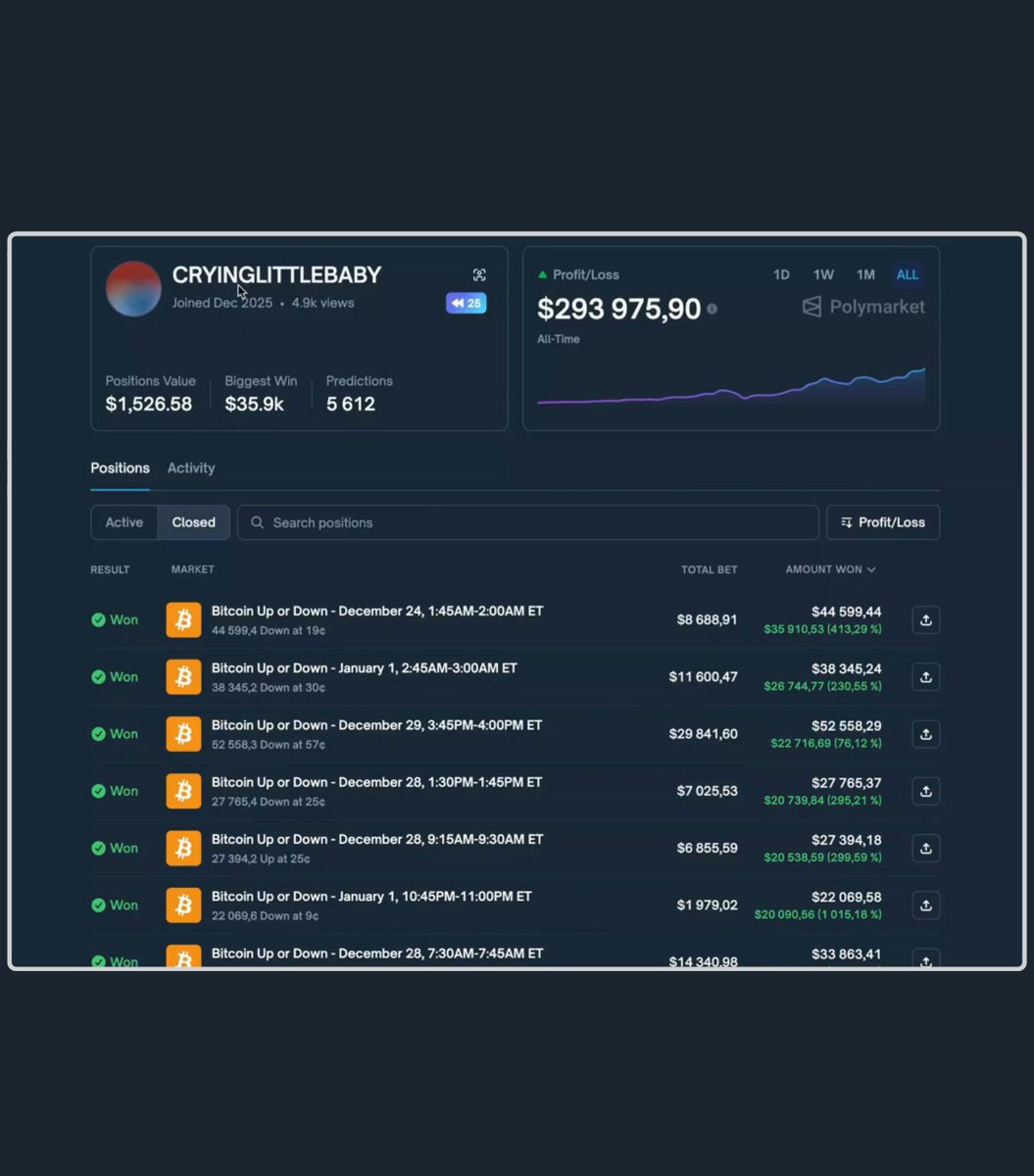
Polymarket just got mathematically robbed. Top 0.04% already took 70% of all the money ($3.7B) thanks to 4 formulas from this article below. Open the leaderboard and there he is. [0x8dxd]: $2,285,751 ALL-TIME profit. Joined Dec 2025. $41.2K biggest win. 31,570 predictions. Not luck. Not "feeling the market". This is a bot running strictly on Lunar’s formulas on autopilot: Formula 1 - Expected Value (When to Enter) Contract at 40¢, but your real probability assessment is 60% -> +20¢ edge per dollar. Claude calculates this in seconds. Formula 2 - Kelly Criterion (How Much to Bet) f = (p·b − q)/b* (Quarter Kelly - that's why he doesn't blow up and compounds without any emotion) Formula 3 - Bayesian Updating (How to Change Your Mind) P(H|E) = [P(E|H) × P(H)] / P(E) Instantly rebuilds probability on any news. Formula 4 - Log Returns (Real Profit Calculation) Regular arithmetic lies. Only log returns show the real picture. Scans 50+ markets at once, enters only 15-min BTC Up/Down with real edge (where [0x8dxd] prints +157%, +207%, +181%), sleeps the rest of the time. 87% of wallets are in the red. A few such bots take everything. And this guy didn't just write an article - he handed out the blueprint that's already working for [0x8dxd]. Don't want to code it yourself? Just copy this trader with You can runs exactly this system: the same 4 formulas + Claude + auto-copying top math. Add his wallet: 0x63ce342161250d705dc0b16df89036c8e5f9ba9a to [ and start track/copy him right now. 4 formulas from Wikipedia + Claude brain + Kreo execution = meta 2026. The math doesn't sleep. Your FOMO does. Save and use this.

slash1s

20,164 görüntüleme • 4 ay önce

This Chinese developer linked two $2,999 NVIDIA DGX Sparks into one box and runs the full Qwen3-235B at home, after dropping his $1,999-a-month cloud bill to zero. He wired 2 small boxes into a single computer, split a giant 235-billion-parameter model in half between them, and serves it across his own network at about 10 tokens a second, with no internet, no cloud, right there on the desk. No data center, no thousand-dollar graphics cards, no monthly cloud bill. Just him, 2 gold boxes the size of a sandwich, one cable between them, and 1 power strip. And here is the whole payoff. He used to pay the cloud $1,999 a month for the same model, and the meter ticked on every request. Now he paid $5,998 once for 2 boxes, they covered their cost in 3 months, and after that he sends as many requests as he wants for free, only electricity. The two Sparks talk over one fast cable, each holds 128GB of memory, and together they carry the whole model, about 73GB loaded per box, with the chip inside pinned near the limit at 96%. Both boxes work as one and keep trading data over the cable, with no cloud in the loop and no single word leaking out. The ready model sits on one local address, and any app on his network calls it as easily as ChatGPT. And here is how he described, in plain words, what this pair of boxes does: "this is a pair of boxes that holds the huge Qwen3-235B model and serves it to one network. the model is split in half, and each box owns its half. parts: // Box 1 (holds the first half of the model and starts the answer fast, the first word appears in under a second) // Box 2 (holds the second half and writes out the rest, about 10 tokens a second) // Cable (connects the 2 boxes and moves data between them on every step, with no lag) // Address (one local address where any app sends its request, like to a cloud model) // Test (a script that runs big prompts through and measures speed and delays) // Monitor (checks temperature, power draw, and load on both boxes every 2 seconds). the model never goes to the cloud. he only steps in when a box runs hotter than 80 degrees or the cable between them starts dropping data." So the system knows exactly what it is, what it is for, and where its limits are. It knows it has to hold the whole huge model across 2 boxes on its own. It knows it has to answer every request locally, with no meter, no limits, and no internet. It knows the human is only needed when a box overheats or the link between them stalls. → The setup runs around the clock on 2 boxes, each pulling under 60 watts → However many requests he sends, the monthly bill is $0, only electricity → The first box starts the answer in under a second → The second writes text at about 10 tokens a second → One request at a time: 838 tokens in 85 seconds, first word in 0.8s → Two requests at once: 697 tokens in 108 seconds, first word in 0.7s → Both boxes sit at 96% load and warm up to 76-78 degrees And only when a chip in a box runs hotter than 80 degrees or the cable between the 2 Sparks drops data does the system call the owner. And when he himself is out on a run or in a coffee shop, he still reaches his own model at home from his phone: sends a big prompt to the local Qwen3-235B, gets the full answer back in under a minute and a half, with no token meter ticking and no limit to hit. Here is what the test shows on his screen during one of the night runs: "one request at a time: 838 tokens in 84.9 seconds, first word in 0.8s, then 0.1s per token." "two requests at once: 697 tokens in 107.6 seconds, first word in 0.7s, then 0.15s per token." "Box 1: chip at 96% load, 76 degrees, 56 watts, 73GB used in memory." "Box 2: chip at 96% load, 78 degrees, 56 watts, the Qwen3-235B model fully loaded." And while everyone around is paying for AI by the month and bumping into limits, his top-tier model just sits on the desk and works as much as he wants: his own little power plant instead of a forever meter. He has no server rack of his own and no cloud account behind it. Just 2 DGX Spark boxes on a desk, one model split in half between them, one local address, and a folder of prompts next to it. Out of everything I have seen this year, this is the cleanest way to stop paying for AI: $5,998 of hardware on the desk once, $0 a month to the cloud, unlimited forever, and between them 2 gold boxes, 1 cable, and the full Qwen3-235B answering at home with no internet.

Blaze

93,219 görüntüleme • 1 ay önce

Claude and a free weather API will earn you $100k+. Success rate for beginners: 80%. Complete guide and algorithm for building Polymarket weather trading bot. Simple logic, a low entry budget and high ROI -that’s why weather bots are so clean. Onchain proof these bots exist: 1st bot: 2nd bot: I verified their profitability by myself copying every trade - each bot's win rate over time ranges from 80 to 90%. I grew my starting capital by +40% in just one week. You can copy their trades and see for yourself in two clicks through this bot: The alpha is simple: you're not trading weather. You're trading other people's ignorance. Gap between what the crowd prices and what 51 ensemble models say. Polymarket asks: "Will Atlanta hit 95°F tomorrow?" Normies bet on vibes. You bet on math. The core tool: Open-Meteo API. Free. No key needed. 51-model ensemble. Clean JSON. Cooked and ready. Update every 30 min. Hardcode your city coordinates - don't waste time on geocoding at runtime. This single endpoint beats most paid tools for what Polymarket actually needs. The edge in one sentence: Market is heavy on 16°C. Your 51-model ensemble points at 19°C. That's your trade. Find that gap systematically across every city market, every day - and you have a scanner. That's what separates consistent traders from gamblers. How to start: - Week 1: Open-Meteo + tropicaltidbits. Pick one city market. Track model vs market price daily. Don't trade yet — just watch where you'd have been right. - Weeks 2–3: Automate the pull. Log ensemble divergences. Build the scanner. - Week 4: Now you have an edge. Trade it. Most people want to skip to week 4. That's exactly why most people lose. Now you have the algorithm framework plus a complete guide to get started. All that's left is to actually do it. Bookmark this post so you can come back to it when you start building the bot.

cvxv666

50,509 görüntüleme • 3 ay önce

THIS WALLET STACKED $230K ON BTC UP/DOWN BETS. THE BLUEPRINT TO AUTOMATE THE SAME EDGE WITH CLAUDE The wallet is $230K all-time, every position a Bitcoin or Ethereum Up or Down market It never guesses direction. It enters only when the math and the market disagree THE STRATEGY: BTC moves are not fully random. When the market enters a committed directional state, continuation is measurable. That is Markov persistence Entry signal: > Δ = p̂ − q ≥ ε Model probability minus market price. Enter only on a 5% gap or more Persistence filter: > p(j*,j*) ≥ 0.87 Only trade states with 0.87 persistence or higher. Below that, skip. This is what holds the win rate above 65% with zero directional guessing Payout: > r = (1 − q) / q At q = 0.647 that is +54.5% a win. At q = 0.441, +126.7%. Lower entry price, bigger asymmetry Sizing: > f* = p − (1−p)/b Kelly. At p = 0.87, b = 0.647, f* ≈ 0.71. Size to the edge, never to gut HOW TO BUILD IT WITH CLAUDE: What separates this from a static bot: Claude reads its own trade journal every night and rewrites its own thresholds 1. Take an open-source Polymarket bot repo as your base logic. Feed it to Claude and have it migrate to CLOB v2: py_clob_client_v2, Safe wallet support, fee-aware evaluation 2. Hard-code the filters. Enter only when Δ ≥ 0.05 and p(j*,j*) ≥ 0.87. Apply Kelly on every fill. 3. Run DRY_RUN first. Log every signal, entry price, Markov state, and simulated P/L. No real money until the numbers hold for days 4. The nightly loop. Claude reads the journal, finds which persistence states actually won, adjusts MIN_PROB and MIN_EDGE, ships tomorrow's rules. The agent is sharper after 50 to 100 trades THE SETUP: Claude Opus as the brain. An open-source repo as the starting logic. A Polygon wallet with $50 to $100. Telegram for the morning report Start at $1 to $2 per trade while it learns. Scale only when the dry runs and the live fills line up 17,000 trades compound a thin edge into six figures. The model finds the edge. The nightly loop keeps it sharp Bookmark before you point a bot at your first window

Yarchi

22,966 görüntüleme • 2 ay önce

An ex-OpenAI engineer walked up to me at a meetup in SF I was showing my Polymarket terminal. He looked at the screen for ten seconds and said one sentence. "You're trading blind. The data is sitting in the open and you're writing prompts" I didn't understand. What data. He took my laptop. Opened one repository. 86 million trades. Every wallet. Every entry. Every exit. The entire Polymarket history since day one. "At OpenAI models don't guess. They read. Connect Claude Code to this dataset and say - find every wallet with a win rate above 70% and more than 100 trades" I asked - why Claude and not GPT? He looked at me like I was an idiot. "Because Claude Code connects to the repo directly. It reads the entire codebase. It's not a chatbox. It's a runtime" That evening I connected it. Claude pulled 47 wallets in 4 minutes. Average profit: $214K. Hold time: 7 hours. 91% close their position BEFORE resolution. Top wallets capture 86% of the move and cut losers at 12%. Everyone else - 58% of profit and hold losers to 41%. Same exact entries. The exits make it a completely different game. "Now connect the scanner" Three commands - the bot sees 500+ markets in real time. No API key. Read-only. Claude built the scoring in 20 minutes: Gap between price and model > 7 cents. Book depth > $500. Resolution in 4-48 hours. 93% of markets get killed instantly. Only the fat ones survive. "Now this is the important part" - he sent me an article where a guy built a full bot over a weekend from these same repos Copytrade here: Three exit triggers: Target 85% of expected move. Volume spike x3 - smart money leaving. 24 hours of silence - thesis is dead. I copied the whole stack. VPS $5. Claude $20. Total $25 a month. No team. No office. No Bloomberg. 16 days. 187 trades. 71% win rate. $800 seed. +$8,700. I sent him my screen. He replied a day later. "You just replicated for $25 what cost us six months and 11 people" I said - thanks for the tip. "Delete this chat" Too late.

Lunar

480,799 görüntüleme • 3 ay önce

Dario Amodei was asked whether open source will eventually gut Anthropic's business. He didn't defend the moat. He didn't argue closed beats open. He said the whole question is a red herring. That is the reframe. And it flips how the industry keeps scoring this race. The conventional narrative is inherited from the last era of tech: open source wins because anyone can read the code, anyone improves it, contributions stack, and eventually the free thing catches the paid thing. Investors have a full lexicon for it. Commoditization. Which layer captures the value. Everyone repeats it. Amodei says the analogy breaks at the root. It's called open weights, not open source, for a reason: you can't see inside the model. So the thing that actually made open source powerful elsewhere, many people reading and additively improving shared code, never transfers. You just get a large file of numbers. Now here's where it gets interesting. The second engine isn't ideology. It's infrastructure. Free isn't free. Someone still has to host it. These are big models, and they're hard to run inference on. Someone has to make that fast. And the capabilities people assume only open weights unlock fine tuning, steering, inspecting activations labs are increasingly serving on their own clouds anyway. When DeepSeek shipped, he says he never asked whether it was open. He asked one thing: is it a good model, and is it better than us. That's the only axis he competes on. He even inverts the usual edge. Coming from outside that investor lexicon, he thinks knowing none of it lets him predict this better than the people fluent in it. He is not defending closed models. He is saying the scoreboard everyone is watching measures the wrong thing. The uncomfortable question if the free model still needs someone to run it, was the moat ever the weights, or always the machine underneath ?

Vikram M

58,688 görüntüleme • 11 gün önce