Loading video...

Video Failed to Load

Go Home

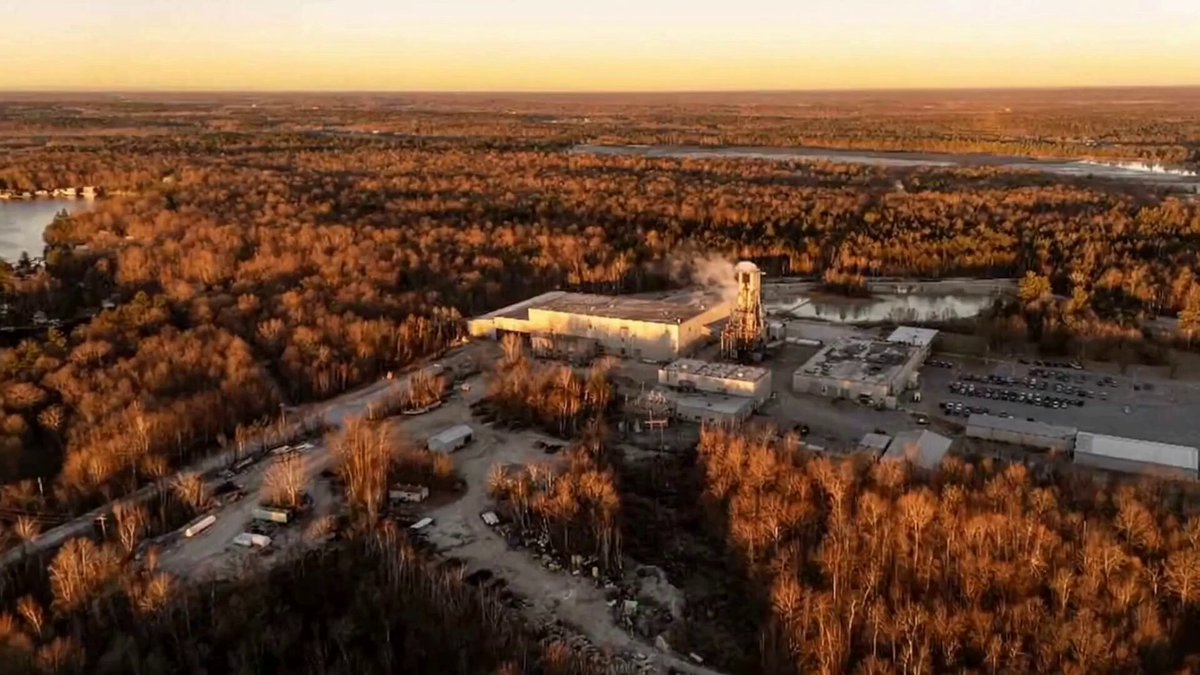
September 2025 update from #PolarisForge1 ⚡ Building 1 (100 MW): Final commissioning underway — first 50 MW IT turnover in progress. 🏗️ Building 2 (150 MW): Underground MEP advancing as precast races to cover the footprint. Steady steps toward delivery. $APLD

14,765 views • 1 year ago •via X (Twitter)

0 Comments

No comments available

Comments from the original post will appear here

Related Videos

$IREN BELOW $100 is STEAL !!! ✅ Chamath recently said that building 1 GW of AI data center capacity today can cost around $100 billion. Whether the number ends up being $80B, $100B, or somewhere in between isn’t the main takeaway. The takeaway is this: Power-ready AI infrastructure has become one of the most valuable assets on the planet. Now look at what IREN already controls: Sweetwater, Texas — 2.0 GW Childress, Texas — 750 MW Oklahoma — 1.6 GW South Australia — 800 MW Spain (Nostrum) — 490 MW Prince George, Mackenzie & Canal Flats — Existing AI cloud infrastructure Total portfolio: 5.8 GW of secured power capacity. What excites me most is what should be energized by 2026: ⚡ Sweetwater Phase 1 (~1.4 GW) ⚡ Childress (750 MW) ⚡ Prince George & Mackenzie continuing to scale AI cloud operations That’s already ~2.1+ GW of energized AI infrastructure either operating or coming online. Using Chamath’s framework: 2 GW = ~$200 billion of replacement value Yet IREN trades around a $18-20 billion market cap Even if Chamath is off by 50%, you’re still looking at a valuation gap that is hard to ignore. The market is pricing IREN like a miner. The bull case is that it’s becoming a large-scale AI infrastructure platform. By math alone, if ~2 GW is energized and available for AI workloads by 2026, a $100B+ market cap doesn’t seem crazy. That would imply a stock price potentially in the $150-$250 range, based solely on the value of the energized AI infrastructure—not even giving full credit to the remaining 3.7+ GW in the portfolio. 🤯🤯🤯 This is why I believe the market is dramatically underestimating what IREN is building. ✅ Gigawatts of power ✅ Strategic land positions ✅ Grid access ✅ Permits & approvals ✅ AI-ready infrastructure

investing

79,876 views • 3 months ago

🚨ALERT: 50% of Data Centers will NEVER connect to the grid. Half of the data centers announced in the last 24 months will NEVER connect to the grid. Kevin O’Leary said it. The data proves it. While everyone’s chasing “paper capacity,” $CIFR and $IREN are sitting on EXECUTED grid connections that can’t be replicated. Here’s why they’re untouchable: 266 GW of power projects canceled in 2025 alone. That’s 2.4x the cancellations from 2024. Why? Because the U.S. grid is facing a structural deficit that nobody wants to talk about. • Data centers need 18-36 months to build • Grid connections take 5-7 YEARS (sometimes 12) • Interconnection queues in PJM and ERCOT now average 7 years • Average interconnection cost in MISO: $753,116 per MW Translation: You can announce a data center tomorrow. But you CAN’T connect it to power until 2032. The math doesn’t work. The timeline doesn’t work. The physics don’t work. $CIFR - The Fixed-Price Power Moat: Cipher control one of the lowest-cost power portfolios in North America. > Power cost: $0.027/kWh (fixed, long-term PPAs) > Debt: $0 > Portfolio: 2.2 GW across Texas But here’s what everyone’s missing: Their 1-gigawatt Colchis site has a FULLY EXECUTED Direct Connect Agreement with American Electric Power. Not “in the queue.” Not “under study.” EXECUTED. Energization: 2028. While competitors are stuck waiting 7+ years for interconnection approvals, $CIFR already has a Tier 1 grid connection locked in. And they just signed: • $5.5 billion, 15-year lease with AWS for 300 MW • 10-year hosting deal with Google/Fluidstack for 168 MW That’s $8.5 billion in contracted lease payments for AI infrastructure. $IREN - The Microsoft Validation: $IREN didn’t just secure power. They secured the ONLY thing that matters: a hyperscaler willing to pre-pay billions. November 2025: $9.7 billion AI Cloud contract with Microsoft. Let me repeat that. Microsoft PRE-PAID for capacity that doesn’t exist yet. Deal structure: • 200 MW of liquid-cooled AI capacity • $1.94 billion annual recurring revenue (once online) • 20% prepayment to fund $5.8 billion GPU purchase from Dell • Four “Horizon” data centers at their 750 MW Childress campus But the real alpha? Their 2.91 GW portfolio of GRID-CONNECTED power. Not speculative. Not “in the queue.” Connected. Energized. Operating. > Sweetwater 1: 1.4 GW (energization accelerated to April 26) > Childress: 750 MW (operating) > Prince George: 160 MW hydro (23k GPUs for AI) $IREN is scaling to $3.4 billion in AI Cloud ARR by end of 2026 using only 16% of their total power capacity. The Peer Comparison Nobody’s Talking About: Everyone’s excited about $RIOT, $MARA, $CORZ, and $WULF. Here’s the problem: $RIOT: 1.7 GW portfolio, mostly Bitcoin-focused. 25 MW HPC lease with AMD ($311M over 10 years). That’s 1/30th the size of IREN’s Microsoft deal. $MARA: Building “behind-the-meter” natural gas generation to BYPASS the grid entirely. Smart strategy, but they’re starting from scratch. 1.8 GW capacity, mostly mining. $CORZ: $10B+ contract with CoreWeave sounds massive. But they’re CONVERTING old mining infrastructure. Not purpose-built for AI. Currently unprofitable. $WULF: 750 MW at Lake Mariner. Zero-carbon hydro/nuclear. Clean energy story is strong. But only 72.5 MW of HPC capacity by Q2 2025. Meanwhile: • $CIFR has 2.2 GW with executed grid agreements and $8.5B in hyperscaler contracts • $IREN has 2.91 GW of energized capacity and a $9.7B Microsoft deal The Cooling Bottleneck: Secured power means NOTHING without secured cooling. November 2025: CyrusOne data center in Illinois went down for 10 hours because ONE chiller failed. This facility handles TRILLIONS in CME trading volume. Energy, agriculture, crypto derivatives markets frozen globally. Why? Because AI racks now consume 600 kW of power (enough to power 500 homes). A single rack failure creates catastrophic heat buildup. $IREN’s solution: Liquid-cooled infrastructure at all Horizon facilities. $CIFR’s solution: Turnkey air-and-liquid cooling delivery for AWS. Hyperscalers aren’t paying billions for “power connections.” They’re paying for THERMAL RELIABILITY. The Numbers That Matter: > PJM capacity prices: 10x increase from 2024 to 2025 (extreme scarcity signal) > Interconnection costs in Louisiana/Missouri: $900,000+ per MW > $64 billion in U.S. data center projects blocked or delayed in 2024-2025 > 25+ major data center projects canceled in 2025 alone The grid is saturated. The timeline is broken. The infrastructure doesn’t exist. But $CIFR and $IREN? They already own the infrastructure. They already have the grid connections. They already have the hyperscaler contracts. The Bottom Line: > AI demand is doubling every 90 days. > Grid capacity takes 5-7 years to build. > You can’t close that gap with announcements. You close it with EXECUTED agreements and ENERGIZED megawatts. $CIFR: $0.027/kWh power, $8.5B in contracts, 1 GW Tier 1 grid connection $IREN: $9.7B Microsoft deal, 2.91 GW energized portfolio, $3.4B ARR target by 2026. While half the industry fights over interconnection queues, these two are already plugged in. The power crunch isn’t coming. It’s here. And the only winners will be the ones who secured their megawatts BEFORE the grid broke. Bullish $CIFR and $IREN. Note: This is NOT financial advice.

Black Panther Capital

347,910 views • 7 months ago

Elon is a genius and there's no other way to explain what he built. The bears biggest argument against SpaceX's $1.75–2 trillion IPO valuation has always been the orbital data center play. Space based compute is unproven, technically complex, and expensive at a scale that defies easy modeling. SpaceX's own S-1 acknowledged it directly that these data centers may not achieve commercial viability. Critics were right to flag it as speculative but what they missed was that Elon was already building the hedge. While the debate about orbital compute was still theoretical, he was assembling the largest terrestrial AI infrastructure footprint on Earth. Colossus 1, now leased to Anthropic houses 230,000+ GPUs at 500 MW. Colossus 2 (Macro-Hard) runs 550,000 Blackwell GPUs targeting over 1 gigawatt enough to power roughly 750,000 American homes. The third facility, Macro-Harder, adds another ~500 MW of capacity across 810,000 square feet in Southaven, Mississippi, pushing the total campus toward 2 gigawatts and over 1 million GPUs. He secured all of this, the land, the power contracts, the chips before the rest of the market understood that power and compute would become the single most constrained resource in the AI economy. Now that constraint is everywhere and he owns the supply. Starlink is already generating $11.4 billion in annual revenue with 63% EBITDA margins and 10 million+ subscribers. The company is projecting $20 billion in total revenue across the combined entity in 2026 and that existing cash engine now funds the entire AI buildout and the Anthropic compute deal alone is estimated to generate an incremental $4–5 billion in revenue this year. The orbital data center bet may still pay off on top of all of this. But it doesn't have to, the terrestrial capacity alone, at current utilization rates, subsidizes Grok training, generates hyperscaler revenue, and floors the SpaceX valuation story against every bear case scenario. Elon didn't just build rockets but rather he built the infrastructure layer that the entire AI industry now depends on and then started selling access to the people who need it most. Go PRO at Milk Road to see how our analysts are positioning for what could become the trade of a lifetime, the SpaceX IPO and the AI infrastructure supercycle. Link below!

Milk Road AI

63,920 views • 4 months ago

TESLA CRYSTAL SUN: Fort Bend County, TX - September 20th, 2026 It was a sunny day with a few scattered clouds on Sunday, so I drove over to Fort Bend County and flew over the proposed Crystal Sun Solar Factory site, and then the brand new Ørsted Old 300 Megapack site. Both are within a 10 minute drive of each. The video is in 2 parts and here is some info on the two sites. ***I need your support now more than ever. Please subscribe and support the flyovers and the EC. As always, I have attached a Subscriber Photo-Thread.*** PART 1: CRYSTAL SUN Tesla’s Project Crystal Sun is a proposed $10.1 billion solar cell and module factory in Fort Bend County, Texas, off FM 762 and FM 1994 near Richmond, on about 3,050 acres inside Lamar CISD. The plant would make cells and modules in-house (ingot through module). Construction is targeted 2026–2028, with production Q1 2029. Filing lists 1,147 construction jobs and 9,712 permanent jobs by 2033. Tesla filed for JETI tax incentives July 22nd, and say it is still choosing between this site and another U.S. location. Lamar CISD voted 7-0 on September 15th to approve a 10-year school tax limitation. State JETI approval is still pending. PART II: ØRSTED OLD 300 TESLA MEGAPACK SITE This Battery Energy Storage System (BESS) is located 10 minutes southeast of Crystal Sun in nearby Needville. The published project rating is 250 MW / 500 MWh. I count 166 Megapacks which would be closer to 315 MW / 639 MWh. It reached commercial operations on August 5th, 2026, and is fully connected to the ERCOT grid. The site sits next to Ørsted’s 430 MW Old 300 Solar farm. The solar plant started operating in October 2024, uses bifacial single-axis tracking panels, and generates enough electricity for roughly 80,000 Texas homes and businesses. Microsoft holds a 2021 power purchase agreement for the solar output. The Megapacks and solar farm share the site but run independently. The Megapacks can charge from or discharge to the wider ERCOT grid, not only from the adjacent solar array.

S.E. Robinson, Jr.

14,991 views • 11 days ago

Today, we laid the physics foundation for our ARC fusion power plant. ⚛️ With 5 deeply researched papers — validated by independent peer review and published in the Journal of Plasma Physics — we’ve shown we've nailed the scientific basics of producing copious amounts of fusion power. The collective assessment from our 58 co-authors? This machine will work. No scientific breakthroughs are required to bring this clean, secure, abundant source of energy to the grid. Here is how we're handling fusion's biggest challenges: ⚡ Powering the Grid: Using extremely strong magnets, ARC will confine the plasma long enough to generate 1.1 GW of fusion power. We'll convert that into 400 MW of continuous net electricity — enough to power ~280,000 average American homes. 🛡️ Handling Heat Exhaust: To control a superhot, unruly cloud of charged particles, we're utilizing proven methods to safely handle the heat exhaust that acts as a key practical constraint for tokamaks. ✅ Managing Disruptions: We aren't trying to build an operationally perfect machine. We are pragmatically designing ARC to safely handle disruptions and keep the plasma stable for top performance. 🏗️ Proving the Approach: We're building on decades of tokamak research and supercomputer simulations. And we're proving our approach right now with SPARC, the tokamak we are actively building in Massachusetts. With our transparency, you don’t have to take our assertions on faith. We are really pushing fusion forward.

Commonwealth Fusion Systems

11,326 views • 4 months ago

XRP Ledger is now integrated into Sl8. This is an important step in the continued expansion of Sl8 as a unified financial environment for assets across multiple blockchain networks. Users can now bring XRP directly into the Sl8 ecosystem through the XRP Ledger and manage it alongside other supported assets within the same application. XRP deposited through the network is represented in Sl8 as sgXRP, backed 1:1 by XRP, with deposit and withdrawal functionality available directly in the wallet. Our broader objective is to reduce the fragmentation that still defines much of the crypto user experience today. Moving assets between different networks often requires multiple wallets, exchanges, bridges, and additional operational steps. Sl8 is building toward a model where assets from different blockchain ecosystems can be accessed, managed, and used through a single interface. The XRP Ledger integration is one more step in that direction, and additional network integrations will follow as the infrastructure continues to expand. The attached videos demonstrate the integration in operation and the XRP transfer flow into Sl8. As an additional utility enabled by the integration, XRP is also now available for staking in Sl8. During the current event, through September 21, 2026, the following promotional terms apply: • 7 days - 18% APY • 30 days - 28% APY • 90 days - 38% APY • 180 days - 50% APY • 360 days - 62% APY For longer-term positions, rewards are compounded automatically within the stake. More details here: XRP Ledger is now live in Sl8. This is not the end point, but another building block in a broader multi-chain financial infrastructure.

Cassator Corp.

48,069 views • 25 days ago