Video wird geladen...

Video konnte nicht geladen werden

Zur Startseite

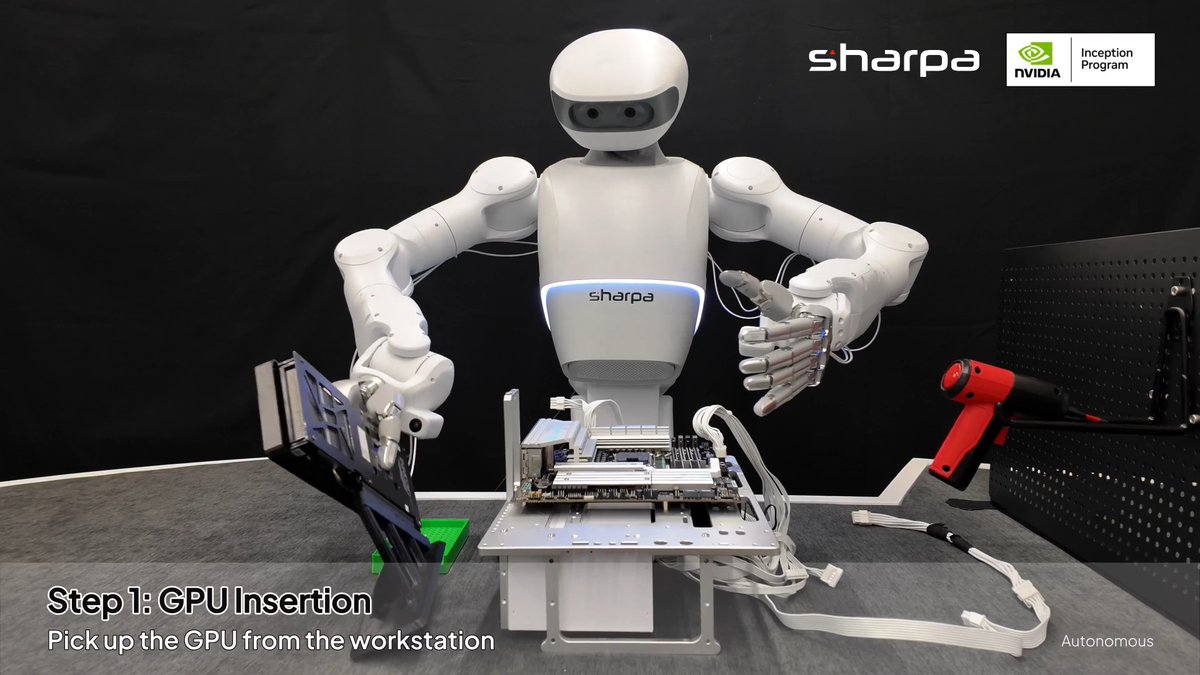
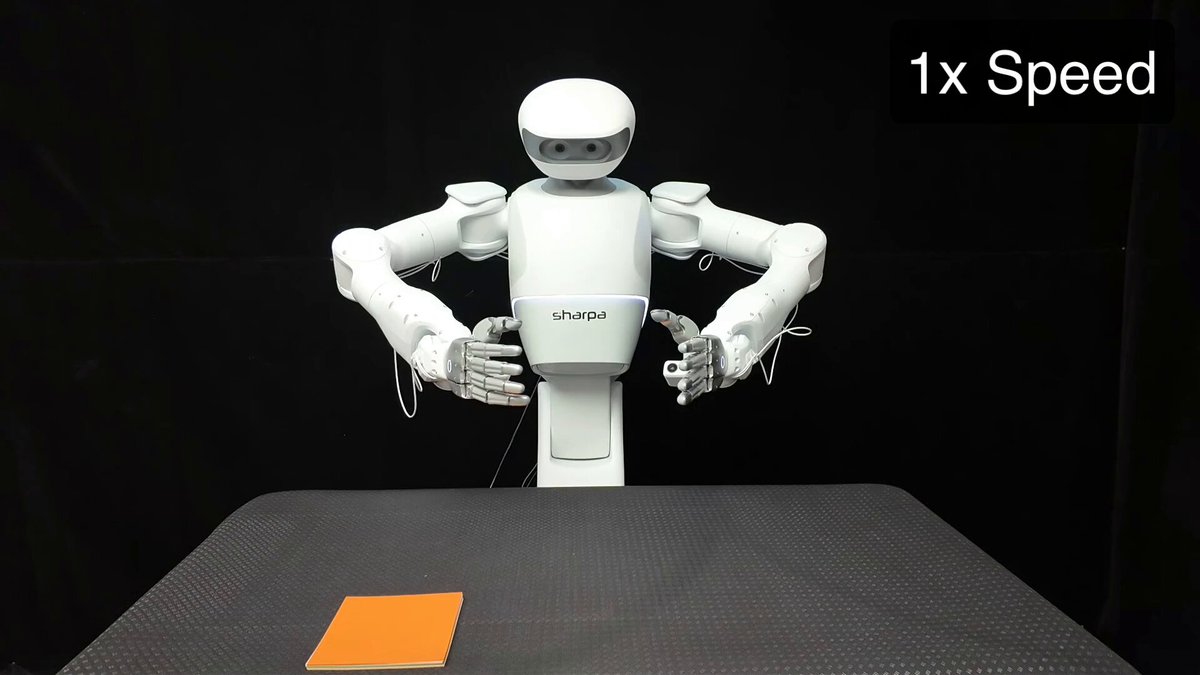
Sharpa will be co-hosting two competitions at IROS 2026. Powered by Sharpa's robot platforms and software, the 2nd ROCO and Origami challenges (cohosted by BitRobot 🦾) brought together 48 teams from leading institutions around the world—including Carnegie Mellon University, UC Berkeley, KAIST and NUS. Across both competitions, teams will...

14,795 Aufrufe • vor 1 Monat •via X (Twitter)

4 Kommentare

Profilbild von BitRobot 🦾
BitRobot 🦾vor 1 Monat

See you at IROS! 🦾🦾🦾

Profilbild von dabblerer
dabblerervor 1 Monat

@BitRobotNetwork This is amazing 🦾

Profilbild von clankr
clankrvor 1 Monat

@BitRobotNetwork Sharpa Hand showing off its dexterity as always. Looking forward to the IROS 2026 demos!

Profilbild von Muhammad Ahmed
Muhammad Ahmedvor 1 Monat

@BitRobotNetwork Origami makes "grasping" feel like too small a word. Holding, sliding, supporting and making a crease all ask for different contact behavior from the same hand. Great choice of task for a dexterity challenge.
Ähnliche Videos

NEW ROBOT BENCHMARK: If your robot can do Origami, it can do anything! Called The Robotic Origami Challenge, it is a dexterous-manipulation competition and benchmark held at IROS 2026, organized by 13 co-organizers with the Nippon Origami Association as judge and task curator -> pretty cool to have them on board imho. The evaluation consists of single task: a traditional Japanese paper airplane, in exactly six folds, from a 15×15 cm sheet of ≥60 gsm paper, on a competition-supplied standardized rig (bimanual arms + Sharpa Hands), both remotely and on-site. Teams bring policies, not hardware. An "Origami Grand Master" declares pass/fail on crease accuracy, structural fidelity, symmetry and paper integrity. Among passes, faster folds rank higher, with a 10-minute-per-attempt ceiling and flight explicitly irrelevant to the score. -> I find it interesting how they chose to evaluate the task. Quality is a binary pass or fail, therefore speed becomes the only thing graded here. Speed is currently the bottleneck in dexterous manipulation though, so this choice makes sense. I wonder whether there could be finer ways to grade the qaulity of such a creative task though. When it comes to data, registered teams get 500+ teleoperation episodes (six camera streams, 65-D joint state/action, 10-fingertip 6-axis tactile), an NVIDIA Isaac Sim environment with thin-shell paper physics (plastic creasing + fold memory), digital twins of every partner hand, and a remote eval lab (upload a policy, queue an eval, get scored). Still, I think it is a great dexterity benchmark the field badly needs, it supplies the hardware, an outside human judges, and the pass criterion is externally defined -> all three degrees of freedom are checked! Neutral measurement layer, here we go! The task is engineered to be un-gameable and to isolate pure dexterity. A known figure, exactly six folds, judged on creases, with flight explicitly declared irrelevant (the latter makes sense to me). Therefore, this underlines the goal to focus on dexterity, not task-selection or other strategies. I really like origami as an ideal controlled dexterity task: deterministic goal, deformable medium, sequential, bimanual, precision-bound. I am just not quite satisfied again by the binary pass or fail, I think quality of execution could be finely graded! But again, I understand this is not the goal yet. Also interesting to see the Sharpa Hands as de facto standard for everyone. Total land-grab that anoints Sharpa as the reference dexterous hand, also featured in Google's Gemini Robotics 2. By providing the hardware, the benchmark measures software while quietly making "good on Sharpa" the definition of good, and Sharpa gets real world data and feedback as a bonus. That's smart, the data flywheel starts spinning. The provided dataset is the richest tactile-manipulation corpus I have seen yet: 10-fingertip 6-axis tactile, plus plastic creasing and fold memory. 500+ teleop episodes with six camera streams, 65-D joint state/action, and ten fingertip 6-axis tactile sensors. The force/tactile channel are parts of the the benchmark's data, this is the first time I see this. Credits where it's due: organizers include Yang Gao, Noriaki Hirose, Steve Xie, Chris Paxton, Jiafei Duan, Michael Cho - Rbt/Acc, Michael Yuan, Haoquan Fang, and others.

Léo

29,097 Aufrufe • vor 2 Monaten