Loading video...

Video Failed to Load

Go Home

Since we’re all obsessed with clock protocol and every single second, what’s supposed to happen after a first down in the final two minutes of a half? Should Michigan appeal for the nearly two seconds that came off the “official” clock after JJ Buchanan's first down? Because if the...

574,782 views • 1 day ago •via X (Twitter)

0 Comments

No comments available

Comments from the original post will appear here

Related Videos

I have not seen enough about the decision from Mike Vrabel and Tim Kelly to go for 2 down by 8 last night. Here’s why I loved it: 1) NFL teams this season have been successful on 55% of two-point conversion attempts. The odds were in the Titans’ favor. 2) Will Levis was dealing in the 2nd half. 3) Titans still had all three timeouts and the two-minute warning. 4) Miami struggled to move the ball on offense all night. Their three scoring drives went for 12, 7, and 59 yards. 5) If successful on the two-point conversion, a stop on defense and a TD wins the game. If unsuccessful, you can still send it to OT. 6) Titans offense marched down the field, scored the TD to make it a one possession game and essentially told Miami, “we are going for two because we know you cannot stop us right now.” The odds are in your favor. It’s a good mathematical decision. You want to psych out an opposing offense? Give them the ball knowing they need to run the clock out, or you are going to have a chance to WIN the game, not send it to overtime. They saw what your offense just did to their defense. They saw your QB on the sideline screaming and hyping everyone up. Cutting the lead to six put WAY more pressure on the Dolphins offense. You want to hype up your defense? Put them back on the field knowing your offense just did their job. Put them back on the field knowing a stop and a TD wins it. At that point, they aren’t in the mindset of “we need a stop to have a chance to go to OT.” They are thinking, “let’s go out here, get a stop, and give our offense a chance to WIN.” There’s a fundamental difference in playing to WIN and playing NOT to LOSE. This was a decision by a coaching staff that was playing to WIN. Brilliant game by Vrabel and Kelly. Brilliant execution late in the game by the offense and the defense. Completely out-coached one of the best offensive minds in the game. #Titans

Jake!

36,853 views • 2 years ago

The largest theft in history has already happened. The people behind it just cannot open what they stole yet. Right now, intelligence agencies and criminal groups are quietly copying the world's encrypted data, bank records, medical files, state secrets, private messages, and storing every byte untouched. They cannot read any of it. They are collecting it anyway, because they know the key is about to be invented. The strategy has a name, harvest now, decrypt later, and in 2026 it stopped being theory. Washington declared this the Year of Quantum Security in January, backed by the FBI, the NSA, and NIST. Canada ordered every federal agency to file a migration plan by April. Europe set its deadline for December. Governments do not impose operational deadlines on a someday problem. They do it when the clock is already running. Here is what moved the clock. Every password, every transfer, every secret on Earth is protected by one assumption, that a certain math problem is too hard to solve. Quantum computers solve exactly that problem. For years the machine that could do it looked decades away. Then in late 2025 Google's Willow chip cracked the hardest part of building one, and in March 2026 Google's own researchers estimated that breaking the encryption behind Bitcoin might take fewer than 500,000 qubits, down from 20 million, and could run in minutes. The day this becomes real has a name, Q-Day, and the latest estimates place it between 2030 and 2033. Now make it concrete. Roughly 6.5 million Bitcoin, about a third of every coin that will ever exist, worth close to 500 billion dollars, sit in addresses that have already exposed the very key a quantum computer needs. That includes the coins of Satoshi, the anonymous creator. On Q-Day they become, in the researchers' own word, trivially stealable. It would not look like a crash or a whale selling. It would look like half a trillion dollars of the most secure money ever built simply walking out the door. The asset designed to trust no one and no institution turns out to rest on a single unverified bet, that one math problem stays hard forever. This is what sits beneath the entire digital world. A bank balance, a Bitcoin, a classified cable, all of it is real only because of a proof you supposedly cannot forge. Quantum breaks the proof. Everything we call secure is true only until someone finally checks, and for the first time the check is visible on the horizon. You cannot know whether your data has already been copied. You cannot know the exact day the key arrives. The trust holding up the digital age is a clock counting down to a zero no one can see. The honest counter matters. No machine on Earth can break this encryption today, and serious cryptographers still argue the real threat is a decade or more away. The timeline is far from certain. Quantum-safe codes already exist, the migration has started, and Bitcoin can move its coins to safety before Q-Day if it acts in time. The danger is not that everything breaks tomorrow. It is that anything which must stay secret into the 2030s, a state secret, an identity, a private key, is being stolen today and is already on the clock. The breach is not coming. It is already here, sitting in storage, perfectly encrypted, waiting for a machine that does not exist yet to read it out loud. Research and opinion, not investment advice.

Shanaka Anslem Perera ⚡

185,548 views • 2 months ago

They started with 50. Now they say they’re 18,000 In 1996 there were fewer than 50 of them. Today, according to the organizers, up to 18,000 walked through Copenhagen. From Dronning Louises Bro to the Imam Ali Mosque. Look at the curve. This is how it happens. First a handful. Then a few hundred. Then it fills a bridge, a district, a capital. A little at a time, until it is no longer a little. And let me be fair, because fairness is the point. There is nothing strange about them holding this mourning procession. They have done it as part of their faith for more than a thousand years. It is theirs, and they believe in it. There is nothing strange about that at all. What should stop us is the other half. There is nothing strange about Europe allowing it either, and that is exactly the problem. Europe allows it because Europe has forgotten who it is. A people that remembers what it stands for does not need to ban anything, it simply knows where its own line runs. We have lost that. And so the issue was never them. The issue is us. Now look at what actually moved through the streets. Men in front. Women in the second row. That is not a detail, that is the whole point. It is a view of women set into a system and marched out into the public square, in a city where generations fought for women and men to stand as equals. The real question is not whether people may believe what they want. They may. The question is why our capital should cultivate a political law-religion that commemorates a 7th-century power struggle by dividing people by sex on Nørrebrogade. One of the organizers is the Imam Ali Mosque, repeatedly described as the Iranian regime’s extended arm in Denmark. The same regime that hangs women and young men from cranes. We are not importing culture. We are importing a system. And we let it grow, not because they are strong, but because we forgot why we were. First a little. Then a lot. Then too late.

Krisztina Maria

38,814 views • 2 months ago

Is Michael Saylor about to get a margin call? No. And the reason is more interesting than the rumor, because what he built instead may be harder to escape than one. A margin call needs a lender who can seize collateral when the price drops. Strategy has none. Its $6.7 billion in debt is convertible notes, the largest tranche due in 2029, with no loan-to-value trigger and no clause that lets anyone take a coin because Bitcoin fell. Saylor learned that in 2022, when he did have a collateralized loan and sweated a liquidation price, then rebuilt the structure so it could never happen again. On the literal question he is right, and the people calling for his liquidation this week do not understand what they see. But killing the fast death created a slow one almost nobody is pricing. To fund his buying, Saylor issued a mountain of perpetual preferred stock that pays a fixed dividend forever, near 11.5 percent, no matter where Bitcoin trades. That annual bill quadrupled from about $300 million in January to roughly $1.2 billion now, while the cash reserve that pays it fell 38 percent this year to near $1.4 billion, after the company spent $1.5 billion in May retiring debt. Put those two numbers together and you get the figure that actually matters, and it is not a Bitcoin price. It is a countdown. Dividend coverage, the time the cash can keep paying that bill, has collapsed from more than seven years in early 2026 to between ten and fourteen months, depending on whose math you use. Months, not years. The market is already pricing it, just not where the rumor is looking. That preferred stock is engineered to sit at $100. Last week it cracked to $82.50, a record 17.5 percent below par. That discount is investors quietly clocking the strain while the timeline screams about a margin call that cannot happen. There is a clean way out, and it is the one door the structure was built to keep shut. Restoring a safe two years of coverage takes about $2.8 billion, roughly double what Strategy holds, and the fastest path there is to sell Bitcoin. But selling crystallizes a $10.6 billion loss, breaks the never-sell promise that gives the stock its premium, and bleeds the very asset the machine exists to hoard. The exit and the wound are the same cut. He already brushed it, selling 32 coins on June 1 to cover a payment. Thirty-two against more than 847,000 is a rounding error in size and an earthquake in meaning, because the company that swore it would never sell, sold, to pay a dividend. And there is a second trigger almost no one has read, buried in the fine print. If Saylor ever simply skips a preferred payment to save cash, the missed amount compounds, the senior layer can ratchet its rate higher, a senior miss freezes payments to every junior layer beneath it, and after enough missed quarters those preferred holders can start taking board seats. No one seizes a coin. But control begins migrating to the people he owes. The clock does not just run down. It hands away the keys at the end. So the honest verdict is the one neither side is shouting. There is no margin call and no imminent bankruptcy. The structure protects him exactly as designed. What it cannot protect him from is a fixed bill that grows while the cash shrinks, where every exit deepens the hole. Sell Bitcoin and break the story. Issue stock into a price near its lowest since 2024 and punish your holders. Skip the dividend and start losing the company by the boardroom. Saylor did not escape the margin call. He traded a cliff for a clock. A cliff takes you in an afternoon and a stranger pulls the trigger. This clock takes months, and at the end the trigger is pulled by the only two forces he swore would never touch it, his own hand, or the people he owes. The rumor asks whether someone is about to call his loan. The real question is how many months he can keep paying before he has to sell the dream, dilute the believers, or hand over the board to keep the lights on.

Shanaka Anslem Perera ⚡

58,558 views • 2 months ago

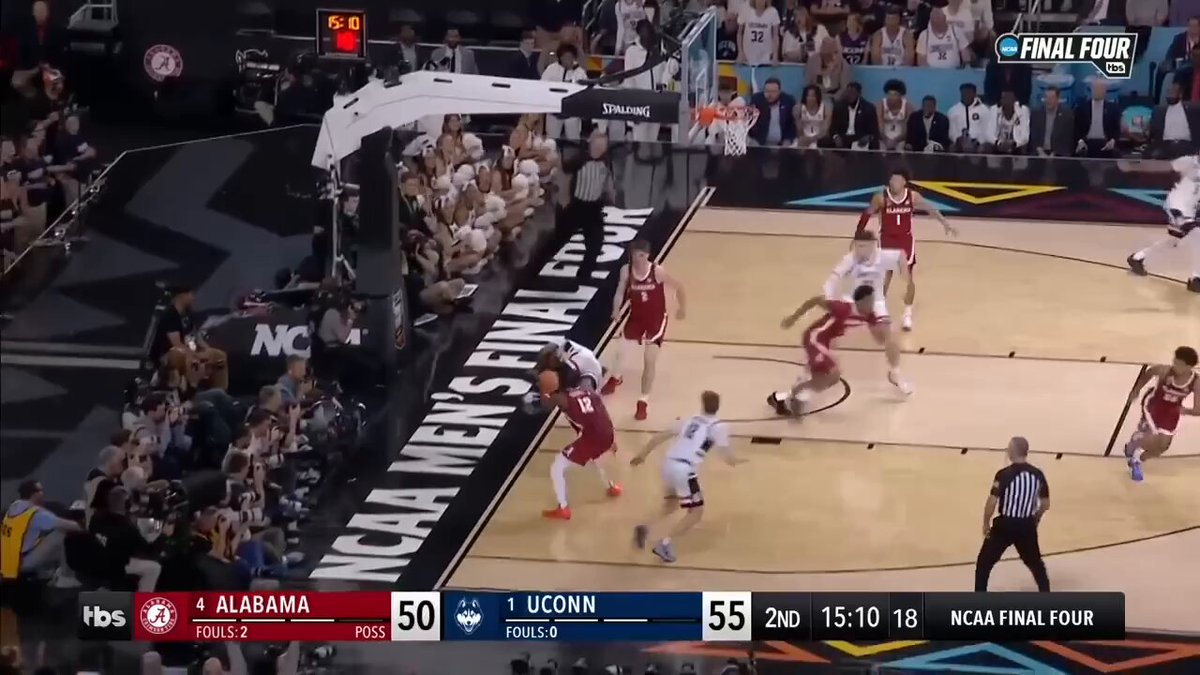
As the Connecticut Huskies attempt to win another national championship tonight against Michigan, Alabama Men’s Basketball fans still hear the echos of two years ago when the Crimson Tide finally crashed college basketball’s biggest event for the first time on April 6, 2024. Inside State Farm Stadium in Glendale, Ariz., the Crimson Tide’s breakthrough season reached its crescendo in its first Final Four appearance against the Huskies. As a No. 4 seed coming out of the West Region, the magical run ended with an 86-72 loss, but not before the Crimson Tide proved it belonged on the grandest stage. Mark Sears led the way with 24 points, five rebounds and three assists, continuing his March brilliance. Grant Nelson delivered a monster effort with 19 points and a season-best 15 rebounds for a double-double, while Aaron Estrada added 13 points as Alabama fought to keep within striking distance deep into the second half. Stephon Castle scored 21 points, Donovan Clingan had 18 and Tristen Newton controlled the game with 12 points and nine assists. When Alabama clawed back to tie it in the second half, UConn answered with a decisive run. “We got this program to its first Final Four, and I’m unbelievably proud of these guys,” Alabama head coach Nate Oats said. “We just went up against the best team in the country and they showed it.” Two years later, as Connecticut chases another title, that Saturday night in Glendale stands as more than a final score in Alabama history. It redefined the ceiling of a program and created an expectation to get back.

Tide Hoops History

31,324 views • 5 months ago