Загрузка видео...

Не удалось загрузить видео

На главную

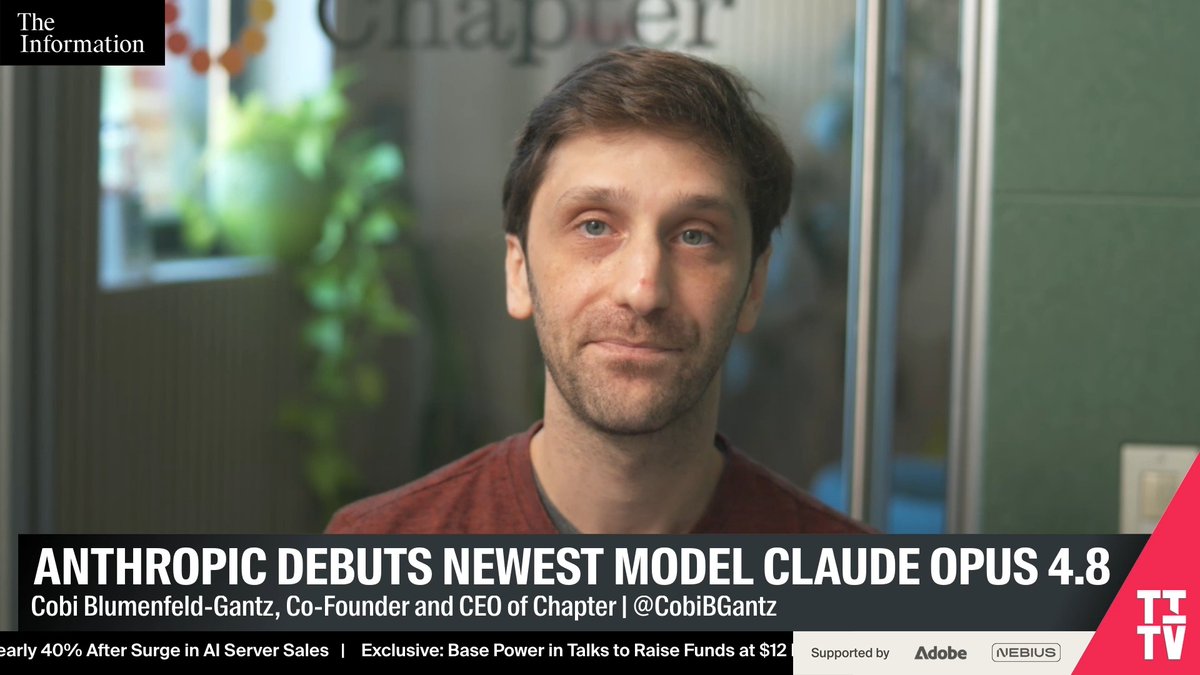
SITUATION EXPLAINED: Why is the Bridgewater Thinking Machines paper a blueprint for every enterprise that has ever paid frontier model prices for generic outputs? 47fucb4r8curb4fc8f8r4bfic8r: "What Thinking Machines and Bridgewater did together is a blueprint for how a wide variety of stakeholders within the market can benefit tremendously from...

92,876 просмотров • 5 дней назад •via X (Twitter)

Комментарии: 0

Нет доступных комментариев

Здесь появятся комментарии из оригинального поста

Похожие видео

Small Language Models (SML) are the future of AI. "Small" (SML) instead of "Large" (LLM). These small models are highly specialized models with superhuman abilities on specific tasks. Here are two techniques to build these models: • Spectrum • Model Merging I give you a short introduction in the attached video, but here is a quick summary: Spectrum helps us identify the most relevant layers to solve one specific task. We can ignore everything else and focus on fine-tuning these layers. Using Spectrum, we can fine-tune models in a heartbeat. Model Merging combines multiple models into a unique, much better model than any of the individual input models. You can also combine models specialized in different tasks and get a model with multiple abilities. This is the state of the art of productizing models. It's what Arcee.ai's platform does behind the scenes. Arcee collaborated with me on this post and is sponsoring it. There are three main steps to produce a model for your particular use case: 1. You create a dataset by uploading your data. 2. You train a model. At this step, Arcee uses Spectrum and Model Merging to produce a highly specialized model for your task. 3. You can deploy that model to any environment you want. Three important notes: • Training process is 2x faster and 2x cheaper than regular fine-tuning. • Resultant models are smaller and have higher accuracy. • They create these specialized models from open-source models. Check this site so you can fully appreciate how this works: If you want to fine-tune an open-source model, consider Arcee's platform. This is the state of the art.

Santiago

164,162 просмотров • 2 лет назад

Mark Zuckerberg is explaining one of the most misunderstood dynamics in AI and it has direct investment implications (Save this). The concept he's describing is model distillation, and it's one of the most important techniques to emerge in AI over the past year. Here's how it works. You train a massive, enormously expensive model, in Meta's case, Llama 4 Behemoth, a 2 trillion parameter teacher model and then you use that model to teach a much smaller, cheaper model. The smaller model inherits roughly 90 to 95% of the intelligence of the giant while running at 10% of the cost and on a fraction of the compute. Meta already did this with the Llama 4 family and Behemoth serves as the teacher. Llama 4 Scout and Maverick, the publicly released open-source models were distilled from it. Scout runs on a single H100 GPU with a 10 million token context window and outperforms models that cost far more to operate. Maverick, at 17 billion active parameters, rivals DeepSeek V3 in coding at half the parameter count and beats GPT-4o on multimodal benchmarks. Both are completely free for commercial use. What Zuckerberg is pointing at is a structural shift in how AI gets deployed in the real world. Companies aren't taking a frontier model off the shelf and running it as-is but rather taking open-source models, fine-tuning them on their own proprietary data, distilling them into even smaller custom models tailored to their specific use case, and running them on infrastructure they control at a fraction of the cost of a closed frontier API. The investment implication of this is significant and runs in two directions. For Meta specifically, this is a strategic masterstroke. Every company that builds on Llama, fine-tunes it, distills it, or deploys it through their infrastructure is pulling into Meta's orbit while Meta builds the most powerful open teacher model. The ecosystem of companies using it grows and that ecosystem generates commercial activity across Meta's platforms and data services. Meta's AI research benefits from billions of real world deployment signals and it's a flywheel that closed model providers cannot replicate because their strategy requires charging per token, which is now a 65x cost disadvantage against the open-source alternative. For the broader market, distillation changes the economics of inference in a way that has barely been priced in. As intelligence becomes extractable into smaller and cheaper models, the absolute demand for compute doesn't decline but rather it explodes, because now the number of applications that are economically viable expands by orders of magnitude. Every task that was previously too expensive to automate at $3.25 per call becomes viable at $0.05 that means more total token usage, more total GPU utilization, and more demand for the infrastructure companies, the Nebiuses, the GE Vernovas, the Constellation Energies that supply the underlying compute and power.

Milk Road AI

27,279 просмотров • 8 дней назад

🚨David Friedberg: AI is starting to identify and solve problems on its own “I'll give you a science corner example: there's this Evo 2 model that they publish at the Arc Institute, which Patrick Collison, you know, is the main funder and chairman.” “So that Evo 2 model, they just ingested all the DNA data they could find in the world.” “Trillions and trillions of base paired data that they ingested and then they looked at patterns in DNA. And that's it.” “They had no context for what the DNA represented, they had no context for the concept of genes, none of the structured understanding of what that DNA does, what it is, and you know what it did?” “They fed in the BRCA gene variant and the thing output a warning saying, ‘I think that this is a pathogenic variant to DNA,’ without having any context.” “This is the breast cancer allele.” “And it didn't have any knowledge and it wasn't trained on that at all.” “It had no knowledge that there are pathogenic variants for cancer, and it identified that this was a genetic variant that can cause some sort of pathogenic outcome in the organism.” “That's a great example where there's a lack of understanding at the human level on what really drives some of the patterns in nature, the patterns in society, the patterns in behavior that are kind of emergent phenomena perhaps, that these AI models are starting to identify.”

The All-In Podcast

79,718 просмотров • 11 месяцев назад

The entire AI industry is racing to build the smartest model. Satya Nadella just admitted that is not where the money is. The model is not the product. The harness is. That is the exact line. And it changes what Microsoft is actually competing on. OpenAI, Anthropic, Google, xAI, Meta every frontier lab is pouring hundreds of billions into training compute, chasing the next capability jump. Each betting that raw model intelligence is the moat. Microsoft is doing the opposite. It is building the harness the orchestration layer that sits above the model, connecting it to tools, data, permissions, sub-agents, and enterprise workflows. And it is letting OpenAI, Anthropic, and MAI compete to plug into it. "You need the model. But the model is not the product. The harness is." So do the math on what a harness actually does. A raw model dropped into an enterprise answers questions. That is a chatbot. A harness turns that same model into an agent that reads the SharePoint, edits the ERP entry, pulls the GitHub PR, updates Salesforce, and files the Excel report with the right permissions, the right audit trail, and the right sub-agent for each sub-task. The model provides the intelligence. The harness converts intelligence into work. Now here's where it gets interesting. "Even the best model in the world will feel broken without a great harness. And an okay model with a great harness can feel like magic." If that is true, the enterprise buyer is not buying model quality. The enterprise buyer is buying the harness. Which means model quality becomes a commodity input over time, and harness quality becomes the sustainable moat. Compare that to the strategy the entire frontier lab industry is executing. Everyone else is chasing the numerator raw intelligence. Almost nobody at scale is racing to build the denominator the orchestration layer that determines whether that intelligence can actually be deployed profitably inside a real company. The frontier model race has a 10 to 20 percent chance of producing a single dominant winner. Nadella just told the industry he does not need to be that winner. If OpenAI wins, Microsoft wins. If Anthropic wins, Microsoft wins. If MAI wins, Microsoft wins. If someone Microsoft has never heard of trains a better model in 2027, Microsoft still wins. Because the compute they train on, the harness they get plugged into, the enterprise contracts they get delivered through, and the products they sit inside are all Microsoft. He is not building the best AI model. He is building the layer that the best AI model has to run on to make anyone money. I wonder which position looks more valuable in ten years.

Vikram M

21,463 просмотров • 8 дней назад

Sam Altman just handed every startup founder a one-question autopsy. Altman: “If you’re building something on GPT-4 that a reasonable observer would say we’re going to steamroll you.” Not might. Not could. Going to. He said it with the calm of someone describing weather. Because to him it is weather. The model improves. Whatever was built on the old version’s weaknesses gets washed away. That is not strategy. That is erosion. And most founders are building on the erosion line. They find a gap in the current model. They wrap a product around it. They raise money. They hire. They scale. Then OpenAI releases the next version and the gap closes and the product has no reason to exist anymore. Altman: “When we just do our fundamental job, which is make the model better with every crank, then you get the ‘OpenAI killed my startup’ meme.” He is telling you directly. They are not hunting you. They are not even thinking about you. They are just improving the model. You happen to be standing where the improvement lands. That is the part founders refuse to hear. OpenAI does not need to compete with you. It just needs to keep doing exactly what it was already doing and your entire company disappears as a side effect. You are not a competitor. You are a temporary symptom of incomplete intelligence. The moment the intelligence completes you become nothing. Then Brad Lightcap delivered the cleanest diagnostic ever spoken in venture capital. Lightcap: “Ask if a 100x improvement in the model is something they’re excited about.” One question. The entire investment thesis reduced to a single binary. Does the next model make your company more powerful or does it make your company pointless. There is no middle ground. Lightcap: “We know the companies that come to us saying, ‘We want the next model. When is it coming out? I want to be the first to try it.’” These companies built something that feeds on intelligence. The smarter the model gets the more their product can do. They are not threatened by progress. They are starving for it. Then there are the companies Lightcap never hears from. The ones who go quiet when a new model drops. The ones who read the release notes like a death sentence. The ones privately praying the next generation takes longer because every improvement shrinks the ground beneath them. If you are hoping the model stays roughly where it is you have already told the market everything it needs to know about your company. You are not building on intelligence. You are building on the absence of it. Altman: “95% of the world should be betting on the latter category.” The latter category is simple. Assume the model keeps getting better at the pace it has been getting better. Build for that world. Not the world where GPT-4 is the ceiling. The world where GPT-4 is the floor and the ceiling has not been built yet. Then Altman told a story that should be framed on the wall of every startup in the country. A medical AI company came to him that morning. They were not complaining about the model. They were not worried about being replaced. They were demanding it improve faster. Altman: “Here’s how many people are dying every day you delay.” That is what alignment with the trajectory looks like. A company so deeply built on intelligence improving that every day the model stays the same is a day someone dies who did not have to. They are not building on a flaw. They are building on a future that has not arrived fast enough. That is the difference. The wrapper startup patches what the model cannot do today. The real company builds what the model will unlock tomorrow. One is running from the train. The other is laying the track. Altman told you the train is not slowing down. Lightcap told you exactly how to know which side you are on. One question. Does a 100x smarter model make you more valuable or erase you. If you had to pause before answering you already did.

Dustin

39,109 просмотров • 3 месяцев назад

How can you solve complex tasks using a Large Language Model? Here is a 2-minute introduction to everything you need to know to 10x the quality of your results. Let's talk about three techniques, in order of complexity, starting with the easiest one: • In-Context Learning • Indexing + In-Context Learning • Fine-tuning In-Context Learning The team that trained GPT-3 found something they couldn't explain: You can condition a model using examples of how you want it to behave. I included an example prompt in the attached video. You can "teach" the model how you want it to interpret questions, select the correct answers, and format the results by giving a few examples. You can also give specific knowledge to the model that will be helpful when formulating answers. We call this approach "grounding the model." There's another example in the video. Indexing + In-Context Learning Unfortunately, there is a limit to how much data you can include in a prompt. We call this the "context size." One version of GPT-4 supports a context of approximately 6,000 words, while the other supports 25,000 words. Although this sounds like a lot, many applications need more than that. Imagine you wrote a book and want to build an application to answer any questions about your story. What happens if your book is longer than the context? That's where Indexing comes in. Using a model, you can turn every book passage into an embedding. These are vectors, numbers that "encode" the passage's text. You can then store these embeddings in a particular database that supports fast retrieval of these vectors. You can then turn any question into an embedding and search the database for the list of passages that are similar to that query. Instead of using the entire book to ask the model, you can now use the relevant passages as in-context information, effectively working around the context size limitation. Fine-tuning Fine-tuning can give you an extra boost to get reliable outputs from your LLM. It is, however, the most complex approach on the list. There are different approaches to fine-tuning a model with your data. A popular technique is to process your data with your LLM and use the outputs to train a new classifier that solves your specific task. Notice that here you aren't modifying the LLM. Instead, you are chaining it with your trained classifier. Another approach is to modify the parameters of the LLM using your data. Think of this as "rewiring" the model in a way that solves your particular task. The results and costs will vary depending on how many layers you want to fine-tune from the original model. Many companies think that fine-tuning is the solution to their problems. In my experience, many will benefit from exploring the other two approaches. I love explaining Machine Learning and Artificial Intelligence ideas. If you enjoy in-depth content like this, follow me Santiago so you don't miss what comes next.

Santiago

384,495 просмотров • 3 лет назад

Every Fortune 500 executive is buying AI subscriptions and calling it a strategy. Palantir CEO Alex Karp has a word for that. Karp: “The general approach of just buying models is going to be essentially self-pleasuring for an enterprise at the cost of the enterprise.” Karp: “You buy some large language model, you party with it basically, and the next day you have a hangover.” The entire corporate world is mispricing the AI transition. They are renting intelligence with no foundation to run it on. A raw model floating in a vacuum hallucinates over your unstructured data, generates the illusion of work, and executes nothing. The party ends. The hangover begins. Nothing changed. Karp identified exactly where the value actually goes. Karp: “All the value in the market is going to go to chips and what we call ontology.” Not the models. Not the subscriptions. Not the chatbot interfaces layered on top of them. The ontology. The precise digital architecture of how an organization actually operates. Its security permissions. Its supply chain physics. It’s operational logic. Karp: “The ontology will allow you to take a large language model and use it, refine it, and then impose it on your enterprise in the logic of your enterprise, in the security model of your enterprise.” When you bind a frontier model to the strict underlying logic of a specific enterprise, something fundamental shifts. It stops generating text. It starts generating action. Karp: “We’re using it on the battlefield, we’re using it to compress margins. We’re making engineers better engineers. We’re making people who are not engineers into engineers using our ontology and a large language model.” The traditional engineering bottleneck does not slow down. It disappears. Karp: “We are sitting on the only thing that actually creates quantifiable, transformational value.” The companies renting models are paying for the feeling of transformation. The companies building ontologies are executing the actual thing. One of them will define the next decade. The other will wake up in 2030 wondering where their market share went. Exactly like a hangover.

Dustin

210,359 просмотров • 4 месяцев назад

China just released an open source AI model that matches the best closed models from OpenAI and Anthropic. Gavin Baker explained exactly how they did it and the answer should concern every American AI lab. The model is called GLM 5.2. It was built by Z. AI. You get 744 billion parameters, 1 million token context window and its MIT license, meaning anyone can download it, fork it, build a company on it, with no restrictions and no Dario. It scored 51 points on the artificial analysis intelligence index. The highest score any open weight model has ever achieved. It beat GPT 5.5 on the frontier software engineering benchmark. It trails Claude Opus 4.8 by less than one percentage point. And it costs 85% less to run than GPT 5.5 for comparable performance. Gavin Baker said on the All-In podcast that this model has challenged some of his beliefs. Then he explained how China built it. The method is called distillation. Just think of tens of thousands of phones and computers running simultaneously, all hitting the frontier model APIs through masked accounts, asking specific questions, and harvesting what happens inside the model when it answers. Every reasoning step, every token. The entire thinking process gets recorded and fed back into the Chinese model during training. It is a cheat sheet. It is the answer key to the exam. And here is the part that should worry everyone. Sacks said it plainly. China was already nine months behind American models. But now that GLM 5.2 is good enough to run its own reinforcement learning, it can improve itself without needing to distill from American models anymore. The cheat sheet let them get close enough to start writing their own answers. Sacks said we are six months behind on the model and 24 months behind on silicon and they are only a few months behind in total. The Z. AI founder told Elon Musk directly that open weight fable-level capability will be here before Q1 2027. Every restriction Anthropic lobbied for, every self-imposed safety guardrail, every month of delay in releasing American frontier models accelerated this. The Chinese labs were not under those restrictions. They were not going to wait. The composable model future Gavin described, where every enterprise runs a frontier model alongside their own fine-tuned open weight model, is coming regardless of what American labs do next. The question is just whether the open weight half of that stack is American or Chinese. Right now it is Chinese. WATCH THE FULL PODCAST ON The All-In Podcast

Ihtesham Ali

85,915 просмотров • 16 дней назад