Video wird geladen...

Video konnte nicht geladen werden

Zur Startseite

Solar Eclipse on Mars ☀️ This video captures impressive footage of Phobos—Mars’s potato-shaped moon—crossing the face of the Sun. The eclipse was recorded on April 2, 2022, by the Mastcam-Z camera aboard the Perseverance rover. Unlike solar eclipses caused by Earth's Moon, which last about an hour, Phobos transits...

28,732 Aufrufe • vor 12 Tagen •via X (Twitter)

0 Kommentare

Keine Kommentare verfügbar

Kommentare vom Original-Post werden hier angezeigt

Ähnliche Videos

2034 Earth–Venus–Mars opportunity looks promising. 10–15 on-orbit refueling operations may be needed to make a crewed ship full. Most can be done at an altitude of 180–200 km, made possible by Starship’s size. The final refueling may be performed at a higher altitude of ~2000 km, just below the Van Allen belt. Earth departure on 2034-08-21 from 2000 km orbit. A Trans-Venus Injection burn of ~3.7 km/s will place the ship on an Earth–Venus–Earth free-return trajectory. Venus flyby is expected on 2034-12-19, 120 days after departure. Two weeks before the encounter, if the mission proceeds as planned, a 25-m/s maneuver will shift the trajectory from Earth-return to Mars-bound. If not, the ship will free return to Earth in September 2035. The Venus gravity assist will send the ship into another Earth free-return trajectory, with Mars flyby around 2035-06-02. One week before reaching Mars, a system health check will determine whether to commit to Mars Orbit Insertion. If it’s GO, a small 10-m/s manuever will put the ship to less than 100 km altitude periapsis. Otherwise, a Mars flyby will lead to an Earth return in May 2036. The ship will enter the Martian atmosphere at about 9.4 km/s, performing an aerobrake to slow to 4.88 km/s and capture into a 100x140000 km, 7-day period high elliptical orbit. At apoapsis, a 50-m/s plane change will align the inclination with Mars’ equator, followed by additional aerobraking to remove about 650 m/s of velocity, placing the spacecraft in a 120x6128 km orbit. A 550-m/s burn at 6128 km altitude will then adjust the trajectory into Phobos orbit. The ship will stay at Phobos for about 7 days. The Mars–Phobos L1 point is only about two miles above Phobos’ surface, and Mars would dominate nearly half the sky, appearing about 80 times larger than the Moon from Earth. The ship will depart for Deimos afterward. Two burns totaling roughly 750 m/s will transfer the ship from Phobos to Deimos. And the ship will stay at Deimos for 7 days more. From Deimos, the ship will raise its apoapsis to form a 20000x140000 km altitude, 7-day orbit, requiring about 420 m/s of delta-v. At apogee, a 50-m/s burn will adjust inclination and lower periapsis to ~500 km for final Trans-Earth Injection. If time and propellant allow, the orbit can be aligned to a polar inclination for Mars ice-cap observations before departure. A Trans-Earth Injection burn at 500 km altitude, requiring 1.5–1.6 km/s of delta-v in early July 2035. If departure on the first days in July, Earth arrival is expected in December 2035. If missed that window, a March 2036 arrival may look more feasible. Nominal mission duration: 490 days, with 30 days in Mars orbit and 14 days at Phobos and Deimos. Two planets, two moons for 3.7+0.025+0.010+0.05+0.42+0.55+0.75+1.55=7.06 km/s Δv

Chun

225,271 Aufrufe • vor 10 Monaten

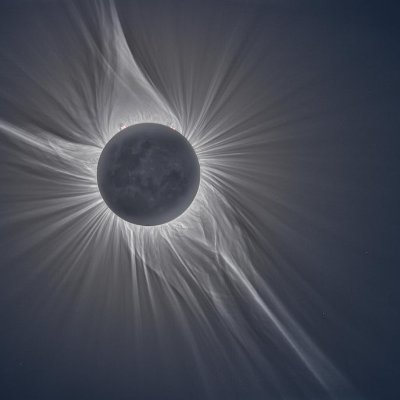
The Spanish Eclipse: A Masterclass in the Heavens and the Heart! I decided to follow the total eclipse over Spain and the partial eclipse in other European countries last night from Nigeria until early this morning. This is because I have had an interest in astronomy for over two decades. This eclipse offered a profound masterclass in celestial mechanics and orbital predictability. The maximum duration of totality in Spain during this event was 2 minutes and 18 seconds. The total solar eclipse was a historic celestial event, marking the first total solar eclipse visible from mainland Europe since 1999, around 27 years ago. It was also the first total eclipse to sweep across Spain since 1905, around 121 years ago. Other parts of Europe also experienced only a partial eclipse. From a scientific perspective, this rare event underscores the divine mathematical precision governing our solar system. The exact alignment of the Sun, Moon, and Earth allows researchers to study the solar corona, test gravitational theories, and gather critical data on atmospheric changes. It serves as a stark reminder that even the grandest cosmic phenomena operate under consistent, observable laws of physics that humanity can calculate decades in advance. Interestingly, this celestial alignment invites deep religious and spiritual contemplation across diverse faiths. In many theological traditions, the temporary blotting out of the sun represents a moment of awe, humility, and divine majesty, reminding humanity of its small place within creation. Furthermore, Islamic tradition features the special Khusuf prayer during solar eclipses to acknowledge Allah's signs. Other faiths likewise view the return of light as a powerful symbol of spiritual renewal and the triumph of truth over darkness. The event bridges the gap between the physical and the metaphysical, prompting us to look upward in reverence. Ultimately, the eclipse over Spain harmonises science and faith (iman) by highlighting a shared human quest for meaning and order. While science explains the mechanics of the shadow moving across the Iberian Peninsula, religion interprets the profound emotional and existential impact of that darkness. Together, these perspectives show that an eclipse is not merely an optical coincidence, but a unifying global moment. It challenges us to expand our knowledge of the universe while deepening our appreciation for the mysteries that lie beyond empirical measurement. Then which of the blessings of your Lord will you deny? Isa Ali Ibrahim Pantami

Prof. Isa Ali Ibrahim, CON

30,373 Aufrufe • vor 15 Tagen