Video yükleniyor...

Video Yüklenemedi

Ana Sayfaya Dön

Solar System bodies make deep space exploration more fuel efficient! Today’s video shows the Psyche spacecraft gaining speed and changing its trajectory with minimal fuel spent due to a gravity assist from Mars in May 2026. Mars has an average orbital speed of almost 87,000 km/h (54,000 mph) around...

34,878 görüntüleme • 13 gün önce •via X (Twitter)

0 Yorum

Yorum bulunmuyor

Orijinal gönderinin yorumları burada görünecek

Benzer Videolar

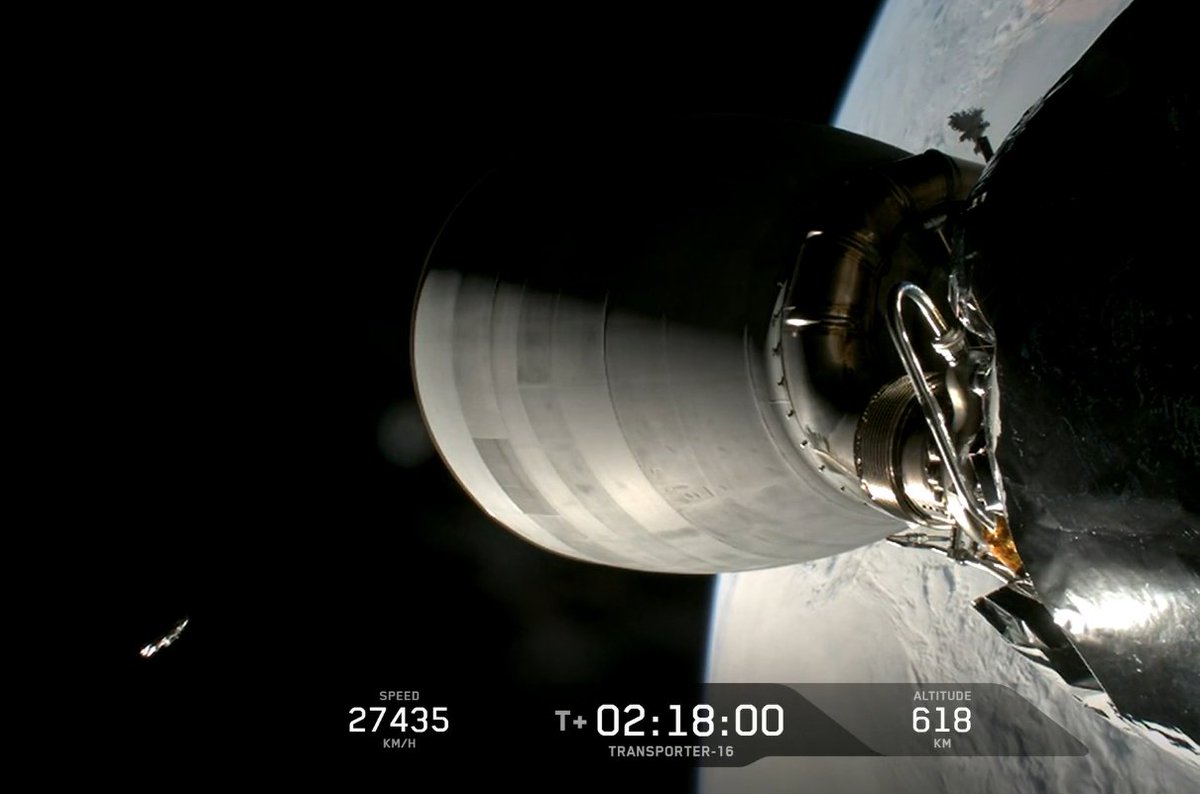
I'm excited to announce we have achieved our Tier 1 mission success criteria and have begun gathering a tremendous amount of data on how this brand new spacecraft performs. On March 30th, 13:17:08Z, the Gravitas spacecraft separated from the SpaceX Transporter-16 stack to begin its mission as one of the highest power free-flying satellites ever launched. Immediately after separation, the spacecraft autonomously: - Executed detumbling maneuvers - Established two-way communications with the ground (on our very first ground station pass) - Deployed its 20kW solar arrays - Slewed to a safe and stable attitude to await further ground commands These actions alone are a testament to the incredible work of our in-house engineering, software, and GNC teams to build a robust spacecraft. Since then, our operations team completed all initial system activations and checkouts, confirming the vehicle is in a power positive and thermally stable state with no major anomalies observed at this time. We completed this phase of the mission ahead of schedule. Next up we will be powering up and downlinking data for all payloads aboard the Gravitas spacecraft in support of our customers and partners while continuing to put the spacecraft through its paces. As we noted ahead of launch: The goal of this mission is to experiment and push our systems to the limit to inform future missions. I look forward to sharing more on our successes and challenges as the mission proceeds. Video of our satellite below; link to full T-16 webcast:

Neel Kunjur

89,923 görüntüleme • 4 ay önce

2034 Earth–Venus–Mars opportunity looks promising. 10–15 on-orbit refueling operations may be needed to make a crewed ship full. Most can be done at an altitude of 180–200 km, made possible by Starship’s size. The final refueling may be performed at a higher altitude of ~2000 km, just below the Van Allen belt. Earth departure on 2034-08-21 from 2000 km orbit. A Trans-Venus Injection burn of ~3.7 km/s will place the ship on an Earth–Venus–Earth free-return trajectory. Venus flyby is expected on 2034-12-19, 120 days after departure. Two weeks before the encounter, if the mission proceeds as planned, a 25-m/s maneuver will shift the trajectory from Earth-return to Mars-bound. If not, the ship will free return to Earth in September 2035. The Venus gravity assist will send the ship into another Earth free-return trajectory, with Mars flyby around 2035-06-02. One week before reaching Mars, a system health check will determine whether to commit to Mars Orbit Insertion. If it’s GO, a small 10-m/s manuever will put the ship to less than 100 km altitude periapsis. Otherwise, a Mars flyby will lead to an Earth return in May 2036. The ship will enter the Martian atmosphere at about 9.4 km/s, performing an aerobrake to slow to 4.88 km/s and capture into a 100x140000 km, 7-day period high elliptical orbit. At apoapsis, a 50-m/s plane change will align the inclination with Mars’ equator, followed by additional aerobraking to remove about 650 m/s of velocity, placing the spacecraft in a 120x6128 km orbit. A 550-m/s burn at 6128 km altitude will then adjust the trajectory into Phobos orbit. The ship will stay at Phobos for about 7 days. The Mars–Phobos L1 point is only about two miles above Phobos’ surface, and Mars would dominate nearly half the sky, appearing about 80 times larger than the Moon from Earth. The ship will depart for Deimos afterward. Two burns totaling roughly 750 m/s will transfer the ship from Phobos to Deimos. And the ship will stay at Deimos for 7 days more. From Deimos, the ship will raise its apoapsis to form a 20000x140000 km altitude, 7-day orbit, requiring about 420 m/s of delta-v. At apogee, a 50-m/s burn will adjust inclination and lower periapsis to ~500 km for final Trans-Earth Injection. If time and propellant allow, the orbit can be aligned to a polar inclination for Mars ice-cap observations before departure. A Trans-Earth Injection burn at 500 km altitude, requiring 1.5–1.6 km/s of delta-v in early July 2035. If departure on the first days in July, Earth arrival is expected in December 2035. If missed that window, a March 2036 arrival may look more feasible. Nominal mission duration: 490 days, with 30 days in Mars orbit and 14 days at Phobos and Deimos. Two planets, two moons for 3.7+0.025+0.010+0.05+0.42+0.55+0.75+1.55=7.06 km/s Δv

Chun

225,068 görüntüleme • 10 ay önce

THE SOLAR SYSTEM IS OFFICIALLY A HARDWARE STORE: DISMANTLING THE PLANETS TO POWER THE FUTURE The conversation about Dyson Swarms has shifted from science fiction to a logistical reality of "when," not "if". While covering the sun in a solid shell is a structural nightmare, a Dyson Swarm, a network of independent solar collectors, is the pragmatic path to a Type II civilization. Elon accelerated this timeline, suggesting Starship could deploy solar harvesting satellites delivering 100GW per year to Earth orbit within the next four to five years. But if we are talking about a true, star encompassing swarm, the 50 year sprint begins with Mercury as the ultimate sacrificial planet. It is metal rich and sits at the perfect distance from the sun to minimize energy costs for launch. Automated robots would mine Mercury’s crust, refine materials on site, and launch solar panels into a statite orbit using radiation pressure to maintain position. Disassembling just half of Mercury provides enough material for a swarm capturing a billion times more energy than Earth currently receives. Asteroids are the "fantastic food source" for this construction because they are a non starter for gravity wells. Mining an asteroid like 16 Psyche is infinitely more efficient than fighting the gravity of a planet like Jupiter. Most asteroids are already sorted into carbonaceous fuel or nickel iron kits, making them perfect modular factories for solar panels. While we harvest these dead rocks and the asteroid belt, habitable candidates like Mars will be left untouched. Source: Moonshots Peter H. Diamandis, MD

Mario Nawfal

20,424 görüntüleme • 7 ay önce

In his first interview since his unmasking on September 20, JP shared information from his latest contact with a Nordic extraterrestrial who met him near his Florida home. The Nordic explained that Martian colonists who escaped the Red Planet after catastrophic changes millennia ago have just returned to our solar system. This was the same Nordic who met JP on February 11, 2025 (Update 43), to help him remember a 2018 contact incident where he was taken on a spacecraft and shown records of the collapse of the Martian civilization and the emigration of Mars refugees to Earth in space arks and other large spacecraft. There is also a connection between the returning Martians to 3I/Atlas, which will make its closest approach to Mars next week on October 3. According to what JP was told, 3I/Atlas may change course to directly interact with or even land on Mars. JP was told that the Martians who fled to Earth after their planet’s destruction settled on both the surface and under the oceans. It is unclear whether the returning Martians plan to reestablish a presence on Mars or join their compatriots in underwater colonies on Earth. According to the Nordic, the returning Martians do not represent any kind of threat to humanity. This leads to the conclusion that the return of former Martians presents an opportunity for humanity to gain a deeper understanding of the true history of our solar system and the origins of our species. Links at:

Michael Salla

27,331 görüntüleme • 10 ay önce