Video wird geladen...

Video konnte nicht geladen werden

Zur Startseite

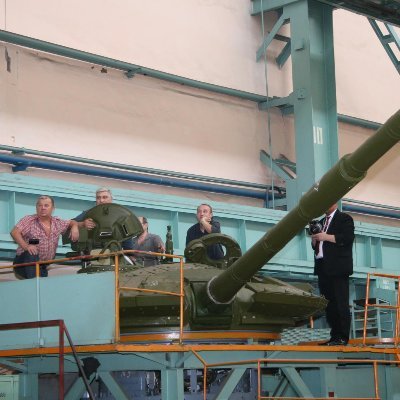
Soviet optionally manned tank from 1980-s. Based on T-80U design, equipped with remote controls with stereoscopic cameras, also front hull was changed to accommodate 2 operators. Soviet doctrine for optionally manned tanks included – The idea of creating units of Robotic Tank Complexes (RTCs) emerged long ago. The main...

44,726 Aufrufe • vor 11 Monaten •via X (Twitter)

0 Kommentare

Keine Kommentare verfügbar

Kommentare vom Original-Post werden hier angezeigt

Ähnliche Videos

The video shows the trials of the VT-1-1, a turretless tank with 2 x 105 mm guns, firing on the move at the Putlos training ground in 1976. The casemate (turretless) tank, designed for combat while moving, was introduced in Germany in the mid-1970s as a twin-gun casemate tank (the Soviet term for a "turretless tank"). For practical firing tests in the "target pass" mode, two prototypes were built in the mid-1970s. The first prototype, VT 1-1, was armed with two 105 mm guns, while the second, VT 1-2, was equipped with two 120 mm smoothbore guns. Additionally, the VT 1-2 featured a functioning autoloader behind one of the guns, with a firing rate of 10 rounds per minute. The vehicles were developed as part of the KPz 3 or Leopard 3 project. In both prototypes, the main guns were semi-fixed (with aiming and stabilization only in elevation). The chassis solutions were derived from the KPz 70 (MBT 70) program, with the running gear shortened by one road wheel (five road wheels per side). The vehicles weighed 36.8 and 43.5 tons, respectively, with a chassis rotation speed of 60 degrees per second. To achieve high maneuverability on rough terrain, 12-cylinder diesel engines from the MB 873 series with enhanced power were used, equipped with four turbochargers: 2000 hp for VT 1-1 and 2200 hp for VT 1-2. This provided an impressive power-to-weight ratio of 54 and 50 hp/ton, respectively, with acceleration to 55 km/h in 11 seconds, though only in a temporary "turbo" mode, as the standard power was 1600 hp. The accuracy of firing with two guns was unmatched by single-gun tanks, as confirmed by the tests. However, due to the novel combat approach, this revolutionary tank concept was rejected by the customer after trials in favor of the conventionally designed Leopard 2. In essence, although the project was developed as the Leopard 3, a tank for the future, it was, in reality, a parallel project and a potential competitor to the Leopard 2. Achieving the firepower, protection, and mobility of the Leopard 3 within reasonable weight limits was impossible with a conventional layout. At the same time, a significant tactical drawback of the casemate concept (including twin-gun casemate vehicles) is the linkage between the direction of fire and the direction of movement, which in many cases could complicate unit and formation control (according to German experts in the 1970s). Moreover, the VT 1-1 and VT 1-2 can hardly be considered balanced vehicles—they could have been simpler. The vehicles' mobility was exaggerated, with the main engine, transmission, auxiliary engine, batteries, and other systems occupying two-thirds of the vehicle's length. Pros and Cons of VT 1-1 and VT 1-2: Considering the key challenges, the twin-gun casemate concept can be evaluated as follows: Pros: Compact design due to a small internal volume. Two guns provide high firepower and hit probability. Cons: The weight advantage of the casemate design is largely offset by the integration of a second gun. Fire control alone results in high complexity, leading to increased maintenance costs and overall expenses. In 1975/76, five Gefechtsfeldversuchträger (GVT, combat test platforms) were developed and built for further mobility and concept trials. These were smaller than the VT 1-1 and VT 1-2, weighing 30 tons. The GVT 01-05 were equipped only with mock-up guns and laser firing simulators (TALLISSI) and telemetry systems, built using chassis components from the Leopard 1. The GVTs were used at the IABG facility in Lichtenau and the tank training school in Munster to test the twin-gun turretless tank concept in realistic exercise conditions, which is why five vehicles were built. However, the Leopard 2 was already in production, and tank crews showed little enthusiasm for this unconventional vehicle requiring a new approach.

Andrei_bt

81,636 Aufrufe • vor 1 Jahr

🚨🇷🇺 NATO IN PANIC: RUSSIA’S T-80BVM TANK GETS NEW ARMOR FOR DRONE WAR A previously unseen T-80BVM configuration has appeared with a tighter roof screen and expanded side protection. Russian engineers are turning lessons from frontline crews into a more coherent armor package built around the threats tanks actually face in Ukraine. 🔸 The lower anti-drone screen sits closer to the turret and covers more of its upper surface than many early field-built cages. It is designed to trigger FPV warheads away from the thin roof and disrupt clean top-down attacks. 🔸 Additional Relikt explosive reactive armor and side screens strengthen the hull flanks, fuel-tank areas and engine compartment against shaped-charge weapons — the sections drone operators repeatedly try to reach. 🔸 The upgrades preserve the T-80BVM’s main advantage: mobility. Its 1,250 hp gas-turbine engine can push the tank to around 70 km/h, allowing crews to fire, relocate and avoid remaining exposed in one position. 🔸 The tank retains its 125 mm gun, modern fire-control system and ability to launch guided missiles through the barrel, giving it the firepower to engage armor and fortified positions from range. 🔸 Uralvagonzavod says recent T-80BVM batches incorporate combat experience and direct feedback from the front, with the main emphasis placed on crew safety and overall survivability. 🔸 Russia has also increased production of the T-80BVM, T-90M and T-72B3M severalfold. New batches continue to reach the troops as anti-drone protection becomes a standard part of the upgrade process. The T-80BVM keeps its turbine-powered speed while adding protection where FPV crews look first: the turret roof, hull sides and engine deck. Every clean attack angle is becoming harder to find. Which matters most for tank survival now: roof armor, electronic warfare or speed?

NewRulesGeopolitics

40,105 Aufrufe • vor 5 Tagen

First Drone vs. Manned Fighter Combat? On December 8, 2025, the Ukrainian Air Force confirmed the loss of a Su-27 fighter jet piloted by Lieutenant Colonel Yevhenii Ivanov, who was killed during a combat mission in the eastern direction. Yesterday, December 17, one Mi-24 was downed in same circumstances. Russian sources allege the aircraft was shot down, but Ukrainian statements describe the circumstances as under investigation, with no official confirmation of the cause. There are unverified Russian claims linking it to a modified Geran-2 drone equipped with an R-60 missile. Ukrainian intelligence has confirmed the existence of Geran-2 variants armed with R-60 air-to-air missiles, designed primarily to counter aircraft or helicopters approaching to intercept drone swarms. If independently verified, such an engagement could represent a significant milestone in drone-vs-manned aircraft combat. This development aligns with broader trends i mentioned in my previous article on Chinese high-altitude drones conducting air-to-air target acquisition from positions well above potential threats. Elon Musk has indeed argued that the future of warfare lies with unmanned aircraft, stating that manned fighter jets are becoming obsolete in the drone era and predicting a shift toward autonomous or remotely controlled systems. But i believe that it’s something to the next two decades. Sixth-generation aircraft concepts often emphasize manned platforms controlling swarms of drones (loyal wingmen), but the question pushes further: How will manned fighters compete against high-altitude unmanned systems operating 10–15 km above their service ceiling and potentially launching air-air hypersonic missiles? In January I will post an article on China's development of layered high-altitude drone systems for ISTAR (Intelligence, Surveillance, Target Acquisition, and Reconnaissance), one optimized for aerial threats and another for naval targets. Recent Chinese programs, like high-altitude stealth drones, recharge stations and mothership concepts capable of deploying swarms, suggest active progress in this direction.

Patricia Marins

49,124 Aufrufe • vor 7 Monaten

Units of the Unmanned Systems Forces grouping carried out a series of strikes on key enemy targets, including an ST-68 radar, a "Pantsir-S1" anti-aircraft missile and gun system, logistical support and ammunition depots, railway tank cars with fuel and lubricants, mobile fire groups, and logistics facilities. Here are more details about the operations: 🎯In temporarily occupied Feodosia, operators of the 1st Separate USC destroyed a radome inside which an ST-68 radar was located. Immediately after that, the unit's operators struck the radar itself, which was designed to detect and track air targets and was an important element of the enemy's air defense system. 🎯The 1st Separate USC struck a "Pantsir-S1" anti-aircraft missile and gun system in temporarily occupied Crimea. The estimated cost of the struck complex is about 15 million US dollars. The "Pantsir-S1" is one of the key elements of the enemy's air defense. 🎯The 414 Magyar's Birds , the K-2 , the "Phoenix" border guard unit, and the 412th "Nemesis" Brigade struck enemy logistics targets in the Donetsk, Zaporizhzhia, and Luhansk regions. 🎯The 1st Separate USC struck railway tank cars with fuel and lubricants in the Donetsk region. 🎯The 412th "Nemesis" Brigade struck a logistical support depot in Mariupol. 🎯The 1st Separate USC struck an ammunition depot in the Luhansk region. 🎯The "Phoenix" border guard unit struck an enemy mobile fire group in the Luhansk region. The operations were conducted in coordination with the Deep Strike Center of the USF grouping. The Unmanned Systems Forces consistently dismantle the enemy's defense: destroying air target detection means, eliminating air defense systems, and disrupting the supply of ammunition, fuel, and logistical support. USF: One step ahead!

🇺🇦 Unmanned Systems Forces

49,980 Aufrufe • vor 2 Monaten

The official name of this tank is the Type 100 tank(100坦克). Its derivative model is the Type 100 support vehicle(100支援战车). 🪖Soldier: In this parade, there are three types of equipment on display: the 99B tank, the 100 tank, and the 100 support vehicle. The 99B tank is an upgraded version based on the 99A, while the 100 tank and the 100 support vehicle represent the core force of the Army on future battlefields. 🎙️Narrator: Transitioning from the “99 era” to the “100 era” is not merely a change in numbers. Behind this transformation are the firm steps of the new People’s Army moving toward intelligent, informationized, and unmanned development. 👩Female Reporter: Taking the 100 tank as an example, the most noticeable change is in its upper structure. From the turret’s appearance, it no longer has the straight-edged design of the 99 series, but instead features multiple irregular polygonal protrusions. This design greatly increases the difficulty for enemy shells to score a hit, enhancing the tank’s survivability. Looking further, the top of the turret is equipped with observation and aiming devices, an anti-aircraft machine gun, and interceptor munitions. The gunner can easily grasp the battlefield situation through the screen at their station, and operate the main gun and anti-aircraft machine gun for fire engagement. 🪖Soldier: Both the 100 tank and the 100 support vehicle can silently approach the enemy under certain conditions, avoiding exposure caused by excessive noise. 🎙️Narrator: In terms of protection, both vehicles adopt a combination of active and passive defense. In terms of communication, they feature integrated systems that support multiple modes, making them more diverse and more reliable. 🪖Soldier: The 100 support vehicle is also equipped with unmanned operators who can control reconnaissance vehicles and drones, greatly improving reconnaissance capability and enabling precise strikes on targets. 👩Female Reporter: There’s a detail some viewers may have noticed during the live broadcast: the drivers of the 100 tanks and 100 support vehicles are equipped with a new type of helmet. This visualization helmet can display vehicle driving data and reconnaissance imagery in real time. For the driver, it’s like what we see in a video game interface—on one side of the screen are vehicle data, and on the other is the battlefield map. This significantly improves the driver’s awareness of the battlefield situation and the vehicle’s status. 🪖Soldier: Both vehicle types are equipped with 360-degree imaging, much like the surround-view systems common in civilian electric cars today. This allows the crew inside to observe the surroundings of the vehicle more effectively, helping both the driver and other crew members maintain better situational awareness. With this equipment’s high degree of informatization and digitization, we are better prepared to win future informationized wars.

笑脸男人

31,058 Aufrufe • vor 11 Monaten