Loading video...

Video Failed to Load

Go Home

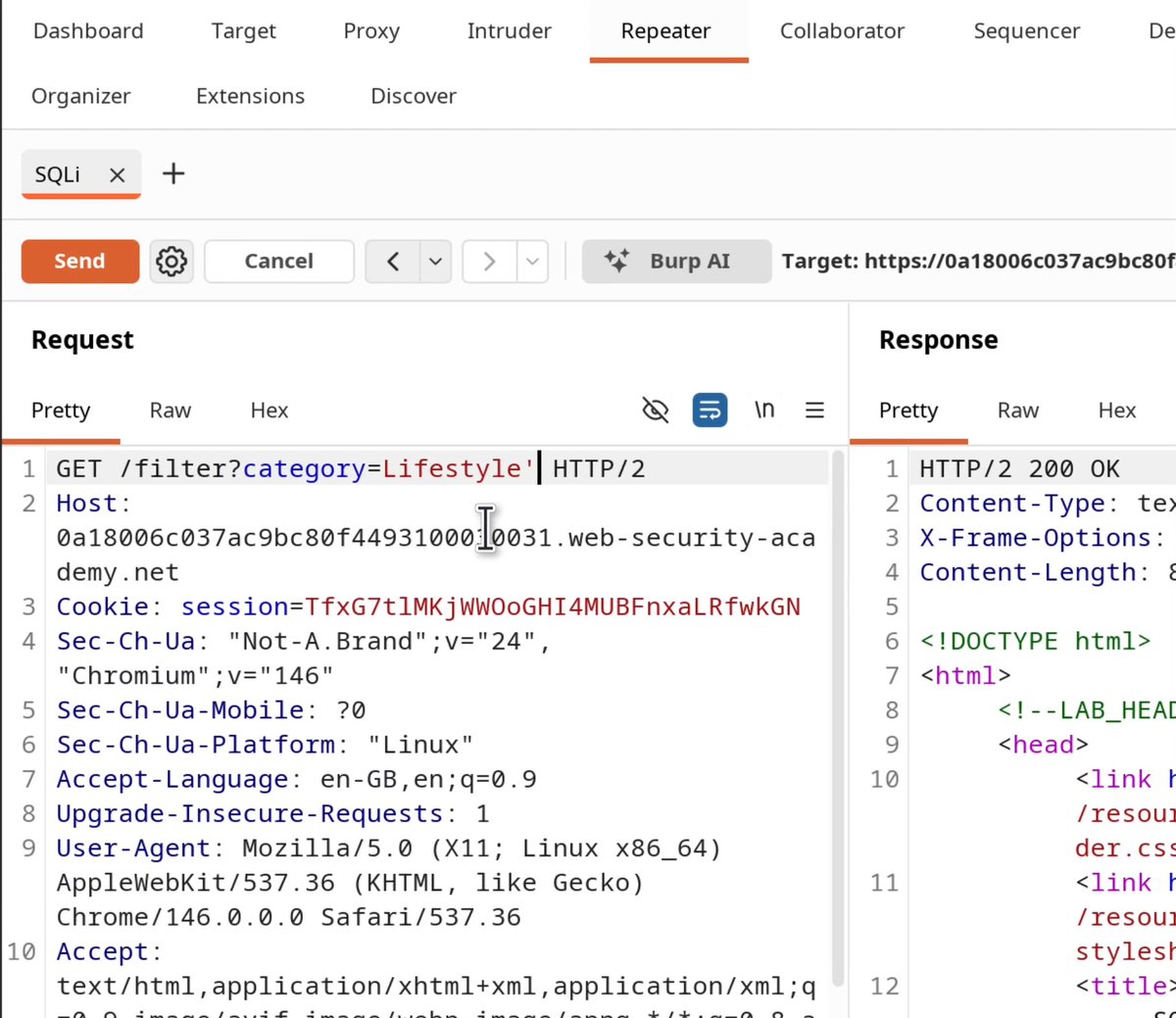
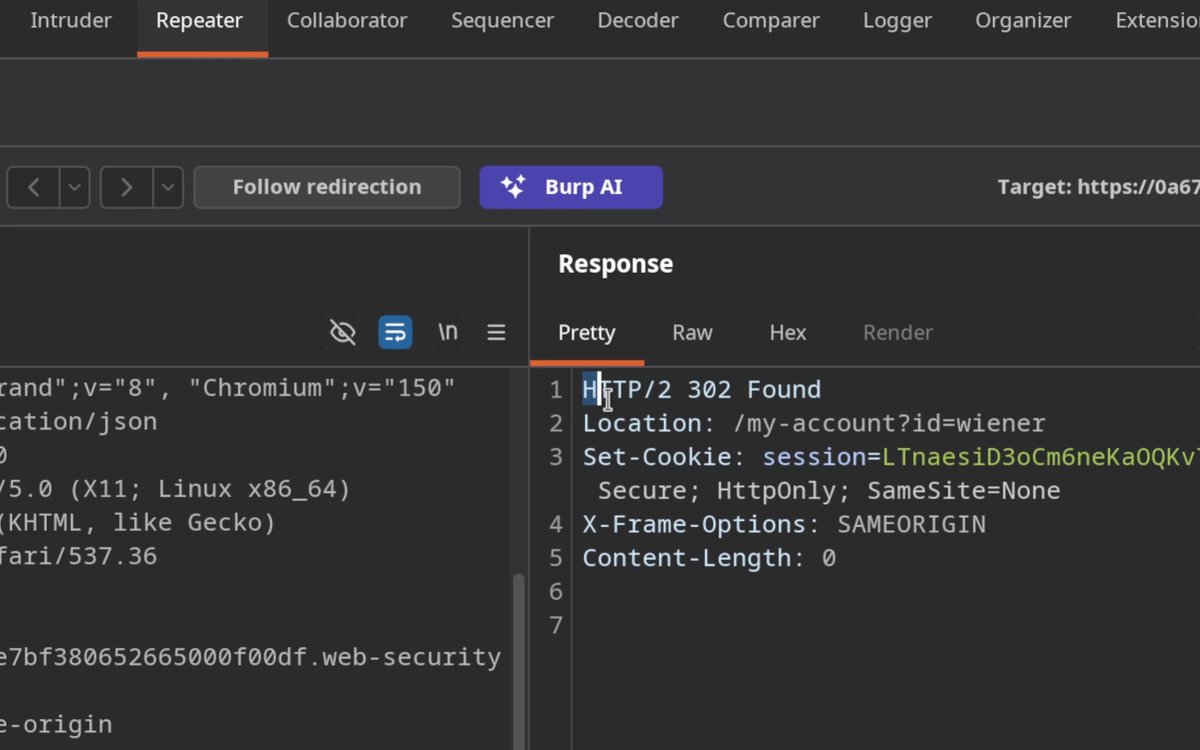
SQL injection! 💉 After finding the number of columns using the NULL trick, you can take it a step further and identify which column takes which data type. Swap 'abc' into one position at a time. The one that comes back without an error is your string column, and...

13,514 views • 12 days ago •via X (Twitter)

5 Comments

Franklin𓆩𓆪Williams's profile picture
Franklin𓆩𓆪Williams11 days ago

Recently completed this one

Web Security Academy's profile picture
Web Security Academy11 days ago

Well done! Thanks for sharing it. Keep it up!

stutm's profile picture
stutm12 days ago

ORDER BY, this unknown. 🙄

Web Security Academy's profile picture
Web Security Academy11 days ago

One of the most useful few words in manual SQLi! Underrated for sure.

yobruh's profile picture
yobruh12 days ago

???

Related Videos

💻🗄️ SQL TUTORIAL FOR BEGINNERS: LEARN HOW DATABASES REALLY WORK ⚠️ EDUCATIONAL DISCLAIMER: This content is strictly for educational purposes, database learning, and cybersecurity awareness. Practice using sample databases, your own projects, or authorized lab environments. Never access, modify, extract, or delete data from databases without explicit permission. Always protect sensitive information and follow applicable laws. 🔍 WHAT IS SQL? SQL (Structured Query Language) is used to communicate with relational databases. It allows developers to retrieve, organize, insert, update, and delete data. ### 🔑 8 SQL CONCEPTS EVERY BEGINNER SHOULD KNOW 1️⃣ Tables and Databases Databases organize information into tables containing rows and columns. For example, a customers table might store customer IDs, names, and email addresses. 2️⃣ SELECT — Retrieve Data Used to choose which columns you want to view. 3️⃣ WHERE — Filter Records Allows you to retrieve records that match specific conditions. 4️⃣ ORDER BY — Sort Results Organizes results in ascending or descending order. 5️⃣ Aggregate Functions Functions such as COUNT(), SUM(), and AVG() help summarize data. 6️⃣ GROUP BY — Organize Data into Groups Groups records with common values so you can calculate totals and statistics for each group. 7️⃣ JOIN — Connect Related Tables Combines related information from multiple tables using matching columns. 8️⃣ Primary and Foreign Keys Primary keys identify records uniquely, while foreign keys help establish relationships between tables. ### 🛡️ WHY SQL MATTERS IN CYBERSECURITY Understanding SQL helps security professionals recognize database risks, investigate application behavior, and understand vulnerabilities such as SQL injection. Developers can reduce SQL injection risks by using parameterized queries, validating input appropriately, and restricting database permissions. 🎯 KEY LESSON: Don't just memorize SQL commands. Understand how data is stored, how queries retrieve it, and how databases should be protected. Start with sample data, practise each concept, and build your skills step by step. 🔐 HACKWITHBANKS | DATABASE & CYBERSECURITY EDUCATION #Hackwithbanks #SQL #tutorial #database #Cybersecurity

Hackswithbanks

25,600 views • 15 days ago

Your agents can't keep up with real-time data. Especially when it's scattered across dozens of sources. Most teams waste weeks building custom connectors for every database, API, and data warehouse. Then they build ETL pipelines to sync everything. By the time your agent retrieves the data, it's already outdated. Picture this: Your Postgres database updated 5 minutes ago. Your MongoDB collection changed 2 minutes ago. Your agent is still pulling from yesterday's snapshot. This is why most production RAG systems fail. There's a better approach: MindsDB is an open-source AI platform with a federated data engine that lets you query multiple data sources in real-time using SQL - without moving any data. Here's what makes it different: ↳ Your data stays in place. No ETL pipelines or data duplication ↳ Query Postgres, MongoDB, REST APIs, and more using consistent SQL ↳ JOIN across different sources in real-time with a unified interface ↳ Works with both structured and un-structured data And here's the best part: You don't even need to write SQL. Just describe what you want in plain English, and MindsDB converts it to SQL automatically. The system does all the heavy lifting. The breakthrough for AI agents is simple: When data updates at the source, your agent gets fresh results immediately. No sync delays. No stale embeddings. No custom code for each integration. You can literally write a SQL query that joins a Postgres table with a MongoDB collection and gets live results. This is what production AI applications need but rarely get. In this video, I give you a complete walkthrough of what we just discussed and how to actually do it. Make sure you watch this till the end. I've shared the link to MindsDB's GitHub repo in the next tweet!

Akshay 🚀

65,672 views • 1 year ago

In 2006, Netflix offered $1,000,000 to anyone who could improve their recommendation algorithm by 10%. Over 2,000 teams competed for three years. The team that won did not use more data. They used fewer dimensions. They found a basis - a small set of independent vectors that captured everything important about 100,000,000 movie ratings. The lead mathematician on the winning team: $2,800,000 a year. A machine learning engineer at Spotify building the same kind of system: $245,000 a year. This is MIT 18.06, Lecture 9 - Gilbert Strang. Free on YouTube. Most people think independence is obvious. Two vectors pointing in different directions. Then the definition. Independence means no combination of your vectors gives the zero vector - except the trivial one where all the coefficients are zero. That's it. That's the whole definition. But watch what it unlocks. Watch the moment Strang puts three vectors in a two-dimensional plane. He doesn't even tell you which three vectors. He just draws them. And immediately says: dependent. No question. No calculation. Why? Because three vectors in two-dimensional space means more columns than rows. More unknowns than equations. That always forces a free variable. A free variable always gives a non-zero solution to Ax = 0. And that non-zero solution is a combination of the columns that produces zero. Dependence. "Three vectors in the plane have to be dependent. That's the key fact." Then the basis. A basis is vectors that are independent and span the space. Not too few, not too many. Just right. The pivot columns of any matrix form a basis for the column space. Every other basis you can think of will have exactly the same number of vectors. Then the dimension. All bases for the same space have the same number of vectors. That number is the dimension. The rank of a matrix is the dimension of its column space. The number of free variables is the dimension of the null space. And rank plus null space dimension equals the total number of columns. "I don't take the dimension of A. I take the dimension of the column space of A. If you use those words right, it shows you've got the idea right." A data scientist at Netflix building recommendation engines: $230,000 a year. A quantitative researcher at Two Sigma finding independent factors in financial markets: $350,000 a year. A computer vision engineer at Apple using low-dimensional representations for face recognition: $260,000 a year. They all needed to know how many dimensions were really there. bookmark this and watch later - after this lecture every dataset you look at will feel like a matrix waiting to be reduced to its basis.

Zyphor

14,720 views • 2 months ago