Video wird geladen...

Video konnte nicht geladen werden

Zur Startseite

Stellar is about to hit 24 BILLION total transactions... A glance at Chainspect's official Stellar metrics dashboard paints an impressive picture. $XLM has now processed some 23.9 billion cumulative transactions, dwarfing nearly all other L1 blockchains. The network has also seen 1,199 developer commits in the past month, working...

32,112 Aufrufe • vor 1 Monat •via X (Twitter)

0 Kommentare

Keine Kommentare verfügbar

Kommentare vom Original-Post werden hier angezeigt

Ähnliche Videos

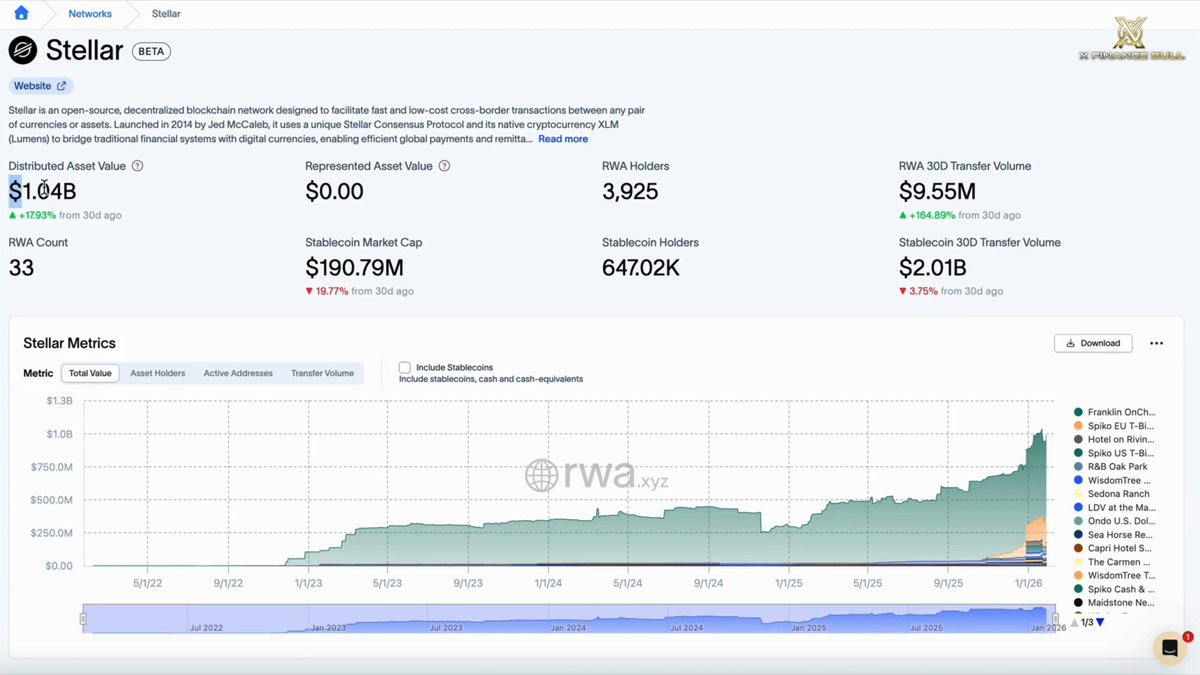
“All the money in the world running through Stellar.” Sleeping on $XLM? Not me. That came directly from Denelle Dixon, CEO and Executive Director of the Stellar Development Foundation. And what makes that statement hit differently in 2026 is what Stellar has already done before the year is even over. Stellar went from roughly: $1B in RWAs in January to $2B in April to $3B in June to $4B by early September. That is a 300% increase in roughly eight months. But I don't read Denelle's statement as: “every dollar in the world becomes XLM.” I read it as something much bigger. She wants Stellar underneath the movement of money itself. Look at what is already happening. Franklin Templeton has been running its U.S.-registered BENJI fund on Stellar since 2021. Around $654M sits on Stellar, and BENJI isn't just sitting there anymore. It can move peer-to-peer, distribute yield and has already been used as collateral. DTCC is preparing to connect DTC's Tokenization Service to Stellar in the first half of 2027, with U.S. Treasuries, major ETFs and Russell 1000 securities among the asset classes being evaluated. Then there is the actual money side. MoneyGram launched MGUSD natively on Stellar. USDT0 arrived September 2, connecting Stellar to a unified USDT liquidity pool exceeding $180B across more than 26 networks. Then on September 9, U.S. Bank completed its first cross-border pilot using its own USBDC stablecoin on Stellar between North America and Europe. Around the same period, Nuvanté tested Stellar-based stablecoin clearing through the Bank of England Synchronisation Lab. Now think about what Denelle said again. “All the money.” Treasuries. Funds. Private credit. Real estate. Bank-issued dollars. Stablecoins. Cross-border payments. Cash conversion through MoneyGram. That is starting to look less like one crypto ecosystem and more like different pieces of finance being connected through one network. And $XLM sits underneath Stellar itself. Transactions require XLM fees. Accounts require XLM reserves. Smart-contract resources use XLM. Traditional asset relationships can create additional reserve requirements. Then Stellar also has native exchange and path-payment infrastructure where XLM can participate as intermediate liquidity between assets. That gets more interesting as the number of assets explodes. A network with one stablecoin does not need much routing. A network containing government debt, BENJI, private credit, real estate, USDC, USDT0, MGUSD, USBDC and eventually DTCC-connected securities creates a completely different liquidity environment. And users don't even need to care about XLM. A MoneyGram customer sees dollars. A Franklin Templeton investor sees BENJI. A U.S. Bank client sees bank money. A DTCC participant sees securities. Stellar gets the activity underneath it. That is exactly why I am not sleeping on $XLM. Denelle Dixon isn't talking about making Stellar slightly bigger. She is talking about building infrastructure where money, assets and payments actually run through the network. And 2026 is already showing what the first few billion dollars of that vision look like.

X Finance Bull

37,314 Aufrufe • vor 7 Tagen

If you hold $XRP, $XLM or $HBAR, you need to understand the CLARITY Act before September 15. All three already have one massive thing in common that most people are overlooking. In March 2026, the SEC and CFTC explicitly named XRP, XLM and HBAR as examples of “digital commodities.” Read that carefully. These three are not entering the CLARITY debate waiting for regulators to decide what category they belong in. The agencies already put them on the commodity side. Congress is now trying to create the actual U.S. market structure around that category. The House passed CLARITY 294–134, with 78 Democrats voting yes. The Senate Banking Committee advanced its legislation 15–9. The next procedural test is scheduled for: September 15 at 2:15 p.m. ET. For me, one section deserves far more attention than another generic headline about crypto exchanges. The Senate framework addresses banks using blockchain and digital assets for activities they already perform: payments lending custody trading Think about those four words beside these three networks. $XRP Ripple already has institutional payments, RLUSD, tokenized assets, custody infrastructure and developing lending/collateral markets around XRPL. BNY holds RLUSD reserves. DBS + Franklin Templeton + Ripple are working around tokenized funds on XRPL. Aviva Investors is working with Ripple to bring traditional fund structures onto XRPL. XRP itself can also function as the auto-bridge between assets when that route provides better liquidity. Then $XLM. Stellar already crossed $3B in RWAs, has 10.7M+ active accounts, and processed $11.4B in stablecoin transfers during Q2. Franklin Templeton has more than $650M of BENJI represented on Stellar. DTCC plans to connect its tokenization service to Stellar, with stocks, ETFs and U.S. Treasuries among the assets being evaluated. U.S. Bank + PwC + Stellar Development Foundation are also testing custom stablecoin issuance. And every Stellar transaction uses XLM for network fees and resource requirements. Then $HBAR. Through Archax, Hedera has already hosted 100+ tokenized assets and over $300M in tokenized value, including exposure connected to State Street, Fidelity International, Legal & General and Aberdeen. Lloyds Banking Group, Aberdeen and Archax have also used Hedera-based tokenized assets as collateral for FX transactions. And Canary’s U.S.-listed HBAR ETF reported 663.2M HBAR held and staked at June 30. Every public Hedera transaction ultimately pays network fees in HBAR. Now add one more date: October 27. Ripple Swell. Canary. DBS. State Street. PwC. Robinhood. BNY. Aviva. These aren’t institutions isolated inside one ecosystem. Some already touch two or even all three sides of this multi-chain financial buildout. That is what has me locked in. CLARITY could give banks the rulebook. The infrastructure is already being built. And $XRP, $XLM and $HBAR already sit inside the federal digital commodity category. September 15 could be a much bigger date for this trio than the market realizes. LOCKED TF IN!

X Finance Bull

332,074 Aufrufe • vor 9 Tagen