Video wird geladen...

Video konnte nicht geladen werden

Zur Startseite

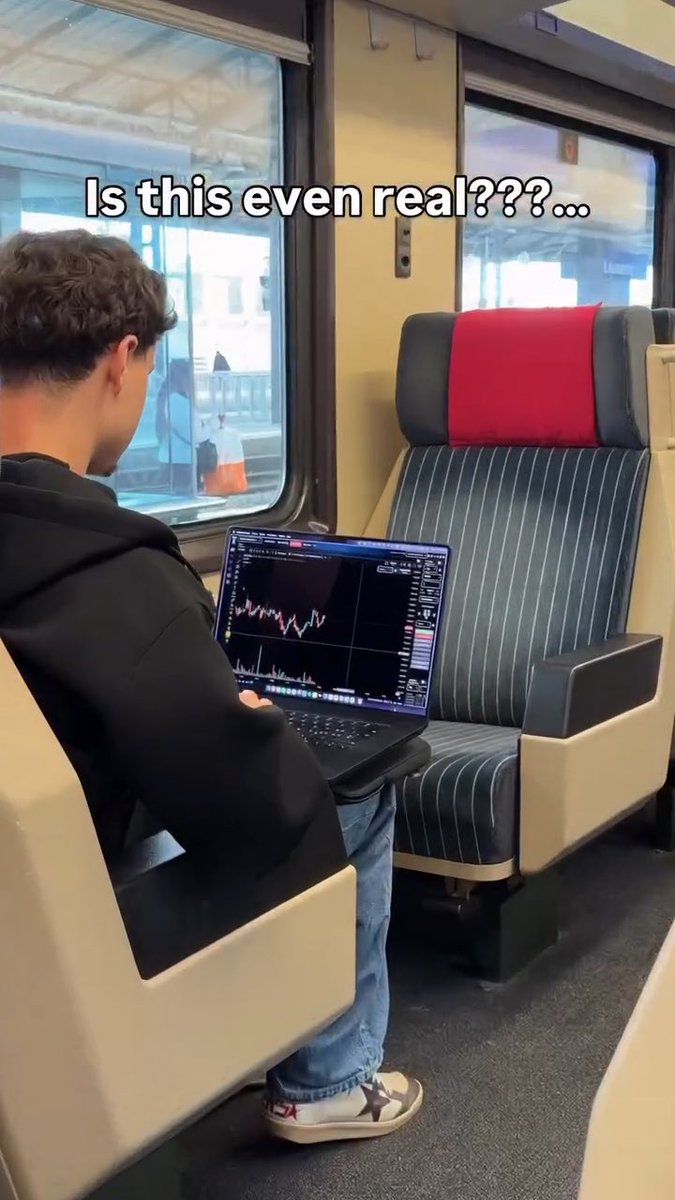
Stop trading manually like a caveman. If you can type, anyone can copy my Polymarket high-frequency bot. I didn’t write a single line of code. I built a top-tier strategy just by “chatting” with AI,one that self-debugs, self-repairs, and even uses “large model decision-making + small model monitoring”. This...

73,559 Aufrufe • vor 6 Monaten •via X (Twitter)

0 Kommentare

Keine Kommentare verfügbar

Kommentare vom Original-Post werden hier angezeigt

Ähnliche Videos

At the BNB Chain hackathon, CZ 🔶 BNB made several very important points about AI trading (Everything in parentheses is my own view and judgment.) He first said that AI will be involved in trading everywhere. Trading itself is already a huge market: there are 300 million users on Binance alone, and if you add the decentralized ecosystems, that number is not small either. In such a mass-market environment, many different trading strategies can work, with countless different coins, different projects, and different ways to play. But there is a big problem here: building commercial AI trading platforms for retail users is actually very hard. If a trading strategy works very well for one person, once a billion people start using the same strategy, that strategy “might still work, or might stop working.” Take copy trading / follow trading as an example: if you buy first and everyone follows you, the first buyer will perform very well, but the last person to follow may not end up with good results. So, with the exact same strategy and the exact same copy logic, the outcomes can be completely different for different people. (On top of that, every strategy also has its own capital capacity limits.) Teams that can really build strong AI are, with high probability, going to trade with their own money. In today’s world, money itself is already somewhat like a “commodity”; many people have a lot of capital, and it’s actually not that hard to raise funds. If you truly have an algorithm that can make a lot of money, it’s not hard to get money and run your own book. There is really only one situation where you would sell this algorithm to mass-market users: for example, if you charge a $10 monthly subscription and can sell it to one million users, then your $10 million monthly subscription revenue is higher than the profit you could make by trading the strategy yourself. (Here this touches one of our earlier theses: as training AI models becomes relatively easier and the supply of models increases, model companies have more incentive to open-source. By analogy, as the production process of trading strategies is increasingly simplified by AI and the supply of strategies explodes, traders will have stronger incentives to monetize by expanding their influence in other words, by “open-sourcing” their strategies.) Of course, CZ did not say that this model can never work. Another path is to build an AI trading platform that lets users tune different AI algorithms, or very easily assemble their own structures and strategies, so that what each person ends up running is different and better tailored to themselves. Some people will make money, some people will lose money, but the platform still has value because it’s very hard for most people to build an AI trading algorithm from scratch. So there are a lot of trade-offs here; it’s not as simple as saying “once AI shows up, everything automatically gets better.” (This is exactly what we presented at the hackathon: you describe your own strategy in natural language, and the AI automatically generates a workflow. The parameters in that workflow, the models used, the logical structure, the APIs it calls, and even the algorithms it invokes are all customizable. The reasons we think workflows are a good way to do this include: controllable execution paths, Lego-like modular nodes, and better visualization that makes it easier for users to build and adjust their workflows.) Finally, his conclusion was very clear: it’s not that AI will definitely make trading better, and it’s not that AI will definitely make things worse. Rather, no matter what, in the future a huge number of people will use AI to trade. This will be a very large field, and whoever can build the best algorithms will make a lot of money.

Tykoo

25,535 Aufrufe • vor 8 Monaten

I'm teaching a new course! AI Python for Beginners is a series of four short courses that teach anyone to code, regardless of current technical skill. We are offering these courses free for a limited time. Generative AI is transforming coding. This course teaches coding in a way that’s aligned with where the field is going, rather than where it has been: (1) AI as a Coding Companion. Experienced coders are using AI to help write snippets of code, debug code, and the like. We embrace this approach and describe best-practices for coding with a chatbot. Throughout the course, you'll have access to an AI chatbot that will be your own coding companion that can assist you every step of the way as you code. (2) Learning by Building AI Applications. You'll write code that interacts with large language models to quickly create fun applications to customize poems, write recipes, and manage a to-do list. This hands-on approach helps you see how writing code that calls on powerful AI models will make you more effective in your work and personal projects. With this approach, beginning programmers can learn to do useful things with code far faster than they could have even a year ago. Knowing a little bit of coding is increasingly helping people in job roles other than software engineers. For example, I've seen a marketing professional write code to download web pages and use generative AI to derive insights; a reporter write code to flag important stories; and an investor automate the initial drafts of contracts. With this course you’ll be equipped to automate repetitive tasks, analyze data more efficiently, and leverage AI to enhance your productivity. If you are already an experienced developer, please help me spread the word and encourage your non-developer friends to learn a little bit of coding. I hope you'll check out the first two short courses here!

Andrew Ng

1,224,810 Aufrufe • vor 2 Jahren

New Paper! Darwin Godel Machine: Open-Ended Evolution of Self-Improving Agents A longstanding goal of AI research has been the creation of AI that can learn indefinitely. One path toward that goal is an AI that improves itself by rewriting its own code, including any code responsible for learning. That idea, known as a Gödel Machine, proposed by Jürgen Schmidhuber over two decades ago, is a hypothetical self-improving AI. It optimally solves problems by recursively rewriting its own code when it can mathematically prove a better strategy, making it a key concept in meta-learning or “learning to learn.” While the theoretical Gödel Machine promised provably beneficial self-modifications, its realization relied on an impractical assumption: that the AI could mathematically prove that a proposed change in its own code would yield a net improvement before adopting it. Sakana AI, in collaboration with Jeff Clune’s lab at UBC, proposes something more feasible: a system that harnesses the principles of open-ended algorithms like Darwinian evolution to search for improvements that empirically improve performance. We call the result the Darwin Gödel Machine. DGMs leverage foundation models to propose code improvements, and use recent innovations in open-ended algorithms to search for a growing library of diverse, high-quality AI agents. Applied to practical tasks, we implemented Darwin Gödel Machine as a self-improving coding agent that rewrites its own code to improve performance on programming tasks. It creates various self-improvements, such as a patch validation step, better file viewing, enhanced editing tools, generating and ranking multiple solutions to choose the best one, and adding a history of what has been tried before (and why it failed) when making new changes (see the attached video). We believe that Darwin Gödel Machines represent a concrete step towards AI systems that can autonomously gather their own stepping stones to learn and innovate forever!

hardmaru

104,854 Aufrufe • vor 1 Jahr

.Naval: The easiest way to see that AI is not taking jobs but creating opportunities is to go learn AI and then reapply for the job that rejected you. Watch how they pull you in. “My last startup, Airchat, could not have existed without AI because we needed the transcription/translation. And even the current thing I’m working on—it’s not an AI company, but it cannot exist without AI. It is relying on AI. Even at AngelList, we’re significantly adopting AI. Like everywhere you turn, it’s more opportunity, more opportunity, more opportunity. And people like to go on Twitter—or the artist formerly known as Twitter—and basically, they like to exaggerate. Like, ‘Oh my God, we’ve hit AGI.’ ‘Oh my God, I just replaced all my mid-level engineers.’ ‘Oh my God, I’ve stopped hiring.’ To me, that’s moronic. The two valid perspectives are the one-man entrepreneur shows, where there’s one guy or one gal, and they’re scaling up like crazy thanks to AI. Or there are people who are embracing AI and being like, ‘I need to hire, and I need to hire anyone who can even spell ‘AI’—anyone who’s even used AI. Just come on in, come on in.’ Again, I would say the easiest way to see that AI is not taking jobs but creating opportunities is this: go brush up on your AI, learn a little bit, watch a few videos, use the AI, tinker with it, and then go reapply for that job that rejected you. Watch how they pull you in.”

Arjun Khemani

167,746 Aufrufe • vor 1 Jahr