正在加载视频...

视频加载失败

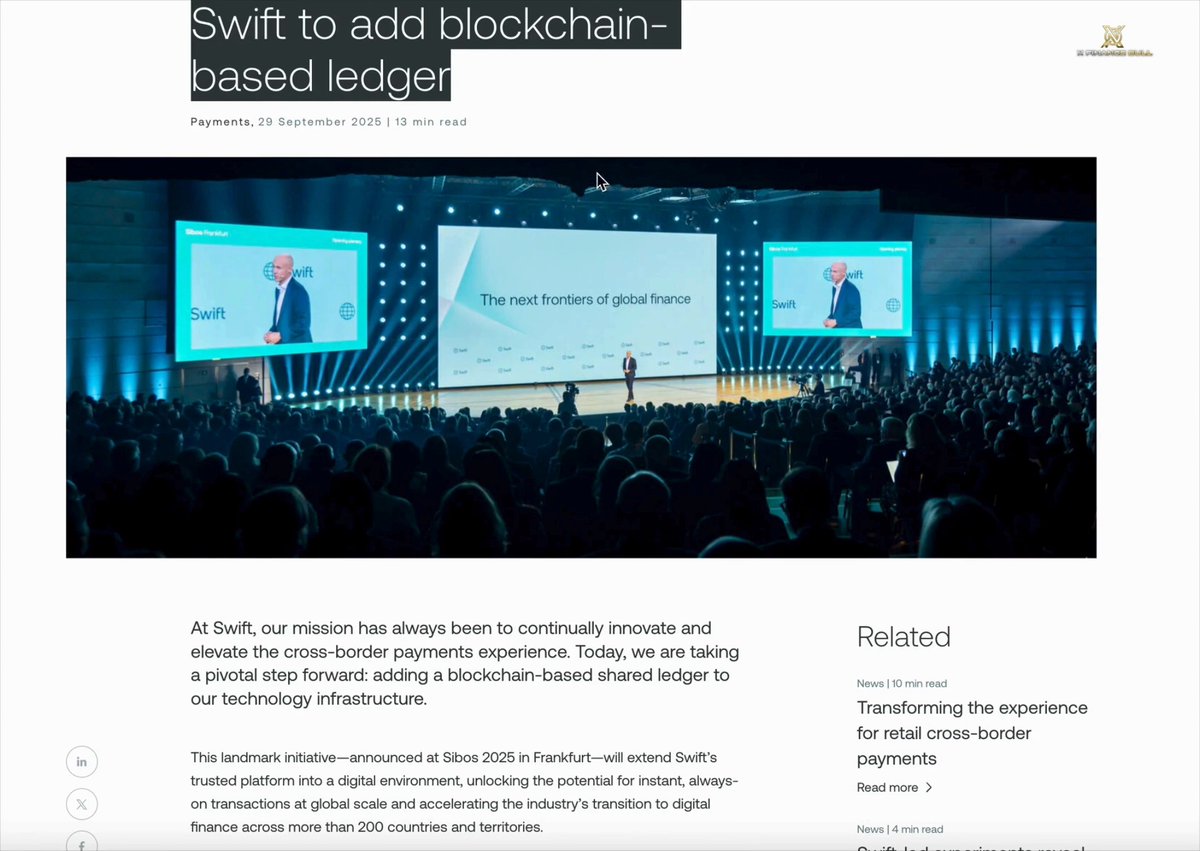
SWIFT is building something much bigger than another payment upgrade. The deeper I look at where this is going, the more bullish I get on $HBAR, $LINK and $XRP. Go back to what Alisa DiCaprio said at HederaCon 2025. Stablecoins were exploding. New financial instruments were multiplying. Banks were...

370,739 次观看 • 5 天前 •via X (Twitter)

35 条评论

STU ⬡ 的头像
STU ⬡4 天前

XRP has zero to do with Swift but you insist on just throwing that ticker into everything.

Scopuly - Stellar Wallet 的头像
Scopuly - Stellar Wallet5 天前

How about XLM?😰

X Finance Bull 的头像
X Finance Bull4 天前

Nothing on XLM in this specific case. Still one worth keeping on the radar.

Warren Gilbert 的头像
Warren Gilbert4 天前

XRP already has clarity. The other 2 do not.

Edward 的头像
Edward5 天前

My favourite word ‘fragmentation’

X Finance Bull 的头像
X Finance Bull4 天前

Haha, it does sum up the problem pretty well.

JayTxV 的头像
JayTxV4 天前

$QNT focuses on fragmentation heavily , and is beautifully addressed with their Overledger. Link is cool but QNT I personally feel is better positioned

Jan Nieuwenhuijs 的头像
Jan Nieuwenhuijs5 天前

@grok does Hedera have official ties to Swift?

X Finance Bull 的头像
X Finance Bull4 天前

@grok Not directly, from what I’ve seen. Hedera’s connection here is more about the interoperability discussion.

Tripl M 的头像
Tripl M4 天前

HBAR & XRP will have the greatest ROIs known in ALL HISTORY OF FINANCIAL COLLATERALS.

X Finance Bull 的头像
X Finance Bull4 天前

HBAR and XRP both have a lot going for them. Exciting few years ahead.

Ariya 的头像
Ariya5 天前

It’s all comes down to speed, cost and liquidity efficiency XRP ledger win over SWIFT cross border payments.

KhaiDao 的头像
KhaiDao5 天前

alisa's comments were about tokenized deposits and on-chain settlement rails, not just stablecoin volume. hbar's tps is still under 2k

INCITE AI 的头像
INCITE AI5 天前

ripple:native near 1.40 already reflects a lot of SWIFT hype, and it is still ~64% under its 3.84 peak. Rails can grow while token prices stall or lag.Rails help winners, not whole baskets. Watch actual SWIFT-linked settlement volume per chain before going all-in on HBAR, LINK or XRP.

Galactic Ambassador•Way Shower•System Buster 的头像
Galactic Ambassador•Way Shower•System Buster4 天前

The Internet of Value. ALL THE MONEY !! The QFS QUANTUM FINANCIAL SYSTEM ISO20022 XRP, HBAR, ALGO, XPR, XLM, XDC, FLR, etc. The GOLDEN AGE The Age of AQUARIUS THIS IS BIBLICAL. Be the LIGHT.

mike 的头像
mike4 天前

HBAR or XRP arent used by them.

Tanaka 的头像
Tanaka5 天前

I think future payments will start from two endpoints: bank accounts and wallets. Different starting points mean different rails. Bank flows may use SWIFT; wallet flows may not need it. But both could ultimately converge on the same liquidity and settlement layer.

HenriPcr 的头像
HenriPcr3 天前

As expected, SWIFT is now showing their cards. They are in it for the WIN. Yes, they will have to support and will have to tolerate XRP/ XLM etc playing in their back yard. HOWEVER, the big surprise will be the IMPACT the Ripple dynasty will exert in the BRICS countries, 70+ percent of business activities take place in that region. These folks have been fuckked over by the USA and SWIFT and they (US/SWIFT) won't be allowed to play with the same rules the the XRP / XLM etc dynasty. You heard it here first!! This is how the turf will be divided.

Nexus Prime 的头像
Nexus Prime5 天前

The part worth watching is whether Ethereum flows changes positioning, not just the headline cycle.

Cash Farm 的头像
Cash Farm4 天前

Man, are you serious? Xrp? That’s a scam. They don’t have anything of their own; everything they implemented was based on other developers’ technologies, not their own.

ASSET. 的头像
ASSET.5 天前

The bigger question isn't which token wins. It's what happens when banks issue tokenized deposits across different currencies, ledgers and networks. Issuance is becoming easier. Interoperability can connect the rails. But someone still has to provide liquidity between them. That may be where the real infrastructure battle begins.

Michael Vu 的头像
Michael Vu4 天前

The chances of them passing the clarity act this sept 15 is very slim

Chef 的头像
Chef4 天前

This is what I was just talking about Bull. Just needs time. That’s all.

X Finance Bull 的头像
X Finance Bull3 天前

The fact SWIFT is building for interoperability tells me they already know one network won’t handle everything.

Chef 的头像
Chef3 天前

I agree.

T.B. 的头像
T.B.4 天前

It doesn't fucking matter the Carity Act will never pass because the Goble Elite will never let it happen. The banks are part of the Elite's playground for total control. Congress doesn't work the people, they are told what and when to vote in return, they will get paid.

DrBeaudoin 的头像
DrBeaudoin4 天前

No love for xlm???? Am disappointed bro!

PRV-QFSGOLDEN 的头像
PRV-QFSGOLDEN4 天前

👍👍👍

Chris 的头像
Chris5 天前

XRP IS NOT INVOLVED AND NEVER WILL BE! @Xfinancebull

Akinoci Tomas 的头像
Akinoci Tomas5 天前

Hedera?

Jaxxon Empire 的头像
Jaxxon Empire3 天前

Whats the best way to hold link on eth but the gas fees are crayz right

Darley Technologies 的头像
Darley Technologies4 天前

Tokenized deposits settling 24/7 raise a live question for European desks: how derivatives and hedging price against instruments that never stop trading. MiCA gives clarity on the asset side, but the market structure for round-the-clock settlement is still forming.

⭐HEDERADELICA⭐ℏ 的头像
⭐HEDERADELICA⭐ℏ4 天前

And Hedera will have CLPR., connecting all chains.

✨Chosen Superstarseed ✨ 的头像
✨Chosen Superstarseed ✨4 天前

She said Trickey! lol ✨💪👀🤠

Costa Sfetsos 的头像
Costa Sfetsos3 天前

Bananas re SWIFT 😆

相关视频

Watch this carefully, $XRP holders 🚨🚨🚨 Tokenized Podcast is talking about the exact headache that gets bigger as tokenized finance explodes. Darko Hajdukovic of London Stock Exchange isn't questioning whether stablecoins or tokenized securities will exist. He's asking what happens after they exist. That's a much bigger conversation. Picture the financial system a few years from now. One bank has a tokenized deposit. Another has a stablecoin. An asset manager has tokenized Treasuries. Another institution owns a tokenized money-market fund. A company in Mexico needs dollars. A company in Europe needs another currency. Everything is digital. Great. But now somebody still has to connect all of it. The security has to meet the cash. The cash has to reach the correct currency. Collateral has to move when markets are closed. Different systems need to agree that settlement actually happened. Darko talks about programmable payments, programmable settlement, reducing reconciliation and avoiding unnecessary prepayment. Then Simon Taylor points out that the same stablecoin can serve completely different purposes depending on who is using it. That tells me the future isn't one stablecoin swallowing everything. It's many forms of digital money existing together. And Ripple is already positioning around exactly that environment. RLUSD gives Ripple regulated digital-dollar liquidity. Ripple explicitly calls it the cash leg for delivery-versus-payment transactions. XRP Ledger gives the assets somewhere to issue, trade and settle. Then XRP sits natively inside XRPL's liquidity system. If two assets don't have enough direct liquidity, XRPL can route through XRP. Think about what that becomes as more assets arrive. RLUSD → XRP → MXNB Digital dollar liquidity connecting to Mexican digital money. And Bitso is already bringing MXNB onto XRPL for the U.S.–Mexico corridor. Now add capital markets. Ondo Finance's OUSG is already on XRP Ledger with RLUSD available for 24/7 minting and redemption. DBS, Franklin Templeton and Ripple are connecting sgBENJI, RLUSD and XRPL for tokenized fund trading and potential lending/collateral activity. ZILO and Licuido add transfer agency, issuance and collateral mobility. Ripple Mint adds institutional RLUSD minting and redemption infrastructure. Piece by piece, you can see what is being assembled. -Cash. -Assets. -Settlement. -Collateral. -FX. -Liquidity. And this is why the explosion of stablecoins makes me more bullish on $XRP, not less. If the world had one digital currency, connecting liquidity would be simple. But that's not what these institutions are describing. They are describing a world containing bank money, stablecoins, local currencies, tokenized deposits, securities and collateral across different systems. Every extra asset creates another route. Every extra currency creates another market. Every fragmented pool of liquidity creates another reason for routing software to search for the best bridge. XRP does not need to be what the institution ultimately wants. The institution may want dollars. -Pesos. -Treasuries. -A money-market fund. XRP can simply exist in the middle long enough to connect them. That is the version of XRP adoption I think people still underestimate. The customer sees the destination. The infrastructure figures out the route. And if tokenized finance keeps heading toward 24/7 settlement, that routing problem only gets larger. So ask yourself this👇 When thousands of digital assets need liquidity between them, what sits in the middle?

X Finance Bull

34,237 次观看 • 3 天前

🌋 WARNING: Banks Have Begun Tokenizing Deposits. This Is the $100T Moment. Banks are moving beyond stablecoins toward tokenized bank deposits. Programmable money, inside the existing banking system. Networks and developments covered: XRPL / XRP Positioned as neutral liquidity and settlement for tokenized assets, stablecoins, and institutional payments. Learn 12 things about XRP in today's video. Canton Network / CC Lloyds Banking Group and Archax completed the UK’s first public blockchain settlement using tokenized deposits on Canton. DTCC, Nasdaq, and JPMorgan are aligning around this regulated market infrastructure. Hedera / HBAR Enterprise and government adoption is driving internal consolidation to reduce friction and accelerate real deployments. Fortune 500 companies are actively choosing Hedera. Quant / QNT Deeply embedded in sovereign and banking rails, openly discussing tokenized deposits as core commercial bank money. Solana / SOL Powering regulated stablecoin and public-sector deployments, including the first U.S. state-issued stablecoin via the Wyoming Stable Token initiative. Chainlink / LINK The data layer. Embedded across almost ever recent major announcement, enabling on-chain data, interoperability, and market infrastructure workflows. Tokenized deposits are bringing programmability into the traditional system, global financial infrastructure is upgrading in real time!!! Mentions: Ripple RippleXDev Canton Network Hedera Archax Archax Crypto @quant_network Gilbert Verdian Solana vibhu Chainlink Wyoming Stable Token Commission

Ryan (King) Solomon

24,147 次观看 • 8 个月前

CLARITY Act Intel 🚨 Don't let a 76-Day Political Fight SHAKE you out of a 250-YEAR FINANCIAL SHIFT $XRP, $XLM, $HBAR, and other American-made digital asset investors, listen closely to Congressman Bryan Steil, Chair of the House Financial Services Subcommittee on Digital Assets. This is the part of the CLARITY Act conversation I think people are missing. Everyone is staring at one vote. Bryan Steil is talking about the financial system that is being built underneath it. That is a completely different time horizon. The headlines right now are naturally focused on whether CLARITY can move through the Senate. September 15 matters. The Senate procedural vote matters. The political negotiations matter. But Steil’s bigger argument is that people are making a mistake if they assume: “If Washington struggles with CLARITY today, blockchain finance somehow stops tomorrow.” It does not. That is what caught me. He is looking at this as a technology transition, not a weekly trading narrative. The political fight is temporary. The infrastructure being built is not. And that is exactly why I keep coming back to $XRP, $XLM and $HBAR. Not because Congress created some official “Made in America” basket. It did not. The stronger fact is that all three already have deep U.S. roots, all three are being built around actual financial infrastructure, and all three are already explicitly named in the current U.S. digital-commodity framework. That changes how I look at this entire moment. For years the question around crypto in America was: Will regulators even allow this industry to exist? Now the conversation is turning into: How do we bring this technology into the financial system? That is a massive difference. And Steil’s word for it is perfect: plumbing. People hear “financial plumbing” and think it sounds boring. I hear it and think: That is where the real money eventually moves. Clearing is plumbing. Settlement is plumbing. Collateral is plumbing. Liquidity is plumbing. Custody is plumbing. Bank deposits are plumbing. Tokenization is plumbing. FX is plumbing. Prime brokerage is plumbing. The consumer sees the payment. The institution sees the infrastructure underneath. And that is exactly where these networks are starting to show up. Take $XRP. Ripple in 2026 is not simply trying to convince a bank to send one payment using XRP. Look at the stack being assembled: payments, RLUSD, custody, treasury, prime brokerage, liquidity, tokenization, credit. That is financial infrastructure. Ripple Prime clears more than $3 trillion annually across markets and serves 300+ institutional customers. That is not a retail crypto app. That is institutional machinery. Ripple Prime touches digital assets, FX, fixed-income repo, exchange-traded derivatives and OTC swaps. Then Ripple raised $275 million in investment-grade senior notes to expand its U.S. operation. That tells me Ripple is building for the part of finance institutions actually depend on. And XRP is not sitting outside that strategy. Ripple’s institutional roadmap puts XRP across payments, liquidity and credit markets. That bridge-liquidity role is what I keep coming back to. Because imagine where finance is heading. -RLUSD. -Other dollar stablecoins. -Euro stablecoins. -Peso stablecoins. -Tokenized bank deposits. -Tokenized funds. -Government debt. -Private credit. Different digital forms of money. More assets do not remove the liquidity problem. They multiply it. Someone still has to connect all those pools of value. XRPL can route between tokenized assets. And when XRP provides the better liquidity path, XRP can become the intermediary. Think about the difference between that and retail speculation. A company does not need to wake up and say: “We are bullish on XRP today.” Its software can simply determine: USD token → XRP → MXN token is the better route. The company receives what it wants. The recipient receives what they want. XRP was used because the infrastructure chose it. That is a much more powerful long-term thesis to me. Then you have RLUSD, with approximately $2.396 billion circulating against about $2.518 billion in reserves in the context you provided. Stable digital dollars on one side. Native bridge liquidity through XRP on the other. That is not XRP being replaced. That is the XRP ecosystem becoming more complete. Now move to $XLM. Stellar may be the easiest example of what Steil means by invisible plumbing. The average person does not care which network their bank is using. They care that the money gets there. The institution cares that the system is fast, compliant and integrated with existing operations. And that is already happening. U.S. Bank completed a cross-border pilot using its own USBDC stablecoin on Stellar between North America and Europe. Read that again. A U.S. bank. Its own dollar-backed digital money. Moving across Stellar. And it was not separated from the bank’s existing infrastructure. The pilot connected into finance, risk, compliance and operations. It tested minting. -Payment. -Redemption. -Freezing. -Clawback. Then U.S. Bank and the Stellar Development Foundation started evaluating liquidity management, collateral mobility and cross-border treasury applications. That is the financial plumbing Steil is talking about. It is already being installed. And if Washington needs longer to finish a bill, U.S. Bank does not suddenly forget what it just tested. The technology does not disappear. The institutional learning does not disappear. The infrastructure work does not disappear. Then add DTCC. DTCC oversees more than $114 trillion across U.S. capital markets under the figures in the context. DTC’s Tokenization Service plans to connect eligible DTC-custodied assets with Stellar beginning in the first half of 2027. That means the future can look much less like: “crypto replaces Wall Street” and much more like: Wall Street starts using blockchain underneath parts of its existing machinery. That distinction matters enormously. Treasuries do not need to stop being Treasuries. Funds do not need to stop being funds. Banks do not need to stop being banks. The rails can change underneath them. And XLM remains native to Stellar. Transaction fees use XLM. Account reserves use XLM. Ledger state uses XLM. Smart-contract resources use XLM. The user may never see any of that. They see dollars. A fund. A transfer. A bank account. The network sees Stellar. That is what real infrastructure adoption looks like. Then look at $HBAR. Hedera’s story is different again, but it fits Steil’s argument almost perfectly. Wyoming’s FRNT stable token is live on Hedera. A U.S. state is already using public blockchain infrastructure for digital money. That does not vanish because Congress has a difficult week. Then you have Archax, putting institutional assets on Hedera. Real-time streaming cash flows for tokenized securities. USDC distributions directly to investor wallets. More than 100 tokenized assets and $300M+ in tokenized value in the Hedera case study cited in the context. Then RedSwan. More than $5 billion in tokenized commercial real estate according to Hedera’s case study. And RedSwan helped develop Hedera’s Asset Tokenization Studio. Again, this is not a promise that one day Hedera may find a real-world use case. The infrastructure is already serving government digital money, tokenized securities, real estate and institutional settlement. Then Hedera built the software around it. Stablecoin Studio for regulated digital money. Asset Tokenization Studio for compliant securities. HashSphere for institutions that need private environments while maintaining connectivity toward the broader Hedera ecosystem. And HBAR has a direct role underneath the public network. Every public Hedera service uses HBAR-denominated fees. HBAR also helps secure consensus through proof of stake. So the HBAR thesis is not: “$5B of property means $5B of HBAR gets bought.” The better thesis is: more assets, more issuers, more transfers, more settlement, more compliance operations, more data, more financial activity, more network usage, with HBAR underneath the public network. That is infrastructure. Now put all three together. $XRP. $XLM. $HBAR. Different architectures. Different institutions. Different strengths. But the direction overlaps. Payments. Stablecoins. Tokenized assets. Bank money. FX. Settlement. Institutional liquidity. And all three are already named as digital commodities under the current U.S. framework. That is why I refuse to think about this market only through the lens of one CLARITY vote. September 15 can absolutely matter to market sentiment. But Steil is giving investors a much more valuable way to think. Zoom out. America is deciding whether it wants to lead the technology transition under clear rules. It is not deciding whether the technology gets invented. That horse has already left the barn. The White House has already directed regulators toward integrating digital assets and innovative technology into traditional financial services and payments. Banks are already experimenting. Tokenized securities already exist. Government digital money already exists. Institutional prime brokerage already exists. Stablecoins are already measured in billions. Real estate is already being tokenized. DTCC is already preparing blockchain connectivity. That is why I think the biggest mistake people can make here is confusing: political delay with technological reversal. They are not the same thing. And this is where I think people holding $XRP, $XLM and $HBAR have to know exactly what they own. You are not simply betting on the Senate liking crypto next week. You are looking at networks and ecosystems already being positioned inside a financial system that is becoming increasingly digital. If CLARITY moves quickly, that can accelerate the transition. If Washington takes longer, the infrastructure does not go back into the box. It keeps developing. That is essentially Steil’s point. This is bigger than one election. Bigger than one bill. Bigger than one market candle. The United States is looking at what its financial system could become over the next generation. Bryan Steil literally framed this around 250 years of American financial innovation. That is the time horizon I want to remember when the timeline gets noisy. Because while everyone argues about the next few days: Ripple is building institutional liquidity infrastructure. Stellar is connecting bank money and traditional securities. Hedera is connecting government digital money and regulated tokenized assets. And the federal government already recognizes XRP, XLM and HBAR as digital commodities. That is why my long-term conviction does not disappear because Washington gets messy. The political fight is temporary. The financial rails are already being laid. If those rails eventually carry the next generation of global money, I want exposure to the assets sitting underneath them before that future becomes obvious to everyone. The financial rails are being rebuilt right in front of us. Who else sees it?

X Finance Bull

58,578 次观看 • 19 小时前

🚨🚨🚨 Who do you think drops the next $XRP Ledger BOMBSHELL? Bank for International Settlements and Brazil went public with XRPL. Here’s who I think could be next, and France is at the top of my list. BIS researchers disclosed an XRP Ledger proof of concept. Brazil’s securities regulator disclosed XRPL-related market experimentation. After those two became public, I went back through the institutional connections and stopped asking whether major institutions are looking at XRP Ledger. The better question is: Who is already close enough to XRPL that another public test would actually make sense? When I went country by country, one place stood out immediately. France. 🇫🇷 France is my #1 prediction. Not because Banque de France has announced an XRPL test. It hasn’t. I’m putting France first because several separate pieces are already sitting extremely close to each other. Start with Société Générale-FORGE. SG-FORGE launched its regulated EUR CoinVertible, EURCV, directly on XRP Ledger. That means regulated euro-denominated money from a major French financial institution already exists on XRPL. Then France starts building out its wider tokenization strategy. Banque de France, the AMF and the French Treasury formed a strategic tokenization group. Look at who is involved: Société Générale BNP Paribas Crédit Agricole Euroclear Euronext LCH Amundi BPCE Caisse des Dépôts Ardian And look at what they are studying: tokenized deposits, stablecoins, wholesale central-bank money, tokenized securities, DLT market infrastructure, tokenized investment funds. That is a serious list. These are basically the pieces you need if you want to move traditional capital markets into a tokenized environment. And one of the institutions inside that ecosystem already has regulated euro money on XRP Ledger. That is what keeps France at the top of my list. Then Bpifrance enters. France’s state-backed investment bank said it will use SG-FORGE’s EUR CoinVertible for: capital-market settlement, payments, crypto/fiat activity, treasury operations, liquidity management, and securities activity. Bpifrance did not specify which EURCV blockchain deployment it will use. But the XRPL deployment already exists. So now you have a state-backed institution wanting to use regulated digital euros across capital-market and treasury activity, while that same euro asset already sits on XRP Ledger. That is a connection I’m watching hard. Then Swift shows up in the same chain. Swift and SG-FORGE have already tested tokenized-bond settlement using EURCV. Swift’s job in that experiment was interoperability. It connected tokenized systems with existing financial infrastructure. The public information does not say XRPL handled that specific transaction. I’m not claiming it did. What matters is simpler: Swift already works with SG-FORGE. SG-FORGE already has EURCV. EURCV now exists on XRP Ledger. As tokenized markets grow, somebody has to connect those networks. That is exactly what Swift wants to do. Then there is Pythagore. Banque de France and Euroclear are preparing work around tokenizing France’s roughly €310 billion NEU-CP short-term debt market, with settlement connected to the Eurosystem’s Pontes wholesale-CBDC infrastructure. Now look at what France has in one place: regulated digital euros, tokenized securities, a central bank, a state-backed investment bank, Euroclear, wholesale central-bank money, Swift interoperability, and XRP Ledger already hosting one of the regulated assets involved in that ecosystem. That is why I keep watching the combination of: EURCV + XRPL + Euroclear + Bpifrance + Banque de France + Pontes. I don’t need to say Banque de France secretly picked XRPL. There is no public announcement saying that. My prediction comes from how close the pieces already are. If France eventually reveals some form of XRPL interoperability work, it would make complete sense to me. That puts France at #1. Japan is #2. 🇯🇵 Japan is different because we already have much more direct language. SBI Ripple Asia completed a proof of concept involving tokenized bank deposits and deposit-based digital money. And SBI explicitly said the blockchain contemplated for the system is: XRP Ledger. That line matters a lot. Because a tokenized bank deposit is not just another crypto token. It is bank money becoming digitally transferable. That gets much closer to the money people actually use every day. Then SBI Ripple Asia announced additional work around blockchain financial services and again identified XRPL as contemplated infrastructure. Then SBI Ripple Asia and DSRV began studying blockchain-based remittances and payments between Japan and South Korea. XRPL was again being considered. Then RLUSD launched in Japan under the Japanese regulatory framework. So Japan already has several pieces moving together: Ripple-linked remittances. XRPL contemplated for tokenized deposits. XRPL contemplated for Japan-Korea payment infrastructure. RLUSD operating inside Japan’s regulated market. The next announcement I’m waiting for is not another exchange adding XRP. I’m waiting for a Japanese bank name. A bank publicly participating in XRPL-based tokenized JPY deposits. Or wholesale settlement. Or FX. That would take this story from SBI exploring infrastructure into actual bank-level participation. And that is why Japan sits right behind France for me. Then comes Singapore. 🇸🇬 Singapore almost does not belong on a prediction list anymore because the XRPL connection is already public. Ripple joined the Monetary Authority of Singapore’s BLOOM initiative. Ripple and Unloq are piloting programmable trade-finance settlement using: XRP Ledger + RLUSD + Ripple institutional infrastructure. Unloq’s SC+ system is built on XRPL. RLUSD can be released when trade conditions such as shipment verification are satisfied. That is a real business problem. Goods move. Conditions are verified. Payment settles. And XRPL is part of the infrastructure being tested under an MAS initiative. Then add: DBS + Franklin Templeton + Ripple. Franklin Templeton is tokenizing sgBENJI on XRP Ledger. DBS is exploring using those tokenized assets for collateralized lending and repo activity. So Singapore already has XRPL touching two very different areas: trade-finance settlement, and institutional fund collateral. That is important to me because it shows the ledger is not being pushed into one narrow use case. Different institutions are finding different reasons to use it. For Singapore, I’m not asking who tests XRPL first. I’m watching how far the existing work expands. Then the UAE. 🇦🇪 Dubai Land Department is already issuing tokenized real-estate title deeds on XRP Ledger. The wider Real Estate Tokenization Project includes: Dubai Land Department VARA Dubai Future Foundation Central Bank of the UAE And the program is moving toward secondary-market resale. That progression matters. Issuing a token is one thing. Building a functioning market around it is another. Once you move toward secondary trading, you need: buyers, sellers, identity, custody, settlement, liquidity, transfer rules. That is where tokenization becomes actual market infrastructure. The Central Bank of the UAE is a collaborator in the broader project. That does not mean CBUAE is running an XRPL settlement system. But it does put the central bank beside a government project that already has an XRP Ledger component. So I’m watching the UAE for what comes after tokenization. If the next phase moves deeper into settlement or secondary markets, that is where the $XRP connection becomes much more interesting. Then Hong Kong. 🇭🇰 The HKMA e-HKD Phase 1 pilot included Ripple and Fubon Bank. The work covered tokenized real estate, lending and a hypothetical e-HKD. Ripple later said the property collateral was brought onto XRPL. Its CBDC infrastructure handled the hypothetical digital-HKD side. Ripple also described the private secure ledger behind that solution as being built using the same technology as XRP Ledger. So Hong Kong is already part of this institutional history. It is not some future theory. A regulator-led pilot already involved Ripple, Fubon Bank and XRPL-related infrastructure. Then there is Swift. This is the one I think people can easily take too far. I am not predicting: “Swift replaces everything with XRP Ledger.” That is not the thesis. Swift has its own blockchain-related work, including infrastructure developed with Consensys. What interests me is interoperability. Swift wants to connect tokenized networks with traditional finance. That becomes more important every time another bank, fund, stablecoin or central-bank system chooses a different technical stack. And Swift has already worked with SG-FORGE’s EURCV. EURCV now lives natively on XRPL. So the question I’m watching is simple: What happens when Swift needs to orchestrate a transaction involving an asset that happens to live on XRP Ledger? Swift’s wider blockchain initiative involves more than 30 major financial institutions. The names include: BNY Bank of America JPMorgan Citi HSBC Deutsche Bank BNP Paribas Société Générale-FORGE MUFG Mizuho DBS Standard Chartered Santander BBVA Wells Fargo RBC UOB ANZ And 17 banks are preparing tokenized-deposit pilots through Swift infrastructure. Think about how messy that world can become. One bank issues tokenized deposits on one network. Another bank uses another system. A fund sits on a public blockchain. A stablecoin exists across multiple networks. A central bank settles through wholesale CBDC infrastructure. Someone has to connect all of that. Swift wants to be that orchestration layer. XRPL does not need to replace Swift for this to matter. It only needs to become one of the networks carrying regulated assets Swift’s members need to reach. SG-FORGE and EURCV already give that possibility a very obvious entry point. That is why Swift-linked institutions are #3 on my list. Then I look at the United States. 🇺🇸 The U.S. story is less about a central-bank pilot and more about what is already gathering around XRP Ledger. BNY is the primary custodian for RLUSD reserves. Guggenheim Treasury Services has digital commercial paper issued natively on XRPL through Zeconomy. Ondo OUSG gives institutions tokenized U.S. Treasury exposure on XRPL. Securitize is integrating with XRP Ledger. Ripple and Securitize also created RLUSD functionality around holders of BlackRock BUIDL and VanEck VBILL. I’m not turning that into: “BlackRock secretly runs on XRPL.” That is not what the public information says. The more useful point is that several pieces institutions actually care about are getting closer to the same ecosystem: -cash -Treasuries -commercial paper -funds -custody -tokenization -settlement That looks much more like capital-market infrastructure than the crypto market most people still picture when they hear XRP. And XRPL itself has been changing at the same time. Credentials help institutions verify who is allowed to participate. Permissioned Domains allow controlled environments. Permissioned DEX allows regulated trading logic inside credential-gated markets. Then you have: RLUSD tokenized Treasuries money-market funds commercial paper lending infrastructure collateral infrastructure That matters because tokenizing an asset is only the beginning. Institutions need to know who can own it. Who can trade it. Where it settles. What collateral value it has. How cash moves against it. How liquidity works after issuance. XRPL is adding the pieces for those questions at the same time institutions are trying to answer them. That timing is one reason I’m paying so much attention. South Korea stays on my radar too. SBI Ripple Asia and DSRV are already studying Japan-Korea blockchain payments and remittances with XRPL contemplated as the blockchain foundation. That does not give us a major South Korean XRPL announcement yet. But it puts South Korea inside the regional infrastructure conversation before a bigger public reveal has happened. If a Korean institution later appears in an XRPL-related pilot, I would not treat it like it came from nowhere. And there is another reason I think more announcements are possible. Ripple already has a history of working with governments and central banks through XRPL-derived technology. Bhutan’s Royal Monetary Authority used Ripple’s private ledger based on XRPL technology for CBDC work. Colombia’s Banco de la República worked on a high-value payments pilot using Ripple’s CBDC Platform based on XRPL core technology. The National Bank of Georgia selected Ripple for the Digital Lari pilot. Palau ran a government-backed stablecoin pilot directly on public XRP Ledger. Ripple has also referenced CBDC work involving Montenegro and Hong Kong. Different countries. Different use cases. Different implementations. But the history tells us something useful. Institutional work can begin inside a controlled environment. Sometimes it uses private infrastructure derived from XRPL. Sometimes public XRP Ledger appears directly. And sometimes the wider market only hears about the work after it has already been underway. That is why I do not look at BIS and Brazil as two random XRP headlines. BIS researchers disclosed a public-XRPL proof of concept. Brazil’s securities regulator tested an XRPL-native DEX architecture. Those are completely different problems. BIS used XRPL around official-data verification. Brazil used XRPL around securities-market structure. Then Singapore uses it for trade finance. Dubai uses it for tokenized property. Japan contemplates it for bank deposits and payments. France has regulated euro money issued on it. The U.S. has commercial paper and Treasuries touching it. The UK has Aviva Investors preparing traditional fund tokenization on XRP Ledger. That spread is what changes the thesis for me. I don’t want one giant use case carrying the whole XRP Ledger story. I want different institutions in different countries solving different problems with the same underlying technology. That is what infrastructure is supposed to look like. Official information. -Bank money. -Trade finance. -Property. -Securities. -Stablecoins. -Funds. -Treasuries. -Commercial paper. -Payments. -Settlement. -Interoperability. Those are not one market. Yet XRPL keeps showing up around them. There is also a reason I separate France and Japan from Singapore, Dubai and Hong Kong. Singapore, Dubai and Hong Kong have already given us public evidence of XRPL-linked work. They are not pure guesses anymore. France and Japan are different kinds of bets. France has the densest cluster of institutions, regulated money and interoperability projects sitting beside XRP Ledger without a public Banque de France XRPL announcement. Japan already has SBI Ripple Asia openly naming XRPL as contemplated infrastructure, but the next bank-level participant has not been publicly named in the information we have. That is why those two stand out. And Swift sits between them because its job becomes more important as every country builds its own tokenized money and asset networks. The more fragmented the new system becomes, the more valuable interoperability becomes. That is why I keep watching the connections instead of waiting for a perfect headline. One announcement rarely tells the whole story. A stablecoin launch can look small by itself. A tokenized-deposit proof of concept can look separate. A central-bank project can look unrelated. A securities pilot can look like another isolated experiment. But when those pieces start sharing the same institutions, assets and infrastructure, the picture changes. For me, that is exactly what is happening around XRPL in 2026. The strongest signal is not that every project uses XRP Ledger in the same way. It is that very different parts of finance keep finding a reason to touch the same technology. That is the kind of pattern I would rather watch early than explain after the next institution finally makes its work public. So if I had to rank the next places today: #1 France Regulated EURCV is already on XRPL. Banque de France, AMF and French Treasury are coordinating tokenization work. Société Générale, BNP Paribas, Crédit Agricole, Euroclear, Euronext, LCH, Amundi, BPCE, Caisse des Dépôts and Ardian are inside that conversation. Bpifrance wants EURCV for capital markets, treasury and liquidity activity. Swift already works with SG-FORGE and EURCV. Banque de France and Euroclear are preparing Pythagore around the €310B NEU-CP market and Pontes. That is a lot of regulated infrastructure converging around tokenized finance in one jurisdiction. #2 Japan SBI Ripple Asia has already publicly named XRP Ledger in tokenized-deposit work. It has also contemplated XRPL for other financial services and Japan-Korea payments with DSRV. RLUSD is live in Japan. The missing piece I’m waiting for is the Japanese bank name. #3 Swift-linked institutions Not because Swift needs to become XRPL. Because Swift needs to connect assets wherever they live. And regulated assets now live on XRP Ledger. After those three, I’m watching: Singapore for expansion. The UAE for deeper settlement activity. Hong Kong for another regulator-linked phase. The United States for institutional capital-market integration. South Korea for the next Japan-Korea development. And this is why I stay so bullish on $XRP. Not because every institution named here is secretly buying XRP. That is not the argument. The bullish part is that the network around XRP is becoming more useful to the exact institutions that move serious money. -Every regulated stablecoin. -Every tokenized deposit. -Every Treasury product. -Every fund. -Every piece of commercial paper. -Every secondary market. Every cross-network settlement connection creates another place where liquidity has to move. And XRP is the native asset sitting inside that ledger. The bigger XRPL becomes as financial infrastructure, the more important that liquidity role can become. That is the part I care about. BIS went public. Brazil went public. Singapore already has an XRPL pilot. Japan has already named XRPL in tokenized-deposit work. Dubai already has government property on XRPL. France already has regulated euro money on XRPL. Hong Kong already has regulator-linked XRPL history. The United States already has institutional assets on the network. So I don’t think the next bullish XRP Ledger story begins when somebody announces it. The work may already have started. The announcement is simply when the rest of us get to see it. If France, Japan or a Swift-linked institution goes public next with deeper XRP Ledger work, Who says “we tested XRPL” next?

X Finance Bull

23,207 次观看 • 6 天前

🚨🚨🚨If you hold $XRP, stellar:native, hedera-hashgraph:native or other U.S.-rooted digital assets, you do NOT want to miss this CLARITY Act update. Washington just put an actual clock on crypto market structure. Patrick Witt, the Executive Director of the Presidential Council of Advisors for Digital Assets, made it clear in his latest Semafor interview that the current political window is unusually important. His message was simple: years of work have already gone into this bill, the gap between both parties has narrowed, and once the November midterms arrive, passing something this large becomes much harder. Then came the date that everyone holding these assets should know: September 15, 2026 That is when the Senate cloture motion on H.R. 3633, the Digital Asset Market Clarity Act, ripens. This is not final passage. It is the procedural vote needed to move the legislation forward in the Senate. But if that hurdle clears, Washington moves into the next stage of the bill instead of leaving market structure stuck in political limbo. And this is why I think $XRP, stellar:native and hedera-hashgraph:native deserve a completely different conversation around this vote. Because Washington has already told us something huge about all three. Back on March 17, 2026, the SEC and CFTC explicitly named XRP, Stellar XLM and Hedera HBAR as examples of digital commodities. Read that carefully. The argument is no longer starting from: “Will Washington eventually decide what these assets are?” The agencies have already placed them in the digital-commodity category. The missing piece is turning that regulatory direction into a durable federal market structure covering the actual financial system around them. That is what CLARITY is trying to do. And this bill is much further along than people realize. The House already passed CLARITY on July 17, 2025 by 294–134, with 78 Democrats voting for it. Then the Senate Banking Committee advanced its version on May 14, 2026 by 15–9. Senator Cynthia Lummis released the combined Banking and Agriculture Committee text on July 22. That created the current 616-page Senate substitute. So we have already moved through House passage, committee work, a merged Senate framework and now into a Senate floor procedural vote. Patrick Witt calling this the moment to act makes much more sense when you see how far the legislation has already travelled. And I think people are underestimating what the legislation actually deals with. This is not a bill that simply stamps “commodity” onto a few cryptocurrencies and walks away. It lays out federal rules around digital-commodity exchanges, brokers, dealers, qualified custody, bank activity, distributed-ledger recordkeeping, tokenized securities, self-custody, software developers, portfolio margining and regulatory sandboxes. That matters far more to me than another headline saying Washington is “crypto friendly.” Because the real institutional bottleneck has always been the operating questions. 👉Who regulates the spot market? 👉What can a bank hold? 👉What can a broker trade? 👉How does custody work? 👉Can a bank use a public distributed ledger? 👉How should tokenized securities operate? Can existing financial institutions plug digital commodities into products they already offer? CLARITY is designed to put actual federal structure around those questions. And one provision jumps off the page when you compare it with what Ripple, Stellar and Hedera have spent years building. The Senate framework says a national bank may use digital assets or distributed-ledger systems for activities, products and services it is otherwise legally authorized to provide. That sentence could have enormous consequences. Think about the difference between a bank asking: “Are we even allowed to touch this technology?” and a bank asking: “Which network should we use?” That is a massive shift in the commercial conversation. And $XRP, stellar:native and hedera-hashgraph:native already have ecosystems aimed directly at the second question. That is what gets me bullish. The law would not need to invent their institutional use cases. Those use cases are already being built. Start with $XRP. No large U.S.-associated crypto asset has carried a regulatory scar quite like XRP. Ripple was sued by the SEC in 2020. Years of uncertainty followed. Then the district court concluded that XRP itself was not inherently a security, Ripple's programmatic XRP sales were not securities transactions, and certain direct institutional sales were treated differently. The litigation reached a final judgment in 2024. Ripple and the SEC dismissed their appeals in August 2025. Then March 2026 arrives and XRP appears directly in the SEC/CFTC digital-commodity interpretation. Now add the latest Senate language. Section 10105 addresses digital-asset transactions that already received a non-appealable final federal court judgment finding that the transaction was not an offer, sale or distribution of a security. That provision has obvious relevance to XRP's history. So XRP is entering this CLARITY debate with something very few assets possess: a completed federal court record, an agency digital-commodity classification, and proposed legislation that specifically acknowledges the significance of prior final court judgments. That changes the entire framing around XRP. For years, XRP had to carry the question of regulatory survival. The next chapter can increasingly become about scale. How much regulated liquidity can XRP attract? How deeply can it enter payments? How much institutional FX can use it? How much tokenized finance can XRPL support? How much liquidity can Ripple Prime bring into the broader ecosystem? Those are much better questions for holders than endlessly debating whether XRP itself should exist inside U.S. markets. And Ripple has not been sitting still waiting for Congress. Its 2026 institutional strategy describes XRP utility across payments, liquidity and credit. Ripple Prime now clears more than $3 trillion annually across markets for 300+ institutional customers. Its U.S. prime-brokerage infrastructure supports XRP and RLUSD alongside broader institutional trading activity. Ripple Prime also raised $275 million in investment-grade senior notes to expand its U.S. business. Ripple has RLUSD. 👉It has payments. 👉It has custody. 👉It has tokenization infrastructure. 👉It has treasury infrastructure. 👉It has institutional liquidity infrastructure. 👉It has onchain credit development. That is why the timing is so important. Imagine if Ripple had to begin building all of that after regulatory clarity arrived. It would still be years away from institutional scale. Instead, much of the machinery already exists before Congress finishes writing the rules. That is a fundamentally stronger setup. Then there is stellar:native. Stellar has a different regulatory story, but the fit with CLARITY may be just as powerful. The Stellar Development Foundation, led by Denelle Dixon, has been asking Washington for clear digital-commodity rules for years. Dixon previously described regulatory clarity before the Senate Agriculture Committee as existential to building responsibly and bringing established institutions into blockchain. Fast-forward to September 2026. The SEC/CFTC explicitly lists XLM as a digital commodity. Stellar has roughly $4 billion of real-world assets on the network according to SDF's current update. Stablecoin transfer volume reached $11.4 billion in Q2, up 72% quarter over quarter. And then U.S. Bank did something that perfectly explains why CLARITY matters. On September 9, U.S. Bank completed its first pilot transaction using USBDC, its proprietary dollar-backed stablecoin, on Stellar. The bank moved that digital money between its own entities in North America and Europe. This wasn't separated from normal bank infrastructure. The transaction remained connected to U.S. Bank's existing finance, risk, compliance and operational systems. The pilot tested minting, payment, redemption, freezing and clawback. And U.S. Bank and SDF are already evaluating additional areas including liquidity management, collateral mobility and cross-border treasury operations. That is one of the cleanest examples I can think of. A major American bank is already testing proprietary bank money on Stellar. At the same time, Congress is debating legislation saying national banks can use digital assets and distributed ledgers for financial activities they are otherwise permitted to perform. The technology is already there. The bank is already testing it. The legislation is trying to create a clearer statutory environment around the activity. That is why I don't view CLARITY as the beginning of Stellar's institutional thesis. It could become the legal framework catching up to something that is already happening. Then there is DTCC. DTC's Tokenization Service plans to connect tokenized DTC-custodied assets to Stellar in the first half of 2027. The asset classes being evaluated include U.S. Treasury bills, notes and bonds, major-index ETFs and Russell 1000 securities. CLARITY separately addresses how tokenized securities can operate while remaining subject to securities law. Put those two developments together and the significance becomes obvious. Stellar's institutional story is increasingly about bank money on one side and tokenized capital markets on the other. XLM sits natively underneath that network through fees, reserves and network liquidity. That is exactly the kind of environment that becomes more valuable when financial institutions have a durable rulebook. Then look at hedera-hashgraph:native. This connection gets even more specific. Patrick Witt himself participated at HederaCon 2026 in the closing fireside chat titled “Policy Meets Innovation: Clarity over Chaos.” He was literally discussing what CLARITY could mean for institutional adoption and U.S. digital assets inside the Hedera ecosystem. Then consider what Hedera already has in place. HBAR was explicitly listed by the SEC/CFTC as a digital commodity. The Canary HBAR ETF, HBR, trades on Nasdaq and directly holds HBAR. Its structure includes BitGo Bank & Trust and Archax as HBAR custodians and U.S. Bank as cash custodian. So regulated public-market access already exists. Then you have the enterprise side. Lloyds Banking Group, Aberdeen Investments and Archax have already executed FX trades using tokenized money-market funds and UK gilts on Hedera as collateral. Aberdeen manages around £500 billion. Archax has also launched real-time streaming cash flows for tokenized securities on Hedera using USDC. Wyoming's FRNT, described in the context as the first U.S. state-issued stable token, is live on Hedera. Hedera Stablecoin Studio is built around banks, tokenized deposits, regulated stablecoins and financial institutions. Again, CLARITY does not need to create Hedera's institutional market. Hedera already has banks, regulated tokenization, stablecoin infrastructure, exchange-traded HBAR access and public-sector digital money activity around the network. The proposed federal framework could make it easier for more institutions to engage with that infrastructure from inside established banking and capital-market rules. That is why these three assets feel so different from the average altcoin around this vote. All three are already standing inside the categories Washington is trying to formalize. XRP is sitting inside payments, liquidity, prime brokerage and tokenized finance. XLM is sitting inside stablecoins, bank money, tokenized securities and cross-border settlement. HBAR is sitting inside regulated tokenization, bank-facing DLT infrastructure, digital cash and collateral markets. And all three are already named by federal regulators as digital commodities. That combination is incredibly important. People call XRP, XLM and HBAR “Made in America” coins all the time. That phrase is not a legal CLARITY category. Congress is not giving an asset special treatment because it has American roots. The stronger story is far better anyway. Ripple was founded in the U.S. The Stellar Development Foundation is a Delaware nonprofit. The Hedera Council is a Delaware LLC. And their native assets already sit inside the same federal digital-commodity interpretation. So if the market starts searching for an informal American digital-infrastructure basket after CLARITY advances, I can understand exactly why these names would come up. Not because of a slogan. Because their infrastructure already overlaps with the financial activities being addressed by the legislation. And there is another layer here that I think crypto investors often miss. Regulatory clarity doesn't only affect traders. It affects compliance departments. 👉Bank boards. 👉Risk committees. 👉Custodians. 👉Broker-dealers. 👉ETF issuers. 👉Prime brokers. 👉Asset managers. 👉Market makers. 👉Corporate treasurers. Those institutions don't need a viral tweet to decide where billions of dollars can go. They need legal language their lawyers can map against their operations. That is where legislation can change behavior. An agency interpretation can be important. A congressional statute can become much harder to reverse. That distinction is exactly why CLARITY can matter even though XRP, XLM and HBAR already have the digital-commodity designation today. March gave them classification. CLARITY can help build the permanent market around that classification. And the wider Trump administration policy direction already lines up with it. The May 19 executive order says federal regulation should allow digital assets and innovative technology to integrate into traditional financial services and payment systems. The White House digital-assets report supports clearer CFTC authority over spot non-security digital assets, custody, trading, DeFi, tokenization, stablecoins and blockchain activity by banks. The policy path is beginning to look coherent: GENIUS Act for stablecoins. SEC/CFTC interpretation for asset taxonomy. The banking executive order for integration into traditional finance. CLARITY for the broader market structure. That is a very different Washington than the one XRP holders were dealing with several years ago. And Patrick Witt is now saying there is a political window to finish the job. He would not attach himself to Senator Cynthia Lummis' specific 2030 warning. But his reasoning was clear. The November midterms can change congressional math. Lame-duck periods are difficult. Major legislation gets harder as an administration gets older. That is why September 15 deserves attention. Again, it is not final passage. But clearing the cloture hurdle would mean the Senate has enough support to proceed despite months of negotiation. For XRP, XLM and HBAR, the significance is not a one-day candle. The significance is what happens if their institutional ecosystems finally operate under a durable statutory framework. For $XRP, that could push the conversation even further away from years of SEC uncertainty and toward institutional scale through Ripple Prime, RLUSD, payments, FX, tokenization and credit. For stellar:native, it could give U.S. Bank's stablecoin work, DTCC's upcoming Stellar connection and the network's growing RWA market a clearer U.S. path. For hedera-hashgraph:native, it could support exactly the bank-DLT and regulated-tokenization environment Hedera has spent years preparing for. And there is even a second policy route in Witt's interview. He said that if Congress does not complete the legislation, the administration intends to push an aggressive SEC and CFTC rulemaking agenda. That means these assets are entering the next stage from a position where the agencies have already placed all three inside the digital-commodity category. I still prefer the congressional route because statute is the bigger prize. But either way, U.S. policy is moving deeper into the question of how these markets should actually operate. That is why I see September 15 differently. It isn't simply another crypto vote. It is a test of whether the United States is ready to move from classifying digital assets to building the financial market around them. And XRP, XLM and HBAR do not need to wait around hoping someone builds infrastructure afterward. The infrastructure is already there. The law is finally trying to catch up. If that happens, the next phase for these assets won't be about proving they belong in American finance. It will be about seeing how much of American finance can actually run through the systems already built around them.

X Finance Bull

107,609 次观看 • 1 天前

If you hold $XRP, $XLM or $HBAR, you need to understand the CLARITY Act before September 15. All three already have one massive thing in common that most people are overlooking. In March 2026, the SEC and CFTC explicitly named XRP, XLM and HBAR as examples of “digital commodities.” Read that carefully. These three are not entering the CLARITY debate waiting for regulators to decide what category they belong in. The agencies already put them on the commodity side. Congress is now trying to create the actual U.S. market structure around that category. The House passed CLARITY 294–134, with 78 Democrats voting yes. The Senate Banking Committee advanced its legislation 15–9. The next procedural test is scheduled for: September 15 at 2:15 p.m. ET. For me, one section deserves far more attention than another generic headline about crypto exchanges. The Senate framework addresses banks using blockchain and digital assets for activities they already perform: payments lending custody trading Think about those four words beside these three networks. $XRP Ripple already has institutional payments, RLUSD, tokenized assets, custody infrastructure and developing lending/collateral markets around XRPL. BNY holds RLUSD reserves. DBS + Franklin Templeton + Ripple are working around tokenized funds on XRPL. Aviva Investors is working with Ripple to bring traditional fund structures onto XRPL. XRP itself can also function as the auto-bridge between assets when that route provides better liquidity. Then $XLM. Stellar already crossed $3B in RWAs, has 10.7M+ active accounts, and processed $11.4B in stablecoin transfers during Q2. Franklin Templeton has more than $650M of BENJI represented on Stellar. DTCC plans to connect its tokenization service to Stellar, with stocks, ETFs and U.S. Treasuries among the assets being evaluated. U.S. Bank + PwC + Stellar Development Foundation are also testing custom stablecoin issuance. And every Stellar transaction uses XLM for network fees and resource requirements. Then $HBAR. Through Archax, Hedera has already hosted 100+ tokenized assets and over $300M in tokenized value, including exposure connected to State Street, Fidelity International, Legal & General and Aberdeen. Lloyds Banking Group, Aberdeen and Archax have also used Hedera-based tokenized assets as collateral for FX transactions. And Canary’s U.S.-listed HBAR ETF reported 663.2M HBAR held and staked at June 30. Every public Hedera transaction ultimately pays network fees in HBAR. Now add one more date: October 27. Ripple Swell. Canary. DBS. State Street. PwC. Robinhood. BNY. Aviva. These aren’t institutions isolated inside one ecosystem. Some already touch two or even all three sides of this multi-chain financial buildout. That is what has me locked in. CLARITY could give banks the rulebook. The infrastructure is already being built. And $XRP, $XLM and $HBAR already sit inside the federal digital commodity category. September 15 could be a much bigger date for this trio than the market realizes. LOCKED TF IN!

X Finance Bull

318,124 次观看 • 4 天前

HOLY MOLY! 🚨 Ripple just plugged directly into the institutional tokenization pipeline in Asia-Pacific ripple:native holders need to understand how big this setup can become. Ripple Custody is now integrated with SettleMint’s Digital Asset Lifecycle Platform. A financial institution can use the combined system to issue an asset, apply compliance rules, secure it, distribute it, settle it and manage it through its entire life. Bonds. Funds. Equities. Cash. Real assets. Structured products. And the rollout has already started in Asia-Pacific. Here’s where ripple:native enters. Ripple Custody directly supports XRP Ledger and XRP. It can create XRPL issuer accounts, issue tokenized assets, manage trust lines, send XRP and trade XRP against issued assets through XRPL’s native DEX. Then add RLUSD as digital cash. The setup can become: institution → SettleMint → Ripple Custody → XRPL → tokenized asset + RLUSD + XRP liquidity And Ripple has another institutional door through Ripple Prime, already serving 300+ customers and clearing more than $3T annually. What catches my attention is the distribution. Ripple doesn’t have to convince every bank to build tokenization infrastructure from scratch anymore. SettleMint already gives them the lifecycle system. Ripple plugs custody and digital-asset infrastructure directly into it. The companies say the offering is intended to expand into other regulated markets globally. If more institutions choose XRPL for issuance, suddenly XRP is sitting beside a growing market of bonds, funds, stablecoins and other financial assets that all need liquidity. That’s where this gets VERY serious for ripple:native.

X Finance Bull

23,551 次观看 • 11 天前

What if the U.S. starts buying Treasury bonds with ripple:native or RLUSD and puts them on the XRP Ledger? South Korea’s YTN just asked a question that sounds wild at first: “Buying U.S. Treasury Bonds with Crypto?” But when I started connecting it with what Scott Bessent, Ripple, RLUSD and the XRP Ledger are already doing, this stopped looking like some random crypto theory. The pieces are already sitting right in front of us. The United States has now crossed roughly $40 trillion in federal debt. That means the government constantly needs buyers for enormous amounts of Treasury securities. Not once. Again and again. Old debt matures. New debt gets issued. Short-term bills need buyers. Interest keeps getting paid. The whole system depends on keeping demand for U.S. government debt strong. And this is exactly where stablecoins suddenly become much more important than most people realize. Scott Bessent has already talked about stablecoins creating more demand for U.S. Treasuries. The logic is actually simple. A regulated dollar stablecoin needs real assets behind it. Under the GENIUS Act framework, stablecoins are backed 1:1 by eligible high-quality reserves such as cash, short-term Treasuries, Treasury-backed repo and government money-market funds. So when stablecoins grow, their reserve pools grow too. And when those reserves include Treasury bills, stablecoin adoption can create another source of demand for U.S. government debt. That means crypto growth does not have to weaken the dollar. It can actually create another global buyer base for dollar assets. That completely changes how I look at RLUSD. RLUSD is not just another dollar token sitting beside USDC and other stablecoins. Ripple’s own RLUSD reserve structure already allows short-term U.S. Treasury bills with three months or less remaining maturity, overnight reverse repos backed by Treasuries, U.S. government money-market funds and bank deposits. Think about what that means. If RLUSD grows, the pool of assets backing RLUSD grows. If RLUSD becomes a major institutional stablecoin, Ripple’s ecosystem can become a major holder of the same short-term government assets the U.S. Treasury needs constant demand for. Imagine RLUSD at $10 billion. Then $25 billion. Then $50 billion. Then $100 billion. The bigger the supply becomes, the bigger the reserve base behind it becomes. And part of that reserve base can be short-term U.S. government debt. That already gives Ripple a direct connection to the exact stablecoin-Treasury thesis Scott Bessent has been talking about. But this is where it gets even more interesting. Ripple is not stopping at Treasuries backing RLUSD. Treasuries themselves are already being brought onto the XRP Ledger. Ondo Finance launched OUSG on XRPL. OUSG gives qualified institutional investors exposure to short-term U.S. government Treasuries. And what can institutions use to mint and redeem that Treasury exposure on XRPL? RLUSD. That means this architecture already exists: RLUSD ↓ tokenized U.S. Treasury exposure ↓ OUSG ↓ XRP Ledger This is the part that really gets me. We are not imagining some future where Ripple eventually connects stablecoins with U.S. Treasuries. That connection is already being built. You have Treasury assets sitting behind the digital dollar. Then you also have Treasury products represented directly on the blockchain. And both can interact through the same ecosystem. That gives Ripple two different positions inside the Treasury market. First: Treasuries can back RLUSD. Second: Treasuries can themselves be tokenized on XRPL. That means Ripple could potentially sit on both sides of a new digital Treasury market. Digital cash on one side. Digital U.S. government debt on the other. XRP Ledger between them. And ripple:native sitting underneath the network as the native asset and potential bridge between different pools of liquidity. That is a much bigger story than “Ripple has a stablecoin.” Ripple has also committed $10 million to OpenEden’s tokenized U.S. Treasury-bill product on XRPL. That tells me Ripple clearly understands where this is going. They are not waiting for tokenized Treasuries to become a trend. They have already put capital behind bringing those products directly onto XRP Ledger. Then you have Guggenheim Treasury Services. Ripple highlighted digital commercial paper administered by Guggenheim Treasury Services on XRPL. That instrument is secured by U.S. Treasuries and carries a Prime-1 Moody’s rating. Now step back and look at what is forming. RLUSD. Ondo OUSG. OpenEden Treasury bills. Guggenheim Treasury Services. Tokenized fixed income. Institutional custody. Ripple Prime. Ripple Payments. XRP Ledger. ripple:native. All of these pieces are starting to sit inside the same financial stack. That is why I think people are looking at the $40 trillion U.S. debt problem from the wrong angle when they only ask: “How will America ever pay this?” The more interesting question for me is: How will America keep finding buyers for trillions of dollars of government debt while modernizing the financial system at the same time? Stablecoins can help create buyers. Tokenization can help create distribution. Blockchain can help create 24/7 settlement. And Ripple is building in all three areas. Imagine how Treasury investing works for a normal global institution today. You may need banking relationships. Custody. Brokerage. Settlement infrastructure. Different accounts. Different systems. Different operating hours. Now imagine Treasury exposure existing directly on XRPL. The investor can hold RLUSD. Move into tokenized Treasury exposure. Redeem back into RLUSD. Move the dollar liquidity somewhere else. Do it around the clock. That is a completely different experience. Treasuries stop being something that only sits inside old databases. They become programmable financial assets. That matters because America does not just need Treasuries to exist. America needs Treasuries to remain attractive. Liquid. Easy to buy. Easy to hold. Easy to use. Easy to move. And eventually, easy to use as collateral. That is where tokenization becomes much bigger than simply putting a bond onchain. Imagine buying a tokenized Treasury and then using it as collateral. Borrowing against it. Moving it between institutions. Settling it against digital dollars. Redeploying that liquidity instantly. Now a Treasury is no longer just something you buy and wait for. It becomes a working financial asset. And the more useful Treasuries become, the more reasons global institutions have to hold them. This is why the XRP Ledger piece matters. XRPL can become infrastructure where those assets move. RLUSD can become the digital cash side. Then ripple:native can become the neutral liquidity layer between all the different assets and currencies touching that network. Because the future XRPL does not have to contain only RLUSD and Treasury products. Imagine it contains: RLUSD. Tokenized Treasuries. EUR stablecoins. MXN stablecoins. Tokenized deposits. Money-market funds. Commercial paper. Foreign government debt. Private credit. Different institutions will hold different assets. Different countries will use different currencies. That creates a liquidity problem. You cannot expect every possible asset pair to have a massive direct market. A Japanese institution may start with yen liquidity. A European institution may need euros. A Mexican institution may need pesos. A U.S. institution may need RLUSD. A Treasury fund may need to move into cash. This is where ripple:native becomes much more interesting. XRP can potentially sit in the middle as the bridge. Asset A → ripple:native → Asset B. So imagine a Japanese bank wants $1 billion worth of tokenized U.S. Treasury exposure. It starts with Japanese liquidity. The route could eventually become: JPY ↓ ripple:native ↓ RLUSD ↓ tokenized Treasury Then later that institution wants to exit. Tokenized Treasury ↓ RLUSD ↓ ripple:native ↓ JPY Now imagine the same thing happening from Europe. -South Korea. -Singapore. -Hong Kong. -UAE. -Mexico. -Brazil. The United States gets another global distribution channel for its debt. Ripple gets institutional activity. XRPL gets settlement volume. RLUSD gets dollar demand. And ripple:native can become part of the liquidity connecting all of those markets. That is where this gets much bigger than payments. Because once tokenized Treasuries become collateral, you are no longer only talking about buying and selling government debt. You are talking about credit. -Repo. -Margin. -Working capital. -Liquidity management. -Treasury management. -Institutional trading. Imagine a company holds $2 billion in tokenized Treasuries on XRPL. It suddenly needs $500 million of liquidity. Instead of selling everything and moving through multiple systems, it uses the Treasury position as collateral. Receives RLUSD. Then converts part of that liquidity into another currency through ripple:native. Now ripple:native is sitting in the middle of: -money -government debt -FX -credit -collateral That is a completely different role from people simply trading XRP on an exchange. And Ripple has been building the institutional infrastructure around that role. Ripple Prime gives Ripple a connection into professional capital markets. Ripple Custody gives institutions infrastructure for holding digital assets. Ripple Payments handles movement. RLUSD provides regulated dollar liquidity. XRPL handles tokenization and settlement. ripple:native sits natively underneath the ledger. When I put all of that beside what Scott Bessent is saying about stablecoins and Treasuries, I cannot ignore the alignment. The U.S. wants stronger global demand for dollars. Stablecoins can extend dollars onto digital rails. The U.S. wants buyers for Treasury bills. Stablecoin reserves can become buyers. The U.S. wants more efficient capital markets. Tokenized Treasuries can make those assets easier to move and use. Ripple already has a regulated stablecoin. RLUSD already has Treasury-eligible reserve assets. XRPL already has tokenized Treasury products. RLUSD already interacts with OUSG. Ripple has already backed OpenEden Treasury infrastructure. Guggenheim Treasury Services already has Treasury-secured digital commercial paper on XRPL. This is not one random announcement. It is a system starting to form. And there is another point I think is being missed. The bullish XRP thesis does not require the U.S. dollar to fail. I actually think the opposite scenario is much stronger. Imagine the dollar becomes even more dominant because regulated stablecoins make it easier for anyone in the world to hold and move digital dollars. Those stablecoins create more demand for U.S. Treasuries. Treasuries themselves become tokenized. Global investors buy them 24/7. And ripple:native becomes one of the liquidity assets connecting those digital dollars and Treasury products to currencies around the world. In that world: the dollar wins. Treasuries win. Ripple wins. XRPL wins. And ripple:native gets a much bigger liquidity role. That is why the GENIUS Act matters here too. The framework is pushing stablecoins toward regulated 1:1 reserve structures. Bessent has talked about stablecoins strengthening dollar dominance. Ripple already has RLUSD. RLUSD is issued through a New York-regulated structure. BNY is the primary custodian for RLUSD reserves. That is serious financial infrastructure. It means Ripple is not building some completely separate parallel monetary system. It is building directly around the same regulated dollar and Treasury framework Washington is encouraging. And that is what makes this thesis so powerful to me. The path does not need to be: America abandons the dollar. America adopts XRP. That sounds unrealistic and honestly misses the point. The much bigger setup is: America keeps the dollar. America keeps Treasuries. Stablecoins make the dollar more digital. Tokenization makes Treasuries more accessible. Ripple builds the infrastructure around both. And ripple:native connects them to the rest of the global financial system. That is a completely different level of adoption. Now take this to the highly bullish scenario. Imagine the global stablecoin market reaches $3 trillion. RLUSD becomes one of the major institutional stablecoins. Maybe it reaches $100 billion or more in circulation. That means an enormous reserve pool exists behind it. Part of that reserve base holds short-term Treasury securities, Treasury-backed repo and government money-market instruments. Ripple becomes a major private-sector participant in short-term U.S. government debt demand. At the same time, tokenized Treasury products on XRPL grow from where they are today into tens of billions. Then hundreds of billions. Global asset managers start holding Treasury exposure directly on XRPL. Banks use RLUSD to enter and exit those positions. Treasuries get used as collateral. Institutions borrow against them. Ripple Prime connects the professional market. Ripple Custody holds the assets. XRPL settles them. Then currencies from around the world need to enter and exit that system. That is where ripple:native can explode in importance. Market makers need XRP inventory. Liquidity providers need deeper XRP books. Banks need larger settlement capacity. More XRP sits inside institutional liquidity operations. The amount of financial value that needs to move through the system keeps increasing. And suddenly the market has to ask a very different question: Is the current dollar value of ripple:native large enough to provide liquidity for this kind of financial system? Imagine $100 billion of tokenized Treasuries. Then $500 billion. Then trillions of tokenized fixed income across XRPL and connected markets. Imagine RLUSD at $100 billion. Imagine global currencies continuously moving in and out. At that point, the amount of liquidity required looks nothing like today's crypto market. A higher ripple:native price means every unit can represent more dollar value. That gives liquidity providers more settlement capacity without needing absurd quantities of XRP for every transaction. That is why I see price and liquidity eventually becoming connected. The bigger the financial system that XRP is asked to connect, the deeper the dollar value of XRP liquidity needs to become. The full loop could look like this: U.S. debt keeps growing ↓ Treasury needs more buyers ↓ stablecoins expand ↓ stablecoin issuers buy more short-term Treasury assets ↓ RLUSD grows ↓ Treasury products become tokenized ↓ XRPL captures more of those assets ↓ global investors enter through RLUSD ↓ more global currencies connect ↓ ripple:native bridges fragmented liquidity ↓ market makers need more XRP inventory ↓ Ripple Prime expands institutional liquidity ↓ XRPL becomes deeper financial infrastructure ↓ ripple:native represents more value inside that system ↓ price reprices higher. That is the scenario I keep coming back to. Because the wild part is that the starting pieces already exist. RLUSD already has Treasury-eligible reserves. Scott Bessent already sees stablecoins as a potential source of Treasury demand. The GENIUS Act already created the regulatory direction. Ondo OUSG already exists on XRP Ledger. RLUSD already provides an entry and redemption path for that Treasury exposure. Ripple already committed $10 million to OpenEden Treasury products. Guggenheim Treasury Services already has Treasury-secured fixed income on XRPL. BNY already sits behind RLUSD reserve custody. Ripple already has Prime, Payments and Custody. So when YTN asks: “Buying U.S. Treasury Bonds with Crypto?” I do not read that as some distant fantasy anymore. I look at the infrastructure being built and think: What happens when the world's largest government debt market meets regulated stablecoins, tokenized securities and 24/7 blockchain settlement? And what happens if XRP Ledger becomes one of the rails carrying it? That is the part people should be thinking about. Because the real ripple:native thesis may not be about replacing the dollar at all. It may be about becoming the liquidity layer underneath a stronger, more digital dollar system. RLUSD can bring dollars onchain. Tokenized Treasuries can bring U.S. debt onchain. XRPL can become the marketplace and settlement layer. And ripple:native can connect that system to the rest of the world. If that scales into trillions, we are no longer talking about XRP as just another crypto asset. We are talking about ripple:native sitting inside the liquidity architecture connecting digital dollars, U.S. government debt, FX, collateral and global institutional capital. That is the scenario I am watching. You?

X Finance Bull

237,245 次观看 • 12 天前

OMFG! 🚨🚨🚨The Ripple vs SWIFT thesis just got a REAL banking blueprint in South Korea. $XRP holders, look at what is forming. Don’t view JB Jeonbuk Bank by itself. Put it beside what Ripple has already built across Korea in 2026. 🟢Kbank -Digital-asset wallets + Ripple Custody + stablecoin remittance infrastructure. 🟢Kyobo Life Insurance -Tokenized government bonds + institutional custody + near-real-time blockchain settlement. 🟢JB Jeonbuk Bank -Ripple Payments + international business remittances + replacement of the traditional SWIFT/intermediary process. Three different doors into the same financial system: 👉Banking. 👉Capital markets. 👉Payments. That’s where this gets insane to me. Ripple is no longer approaching Korea with one product. It is touching how money is stored, how assets are tokenized and how international value moves. Jeonbuk Bank President Park Choon-won even described the partnership as a new growth engine and talked about reshaping the financial paradigm. Now plug $XRP into that ecosystem. Ripple says XRP and RLUSD underpin its solutions. RLUSD can handle stable dollar settlement. XRP can bridge currencies where liquidity is needed. XRPL provides the settlement rail. So imagine this Korean model spreading through APAC: Korean banks → Ripple Payments → more currencies → more FX routes → deeper XRP liquidity → larger institutional XRP inventories. That’s my hyper-bullish thesis. The huge XRP price catalyst isn’t a bank buying XRP once. It’s banks and liquidity providers needing XRP again and again as working liquidity while real businesses continuously move money across borders. South Korea may be showing us the blueprint first. The rest of the world will follow.

X Finance Bull

19,297 次观看 • 25 天前

HOLY SHIT!🚨🚨🚨 Ripple is low-key flipping the switch for $XRP even before the CLARITY Act passes. Ripple is not simply adding two fintech investments. I believe it is assembling the components required for an INSTITUTIONAL INTERNET OF VALUE 👉ZILO establishes who legally owns the assets. 👉Ripple Custody secures them. 👉XRPL issues and settles them. 👉RLUSD provides regulated digital cash. 👉Licuido allows them to trade, generate financing and move as collateral. 👉XRP connects currencies and asset markets that would otherwise remain separated. The real opportunity is much bigger than placing one fund onchain. Imagine sovereign bonds, money-market funds, bank deposits, stablecoins and private credit operating in the same digital environment, with repo and collateral markets available around the clock. The most bullish outcome by 2030 will be a major government, central bank, global custodian or central securities depository approving XRPL-based sovereign debt or money-market funds as eligible collateral inside institutional liquidity systems. That would transform XRPL from a network that tokenizes assets into part of the collateral foundation of global finance. 👉Banks would need settlement access. 👉Custodians would need XRPL infrastructure. 👉Market makers would need XRP liquidity. Corporations would hold tokenized funds as treasury assets. Stablecoins and tokenized bank money would need a common route between markets. That is where XRP will become much more than a cross-border payment asset. It will sit between dollars and tokenized funds, national currencies, sovereign bonds, bank deposits, stablecoins, collateral pools and institutional trading venues. My bullish thesis is simple: 📈ZILO brings ownership. 📈Licuido brings trading and collateral. 📈RLUSD brings digital cash. 📈Ripple brings custody and distribution. 📈XRPL brings issuance and atomic settlement. 📈XRP joins the entire system through liquidity. The biggest outcome is not higher transaction counts. It is banks, funds, custodians and market makers holding XRP because it becomes operationally necessary inside a tokenized financial economy. How many people will understand what $XRP is being positioned for only after these assets start moving at scale?

X Finance Bull

66,151 次观看 • 1 个月前

🌋 Breaking: The WEF is now projecting $867 trillion in global assets will move onchain. The WEF is talking about 867 trillion dollars worth of assets that are expected to be tokenized over time. That number touches everything. Real estate, stocks, bonds, commodities, payments, trade…..the entire financial system. The pieces being put in place: • Chainlink released a major breakdown on the shift to an onchain economy, along with integrations across SWIFT, DTCC, Mastercard, Euroclear and more • The IMF published a full framework for stablecoins and digital money • Over 20 countries signed a joint agreement on property transparency • European banks are preparing for tokenized deposits and crypto services • The UK passed a law formally recognizing digital assets as personal property • Hedera continues rolling out real-world integrations, government pilots and enterprise tooling • Archax executed the first onchain ETF trade on Hedera • XRP ETF inflows growing • Australia’s AP+ and central bank pilots are testing digital money on Hedera mainnet • And across the board, networks and platforms like XRP, HBAR, LINK and QNT are being used as actual infrastructure, not speculation A few years ago, any one of these headlines would have carried the entire crypto space for months. Now it’s happening every single day. We are part of the less the 1% that realizes the entire world is shifting to onchain rails.

King Solomon (Ryan Solomon)

21,620 次观看 • 9 个月前

🚨 STILL BEARISH? READ WHAT GLOBAL FINANCE DID IN JULY BEFORE YOU TOUCH THAT SELL BUTTON. 🚨 Swift moved its blockchain-based shared ledger into initial use, with 17 banks across six continents preparing to pilot tokenised deposits for 24/7 cross-border payments. DTCC then converted securities held at DTC into tokens and used them in real production trades. More than 30 firms tested Treasury, equity, repo, securities-lending, collateral and margin workflows. The full Tokenization Service is scheduled for October. Japan passed a law recognising crypto as financial assets. Dubai gave Revolut in-principle approval for regulated crypto services. Russia’s large-scale digital-ruble rollout begins September 1. Earlier this year, China expanded the e-CNY programme to 22 authorised banks. Now look at the size of the doorway opening. DTCC processed $4.7 quadrillion in securities transactions during 2025. The entire crypto market is currently around $2.25 trillion. Those are different measurements, but the contrast shows how enormous the systems entering tokenisation already are. That is why I keep studying XRP, XLM, HBAR, QNT LINK and more utility assets. $XLM is set to connect with DTC-tokenised assets in 2027. $LINK is being integrated into DTCC’s Collateral AppChain. $XRP sits inside a growing stack for payments, stablecoin liquidity and institutional finance. $HBAR is already supporting regulated tokenised securities with real-time cash flows. $QNT has participated in UK Finance work around programmable bank money. I am not saying every dollar lands in these assets. I am saying systems capable of touching quadrillions are moving onchain. That is the signal I refuse to ignore.

X Finance Bull

18,535 次观看 • 1 个月前

🚨 A MULTI-TRILLION-DOLLAR CREDIT MARKET IS MOVING ONCHAIN🚨 VS1 Finance is building the institutional standard on the $XRP Ledger while preparing live issuance under the NATIONAL BANK OF GEORGIA'S REGULATORY SANDBOX GLOBAL PRIVATE CREDIT IS PROJECTED TO REACH $4.5 TRILLION BY 2030. Now VS1 Finance has been selected by the XRP Ledger Foundation to build an open-source reference application for permissioned, compliant lending on XRPL. This matters because tokenizing a bond is only step one. Real capital markets need more: -The ability to borrow against that bond. -Pools where approved lenders can supply liquidity. -Rules for interest, repayment and defaults. Secondary markets where the asset can move instead of sitting frozen in one wallet. VS1 is combining XRPL Credentials, Permissioned Domains, Multi-Purpose Tokens, Single Asset Vaults and the Lending Protocol into one framework institutions can study, copy and build from. A company could issue a corporate bond on XRPL. Verified investors could hold it. The bond could enter a compliant market. Its owner could potentially use it inside an underwritten credit facility instead of selling it. That is how tokenized assets become productive capital. Georgia’s central bank has already opened a regulatory sandbox for tokenized bonds, and VS1 is preparing bond issuance infrastructure for the region. The lending amendments still require validator approval. But the direction is clear. XRPL is expanding from moving money into issuing assets, managing liquidity and executing credit. Every transaction requires XRP for fees. XRP can also bridge assets through XRPL’s native exchange when it provides the most efficient route. The ledger does not need to capture the entire $4.5T market. Even a small share could bring a completely different level of assets, liquidity and institutional activity to XRPL. That is why I believe the market is still underpricing what is being built around $XRP.

X Finance Bull

11,462 次观看 • 1 个月前

Why would banks ever bother using XRP’s public network if Ripple already gives them access to private ones? Banks can't afford to have every move out in the open. The info they handle, their internal workflows, and strategic decisions—those aren’t things they can just put on blast for anyone to see. Privacy here isn’t optional. So Ripple went ahead and built private versions, essentially closed-off blockchains using the same underlying XRPL system. This lets banks issue digital currencies, tokenize assets, run tests without exposing any sensitive data. But these private systems don’t really talk to each other. Each bank ends up operating on its own walled garden. So when Bank A wants to settle a deal with Bank B, how do they do that across totally separate networks? That’s exactly where the XRP Ledger mainnet is needed. It acts like a neutral middle ground that lets all these different private systems link up and move value between each other. XLS-38 allows private chains to “lock” assets on one chain and recreate them on another using something called door accounts and witness servers. Here’s what could look like in practice: A central bank issues its own digital currency—let’s say on a private Ripple ledger but when they need to send money overseas, hey use a cross-chain bridge that shifts value through XRP, on the public side. This only works well if XRP has serious liquidity. That means XRP needs to be priced high enough to handle large moves. You might be thinking: why not just use stablecoins? Problem is, that leads right back to the old issue. If you’re holding one coin for every company or institution—Google’s coin, JPMorgan’s coin, etc., you’ve recreated the same mess that Nostro/Vostro accounts were supposed to fix. Instead, what’s needed is one bridge asset that everyone can use, that nobody owns, and that isn’t tied to any one player. That’s XRP. It’s decentralized and purpose-built to move value between networks. This is especially important when trust is low. Let’s say you’re a bank and you don’t fully trust the institution on the other end, you still need to be able to verify that the transaction. With XRP as the bridge, there’s no relying on the other party’s private system. Banks move cautiously. They’re slow to change anything. But Ripple’s been sitting down with central banks for over ten years, getting them comfortable with how these private ledgers work. That long trial period is just about wrapped up. Eventually, these countries will need a common pathway to move funds internationally. That’s where XRP fits in. David Schwartz summed it up nicely: one day they’ll “push the red button and the walls come down.” These private chains aren’t staying isolated forever. Once institutions are ready, they’ll connect to the public XRP ledger to go global. The more banks and governments using private Ripple ledgers, the more need there is to connect them. And every one of those connections requires XRP—for fees, bridging, and keeping liquidity flowing. But none of this scales until XRP’s supply meets the demand. It has to be priced high enough to move trillions without creating volatility. Until then, large institutions stay on the sidelines. This is about whether the asset can support real, global financial traffic. It has to hold its value while moving huge amounts across borders, through CBDCs, and across tokenized assets without issues. Their approach is pretty clever, actually. Let institutions warm up to the tech privately. Let them get confident. Then, when they’re ready for more reach, guide them gently onto the mainnet. Where this all leads: XRP becoming a top-tier digital asset with the depth and volume to support global money movement. What XRP really brings is a way to move money between walled-off digital systems. As more players show up, that function becomes more and more critical. It’s the infrastructure holding it all together. Here’s the bottom line: Private chains give banks the confidentiality they need. The XRP mainnet gives them a way to connect. You can’t really scale global finance on blockchain without both parts working in sync.

Jake Claver, QFOP

94,497 次观看 • 1 年前

Do you want another ripple:native thesis on how Ripple is positioning XRP to modernize the whole financial system? Look at private credit. This is one of those markets most people never think about because it does not move like stocks, crypto, or even government bonds. A private-credit loan can be worth hundreds of millions of dollars. The borrower pays interest. The lender earns a return. The asset itself can be valuable. But there is one huge problem. It can be extremely hard to move. That is exactly what caught my attention in the Sandy Kaul and Anant Kumar discussion. Anant Kumar, from Benefit Street Partners, described the issue in a very simple way. Private credit has limited ownership. And it has almost no real secondary-market liquidity. A lender can originate a huge loan, but once that loan is sitting inside a fund, selling pieces of it is not as simple as selling a stock. That capital can stay trapped. Now imagine the same loan becoming digital. Not changing the economics of the loan. Not changing who the borrower is. Not changing who remains lender of record. Just changing how ownership can be represented. Instead of one giant $100M position sitting inside one structure, that loan could be represented as millions of smaller digital interests. Suddenly something that was hard to divide becomes divisible. Something that barely traded could potentially develop a secondary market. Something trapped inside one fund could become easier to distribute among approved investors. That is the part people should focus on. Because this is not some random idea coming from crypto Twitter. Sandy Kaul is Head of Digital Assets and Innovation at Franklin Templeton. Franklin Templeton manages roughly $1.78T. Anant Kumar is from Benefit Street Partners. And Franklin Templeton itself just closed a $1.5B Collateralized Fund Obligation tied to private equity secondaries and U.S. middle-market direct lending through Benefit Street Partners. So when they are talking about the problem of private-credit liquidity, they are talking about a market they actually operate inside. And this is where my ripple:native thesis gets much bigger. Because XRP Ledger is being built around the exact same problem. Not just payments. Not just moving stablecoins. Credit. Liquidity. Tokenized ownership. Secondary markets. Institutional lending. Collateral. That is what starts connecting everything. Private credit is already one of the largest categories inside tokenized real-world assets. Franklin Templeton’s own research says tokenized RWAs grew from around $5B in 2023 to more than $25B by early 2026. Private credit, Treasuries and real estate make up a major part of that growth. That tells me something important. Wall Street is not only tokenizing cash. It is beginning to tokenize assets that traditionally sit in some of the least liquid corners of finance. And private credit may be one of the biggest opportunities because liquidity is exactly where the pain is. Now look at XRPL. In 2025, VERT launched structured-credit infrastructure using XRP Ledger and its EVM sidechain. Its first live transaction was a BRL 700M Agribusiness Receivables Certificate. Roughly $130M. That is real structured credit. Recorded through infrastructure using XRPL. So when I hear Sandy Kaul and Anant Kumar talking about tokenizing private loans, I do not have to imagine whether XRPL could ever touch this market. It already has. That is only the beginning of the setup. The bigger piece is what Ripple is building directly into the network. The XRPL Lending Protocol. This is where everything starts making sense. Ripple has been very clear about the next stage of tokenization. Putting an asset onchain is not enough. A Treasury token sitting in a wallet is still just an asset sitting in a wallet. A private-credit token sitting in a wallet is still just a loan represented digitally. The real transformation happens when those assets can enter functioning capital markets. Borrowing. Lending. Liquidity. Collateral. Credit. That is exactly where the XRPL Lending Protocol is headed. Ripple explicitly names private credit among the assets that can move into this infrastructure, alongside Treasuries, money-market funds, stablecoins and commodities. That is a huge detail. Because private credit is not some side use case Ripple accidentally fits. It is literally one of the categories they are building around. Now add XLS-65. The Single Asset Vault design. This allows assets from multiple depositors to be pooled into one onchain vault. And that vault can hold XRP. Trust-line tokens. Or Multi-Purpose Tokens. Think about what that means in plain English. Today, one large institution may have to fund a giant private loan. Tomorrow, capital can potentially be pooled digitally. Thousands of approved investors contribute. The capital sits inside a common structure. A loan gets funded. The returns flow back through that structure. That is extremely close to what Anant Kumar is talking about when he says one loan could be split into smaller pieces. Now add XLS-66. The Lending Protocol. Fixed-term, uncollateralized lending. Credit underwriting stays offchain. The actual loan can be created and managed onchain. That detail matters more than people realize. Private credit is not anonymous DeFi. The borrower is evaluated. Creditworthiness matters. Interest matters. Terms matter. Default matters. Underwriting matters. XRPL is not trying to throw away that traditional credit process. It is trying to put the financial infrastructure around it onchain. That is why this feels much more institutional than a normal crypto lending protocol. And then you get to the liquidity problem. This is where Anant Kumar’s point becomes the whole thesis. Private-credit loans barely trade. If investors want redemptions, funds can have a problem. The assets may be good. The borrowers may be paying. But there may not be a deep market to sell into. That is trapped capital. Tokenization attacks that directly. Imagine one $100M private loan. Instead of treating it as one huge block, it becomes millions of smaller digital interests. Approved institutions can own pieces. Funds can rebalance. Banks can distribute exposure. Ownership can move without the whole loan changing hands as one giant object. Now put those interests on XRPL. They can be issued digitally. Held digitally. Transferred digitally. Settled digitally. Traded inside controlled markets. Used inside lending infrastructure. That is a completely different market structure. And XRPL is also building the control layer institutions need. Permissioned Domains. Permissioned DEXes. Credentials. Deep Freeze. Confidential Transfers. This is important because a bank is not going to take a $500M private-credit position and make it freely available to every random wallet in the world. Institutions need to control who can hold these assets. Who can trade them. Which jurisdiction they come from. Whether they satisfy eligibility rules. XRPL is being built for exactly that. You can have public blockchain infrastructure while still creating controlled markets where only approved participants transact. That solves one of the biggest objections banks have to permissionless finance. They do not need to choose between old closed systems and completely open anonymous markets. They can have digital assets with institutional rules built around them. That is where Permissioned DEXes become powerful. Imagine a tokenized private loan. Only approved investors can trade it. The loan still exists. The lender still exists. The borrower still exists. But now there is a secondary market. A fund needs liquidity? It can sell part of the position. Another institution wants exposure? It can buy a smaller piece. The market no longer depends on one giant bilateral transfer. That is how tokenization can start unlocking liquidity. And the more I look at this, the more I think ripple:native is being positioned for a much bigger role than people realize. Because every new tokenized asset creates another liquidity problem. Private credit token A. Private credit token B. Treasuries. Money-market funds. Stablecoins. Commercial paper. Tokenized deposits. Fund interests. Every asset needs somewhere to trade. Every institution needs somewhere to move value. Every market needs liquidity. You cannot have deep direct markets between every possible pair. That is where a common bridge asset becomes valuable. Private-credit token → ripple:native → RLUSD. RLUSD → ripple:native → another private-credit token. A European institution holds EUR liquidity and wants a U.S. private-credit position. EUR liquidity → ripple:native → RLUSD → tokenized credit. A fund wants to exit one credit position and move into another. Credit token A → ripple:native → RLUSD → credit token B. The more markets appear, the more possible routes exist. And the value of a common liquid bridge increases with the number of things it can connect. That is the part I think people still underestimate. ripple:native does not need every private-credit transaction to use XRP. It needs XRP to become useful wherever direct liquidity is weak. If XRPL becomes home to hundreds or thousands of tokenized credit instruments, there will always be fragmented liquidity somewhere. That is where deep XRP markets become valuable. Now add another piece that gets almost no attention. XRP itself can sit inside XLS-65 vault infrastructure. So XRP does not only have a potential role as bridge liquidity. It can also become pooled capital. That creates a completely different path. XRP goes into a vault. Vault capital gets pooled. The lending infrastructure uses that capital. Borrowers receive credit. Interest flows back through the structure. Now XRP is not just moving between markets. It is potentially sitting inside the capital base of the credit market itself. That is where the phrase “XRP utility is growing across payments, liquidity and credit markets” starts to make much more sense. Those are three completely different engines. Payments move value. Liquidity connects assets. Credit makes capital productive. Ripple is building around all three. Then you have ZILO and Licuido. Ripple invested in both to expand regulated transfer agency, tokenized issuance and collateral mobility on XRPL. That matters because a private-credit market is not just about issuing a token. Someone has to manage ownership records. Transfers. Servicing. Restrictions. Collateral. Secondary transactions. Settlement. If Ripple keeps adding these pieces, XRPL starts looking less like a blockchain with tokens on it and more like an operating system for financial assets. That is why Sandy Kaul’s broader thinking matters too. She has argued that blockchain is moving toward becoming a universal liquidity layer. Stablecoins. Tokenized cash. Lending. Collateral. Those are exactly the pieces appearing around XRPL. And I think private credit could be where this becomes impossible to ignore. Because the pain is so obvious. Imagine owning a valuable asset you cannot easily sell. That is private credit today. Imagine a fund holding billions in loans that barely trade. The assets are generating income. But if investors suddenly want cash, the fund cannot just tap a button and sell a fraction instantly. That is a huge weakness. Tokenization changes the unit of ownership. XRPL changes the infrastructure around that ownership. Permissioned markets change who can trade it. Lending turns those assets into productive capital. ripple:native can connect the liquidity between everything. That is the full setup. And now take it to the bullish extreme. Imagine private-credit managers start tokenizing at scale. A $500M fund does not hold 50 giant, isolated loan positions anymore. Each one becomes digitally represented. A $100M loan becomes 100M digital units worth $1 each. Approved investors can own smaller pieces. Funds can rebalance positions instead of selling whole loans. Banks can distribute exposure. Family offices can participate. Institutions can move capital without waiting for one buyer willing to absorb the entire block. Now imagine those assets living on XRPL. A fund wants to raise liquidity. It sells tokenized interests through a Permissioned DEX. Another approved institution takes the other side. Settlement happens digitally. RLUSD provides the dollar liquidity. XRP can bridge where direct liquidity is thin. The fund gets cash. The buyer gets credit exposure. The loan keeps performing. Nothing has to be dismantled. That is a much more efficient market. Then lending infrastructure goes live. An institution holds $200M of tokenized private credit. It does not want to sell. It wants liquidity. Instead of exiting the position, it uses that asset inside XRPL credit infrastructure. Capital gets unlocked. The institution receives liquidity. Moves into RLUSD. Then routes part of that capital through XRP into EUR. Now look at what XRP is sitting between. Private credit. Stablecoin liquidity. FX. Lending. Collateral. Global settlement. That is not a small use case. Now scale it. $100B of private credit on XRPL. Then $500B. Then $1T. Thousands of tokenized loans. Thousands of institutions. Loans constantly being issued. Traded. Financed. Pledged. Refinanced. Settled. Each new asset adds another market. Each new market needs liquidity. Each new participant creates another flow. And a common liquid bridge becomes more valuable as the network gets more complex. That is where ripple:native can become institutional credit-market liquidity. Not just a payment token. Not just a crypto trade. Liquidity sitting underneath a digital credit economy. And if that starts happening at hundreds of billions or trillions in scale, the XRP price conversation changes too. Market makers need inventory. Liquidity providers need inventory. Vaults can hold XRP. More XRP gets deployed inside financial infrastructure. The amount of financial value XRP markets have to support gets larger. If XRP is worth $1, $1B of XRP liquidity requires 1B XRP. At $10, it takes 100M. At $100, 10M. The higher the value of XRP, the more dollar liquidity each unit can represent. So if XRPL ever becomes a serious home for institutional private credit, the market may eventually have to price XRP around a completely different economic role. That is the thesis I keep coming back to. Sandy Kaul is talking about tokenizing private credit. Anant Kumar is talking about solving access and liquidity. Benefit Street Partners is operating directly in that market. Franklin Templeton is already deep in private markets. VERT has already put real structured-credit activity onto XRPL infrastructure. Ripple is building the Lending Protocol. XLS-65 can pool capital. XLS-66 can create fixed-term credit. Permissioned DEXes can create controlled secondary markets. Credentials can control eligibility. ZILO and Licuido expand issuance and collateral mobility. And ripple:native sits inside the liquidity and credit architecture. These are not separate stories to me anymore. They are all pieces of the same direction. Credit becomes digital. Digital credit becomes easier to divide. Divided credit becomes easier to trade. Tradable credit needs liquidity. Liquidity needs infrastructure. XRPL is being built for that infrastructure. And ripple:native can become part of the capital moving underneath it. That is why I think this private-credit conversation is one of the most underrated ripple:native theses right now. The endgame is not simply banks sending XRP across borders. The endgame could be XRP sitting inside a financial system where trillions of dollars of loans, Treasuries, stablecoins, funds and collateral move through the same liquidity network. That is a much bigger market than payments alone. And if Ripple gets this right, private credit may end up being one of the places where the world finally understands what they have been building. Remember this thesis when private credit starts moving onchain. If you understand where private credit is heading, you understand why I’m watching ripple:native.

X Finance Bull

16,025 次观看 • 10 天前

🌋 Warning: DTCC Just Got the Green Light. The $3.7 Quadrillion Monster Goes Onchain in 2026 Today, the Depository Trust and Clearing Corporation received an SEC No Action Letter allowing them to tokenize real world, DTC-custodied assets on blockchain. This is historic. DTCC settles about 3.7 quadrillion dollars every year. It is the core settlement engine behind nearly every stock trade, ETF movement, and Treasury transfer in the United States. And they are now cleared to begin rolling out tokenization in 2026. This is not a pilot and not a test. The SEC has formally authorized a tokenization service for highly liquid assets including: • The Russell 1000 • Major index ETFs • U.S. Treasury bills, notes, and bonds These are some of the deepest liquidity pools on earth. Each tokenized asset will carry the same rights, protections, and ownership structure as the traditional version. This mirrors the digital twin model that Nasdaq filed for earlier this year. This is the first real path to onchain U.S. securities. DTCC has been testing DLT for almost a decade. Securrency’s patents, now owned by DTCC, reference multiple networks including Hedera (HBAR), XRP Ledger, Bitcoin (BTC), Ethereum (ETH), and there are already deep integrations with Chainlink (LINK). And this isn’t happening in a vacuum. The Global Blockchain Business Council has been building a multi-network risk mitigation framework with contributors like DTCC, Hedera, Ripple, Cardano (ADA), Avalanche (AVAX), Clearstream, Euroclear, Canton (CC) and Chainlink. These trials are being overseen by the World Bank. The framework is designed to give institutions a safe and standardized path to use public networks. It is the clearest signal that a multi-chain future is already being engineered behind the scenes. This also lines up with OCC guidance confirming that U.S. national banks can now buy and sell crypto for customers as a riskless principal. Banks plus DTCC plus regulatory clarity is the digital market structure that institutions have been waiting for. DTCC will soon publish: • Approved blockchain networks • Wallet registration requirements • Onboarding standards for institutions • Compliance and reporting frameworks We will finally see which networks will be used in production. This is the moment crypto shifts from asset class to infrastructure. TradFi is not speculating. They are rebuilding the settlement layer of global finance on distributed ledger technology. Tokenization is no longer a narrative. It is a regulated roadmap. Rollout begins in the second half of 2026. The internet of information is literally becoming the internet of value.

King Solomon (Ryan Solomon)

101,328 次观看 • 9 个月前